bp plc is a client of Edison Group. Edison Group produces and distributes this and other content. Edison does not hold any position in bp plc.
Our previous analyses (which you can find here and here) examined bp’s strategic pivot and compared its approach with European peers. The internal plan centers on a constrained capital budget, cost reductions, a significant divestment program and early operational delivery. But an investment case does not exist in isolation from its operating environment.
For Californian-based investors in particular, the state’s regulatory and market environment provides a useful lens through which to assess the external pressures that can shape, or limit, the long-term profitability of any major energy company.
This final analysis assesses three categories of risk and evaluates what they mean for bp’s investment case: the structural changes in West Coast refining, the permanent cost of carbon pricing and the evolving landscape of climate-related litigation. In each case, we connect the risk back to the financial framework that defines bp’s strategy.
The refining landscape: Structural supply risk on the US West Coast
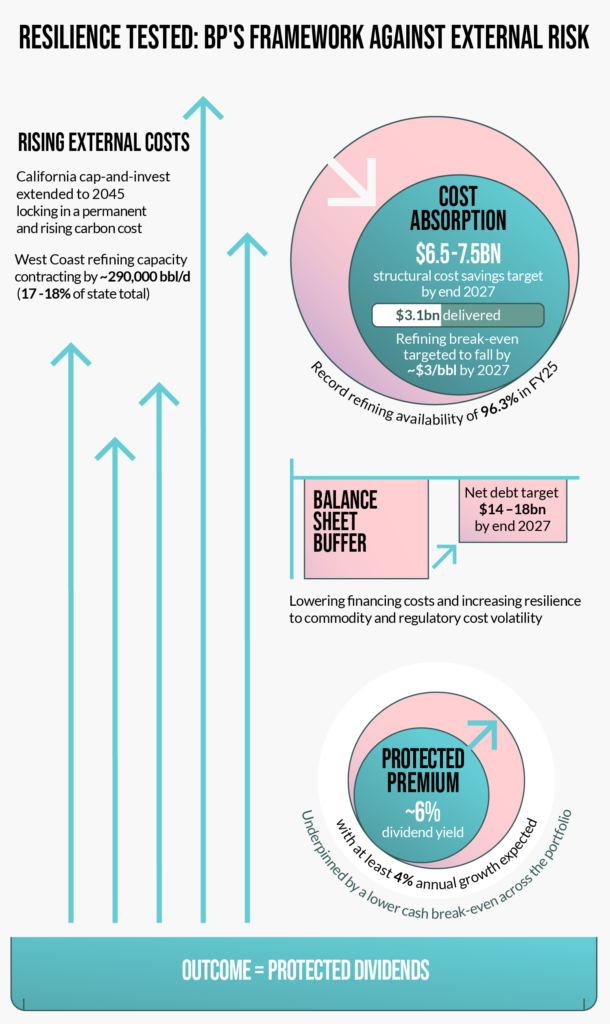
California’s refining sector is undergoing a structural contraction. The closure of Phillips 66’s Wilmington refinery near Los Angeles in late 2025 and Valero’s planned shutdown of its Benicia facility by April 2026 will eliminate approximately 290,000 barrels per day of processing capacity, roughly 17–18% of the state’s total. According to the US Energy Information Administration (EIA), the closures will have an outsized impact on the region because the West Coast has limited logistical connectivity to other major US refining hubs.
bp does not operate refineries in California. However, its Cherry Point Refinery in Washington state, the largest in the Pacific Northwest with capacity to process approximately 250,000 barrels per day, is a significant supplier of fuel to the broader West Coast market, including California.
For bp, this tightening supply picture creates a mixed dynamic. Reduced regional capacity could support stronger refining margins for remaining operators, including bp at Cherry Point. At the same time, California’s regulatory response introduces uncertainty. Minimum fuel inventory requirements enacted under AB X2-1 give the California Energy Commission (CEC) the power to set storage mandates for refiners, which could affect operational flexibility. A separate price gouging penalty mechanism that empowers the CEC to cap gross refining margins has been paused for at least five years as of August 2025, but has not been repealed.
The EIA has revised its 2026 outlook to reflect a more volatile pricing environment for the West Coast, effectively reversing prior expectations that lower crude costs would mitigate the impact of regional capacity reductions. The agency now maintains a risk premium on crude oil prices throughout the forecast period, as it expects uncertainty around future supply disruptions to keep prices elevated above pre-conflict levels.
In practical terms, Cherry Point’s strategic importance to the region is increasing. Investors should monitor both the margin environment and the regulatory response in Sacramento, as each will influence the refinery’s cash flow contribution.
The carbon pricing overlay: Cap-and-Invest through 2045
In September 2025, California extended its cap-and-trade program to 2045 and rebranded it ‘Cap-and-Invest’ via AB 1207. This legislation removes any ‘sunset’ optionality for companies operating in the state and effectively creates a permanent, rising cost on every unit of carbon emitted.
For bp, this is a familiar operating environment. A long-standing supporter of California’s carbon market initiatives, the company also navigates the EU Emissions Trading System and other carbon pricing regimes including Washington State’s Climate Commitment Act (2021). California’s program, with allowance prices that have traded above $30 per barrel in recent months and a declining cap that will tighten through 2045, represents an incremental but ongoing cost for its West Coast operations.
This is where bp’s stated focus on cost discipline becomes particularly relevant. The company’s target to reduce the operating cash break-even of its refining portfolio by approximately $3 per barrel by 2027 is not merely an efficiency exercise; it is a necessary buffer against a rising regulatory cost base. In 2025, bp delivered record refining availability of 96.3%, demonstrating the operational capability that underpins these efficiency targets. A lower break-even means the business can sustain profitability across a wider range of carbon-cost and commodity-price scenarios. For investors assessing the long-term resilience of bp’s refining margins, the trajectory of California’s carbon price should be monitored alongside the company’s operational delivery.
Legal risk: The evolving climate liability landscape
Climate-related litigation is a sector-wide factor that applies to all major integrated energy companies, not to bp alone. In September 2023, the California attorney general filed a lawsuit against five of the largest oil and gas companies, including bp, and the American Petroleum Institute. This is one of over thirty state and municipal climate liability cases across the US.
Separately, SB 684, the ‘Polluters Pay Climate Superfund Act of 2025’, has been introduced in the California legislature, although remains pending legislation and has not been enacted. If enacted, the bill would create retroactive strict liability for fossil fuel companies, modelled on similar laws passed in Vermont and New York. However, both of those laws are currently being challenged in court by the US Department of Justice, which has argued they are unconstitutional.
Outcomes remain highly uncertain, and the current federal administration is actively opposing state-level climate liability actions. The litigation and regulatory landscape is likely to evolve over a period of years, not months. For investors, this represents a contingent risk that is difficult to quantify but worth monitoring as part of the broader regulatory environment. Importantly, it is not a risk unique to bp. and every major energy company faces the same legal landscape.
The investment case in context: Resilience, not retreat
California represents arguably the most demanding regulatory environment in which any oil major operates. For investors, it therefore serves as a litmus test for management quality and operational resilience.
bp’s strategic pivot is, in part, designed to build resilience against exactly these pressures. The financial discipline framework outlined in our previous analyses – capital expenditure tightened to $13–13.5bn for 2026, a structural cost reduction program increased to $6.5–$7.5 billion by the end of 2027, reflecting the outcome of the strategic review of Castrol and the announced agreement to sell the Gelsenkirchen refinery. (of which $3.1bn has been delivered), and a $20bn divestment program to reduce net debt to $14–18bn by the end of 2027 – is intended to lower bp’s cash break-even across its global operations. A lower break-even is the ultimate defense for shareholder returns, making the dividend more sustainable across a wider range of regulatory, carbon-cost and commodity-price scenarios.
In addition, bp’s commercial capabilities provide a degree of insulation. The company’s supply and trading business has delivered an average uplift of approximately 4% to the group’s return on average capital employed over the last six years, according to company disclosures. This capability is designed to provide resilient earnings during periods of market volatility and regulatory dislocation.
There is also an element of strategic positioning within the transition itself. Cherry Point’s existing investment in renewable diesel co-processing – producing fuel that is chemically identical to petroleum diesel but with a lower carbon footprint – positions the refinery to benefit from California’s Low Carbon Fuel Standard (LCFS) credits. This is a pragmatic example of bp adapting its existing asset base to generate value from the regulatory framework, rather than simply absorbing its costs.
In conclusion
Our three-part analysis of bp’s investment case for Californian-based investors presents a clear balance of factors.
The bull case, as established in our previous analyses, is built on an interconnected system: ambitious free cash flow growth – with approximately 55% delivered in 2025 on a price-adjusted basis – underpinned by a disciplined capital frame, a cost reduction program that has already delivered c$3.1bn, a deleveraging strategy that has passed the halfway mark and strong operational performance, with first quarter 2026 underlying replacement cost profit of $3.2bn reinforcing the trajectory.
The board’s decision to suspend buybacks and prioritize the balance sheet is a departure from the approach of peers. It represents a near-term reduction in total shareholder distributions but is designed to accelerate the creation of a more resilient financial foundation. The dividend commitment of at least 4% annual growth remains the anchor of the income proposition.
Furthermore, bp’s deep resource base provides a real competitive advantage. It provides the potential for long-term organic growth and, combined with disciplined investment criteria, enables the company to progress the most value-accretive options with the highest returns.
The bear case, as explored in this analysis, centers on external risks that are real but should be assessed in proportion. The disclosure regime creates incremental compliance costs but is sector-wide. The West Coast refining contraction presents both margin opportunity and political risk. Carbon pricing is a permanent and rising cost, but bp’s cost-reduction program is designed to mitigate its impact. And climate litigation, while a material contingent liability, is subject to deep legal and political uncertainty that will take years to resolve.
For investors, the final question is not whether these risks exist – they clearly do – but whether bp’s management has built a financial framework with sufficient resilience to navigate them. On the evidence of the 2025 results, including record plant reliability, accelerated cost savings, faster-than-planned free cash flow growth and a divestment program that is well ahead of schedule, the company has constructed a credible case. But the regulatory environment in California serves as a constant reminder that execution discipline is not optional, it is essential.
The ultimate investment decision rests on an investor’s confidence in management’s ability to deliver on its internal plans while navigating the external realities of a rapidly evolving regulatory landscape.
Forward-looking targets are based on current expectations and planning assumptions. Actual results may differ materially based on various factors including but not limited to commodity prices, operational performance, regulatory changes, and global economic conditions.
Shareholder distribution decisions, including dividends and share buybacks, are subject to board discretion, taking into account factors including, but not limited to, current forecasts and credit metrics.