bp plc is a client of Edison Group. Edison Group produces and distributes this and other content. Edison does not hold any position in bp plc.
For much of the past decade, the investment conversation around major energy companies focused on two poles: maximizing returns from hydrocarbons and the pace of the energy transition. Now, a third factor has asserted its importance at the center of that debate: energy security.
The reasons are not hard to find. Geopolitical shocks and sanctions have reshaped global oil and gas flows, exposing the fragilities in supply chains that many had taken for granted. At the same time, forecasts from leading agencies now include scenarios of both supply surplus and price weakness, even as structural demand for energy remains high. Households, industry and policymakers increasingly need energy that is reliable and cost-effective.
This build up of pressures has elevated the question of how the world’s largest energy companies are positioned to deliver secure, affordable energy through volatile cycles, while continuing to fund a disciplined, returns-driven transition.
Energy demand: The structural tailwind
A new structural driver has emerged: the surge in energy demand from AI data centers. Global data center electricity consumption is projected to double to approximately 945TWh by 2030. In the US alone, data centers could account for up to 12% of total electricity by 2028, with Texas and Virginia the largest markets.
For integrated companies with gas-to-power capabilities, this represents a significant opportunity. The world is not simply switching fuels; it is adding energy capacity across the board. This is energy addition – a theme that underpins the investment case for companies with diversified hydrocarbon portfolios.
How integrated majors stabilize the system
In this context, integrated energy companies occupy a distinctive position in the global energy system. Unlike pure-play producers or specialist renewable developers, integrated majors operate across multiple fuels and value chains, including upstream oil and gas, liquefied natural gas (LNG), refining, products, trading and lower-carbon energy. This diversification is not merely a historical inheritance; it is a structural feature that enables a more flexible response to supply disruptions and demand shifts.
The scale of these operations matters. Strong balance sheets and robust cash flows support the long-life projects that underpin reliable supply over decades. A 20-year deepwater development or a multi-billion-dollar LNG facility requires the kind of patient capital that integrated majors are uniquely positioned to deploy.
Critically, global trading and logistics capabilities provide these companies with the flexibility required to synchronize supply with regional demand across the energy spectrum. When a regional market experiences a supply shock, a well-integrated energy company can reroute cargoes, optimize refinery throughput and manage inventories to keep energy flowing to customers. This system-level resilience is a core part of what integrated majors contribute to energy security.
bp’s strategy for a more secure energy system
Against this backdrop, bp has adjusted its corporate strategy to address the realities of a world where energy security, affordability and the transition must be balanced simultaneously. In February 2025, the company announced what it termed a ‘fundamental strategic pivot’, a clear prioritization of financial discipline, operational focus and capital efficiency.
The strategy rests on three interconnected pillars; growing the upstream, focusing the downstream and disciplined investment in the transition.
Refocusing on cash-generative hydrocarbons
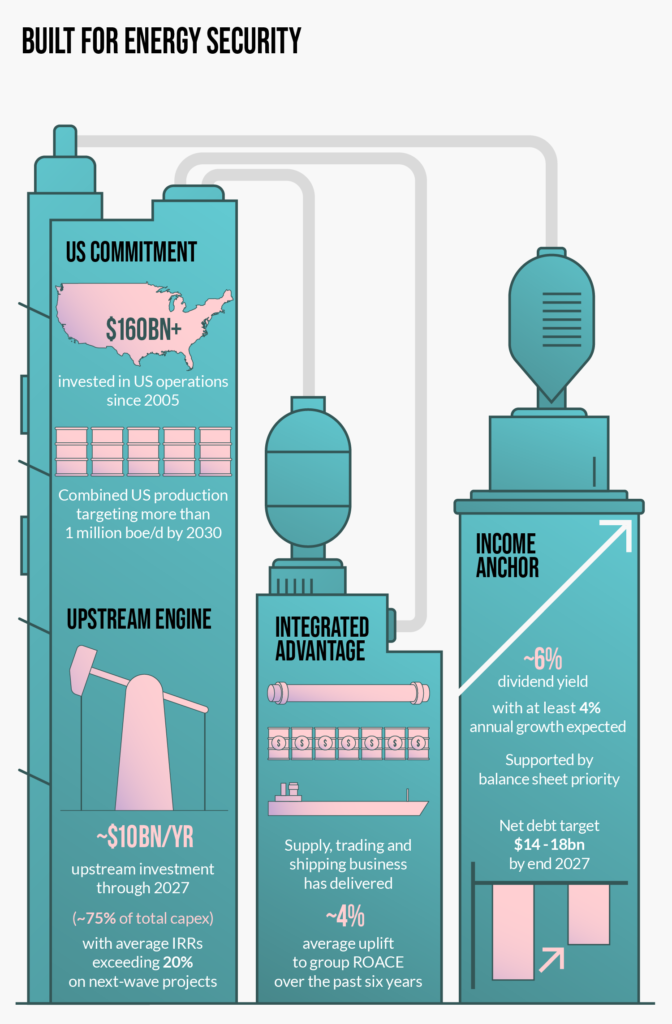
The first pillar is a renewed emphasis on bp’s core strength: its oil and gas business. The company is prioritizing high-return projects that support strategic alignment and meet disciplined investment economics criteria. This includes a significant increase in investment in upstream oil and gas to approximately $10bn per year through 2027, representing around 75% of total capital expenditure.
In the US, bp’s operational footprint is substantial. The bpx energy division, headquartered in Denver, holds more than seven billion barrels of oil equivalent in resources across the Permian, Eagle Ford and Haynesville basins. Production is expected to grow to more than 650,000 barrels of oil equivalent per day in 2030. In the deepwater Gulf of America, headquartered in Houston, bp operates five production platforms and is building capacity to produce more than 400,000 barrels of oil equivalent per day by the end of the decade. The recently approved Tiber-Guadalupe project and the under-construction Kaskida platform represent the next chapter in unlocking 10 billion barrels of discovered Paleogene resources in the region.
Taken together, bp is targeting combined US offshore and onshore production of more than one million barrels of oil equivalent per day by 2030.
In exploration, bp made the Bumerangue discovery offshore Brazil in 2025, with an estimated eight billion barrels of liquids in place – bp’s largest discovery in 25 years. While at an early stage, with a wide uncertainty range and an appraisal program expected to start in late 2026, this find adds significantly to bp’s deep hopper of future opportunities.
Focusing downstream and strengthening the balance sheet
The second pillar is a decisive reshaping of bp’s downstream portfolio. Rather than maintaining breadth across every segment, bp is high grading its operations, exiting or restructuring positions that no longer meet return thresholds. bp has announced that it has reached an agreement to sell its Gelsenkirchen (GSK) refinery in Germany, has narrowed its biofuels pipeline from five potential projects to one high conviction opportunity, and is pursuing a 10% reduction in company owned, company operated (COCO) retail sites by the end of 2026. Electric vehicle charging investment is being approached selectively, focused on markets where demand and returns justify the capital.
In December 2025, bp announced the agreement to transition Castrol into an independent joint venture, selling a 65% stake to Stonepeak at an enterprise value of $10.1bn. bp will retain a 35% stake upon completion with optionality to realize further value after a two year lock up. Expected net proceeds of approximately $6bn will be fully utilized to reduce net debt.
This downstream restructuring is simultaneously accelerating balance sheet repair. With the Castrol transaction, bp has completed or announced over half of its $20bn divestment program, approximately $11bn to date. Net debt stood at $25.3bn at the end of Q126, temporarily higher than the $22.2bn at end 2025, driven by a $6.0bn working capital build reflecting seasonal effects and the rising price environment. Management expects around $5bn of the build to unwind in total, with $3bn occurring by the end of 2026, and net debt declining in the second half as divestment proceeds are received.
The board has reinforced this priority by suspending the share buyback program and fully allocating excess cash to strengthen the balance sheet. bp has also announced plans to reduce its hybrid bond financing by approximately $4.3bn, from $13.3bn to approximately $9bn by end 2027, through the redemption without replacement of bonds at their call dates.
A stronger balance sheet provides a crucial safety buffer. It lowers financing costs, increases resilience to commodity price volatility, and provides the foundation for sustainable shareholder returns through the cycle. The company maintains an expectation for annual dividend increases of at least 4% subject to board approval, which is 8.32c per ordinary share.
More selective transition investment
The third pillar involves a recalibration of bp’s approach to the energy transition. The company has acknowledged that its previous strategy moved too far, too fast in certain areas. Capital expenditure on transition businesses is being reduced to $1.5–2.0bn per year, more than $5bn lower annually than the 2023 base.
This is not a withdrawal from lower-carbon investments, but a more selective approach. bp is redirecting capital towards lower-carbon opportunities that strengthen system resilience and deliver attractive returns, such as biofuels and biogas. Partnerships, including the JERA Nex bp joint venture in offshore wind, allow the company to participate in growth areas through a capital-light model.
In its 4Q25 results, bp reported approximately $4bn in post-tax impairments, primarily related to its transition businesses. These impairments reflect a significant repositioning of the portfolio, with management acknowledging that every impairment reflects prior capital outlay and committing to improved capital allocation discipline focused on returns.
Resilient exposure for investors and stakeholders
For investors, bp’s strategy offers a value proposition tied directly to the energy security theme. The company is positioning itself as a high-cash-return, internationally diversified energy exposure, with revenues spread across multiple regions and demand centers.
The shareholder return framework has been recalibrated with a clear priority. In the near term, balance sheet strengthening takes precedence, with excess cash fully allocated to accelerating the reduction of net debt towards the $14–18bn 2027 target. The dividend continues to grow, with the board having delivered an increase to 8.32c per ordinary share, representing at least 4% annual growth. Shareholder distributions in FY25 were approximately 30% of operating cash flow.
The rationale for this approach is that a stronger balance sheet creates a more resilient platform, one that can sustain the dividend through commodity cycles and position the company to invest with discipline into its distinctive upstream opportunities. The board’s decision signals a focus on building long-term value over near-term cash return.
bp currently offers a dividend yield of approximately 6% based on consensus estimates for FY26. A base case for the stock assumes that consistent delivery against the new financial framework will be the catalyst for a potential re-rating over time.
From Texas to the world
Texas occupies a central position in bp’s integrated model, where upstream production, midstream infrastructure and global trading capabilities meet. The state serves as a hub connecting abundant US supply with allies and customers worldwide.
bp has invested more than $160bn in US operations since 2005, a larger economic footprint than in any other country where it operates. The bpx energy operations in Texas and the deepwater Gulf of America business provide the production base. Two major refineries, Whiting in Indiana and Cherry Point in Washington state, are vital to US transportation fuel supply. And bp’s trading and shipping teams optimize flows to keep energy moving, even during disruptions.
This integrated approach, combining upstream, midstream and trading capabilities, is designed to deliver secure and reliable energy today while investing in the infrastructure that will deliver against tomorrow’s demand.
Why this matters now
Energy security is not a single metric. It is the ability to deliver energy that is secure, affordable and lower in carbon intensity across the inevitable cycles of energy price and policy uncertainty. bp’s strategic pivot, anchored in financial discipline, operational focus and a selective approach to the transition, is designed to position the company to meet that challenge.
For investors focused on income and long-term value creation, the framework is clear. A renewed focus on core oil and gas assets, a credible path to a stronger balance sheet and an expectation to grow the dividend provide the building blocks of the investment case. Success depends on consistent operational delivery.
To learn more about bp’s strategy and how its refocused portfolio is designed to deliver shareholder returns, read the next report.
Forward-looking targets are based on current expectations and planning assumptions. Actual results may differ materially based on various factors including but not limited to commodity prices, operational performance, regulatory changes, and global economic conditions.
Shareholder distribution decisions, including dividends and share buybacks, are subject to board discretion, taking into account factors including, but not limited to, current forecasts and credit metrics.