“Edison is the go-to for a new investor to get full understanding of the investment case and business. Edison’s distribution reaches investors that we want to connect with directly.”
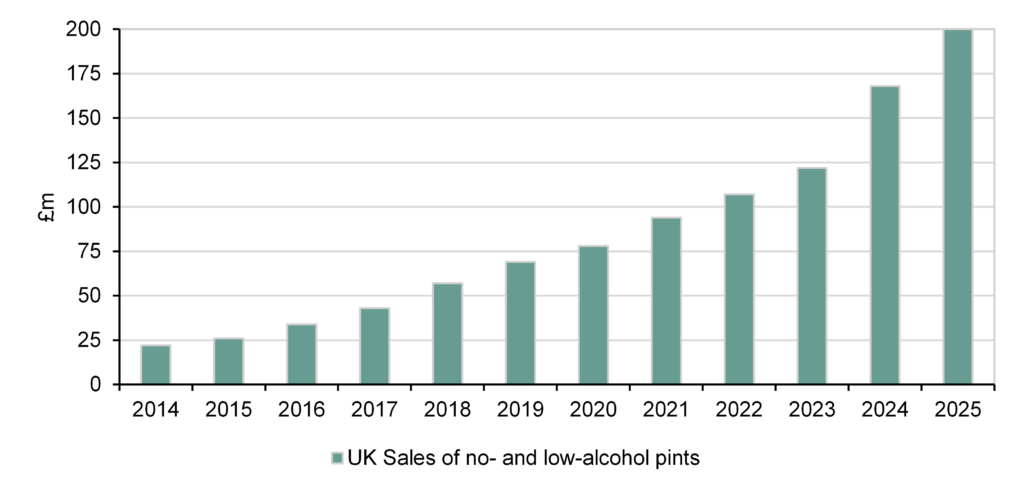
The proportion of UK drinkers actively managing their consumption has reached a level that makes moderation the default rather than the exception. According to the Drinkaware Monitor 2026, 91% now use at least one technique to moderate, up from 87% in 2025 and equivalent to c 42 million people, with drink-free days and switching to no- or low-alcohol alternatives the most common. The category that has grown around that behaviour is no longer marginal. The British Beer and Pub Association (BBPA) reports 200m pints of no- and low-alcohol beer sold in the UK in 2025, which is close to 3% of the total beer market, and forecasts more than 64m pints across June to August 2026 alone. For investors, the more useful question is not whether drinkers are moderating but which companies are capturing the spending that alcohol is giving up.
Exhibit 1: UK Sales of no- and low-alcohol pints (million)
Source: BBPA Annual Barrelage Survey
Is this a cyclical dip or a structural shift?
Morgan Stanley’s European consumer staples team identifies three main long-term structural pressures that are reshaping the beverage industry. Younger drinkers are moderating, with today’s 18–34 year olds drinking around 30% less than the same age group 20 years ago; ageing populations in developed markets are entering the years in which consumption physiologically declines with age, which includes the heaviest-drinking cohort (today’s 45–55-year-old age group); and a broad health and wellness shift that predates both the pandemic and the current squeeze on incomes. None of these trends are likely to reverse when consumer confidence recovers. IWSR data support the reading, showing total alcohol beverage volumes falling for a third successive year in 2025, down 2%, with beer, wine and spirits all contracting and only ready-to-drink (RTD) products and no-alcohol beverages in growth. NielsenIQ finds health as the primary motivation to moderation, ahead of financial pressure. The distinction matters commercially, since a business facing a cyclical dip is able to wait, while one facing a structural shift could be forced to reposition.
Where is the lost alcohol spending actually going?
Falling alcohol sales do not simply vanish from the drinks market; they reappear in adjacent categories, and the pattern of that reallocation is now visible in the data. NielsenIQ’s analysis of the UK beverage basket found the off-trade losing £130m in spirits and £91m in beer year-on-year, while soft drinks expanded 6.1% in value. NielsenIQ attributes 93% of no- and low-alcohol’s shifting gains coming from beer, wine and spirits, which means the category is taking volume directly out of alcohol rather than competing with soft drinks for the same occasions. RTD products are drawing from both directions and now account for £17.50 of every £100 of new product sales. Willingness to pay has moved with the volume, where KAM’s Low & No 2026 study puts 29 million UK adults consuming low and no drinks monthly, with 65% prepared to pay more for a premium option. That combination of transferred volume and preserved price is what makes the theme investable, and it points towards three distinct groups of beneficiaries.
Which soft drinks and functional beverage companies are capturing it?
Functional drinks carry a price premium and generate repeat purchases once trial is achieved. However, establishing credibility in the category from a standing start takes years, which gives soft drinks groups with existing retail distribution a strong incentive to acquire rather than build. Nichols, the Vimto owner whose brands reach more than 60 countries, took that route on 10 August 2026 with the €75m (£64m) acquisition of Dublin-founded VITHIT. The target brings what Nichols lacked internally: a low-calorie, vitamin-fortified range with leading positions in the UK and Ireland, strengthening Nichols’ position in the health and wellness segment. Set against earlier launches of Myprotein Water and Vimto Wonderfuel, the deal completes a functional portfolio rather than beginning one.
Brand extension is a cheaper alternative, but it only works where the parent brand carries enough awareness to legitimise an unfamiliar format. AG Barr, the Scottish group behind Irn-Bru, Rubicon, Boost and Funkin Cocktails, stated that Rubicon Springs carries more than three times the brand awareness of the leading functional water brand. Rubicon Spring Vits, launched in March 2025 with £2m of brand investment, states that it carries 100% of the recommended daily multivitamin intake at 15 calories and is high fat, salt or sugar (HFSS)-compliant.
The third group, mixers, faces a harder problem, because it is structurally tied to the spirits volumes that are falling fastest. Businesses in that position must either contract alongside their host category or establish themselves as soft drinks in their own right. Fevertree Drinks is attempting the latter, with CEO Tim Warrillow framing the ambition as being ‘not only the premium mixer but also premium soft drink of choice’. UK revenue fell 2% in 2025 but improved markedly through the second half on the strength of the premium soft drinks range, an early indication that the repositioning is finding traction.
Which dedicated no- and low-alcohol producers are benefiting?
Competitive advantage in alcohol-free wine rests on production capacity rather than brand equity, because dealcoholisation is capital-intensive, and the quality of the finished wine depends directly on the technology used to strip the alcohol out. Schloss Wachenheim, one of Europe’s largest sparkling wine producers, has invested accordingly. Growth in sales volumes of more than 10% took the group close to the limits of its existing capacity, and it responded by building and commissioning a second dealcoholisation plant at its Trier site in mid-2024. It is the German market leader in alcohol-free sparkling wine through LIGHT live and owns Eisberg, the UK’s largest dedicated alcohol-free wine brand.
Elsewhere the binding constraint is regulatory rather than industrial, since in the Nordic monopoly markets the addressable universe for lower-alcohol products is set by statute, and changes to those thresholds create step-changes in market size. Anora Group, the Nordic wine and spirits brand house (formed from the 2021 merger of Altia and Arcus) and owner of brands Koskenkorva, Linie and Blossa, was well placed when Finland lifted the grocery-store alcohol ceiling from 5.5% to 8.0% in June 2024. As the country’s market-leading wine company with domestic production, it launched a broad range of 8% wines across its own and partner brands into a channel that had previously been closed to them.
For diversified brewers, a more revealing measure is whether no- and low-alcohol represents a discrete bet or is systematically embedded in product development, because launch cadence indicates how seriously a board treats the category. Olvi discloses enough to answer that. The Finnish group was founded in Iisalmi in 1878 expressly to offer milder alternatives to spirits and now spans beers, soft drinks, waters, ciders, long drinks and sports and wellness drinks. It made 444 product launches in 2025, of which 11 were new non-alcoholic products within its alcoholic categories and 39 were sugar-free or low-sugar additions to its non-alcoholic ranges.
Are established brewers winning new drinkers or just keeping their own?
Whether no- and low-alcohol sales are incremental or merely substitutional determines whether they create value for an incumbent brewer or simply move existing revenue onto a different line at a different margin. This is the single most important disclosure gap in the theme. Brand extension is the cheapest way to test it, because a 0.0 variant borrows the parent brand’s equity and so isolates the demand question from the marketing question.
Kopparbergs Bryggeri, the Swedish brewer behind one of the UK’s leading flavoured ciders, has run that test longer than most, having offered non-alcoholic variants for close to two decades. H126 net sales rose 2.3% to SEK1,235.5m with EBITDA up 7.4% to SEK163.7m. It reports that its non-alcoholic cider continues to develop positively and is reaching more consumers. C&C Group, the Irish drinks group behind Bulmers, Magners and Tennent’s, is explicit about where it expects the return to come from. Following an encouraging FY26 for Bulmers, the group says it will invest further behind Bulmers Zero and a series of flavour innovations, using the parent brand’s existing consumer awareness to position it for what it describes as an increasingly attractive no/low segment. In addition, Tennent’s Zero was separately reintroduced with an improved recipe following consumer feedback. Shepherd Neame, Britain’s oldest brewer and operator of just under 300 pubs and hotels across London and the South East, extended the same logic in June 2026 with Whitstable Bay 0.5% Pale Ale, a permanent addition building on its Noughty Bear 0.5% IPA.
Scale changes what the evidence can tell us, because a global portfolio shows whether the category effect holds across markets. Diageo reported beer growing 5% globally in FY26 against a 1% decline in spirits, with double-digit Guinness growth in Great Britain. It has expanded non-alcoholic availability to 17 markets from 15 in FY25, with Guinness 0.0 now available in 12 markets. Where organic extension is too slow, acquisition offers the same diversification in one step. Carlsberg completed its £3.3bn acquisition of Britvic in January 2025 to create Carlsberg Britvic, the UK’s largest multi-beverage supplier. The purchase almost doubled Carlsberg’s soft drinks exposure, from 16% of total volumes in 2024 to c 30%, and Britvic contributed DKK2,195m (£253m) of operating profit in FY25 with c 30% of the £110m cost synergies delivered ahead of plan.
How are pubs and hospitality groups responding?
Pubs operate on margins thin enough that small changes in what customers order matter, with the BBPA noting that the average pub makes c 12p of profit on a £5 pint. Moderation does not necessarily reduce footfall, but it does change the mix of what is sold, and a lower-margin serve is harder to absorb on that base. The sector has already adapted at the point of sale, with the BBPA reporting that almost nine-in-10 pubs now stock no- and low-alcohol options and citing research indicating that nearly one-in-three pub visits is completely alcohol free. The differentiator between operators is therefore not whether they stock the alternatives but whether they have found other ways to hold spend per visit.
Capital investment in the estate is one answer, and Marston’s, which operates more than 1,300 pubs, has made it the centre of its strategy. It completed 60 new-format refurbishments in H126, ahead of its full-year target of 50, with those sites delivering average ROIC of 35% and growth of c 20% l-f-l. Group sales nonetheless fell 0.5% l-f-l. The gap between those two figures is the investment case: growth is coming from the converted estate rather than from a recovery in underlying demand, which makes the pace of conversion, and the capital available to fund it, the variable to watch.
Revenue mix is the other answer, and the clearest evidence that breadth of offerings insulates a pub business comes from an operator where every line is growing at once. Fuller, Smith & Turner, which runs more than 380 premium pubs and hotels across southern England, reported FY26 managed-estate like-for-like growth in drinks of 5.8%, accommodation of 4.9% and food of 3.5%, lifting revenue 5.7% to £397.8m and adjusted PBT 28% to £34.6m. The implication is that moderation is not, by itself, the binding constraint on a pub business. Where drinks sit alongside food and accommodation of comparable quality, a customer drinking less can still spend the same or more across a visit.
A small number of operators have gone further and built the venue itself around moderation, which tests whether alcohol-free can anchor an occasion rather than merely accompany it. Lucky Saint, the independent alcohol-free beer brand founded in 2018, opened its own Marylebone, London, pub in March 2023 serving both alcoholic and alcohol-free drinks.
Can beverage premiumisation compensate for falling volumes?
Premiumisation is the shift towards higher-quality, higher-priced alcoholic beverages, as consumers prioritise quality, craftsmanship, authenticity and unique experiences over volume. For producers, it represents a strategy of encouraging consumers to trade up and spend more per serve rather than drink more. This has been the drinks industry’s default answer to declining consumption for the better part of a decade. IWSR’s assessment is that the industry’s premiumisation tailwind has under-indexed against inflation. Global inflation has consistently outpaced growth in beverage alcohol price per litre since 2022, which means a significant share of the value growth reported over that period reflected rising prices across the whole economy rather than consumers genuinely trading up. Stripping inflation out of that value growth, according to IWSR, is the test of whether a premiumisation strategy is a pricing story or a consumer story. The consequences are now visible: super-premium-and-above spirits value fell 15% in 2025, and IWSR reports on-trade premiumisation across 20 markets stalling and, in some measures, reversing.
The limits are most visible in the portfolio that built much of the original case for the strategy. Diageo’s FY26 reported net sales fell 3% to $19.6bn mainly due to organic net sales decline of 2%, with US spirits down 11.5% and US tequila, specifically, down 21.1%, driven by the premium brands Don Julio (-19.2%) and Casamigos (-27.7%). New CEO Dave Lewis has since announced a plan to cut c $1bn of costs over three years, at an implementation cost of $1.2bn, a reallocation of management attention from margin expansion towards competitiveness.
The same pressure is legible at smaller scale, and in one case a company has responded by hedging against its own strategy. Lanson-BCC, the French group of eight champagne houses including Lanson, Philipponnat and De Venoge, saw 2025 revenue fall 8.7% to €233.3m and net income fall 31.9% to €16.2m. It completed a €50m acquisition of Heidsieck & Co Monopole in January 2026 to strengthen the premium end, while simultaneously signalling a push back into entry-level champagne through the relaunch of its Chanoine Héritage cuvée. Pursuing both directions at once is itself an assessment of how much weight premiumisation can now bear.
Exhibit 2: Premiumisation faces pressure as consumers moderate and trade down
Pouring Champagne into Flute. Unique Perspective from Above.
Source: iStock/Kesu01
Where is beverage premiumisation still working?
The categories in which trading up continues to deliver are those still recruiting new drinkers rather than defending an ageing base, and sparkling wine is the clearest current example. IWSR data show total still and sparkling wine volumes contracting 15% between 2019 and 2024, with declines in all five of the largest markets, yet global sparkling wine volumes grew at a CAGR of 2% over the same period, led by prosecco and no-alcohol variants. The recruitment is happening at the premium end of the domestic market too, with Waitrose reporting 2025 English wine sales up 10%, led by a 15% rise in English sparkling wine and 14% rise in English rosé.
Public-market access to that growth has narrowed, leaving Chapel Down as the principal listed way into English sparkling wine. Chapel Down, England’s leading wine producer, reported H126 net sales revenue up 19% to £9.4m and a gross margin improvement of 3.5 ppts to 49.6%, driven by the increased mix of Traditional Method Sparkling. This represents 74% of Chapel Down’s wine sales, up from 70% in H125, and its price index against Champagne was maintained at 92%. Its sparkling wine sales grew 20% against English Sparkling Wine category growth of 15% in the same period, lifting its off-trade market share of English Sparkling Wine to 37%. In addition, Chapel Down has opened a new tasting room, The Hythe, extending the premium positioning into experience.
The contrast with champagne is worth drawing out, because both categories are raising prices in a shrinking wine market and only one is making it work. Champagne is defending an ageing and contracting drinker base, and IWSR data show its UK volumes falling 4% in 2024 with buyers down-trading from premium to standard-priced bottles. English sparkling wine is doing the opposite, adding drinkers, particularly among Gen Z, which IWSR identifies as one of the few segments gaining ground. Premiumisation works when there are new drinkers to trade up; it stalls when the only available move is charging existing drinkers more.
Can a company pursue both strategies at once?
For a business whose core category is in structural decline, the governing question is how quickly the revenue mix can be shifted before the core erodes. The most reliable signal of intent is a disclosed target rather than a stated ambition. Berentzen-Gruppe, the German group operating across spirits, non-alcoholic beverages and fresh juice systems, set out that commitment in November 2025 with its ‘Berentzen Evolve 2030’ strategy, targeting consolidated revenue above €200m and a group EBIT margin above 8% by 2030, against €162.9m and 5.2% in FY25. Management has been explicit that the segment mix will shift with it, stating that the share of revenue from non-alcoholic products will increase significantly and identifying no- and low-alcohol concepts, new distribution channels and international markets as essential elements of the strategy. The acquisition of the Juma brand in functional lifestyle drinks is the first substantial move. The transition is not yet self-funding, with FY25 spirits generating €7.3m of EBIT against a €1.7m loss in non-alcoholic beverages, although the segment total has been depressed by disposals while its focus brand Mio Mio continues to achieve significant sales growth. On 21 September 2026 Berentzen entered into a merger agreement with US spirits group Sazerac.
The same repositioning is underway on the wine side, where the strategic logic is identical even though the starting portfolio is not. Italian Wine Brands, Italy’s largest private wine group, reported 2025 revenues of €395.9m and adjusted EBITDA of €49.1m. It lists the launch of its first no- and low-alcohol products alongside the development of its top brands as a core strand of strategy, framing the category as a growth segment rather than a defensive hedge.
What should investors be mindful of?
The coming reporting cycles should resolve three questions that currently separate the companies genuinely adapting to moderation from those benefiting temporarily from it.
The first concerns substitution, and specifically whether no- and low-alcohol sales are incremental or are cannibalising full-strength volumes at similar or lower margin. Disclosure here remains thin across the sector and is worth pressing management on directly.
The second concerns cost, which for hospitality operators may prove as consequential as falling alcohol revenue. UKHospitality’s analysis of the Autumn Budget indicates an average pub’s rates bill will be c £4,500 higher than today in 2027/28 and £7,000 higher in 2028/29, a 76% increase, with hotels facing a 115% rise. Whether format, food and accommodation-led diversification can absorb that pressure alongside the turn to moderation will determine which operators are genuinely adapting and which are relying on temporary gains.
The third concerns premiumisation: whether spirits and wine companies can restore value growth once inflation is stripped out of the reported numbers or whether the strategy has reached its practical ceiling outside categories still recruiting drinkers.
Edison insight
Moderation has become a structural feature of the drinks market rather than a passing consumer trend, and the spending it displaces is now traceable. Soft drinks, functional beverage and no- and low-alcohol producers are the clearest beneficiaries, with NielsenIQ attributing the large majority of no- and low-alcohol’s gains directly to beer, wine and spirits. Pub operators are defending revenue through format investment, food and accommodation rather than through volume. Premiumisation, the industry’s default answer for a decade, is proving reliable only in categories still recruiting drinkers. Coming reporting cycles should distinguish genuine adaptation from temporary gains.
Megatrends:Changing demographics, future consumer
*Shepherd Neameis a client of Edison Investment Research
Back on trajectory: H126 EBITDA up 23%, full-year guidance that management itself calls conservative, a €600m buyback underway and a slate of structural catalysts – the concessions demerger; a potential Metka IPO; growth in critical metals, defence and battery storage; and Greece’s return to developed-market status – with Edison’s valuation pointing to €72 a share.