bp plc is a client of Edison Group. Edison Group produces and distributes this and other content. Edison does not hold any position in bp plc.
In February 2025, bp announced a fundamental strategic pivot, re-anchoring its business in the oil and gas operations that generate its highest returns and strongest cash flows. For much of the past decade, bp pursued one of the most ambitious energy transition strategies among the integrated oil majors, accelerating investment into renewables and setting ambitious targets for reducing oil and gas production. Management has since acknowledged that approach moved ‘too far, too fast’.
For investors in markets like California – where electricity demand is projected to increase at a rate unprecedented in US utility history and grid reliability is under sustained pressure – this repositioning raises a direct question: what does bp’s pivot mean for the company’s long-term value?
The answer lies in what bp describes as a ‘simpler, stronger and valuable’ model: using its hydrocarbon engine to deliver energy security, generate robust cash flows and fund only those transition investments that meet strict return thresholds.
The hydrocarbon engine: Back to core strengths
In 2025, bp started up seven major upstream projects, five of them ahead of schedule. In the deepwater Gulf of America, the recently sanctioned Tiber-Guadalupe project and the under-construction Kaskida platform represent the next chapter in unlocking 10 billion barrels of discovered Paleogene resources. Onshore, the bpx energy division holds more than seven billion barrels of oil equivalent across the Permian, Eagle Ford and Haynesville basins, with production expected to grow to more than 650,000 barrels of oil equivalent per day in 2030.
The company has retired its previous ambition to cut oil and gas production by 40% by 2030. In its place is a growth target of 2.3–2.5 million barrels of oil equivalent per day in 2030 with combined US offshore and onshore production expected to exceed one million barrels per day.
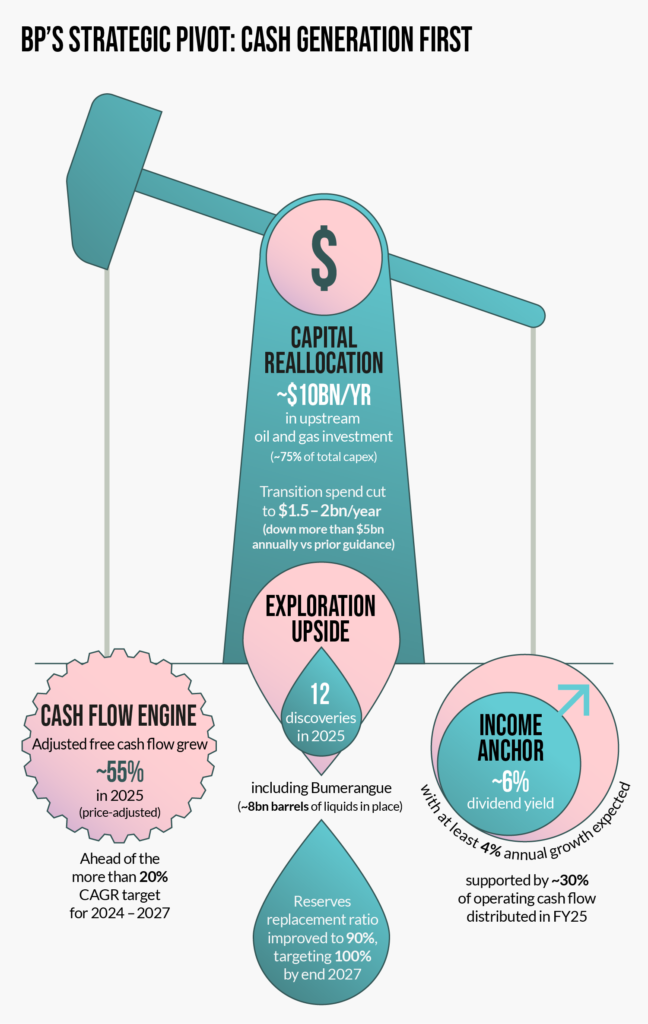
These are not marginal projects. bp expects average internal rates of return exceeding 20% from its next wave of major upstream developments. The focus on high-margin, ‘advantaged barrels’ is designed to generate cash through the commodity cycle. In 2025 adjusted free cash flow grew by approximately 55% on a price-adjusted basis, progress that was ahead of the company’s plan to achieve a compound annual growth rate of more than 20% from 2024 to 2027.
A further indicator of the quality of bp’s opportunity set came from exploration. The company announced 12 discoveries in 2025, inc luding Bumerangue in Brazil’s pre-salt Santos Basin – its largest find in 25 years, with an initial estimate of approximately eight billion barrels of liquids in place. While at an early stage, with a wide uncertainty range and an appraisal program expected to start in late 2026, this find adds significantly to bp’s deep hopper of future opportunities. bp’s reserves replacement ratio improved to 90%, up from an average of approximately 50% in the prior two years, with a target of 100% by end 2027.
Capital discipline: Returns over megawatts
bp is reducing capital expenditure on transition businesses to $1.5–2bn per year, more than $5bn lower annually than previous guidance. That capital is being reallocated to oil and gas investment of approximately $10bn per year through 2027, representing roughly 75% of total capex. For 2026, management has tightened the total capital expenditure frame to $13–13.5bn, demonstrating a continued commitment to spending discipline.
This pivot reflects both management’s own reassessment and sustained investor pressure demanding improved returns. The approximately $4bn in post-tax impairments recognized in Q425, primarily in the gas and low-carbon energy segment, represent a decisive repositioning of the portfolio away from lower-returning assets.
For income-focused investors, bp’s shareholder return framework centers on the dividend. The company maintains an expectation for annual increases of at least 4%, subject to board approval, supporting a yield of approximately 5.6% at the time of writing. In February 2026, the board took the decisive step of suspending the share buyback program and fully allocating excess cash to accelerate strengthening the balance sheet. The company’s dividend of 8.32 cents per ordinary share is expected to grow by at least 4% annually, subject to board approval. Total shareholder distributions in 2025 were approximately 30% of operating cash flow.
This is a balance sheet first approach. By prioritizing deleveraging now, management is building a stronger and more resilient platform from which to invest with discipline into bp’s distinctive set of oil and gas opportunities, and from which enhanced shareholder distributions can resume once the balance sheet target is achieved.
A selective approach to transition
bp has exited or restructured multiple low-carbon positions. The US onshore wind business was sold to LS Power. Offshore wind assets were consolidated into the JERA Nex bp joint venture, reducing direct capital exposure while maintaining optionality. bp has also reduced its hydrogen and CCUS portfolio down from 30 projects to 5-7 projects.
The transition businesses that remain target areas for direct investment are biogas, biofuels and EV charging through bp pulse. In California, where the electrification of transport is advancing rapidly (industry analysts have estimated the state may need to add 20 times the new generation capacity added in the past 15 years), the strategy is to position the forecourt as a ‘mobility hub’, where the fuel, whether gasoline or electricity, supports high-margin retail operations.
The discipline test is clear: every transition investment must now compete on financial returns alongside oil and gas opportunities. This is a structural change from the previous approach.
Energy security: The integrated advantage
California’s energy challenge illustrates a broader global reality. Even as the state leads the nation in battery storage and renewable deployment, grid reliability concerns persist. Natural gas continues to play a role in industrial demand and as a backstop during periods of low renewable generation. This mixed energy landscape provides a relevant context for assessing bp’s competitive position, even though the company’s strategic value to investors does not depend on any single state’s energy mix.
bp’s integrated model is designed for this complexity. The company’s supply, trading and shipping business has delivered an average uplift of approximately 4% to the group’s return on average capital employed over the past six years. In periods of commodity volatility, whether driven by geopolitical events, seasonal demand spikes or supply disruptions, this commercial capability provides a mechanism to optimize supply and capture value that pure-play producers cannot replicate. bp’s integrated LNG position provides further exposure to growing global gas demand, particularly for markets where renewables cannot yet meet baseload requirements.
The realist’s road ahead
The global energy system is changing, but bp has concluded it cannot lead that change without financial robustness. The strategic pivot prioritizes cash generation, balance sheet strength and disciplined capital allocation.
The framework is measurable:
- A target of more than 20% compound annual growth in adjusted free cash flow from 2024 to 2027, against which the company delivered approximately 55% growth in 2025 on a price-adjusted basis.
- A net debt reduction target of $14–18bn by end 2027, with net debt standing at $25.3bn as of Q126.
- A structural cost reduction program, which now targets $6.5–$7.5 billion by the end of 2027, reflecting the outcome of the strategic review of Castrol and the announced agreement to sell the Gelsenkirchen refinery. To date, approximately $3.1 billion has been delivered.Return on average capital employed of approximately 14% in 2025 on a price-adjusted basis, up from approximately 12% in 2024, tracking towards the target of more than 16% by 2027.
bp is positioning itself to remain a fixture in the global energy landscape for decades, with the financial staying power to navigate the transition regardless of how fast it ultimately moves.
To examine how bp’s approach compares with its European peers, read the next report.
Forward-looking targets are based on current expectations and planning assumptions. Actual results may differ materially based on various factors including but not limited to commodity prices, operational performance, regulatory changes, and global economic conditions.
Shareholder distribution decisions, including dividends and share buybacks, are subject to board discretion, taking into account factors including, but not limited to, current forecasts and credit metrics.