bp plc is a client of Edison Group. Edison Group produces and distributes this and other content. Edison does not hold any position in bp plc.
Europe’s three largest integrated energy companies have each responded to the same market forces – energy security concerns, investor pressure for returns and an uncertain transition timeline – with materially different strategies. Shell has pursued what it terms ‘accelerated momentum’, combining cost discipline with substantial cash generation. TotalEnergies has maintained a ‘differentiated’ model, growing hydrocarbons alongside a significant integrated power business. bp has executed a fundamental strategic pivot, re-anchoring in oil and gas after acknowledging its previous transition strategy moved ‘too far, too fast’.
One year after bp’s pivot, the question for investors is no longer whether the company has changed direction but whether its pace of execution can close the performance gap with its peers. This analysis compares the three European majors across four dimensions that matter most to income-focused investors: production trajectory, capital allocation, shareholder distributions and balance sheet strength.
Production: Growth from different starting points
Underlying upstream production in 2025 was broadly flat year-on-year, supported by seven major project start-ups and record upstream plant reliability of 96.1%. The company is now targeting 2.3–2.5 million barrels of oil equivalent per day in 2030, a sharp reversal from its 2020 pledge to cut production by 40% to 1.5 million barrels of oil equivalent per day. In the deepwater Gulf of America, the sanctioning of the Tiber-Guadalupe project and the progression of Kaskida represent the next phase of growth.
bp’s renewed commitment to exploration is important for future growth. On this front, 2025 results were encouraging. The company announced 12 exploration discoveries, including Bumerangue in Brazil’s pre-salt Santos Basin, its largest find in 25 years. The initial estimate is approximately eight billion barrels of liquids in place, although at this stage there remains a wide range of uncertainty around that figure. An appraisal program is expected to begin around the end of 2026. bp has set a target to return to 100% reserves replacement by end-2027, and the reserves replacement ratio improved to 90% in 2025, up from approximately 50% in the prior two years.
Bp’s deep resource base provides a real competitive advantage. It provides the potential for long-term organic growth and, combined with disciplined investment criteria, enables the company to progress the most value-accretive options with the highest returns. Along with high-quality assets, outstanding capability and advanced technology, this is a key differentiator supporting the bp investment case.
Capital allocation: The transition spending divergence
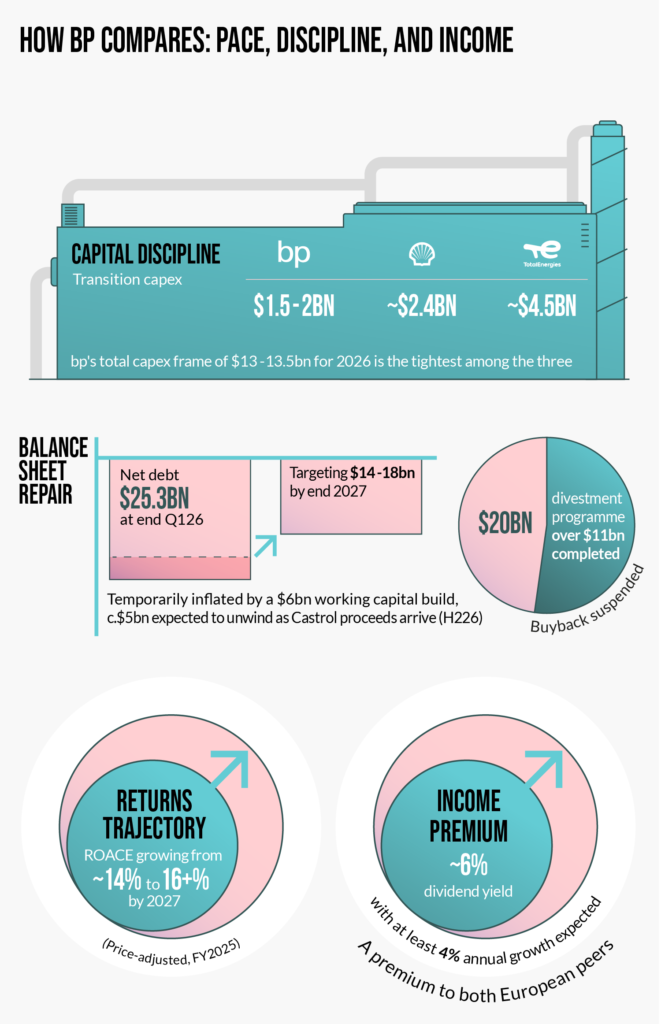
Capital allocation is where the three strategies diverge most sharply. bp aims to cut capital expenditure on transition businesses to $1.5–2.0bn per year, down from a previous commitment of approximately $7bn annually. Shell has made a similar reduction, from $5.6bn in 2023 to approximately $2.4bn. TotalEnergies remains the outlier, maintaining approximately $4.5bn in annual transition capex while building a significant integrated power business across renewables, gas-fired generation and battery storage.
bp’s rationale is straightforward. The reallocation funds approximately $10bn per year in upstream oil and gas through 2027, concentrated on projects with expected average internal rates of return exceeding 20%. Overall capex has been tightened to $13–13.5bn for 2026, the most disciplined spending envelope among the three majors. In 2025, total capex was $14.5bn, a 10% reduction year-on-year, with organic capex at $13.6bn. For investors, a tighter capital budget matters because it leaves a greater share of operating cash flow available for debt reduction and, in due course, shareholder distributions.
Shareholder distributions: Scale versus trajectory
bp’s position has changed materially since our initial analysis. In February 2026, the board suspended the share buyback program and retired the guidance to distribute 30–40% of operating cash flow to shareholders. Excess cash is being fully allocated to accelerating the strengthening of the balance sheet. The rationale is explicit: a stronger and more resilient platform from which to invest in bp’s distinctive oil and gas opportunity set, and from which enhanced distributions can follow.
The dividend remains intact. bp maintains its expectation for annual increases of at least 4%, subject to board approval. At a dividend yield of approximately 6%, bp continues to offer a premium to both peers. Total shareholder distributions in 2025 – including dividends and the buybacks executed earlier in the year – were approximately 30% of operating cash flow.
Balance sheet: The leverage differential
bp’s net debt fell to $22.2bn at end 2025, from $23.0bn a year earlier, despite the company also redeeming $1.2bn of perpetual hybrid bonds and making $1.2bn in pre-tax payments against the Gulf of America settlement liability during the year. Net debt increased to $25.3bn at the end of the first quarter 2026, primarily driven by a $6.0bn working capital build reflecting seasonal inventory effects and the rising price environment. Management expects around $5bn of the build to unwind in total, with $3bn occurring by the end of 2026.
bp is also in action with a $20bn divestment program. With over $11bn completed or announced by early 2026 – including the Castrol transaction with expected net proceeds of approximately $6bn – the program is past the halfway mark. For 2026, bp expects $9–10bn in divestment and other proceeds, significantly weighted to the second half of the year. Subject to the macro environment and prices, management expects net debt to increase modestly through the first half of 2026 before falling significantly in the second half as the Castrol proceeds arrive.
In a further step to strengthen the balance sheet, bp has announced plans to reduce its hybrid bond financing by approximately $4.3bn, from $13.3bn to approximately $9bn by end 2027, through the redemption without replacement of bonds at their first call dates.
The net debt target of $14–18bn by the end of 2027 remains in place. If achieved, this would fundamentally change bp’s risk profile and its capacity for substantially larger buybacks. A stronger balance sheet is not merely a financial metric. It is the prerequisite for bp to match its peers on buyback scale without compromising dividend security through the commodity cycle.
The differentiated bet
bp is executing a concentrated strategy – leaner spending, tighter portfolio focus and aggressive deleveraging – to close a performance gap with peers. Meg O’Neill, who took up the role of CEO on 1 April 2026, brings deep operational credentials from her tenure at ExxonMobil and as CEO of Woodside Energy. She succeeded interim CEO Carol Howle, who now serves as deputy CEO.
The decision to suspend buybacks and prioritize the balance sheet is a divergence from peers. For investors who believe bp can deliver on its operational targets, the current valuation discount and premium dividend yield offer asymmetric upside as the balance sheet strengthens through 2026 and 2027. For those who require proof of execution before committing, the next 12 to 18 months of delivery against the scorecard will be decisive.
To examine the regulatory and pricing risks that could shape bp’s long-term profitability, read the next report.
Forward-looking targets are based on current expectations and planning assumptions. Actual results may differ materially based on various factors including but not limited to commodity prices, operational performance, regulatory changes, and global economic conditions.
Shareholder distribution decisions, including dividends and share buybacks, are subject to board discretion, taking into account factors including, but not limited to, current forecasts and credit metrics.