bp plc is a client of Edison Group. Edison Group produces and distributes this and other content. Edison does not hold any position in bp plc.
For investors evaluating integrated energy companies, geographic diversification is often an underappreciated factor. The ability to generate cash flows across multiple regions, regulatory environments and commodity markets provides a natural hedge against the concentration risk inherent in any single-geography strategy.
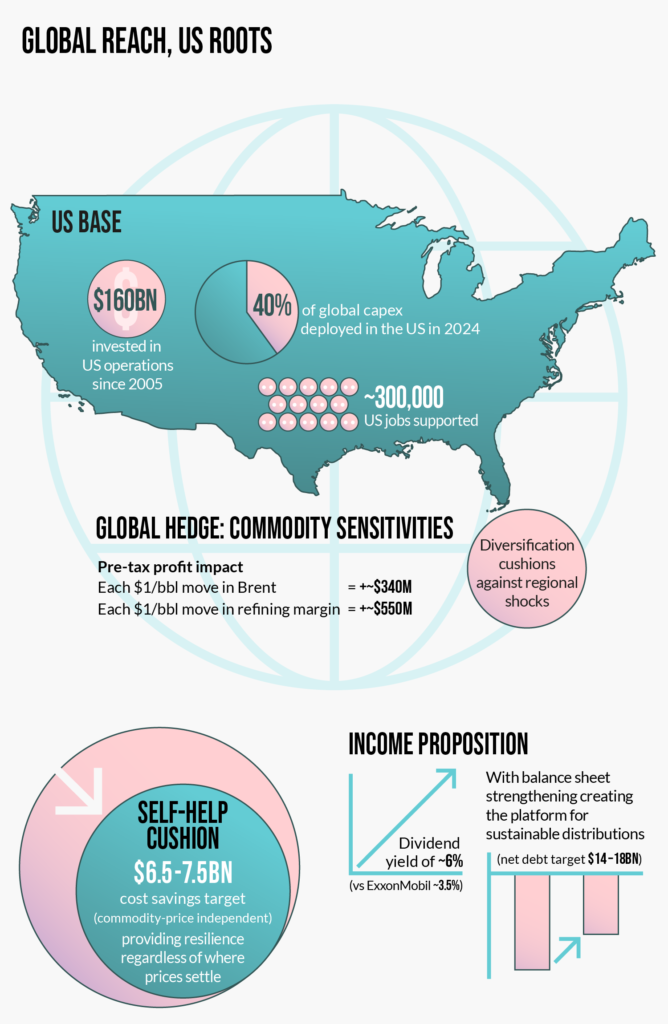
bp occupies a distinctive position in terms of geographic diversification. The company has committed more capital to the US than to any other country: $160bn invested since 2005, supporting approximately 300,000 jobs and encompassing major operations from the Permian Basin to the deepwater Gulf of America. Nearly one-third of bp’s global workforce is in the US, and approximately 40% of global capital investment was deployed domestically in 2024.
Yet despite this substantial US commitment, bp has a diversified international footprint spanning Europe, Asia and the Middle East.
For the income-focused investor, this structure represents meaningful exposure to US energy fundamentals, combined with a built-in hedge against regional concentration. It is, in effect, a balanced portfolio approach.
Competitive positioning: The integrated model advantage
This concentration on high-quality, low-cost North American assets is an efficient and proven strategy. It has delivered strong returns and simplified operational focus. However, it also creates inherent exposure to North American policy cycles, regional commodity dynamics, and, in certain geographies, evolving territorial and regulatory uncertainties.
bp occupies a differentiated competitive position. The company maintains significant US upstream operations through bpx energy, its onshore oil and gas arm, and its Gulf of America deepwater portfolio, while simultaneously accessing global markets through its integrated trading and supply chain capabilities.
This trading capability is a structural differentiator. According to bp’s disclosures, the company’s supply, trading and shipping business has delivered an average uplift of approximately 4% to the group’s return on average capital employed over the past six years. In periods of commodity volatility, whether driven by geopolitical events, supply disruptions or demand shifts, this commercial capability provides a mechanism to capture value that pure upstream producers cannot replicate.
The integrated model, combining upstream production, midstream logistics, downstream refining and global trading, allows bp to optimize value across the energy chain. When one segment faces headwinds, others can provide offsetting support. This integration is particularly valuable in a multipolar world where regional dislocations are increasingly common.
Valuation impact: Resilience across scenarios
bp’s medium-term financial targets are anchored in explicit price assumptions. According to the company’s capital markets update guidance, the 2027 targets are based on $74.4 per barrel Brent, $4.3 per mmbtu Henry Hub and a refining indicator margin of $10.9 per barrel, all expressed in 2024 real terms with approximately 2% assumed inflation.
The company’s sensitivity to commodity price movements is transparent. Each $1 per barrel move in Brent has an impact on pre-tax replacement cost operating profit of approximately $340m. Each $0.10 per mmbtu move in Henry Hub affects pre-tax profit by approximately $40m. Each $1 per barrel move in the refining indicator margin has an impact on pre-tax profit of approximately $550m.
This transparency allows investors to stress-test bp’s financial framework across a range of commodity scenarios. The structural cost reduction program – originally targeting $4–5bn and on completion of the Castrol and the Gelsenkirchen refinery transactions, now increased to $6.5–7.5bn by end 2027, with c$3.1bn already delivered – is not dependent on commodity prices and provides a self-help cushion that improves the company’s resilience regardless of where oil and gas prices settle.
In the current environment, integrated oil and gas majors have attracted investor interest as relatively defensive positions during periods of trade policy uncertainty and currency volatility. bp’s operational scale and disciplined capital frame of $13-13.5bn for 2026 demonstrates flexibility to adjust the pace of investment through the cycle without compromising the core program.
The shareholder return framework has been recalibrated to reflect the current environment and bp’s strategic priorities. The board’s decision to suspend the share buyback and fully allocate excess cash to balance sheet strengthening allows the company to accelerate the reduction of net debt from $22.2bn at year-end 2025 towards the $14–18bn target by end 2027.
The dividend continues to grow. bp’s dividend of 8.32c per ordinary share represents at least 4% annual growth, and FY25 shareholder distributions totaled approximately 30% of operating cash flow. The board’s decision to prioritize deleveraging over buybacks should be understood in context: a stronger balance sheet creates a more resilient platform that can sustain the dividend through commodity cycles and positions the company to invest with discipline into high-quality upstream opportunities. This is complemented by a planned reduction of approximately $4.3bn in hybrid bond financing by end 2027, further strengthening bp’s overall capital structure. As the deleveraging program progresses, the board retains flexibility to reassess the pace and composition of shareholder returns.
Closing the valuation gap: The differentiated proposition
bp’s strategic pivot, announced in February 2025, represents a deliberate alignment with the operational philosophy that has delivered strong returns at ExxonMobil and across the sector. The appointment of Meg O’Neill as chief executive officer, effective 1st April, in December 2025, following her 23 years at ExxonMobil and successful tenure as CEO of Woodside Energy, provides a signal that this alignment is more than rhetorical.
The return on average capital employed (ROACE) target of more than 16% by 2027 signals further improvement from approximately 14% (price-adjusted) in FY25. The net debt reduction target of $14–18bn by end 2027, supported by the $20bn divestment program – of which more than half has been completed or announced – addresses the balance sheet concerns that have historically contributed to bp’s valuation discount.
bp’s FY25 operational delivery provides tangible evidence that the plan is taking hold. Upstream plant reliability of 96.1% and refining availability of 96.3% were both the highest on record. Seven major projects were started during the year, five ahead of schedule. Adjusted free cash flow growth of approximately 55% (on a price-adjusted basis) was ahead of the trajectory implied by the more than 20% CAGR target for 2024–27. Capital expenditure of $14.5bn represented a 10% year-on-year reduction, with organic capex of $13.6bn.
For investors, bp now offers a proposition that combines familiar elements with distinctive characteristics. The familiar elements include exposure to the integrated oil and gas model, significant US operational presence and a commitment to a growing dividend. The distinctive characteristics include global revenue diversification, trading capabilities that capture value in volatile markets and a transformation program with defined milestones that create discrete catalysts for potential re-rating.
The current valuation reflects legitimate investor caution regarding execution risk. bp’s price-to-earnings ratio of approximately 10–11x compares to approximately 20x for ExxonMobil and 18x for Chevron. Part of this differential reflects the structural discount at which UK-listed equities typically trade relative to US markets. The dividend yield of approximately 6%, based on consensus estimates for FY26, is nearly double that of ExxonMobil.
This discount can be interpreted in two ways. For sceptics, it reflects the market’s judgment that bp’s turnaround carries meaningful execution risk and that the suspension of buybacks signals constrained financial flexibility. For those with conviction in management’s ability to deliver, it represents an opportunity to access the integrated energy model at a material discount while being paid a premium yield to wait, with the added potential for re-rating as the deleveraging program and operational improvements materialize.
The geographic diversification embedded in bp’s portfolio does not eliminate commodity price risk or execution risk. It does, however, provide a natural hedge against the regional concentration that characterizes pure-play US energy exposure. For investors seeking to balance their energy allocation, this represents a differentiated value proposition.
Forward-looking targets are based on current expectations and planning assumptions. Actual results may differ materially based on various factors including but not limited to commodity prices, operational performance, regulatory changes, and global economic conditions.
Shareholder distribution decisions, including dividends and share buybacks, are subject to board discretion, taking into account factors including, but not limited to, current forecasts and credit metrics.