bp plc is a client of Edison Group. Edison Group produces and distributes this and other content. Edison does not hold any position in bp plc.
For income-focused investors evaluating the integrated energy sector, the question of operational efficiency is fundamental. A company’s ability to convert capital into cash flow, and to do so consistently through commodity cycles, determines the sustainability of dividends and the capacity for long-term value creation.
Following a ‘fundamental strategic pivot’, announced in February 2025, bp aims to narrow the performance differential with its US peers. The current valuation offers investors a premium yield while the company executes on this plan.
The starting point: Quantifying the gap
A clear-eyed assessment must begin with the current performance differential. The table below summarizes key metrics from the three companies’ most recent full-year results.
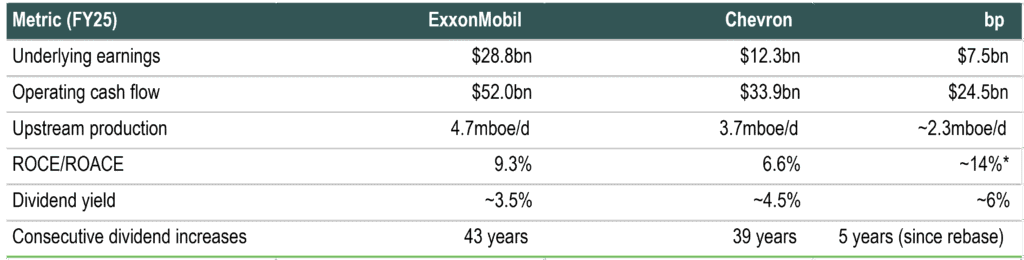
Note: *bp reports a return on average capital employed (ROACE) on a price-adjusted basis (normalized to reference price assumptions). Actual reported ROACE was 13.9%, slightly lower given FY25 Brent averaged $69/bbl versus bp’s $71.5/bbl 2025 reference price. ExxonMobil and Chevron report actual ROCE.
The data also reveal something significant: bp’s price-adjusted return on average capital employed (ROACE) of approximately 14% compares favorably against both US peers, reflecting the early impact of capital reallocation and cost discipline. The company also trades at a material valuation discount while offering a significantly higher dividend yield. The investment question is therefore not simply which company is performing best today but whether the current discount is an opportunity tied to a credible turnaround.
The strategic pivot: From transition to returns
bp’s previous strategy, which accelerated investment into the energy transition, has been acknowledged by management as having moved ‘too far, too fast’. The February 2025 strategic pivot represents a reorientation towards the integrated model that has delivered strong returns across the sector: capital discipline, focus on the highest-returning projects and a willingness to exit positions that do not meet return thresholds.
The shift is substantive. Transition spending is being reduced by more than $5bn per year, with capital reallocated to oil and gas investment of approximately $10bn annually through 2027. The company has retired its previous ambition to cut oil and gas production by 40% by 2030. In its place is a model focused on returns-based capital allocation.
The Q425 impairments of approximately $4bn after tax, primarily in its transition businesses, represent a significant step in repositioning the portfolio. Management has acknowledged that every impairment reflects prior capital outlay and has committed to improved capital allocation discipline. While further adjustments may occur as market conditions evolve, these charges reflect a clear shift in priorities away from lower-returning businesses.
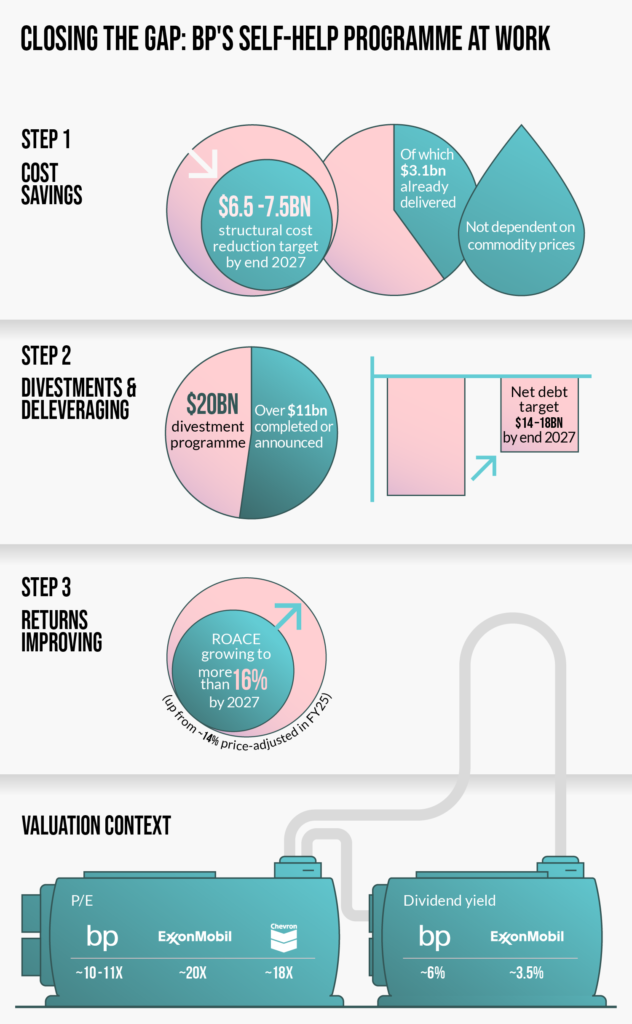
The target is explicit: a return on average ROACE of more than 16% by 2027, up from approximately 14% (price-adjusted) in 2025. Achieving it requires continued discipline: growing earnings while managing the capital base efficiently.
In exploration, the Bumerangue discovery offshore Brazil, with an estimated eight billion barrels of liquids in place, represents bp’s largest find in 25 years. While at an early stage with a wide uncertainty range and an appraisal program expected to start in late 2026, it materially strengthens bp’s deep resource hopper and the long-term optionality of the upstream portfolio. Combined with 12 exploration discoveries made during 2025 and a reserves replacement ratio of 90% (up from an average of approximately 50% in the prior two years), bp’s resource base is expanding.
Bp’s deep resource base provides a real competitive advantage. It provides the potential for long-term organic growth and, combined with disciplined investment criteria, enables the company to progress the most value-accretive options with the highest returns. Along with high-quality assets, outstanding capability and advanced technology, this is a key differentiator supporting the bp investment case.
The self-help playbook: Structural cost savings
bp is pursuing its own disciplined self-help strategy. The company originally targeted $4–5bn in structural cost reductions by the end of 2027, relative to a 2023 baseline. As of Q126, c$3.1bn had been delivered cumulatively, indicating the program is ahead of schedule. Reflecting the outcome of the strategic review of Castrol, which resulted in a decision to divest a 65% shareholding and the announced agreement to sell the Gelsenkirchen refinery in Germany, bp has now increased this target to $6.5–7.5bn by end 2027.
The savings are concentrated in the downstream business. The Customers division is targeting approximately $1.8bn in reductions through three primary levers: streamlining the operating model by reducing interfaces and eliminating duplication; deploying digital and automation tools to drive frontline efficiencies; and materially consolidating the supplier base to standardize processes and achieve economies of scale. The Products division is targeting more than $700m in additional savings.
Crucially, these savings are not dependent on commodity prices. They represent genuine self-help – improvements to the cost structure that will flow to the bottom line whether oil is at $60 or $80 per barrel.
Balance sheet repair: Closing the leverage gap
bp’s current gearing reflects its acquisition history and the legacy of its previous strategy. The $20bn divestment program bp announced as part of the strategic pivot is designed to close this gap. The explicit target is to reduce net debt to $14–18bn by the end of 2027.
Progress has been substantial. In December 2025, bp agreed the sale of a 65% stake in Castrol to Stonepeak at an enterprise value of $10.1bn. Expected net proceeds of approximately $6bn will be fully utilized to reduce debt following completion. bp will retain a 35% stake on completion with optionality to realize further value after a two-year lock-up. With this transaction, bp has completed or announced approximately $11bn of its $20bn divestment target.
Net debt stood at $25.3bn at the end of Q126, having increased from $22.2bn at end 2025 primarily driven by a $6.0bn working capital build. Management expects around $5bn of the build to unwind in total, with $3bn occurring by the end of 2026.
Importantly, the board’s decision in February 2026 to suspend the share buyback and fully allocate excess cash to balance sheet strengthening represents an acceleration of this deleveraging strategy. The previous guidance for shareholder distributions in the range of 30–40% of operating cash flow has been retired. In its place is a clear priority: build a stronger, more resilient platform from which to invest with discipline into bp’s deep basket of oil and gas opportunities.
In a further signal of balance sheet strengthening, bp has announced plans to reduce its hybrid bond financing by approximately $4.3bn, from $13.3bn to approximately $9bn by end 2027.
In 2026, the company expects net debt to increase through the first half of the year before falling significantly in the second half, as the Castrol proceeds (approximately $6bn expected) and other divestments (total 2026 proceeds expected at $9–10bn) are received.
A stronger balance sheet is not merely a financial metric. It provides a larger safety buffer for the dividend, lowers financing costs and increases resilience to commodity price volatility. It is the foundation on which sustainable shareholder returns are built.
Leadership alignment: A focus on operational discipline
One of the strongest signals that bp is serious about closing the efficiency gap is its leadership change. Meg O’Neill took up the position of chief executive officer, effective 1st April. O’Neill, the former CEO of Woodside Energy, spent 23 years at ExxonMobil before joining Woodside in 2018.
The significance of this appointment should not be underestimated. O’Neill brings a proven track record of capital efficiency and shareholder returns, most recently at Woodside where she oversaw consistent operational delivery. Her selection represents a deliberate alignment with the operational philosophy that has delivered strong returns across the integrated energy sector.
The appointment reflects bp’s board prioritizing operational excellence and capital discipline. O’Neill’s track record at Woodside, where she delivered consistent shareholder returns, demonstrates alignment with bp’s renewed focus on financial performance. This leadership change provides confidence that the strategic pivot has board-level commitment.
The valuation opportunity: What the market is pricing
The market is currently pricing bp at a discount to its US peers. bp’s price-to-earnings ratio of approximately 10–11x compares to approximately 20x for ExxonMobil and 18x for Chevron. Part of this differential reflects the structural discount at which UK-listed equities trade relative to US markets – FTSE 100 companies typically trade at lower multiples (average P/E of approximately 14–15x) than their S&P 500 counterparts (average P/E of approximately 25–30x). At the same time, bp’s dividend yield of approximately 6% is nearly double that of ExxonMobil’s at 3.5%.
This discount reflects legitimate concerns: a less robust balance sheet, a more complex portfolio and a history of self-acknowledged ‘too far, too fast’ transition strategy. The dividend cut in 2020, while Exxon maintained its 43-year streak of consecutive annual increases, remains in recent memory.
However, the strategic pivot is a direct response to these concerns. If bp delivers on its stated targets – specifically ROACE of more than 16%, net debt of $14–18bn, and $6.5–7.5bn in cost savings – the fundamental case for a re-rating becomes compelling.
The table below summarizes the trajectory bp is targeting, compared to its FY25 position.
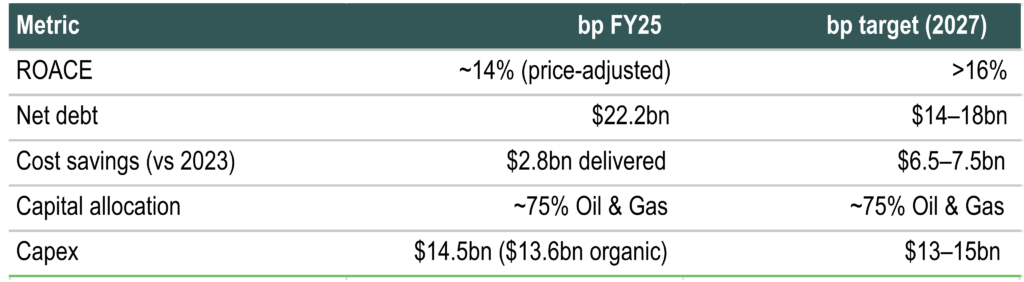
The dividend yield of approximately 6% provides income while investors assess management’s delivery against targets. Bp expects to grow the dividend by at least 4% annually (subject to board approval), maintained even as the buyback has been suspended, signals confidence in the durability of the underlying cash flows.
The risk perspective: Execution is everything
A credible analysis must acknowledge the bear case. The targets bp has set are ambitious, and the risks to delivery are real.
Execution risk: Cost programs of this scale are complex to deliver in full. The downstream efficiency improvements require sustained operational discipline across a global organization. Slippage on any of the major initiatives would affect the trajectory towards the ROACE target.
Commodity sensitivity: bp’s financial targets are based on a reference price of approximately $74 per barrel Brent in 2027 ($70 in 2024 real terms with c 2% inflation assumed). A sustained period of significantly lower prices would pressure cash flows and potentially constrain the pace of deleveraging. For context, Brent averaged $63.73 per barrel in Q425, well below the reference trajectory, underscoring the importance of bp’s self-help programs. In Q126, Brent averaged $81.13 per barrel, above the reference price trajectory, although heightened volatility driven by Middle East disruption makes the forward price path uncertain.
Dividend track record: bp cut its dividend in 2020. Exxon has increased its dividend for 43 consecutive years; Chevron for 39 years. The suspension of the buyback program, while designed to accelerate balance sheet repair, may reinforce concerns among investors focused on total cash return. Investors may continue to apply a discount to bp until a longer track record of stability is established under the new framework.
Scale disadvantage: bp’s upstream production of approximately 2.3 million barrels of oil equivalent per day is roughly half that of Exxon. The company lacks the massive, low-cost growth engines – specifically the Permian Basin scale and Guyana – that its US peers possess. The path to higher returns must therefore come primarily from efficiency gains, cost discipline and high-quality project execution rather than volume growth alone.
These risks are real, and investors must weigh them carefully. However, the strategic pivot is explicitly designed to address each of these vulnerabilities. Over FY25, bp has demonstrated tangible progress: record upstream plant reliability of 96.1%, record refining availability of 96.3%, seven major projects started up (five ahead of schedule), $2.8bn in structural cost reductions delivered and $5.3bn in divestment proceeds received. The market will continue to judge bp on delivery against defined milestones, not on promises.
Conclusion: The differentiated investment case
bp is remodeling its business around operational discipline and returns-focused capital allocation. The company’s framework now prioritizes the same financial metrics that have driven valuations across the integrated sector.
The strategic pivot involves three interconnected elements: a reallocation of capital to the highest-returning oil and gas projects; a structural cost reduction program that is not dependent on commodity prices; and a balance sheet strengthening strategy funded by $20bn in divestments. The appointment of a chief executive with a proven track record of capital discipline signals the board’s commitment to the transformation. The decision to suspend buybacks and accelerate deleveraging demonstrates a willingness to prioritize long-term resilience over near-term cash return.
Furthermore, bp’s deep resource base provides a real competitive advantage. It provides the potential for long-term organic growth and, combined with disciplined investment criteria, enables the company to progress the most value-accretive options with the highest returns.
For investors, this creates a differentiated proposition. bp offers exposure to the integrated energy model at a P/E of approximately 10–11x compared to approximately 20x for ExxonMobil and 18x for Chevron, with a dividend yield of approximately 6% versus 3.5% for ExxonMobil. Part of this discount reflects the broader UK market valuation differential, while the remainder reflects execution risk, which also creates potential upside if management delivers on its stated targets.
bp’s investment case will be measured by performance against its stated milestones. For income-focused investors willing to accept the execution risk, the current valuation may represent an attractive entry point into a company that is actively rebuilding its competitive position.
To examine the specific metrics and investor scorecard that will determine whether bp’s pivot is succeeding, read the next report.
Forward-looking targets are based on current expectations and planning assumptions. Actual results may differ materially based on various factors including but not limited to commodity prices, operational performance, regulatory changes, and global economic conditions.
Shareholder distribution decisions, including dividends and share buybacks, are subject to board discretion, taking into account factors including, but not limited to, current forecasts and credit metrics.