“Edison is the go-to for a new investor to get full understanding of the investment case and business. Edison’s distribution reaches investors that we want to connect with directly.”
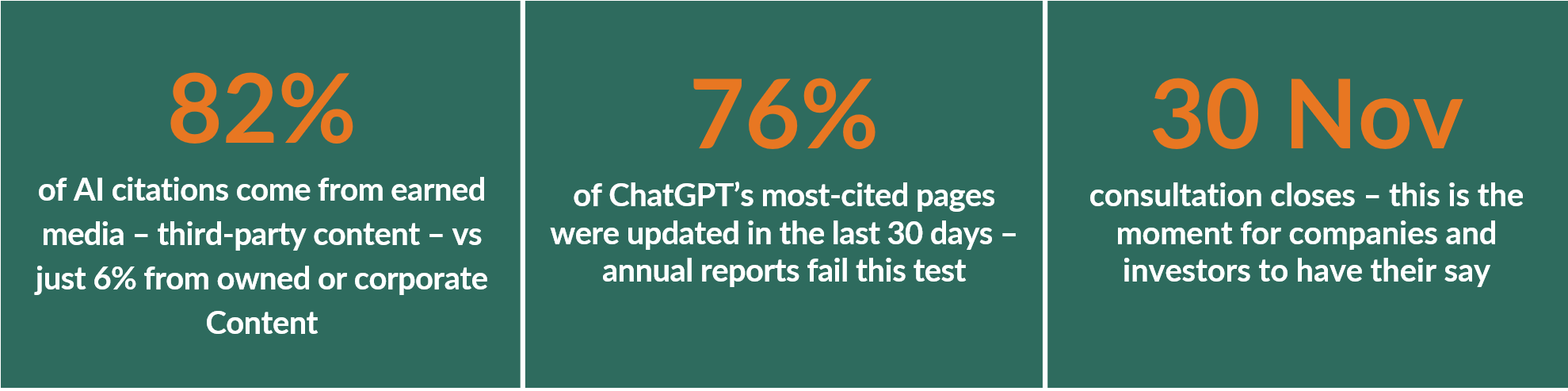
The government last month launched what the Chartered Institute for Management Accountants (CIMA) has described as ‘potentially the most significant shake-up to the UK corporate reporting landscape in a generation’. The Modernising Corporate Reporting consultation, published on 7 September 2026 and open until 30 November, sets out a wholesale review of how UK companies communicate with investors and creditors – from annual reports and strategic disclosures to AGMs and digital communications.
The diagnosis in the consultation document is refreshingly candid. The government itself states that the UK’s reporting framework has ‘lost its way’. The Institute of Chartered Accountants of Scotland (ICAS) describes annual reports as having become ‘a dumping ground for information’ in which ‘the growing volume can make the report harder to navigate and less effective’. One UK top 100 company head of corporate reporting goes further: ‘You end up being safer if you throw the kitchen sink at it. Nobody is forced to actually stick their neck out and say these are the things which are material to us.’ These are not outside critics; they are the voices the government itself chose to reproduce in its own consultation paper.
That is a problem for all investors, but it is a particularly pressing one for the growing population of retail investors who have entered UK equity markets in recent years and who are trying to understand the companies they own without the Bloomberg terminals, research subscriptions or analyst access that institutional investors take for granted.
Exhibit 1: UK corporate reporting: The reform, the AI question and what is at stake for investors
Chapter 8 of the consultation proposes making digital the default for communicating with shareholders, which would end the requirement to send printed annual reports by post. It also proposes electronically tagging the data within annual reports – in plain terms, structuring the numbers so that machines can read and process them directly, rather than treating every document as a wall of text. It seeks views on moving some disclosures from annual reporting cycles to company websites, where investors can access them throughout the year. And it proposes clarifying that AGMs may take place virtually where there is shareholder consent, although this has already drawn sharp criticism from shareholder advocacy groups, which argue that online-only AGMs would reduce rather than improve retail investor access. The jury is still out, which is precisely why the consultation matters.
Taken together, these proposals point in an important direction: away from a paper-based, annual-cycle model of corporate communication and towards something more continuous, accessible and digital. For the retail investor who researches companies on their phone, consults YouTube for management commentary and increasingly asks AI tools to summarise an investment case, this represents real progress.
The question the consultation has only partially answered
What is notably self-aware about the consultation is that the government states responses will themselves be analysed using Generative AI in a tacit acknowledgement that AI is already reshaping how information is processed. Yet the proposals on digital reporting, while welcome, do not fully grapple with what AI-readability means in practice for the investor.
Digital tagging makes financial data machine-readable inside a document. But the AI tools retail investors are already using to research companies – ChatGPT, Perplexity, Gemini, Claude – do not primarily draw on tagged annual report data; they draw on whatever content is publicly available, openly accessible and regularly updated online. Research shows that 82% of AI citations come from earned media – third-party, independently produced content – and only 6% from owned or corporate content. And AI tools consistently favour recent content: analysis of ChatGPT’s citation patterns found that 76% of its most-cited pages had been updated in the last 30 days. An annual report, however well-tagged, is a once-a-year document. Most of what an AI tool will tell a retail investor about a company comes from somewhere else entirely.
Some companies are already moving in this direction without waiting for legislation to catch up. Rather than relying solely on the annual report, they are complementing formal disclosure with focused, accessible content structured around what investors actually want to understand. When Molten Ventures published its FY25 annual results, Edison produced four thematic pieces distilling the company’s strategy, business model, investment case and approach to exits into bite-sized explainers – published openly on Edison’s website and structured for discovery by the investors and AI tools that formal filings rarely reach. The reason is straightforward: AI tools do not reliably cite content buried in a PDF and strongly prefer regularly updated content from trusted third-party sources over documents published once a year. This is one example of what more accessible corporate communication can look like today and a foretaste of what the consultation’s digital reforms could unlock at scale.
What this means for companies responding to the consultation
The consultation is an opportunity for companies and investors to shape an outcome that genuinely serves the interests of the growing retail shareholder base. The most useful contribution companies can make is not to argue for less reporting, but to argue for better reporting: content that is focused, written in plain language, regularly updated and structured for the channels that retail investors actually use – not just for compliance purposes.
Edison intends to submit a formal response to the consultation before it closes on 30 November 2026 and will publish that response. This piece is the first in a series of articles in which we will set out our thinking on the proposals and what they mean for companies, investors and the future of corporate communication. We welcome the views of investors, analysts and IR professionals on what they value in current reporting, and what they would want to see protected, improved or fundamentally changed. The government is listening. So are we.
To find out how Edison helps companies build meaningful engagement with their investor base, visit edisongroup.com.