“Edison is the go-to for a new investor to get full understanding of the investment case and business. Edison’s distribution reaches investors that we want to connect with directly.”
AI search tools have become a significant and growing part of how investors research companies, and the way they work is fundamentally different from traditional search. When a retail investor, institutional analyst or financial journalist queries ChatGPT, Perplexity, Gemini or Claude about a listed company, they receive an amalgamated answer instead of a list of links to browse. With traditional search, investors could click through to the company’s own investor relations page, which presented the narrative on its own terms. But AI-generated answers collapse that step: the company’s owned content competes directly with everything else written about it – and rarely wins. For most companies, the narrative presented to investors is increasingly shaped by what third parties have published rather than what the company itself has said.
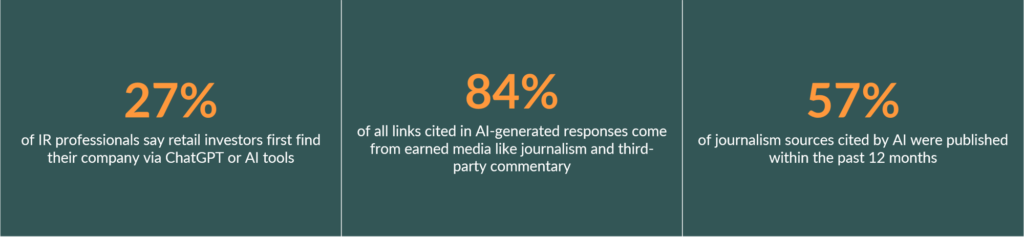
Exhibit 1: AI search and investor relations – the discovery gap in numbers
Sources: IR Society Annual Conference, June 2026; Muck Rack, Generative Pulse: ‘What is AI Reading’, May 2026
The narrative gap is structural, not accidental
The content most available for AI tools to draw on is financial news coverage, and research published by the London School of Economics confirms what investor relations professionals have long observed: financial media coverage is structurally biased towards negative news. Large, out-of-the-ordinary events – the kind that drive news cycles – tend to be negative; positive developments are typically incremental and therefore less likely to be reported.
This bias is not new; what has changed is how investors access information. In a traditional research process, media coverage was one input among many: investors could navigate directly to a company’s IR website, read its investor presentations and reports, or watch management interviews. Company-owned content provided a counterweight to third-party sources. However, in an AI-mediated research process that counterweight largely disappears. As discussed above, AI tools draw predominantly from third-party earned media – the very sources where the negative bias is most pronounced. Short-seller commentary, forum posts and competitive comparisons amplify that dynamic further. For a company without a substantial open-access third-party content presence, the AI-generated picture will tend to reflect the structural biases of the sources AI relies on most heavily.
It is worth noting that AI tools can behave differently in conversational contexts, where sycophantic tendencies are well documented, than in research-style queries, where citation-based synthesis is the dominant mechanism. The concern here is not conversational AI; it is the way AI synthesises publicly available third-party content when an investor asks about a company.
What AI tools actually look for
This is where a relatively new concept – generative engine optimisation, or GEO – becomes directly relevant to IR teams. Just as search engine optimisation (SEO) describes making content visible in Google results, GEO describes making content visible in AI-generated answers. The principles are related but the underlying logic is different, and that difference matters.
SEO rewards a mix of owned content, technical optimisation and accumulated authority signals such as inbound links. GEO rewards something more specific: credibility conferred by third parties. Foundational academic research from Princeton, Georgia Tech, IIT Delhi and the Allen Institute for AI established that AI engines strongly favour content published by credible third parties – what communications professionals call ‘earned media’ – over brand-owned content. The scale of that preference is striking: according to research from Muck Rack, 84% of AI citations come from earned media sources, while paid and advertorial content accounts for just 0.3%. For IR teams accustomed to managing a company’s owned content – the IR website, investor presentations, annual reports – this represents a fundamental shift in how influence over the narrative works.
Recency matters too, though it is not unique to AI: Google’s search algorithm has always favoured fresh content. What may be different is the degree to which recency displaces authority in AI citation patterns. In traditional search, an authoritative document can remain visible for years regardless of age. Muck Rack’s analysis of AI citation behaviour found that 57% of journalism sources cited by AI were published within the past 12 months, with citation rates peaking sharply in the first month after publication and declining steadily thereafter. Annual reports published once a year in PDF format score poorly on both the earned media and the recency dimensions. Third-party independent research – published regularly, in accessible formats, and without a registration wall – scores well on both.
Six practical steps for IR teams
Improving AI discoverability does not require a significant budget. It requires understanding where the gaps are and addressing them methodically:
Audit your AI footprint. Search your company on ChatGPT, Perplexity, Claude and Gemini, but go beyond a simple name search. Ask the questions your investors would ask. Is this company profitable? What are the key risks? How does it compare with its peers? The answers will reveal where your AI discoverability is strong and where it falls short. Are your competitive strengths clearly represented? Is the narrative accurate and current? Identifying these gaps now, before your investors do, is the starting point for any meaningful GEO programme.
Move key IR content from PDFs to accessible web pages. Investor highlights, key financial metrics and management commentary should live on crawlable HTML pages, not only in PDF documents. The open web runs on HTML pages: they are linked to, referenced and cited in ways that PDFs – downloaded as documents rather than navigated as web content – simply are not. Your IR content does not need to change, but the format and location do.
Review how your site is configured for AI crawlers. AI retrieval bots operated by OpenAI, Anthropic, Google and others will crawl your site by default – you do not need to actively grant permission. However, security firewalls and certain site configurations can inadvertently block them. It is worth asking your IT department to confirm that AI crawlers are not being blocked and, where relevant, that your robots.txt file is actively signalling to them rather than simply not impeding them. Many IR websites have not been reviewed with this in mind.
Publish regularly. Recency is a significant factor in AI citation patterns. A company with frequent, accessible investor communications such as market updates, commentary and Q&A content will be better represented than one whose investor-facing content is refreshed once a year.
Ensure that independent research about your company is open-access. AI engines weight third-party sources more heavily than owned content. Open-access research, freely available on platforms including stock exchanges and research aggregators, is discoverable in a way that gated or paywalled content is not.
Review your document metadata and content for consistency. AI tools read more than the visible text of documents and web pages. The title, author and description fields embedded in your PDF documents – and the meta-descriptions on your IR website pages – all influence how AI systems identify and attribute your content. A results presentation titled ‘Q3 presentation’ tells an AI tool very little about your company, but one titled ‘Your Company Name Q3 2024 interim results – investor presentation’ is immediately attributable. Apply the same logic across your IR document library: results announcements, investor presentations and strategy documents should all carry clear, company-specific metadata. The IR Society’s AI Working Group also advises IR teams to compare their website against their latest reporting, looking for outdated strategic messages, superseded financial metrics or inconsistent management commentary. Where information is fragmented or contradictory across channels, AI tools will treat it as a less reliable source and may supplement it with third-party narratives instead.
The first-mover window is open
AI discoverability is where website SEO was two decades ago: most IR teams have not yet engaged with it, and the first-mover advantage is real. Citation authority, like domain authority before it, compounds over time. The companies that build their AI footprint now will find their investment narrative consistently and accurately represented in the tools investors increasingly reach for first. The companies that wait will find their narratives influenced by what already exists: the extraordinary, and disproportionately negative, events that financial news naturally gravitates towards.
To find out how Edison helps companies build meaningful engagement with their investor base, visit edisongroup.com.
The UK government opened the Modernising Corporate Reporting (MCR) consultation in September, proposing a wholesale review of how UK companies communicate with investors and creditors: From annual reports and strategic disclosures to AGMs and digital communications.