“Edison is the go-to for a new investor to get full understanding of the investment case and business. Edison’s distribution reaches investors that we want to connect with directly.”
Join us for investment knowledge across your choice of sectors and equities.
To continue reading, log in or create a free account below.
Close
Close
Close
Create An Account
If you have an account with us, please click the sign in button below.
The AGM isn’t broken – it’s just talking to the wrong people
The AGM isn’t broken – it’s just talking to the wrong people
The government’s consultation on Modernising Corporate Reporting has put AGM reform back on the agenda. But the debate so far has focused on format – physical versus hybrid versus virtual – rather than the deeper questions of who the AGM is for and how often companies should be speaking to their shareholders.
The UK government’s consultation on Modernising Corporate Reporting, published in September 2026, represents a genuine opportunity to rethink how listed companies engage with their shareholders. For years, the AGM has been the centrepiece of that engagement – the annual moment at which the board stands before shareholders, presents its stewardship and seeks a mandate for the year ahead.
But there is a growing tension at the heart of this conversation. Reform advocates are correct that the AGM needs to change. They are asking, broadly, the right questions. What they are not asking, at least not yet, is whether the AGM alone can ever be enough.
What the data tell us
The COVID-19 pandemic gave UK-listed companies an unexpected prompt – and, briefly, the legislative cover – to rethink how they held their AGMs. Emergency regulations introduced in 2020 allowed companies to hold meetings virtually, and many amended their articles to make that flexibility permanent. Hybrid AGMs, once a rarity, became significantly more common, and by 2022, 42% of the UK’s largest listed companies had adopted a hybrid format.
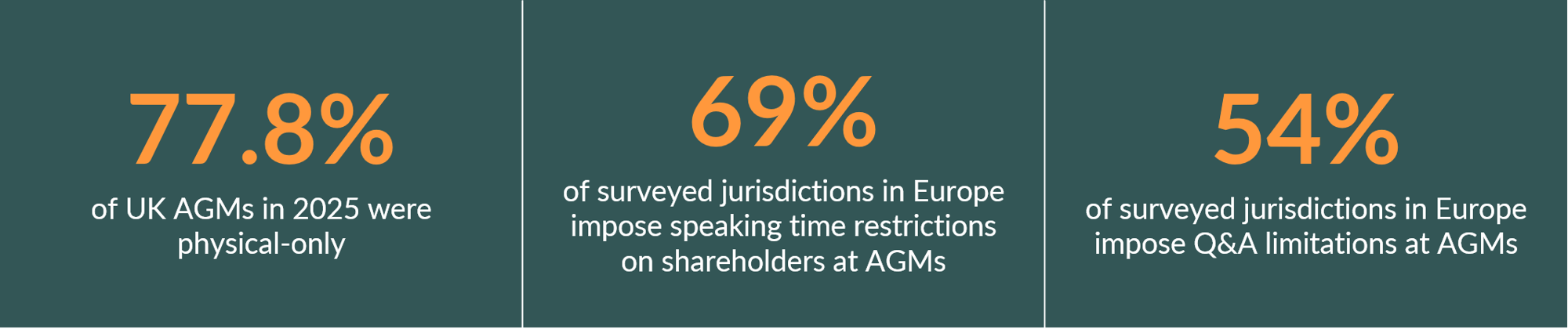
The retreat since then has been striking. According to LexisNexis’s AGM Trend Report, hybrid meetings accounted for less than 10% of UK AGMs in 2025 – and 77.8% were physical-only. That swing back to physical sits awkwardly alongside a government consultation designed to encourage more accessible, digitally inclusive shareholder engagement.
Exhibit 1: The AGM engagement gap: Format, access and voice
Breaking that down: among the UK’s largest listed companies, around 19% held hybrid AGMs in 2025. Among mid-cap companies, that figure falls to just 3%, dragging the market average below 10%. The gap matters as mid-cap companies tend to have a proportionally larger retail shareholder base, precisely the group for whom digital participation would make the greatest difference.
Why the retreat? The reasons are partly legal and partly structural. Section 311 of the Companies Act 2006 does not expressly permit fully virtual AGMs, and companies that have moved in that direction have done so without complete legal certainty. At the same time, the Investment Association has announced that it will apply a ‘red top’ IVIS signal indicating a significant governance concern to virtual-only AGMs for companies with financial year-ends from September 2026 onwards, unless specific safeguards are in place. The combined effect is that the legal and governance environment is actively discouraging the format that would give retail shareholders the easiest access.
But even if every company moved to a well-run hybrid format tomorrow, a more fundamental problem would remain. The AGM itself, in any format, is not designed for the kind of engagement retail shareholders actually need. BETTER FINANCE, the European federation of investors, surveyed AGM practices across 15 jurisdictions and found that shareholders face speaking time restrictions in 69% of those markets and Q&A limitations in 54%. The AGM is the wrong vehicle for genuine dialogue, wherever you are.
Who the AGM was designed for
To understand why, it helps to be honest about what the AGM was designed to do in the first place. It is, at its core, a legal exercise – the formal mechanism by which a company discharges its statutory obligations to shareholders: presenting accounts, putting resolutions to a vote, re-electing directors. It was never conceived as an engagement tool. And it was certainly never designed with retail investors in mind.
For institutional shareholders, this legal framing is entirely workable. Voting decisions are made well in advance through proxy advisers and engagement teams, so the AGM is the endpoint of a process, not the start of a conversation. Institutional investors have multiple touchpoints with companies throughout the year – results calls, roadshows, investor days, bilateral meetings – and the AGM is one item in a well-managed calendar.
For retail shareholders, the picture is almost entirely different. The AGM may be their only formal opportunity in the year to engage directly with the board. They arrive – if they arrive at all – without the infrastructure of a proxy adviser, without the research briefings, without the year-round access that institutional investors take for granted. They are, technically, equal shareholders. In practice, they occupy a very different position.
This is the gap the reform debate has not yet confronted. The question is not just whether the AGM should be physical, hybrid or virtual. It is whether a single annual governance event, whatever its format, can ever be the right vehicle for building a genuine relationship with the retail investors who make up an increasingly significant part of the shareholder register. Genuine engagement requires a different approach entirely. This is precisely where the conversation needs to go.
What good looks like
The opportunity here is not just about changing the format of the AGM. It is about expanding the architecture of engagement using the tools that now exist to give retail shareholders more than one moment in the year when they are actively included in the conversation.
Consider what institutional investors already receive: results calls, strategy days, sustainability briefings and bilateral access. Companies already produce much of this content. The question is simply whether they are making it available to the full shareholder register, or only to those who already have a seat at the table.
A more thoughtful approach might look something like this:
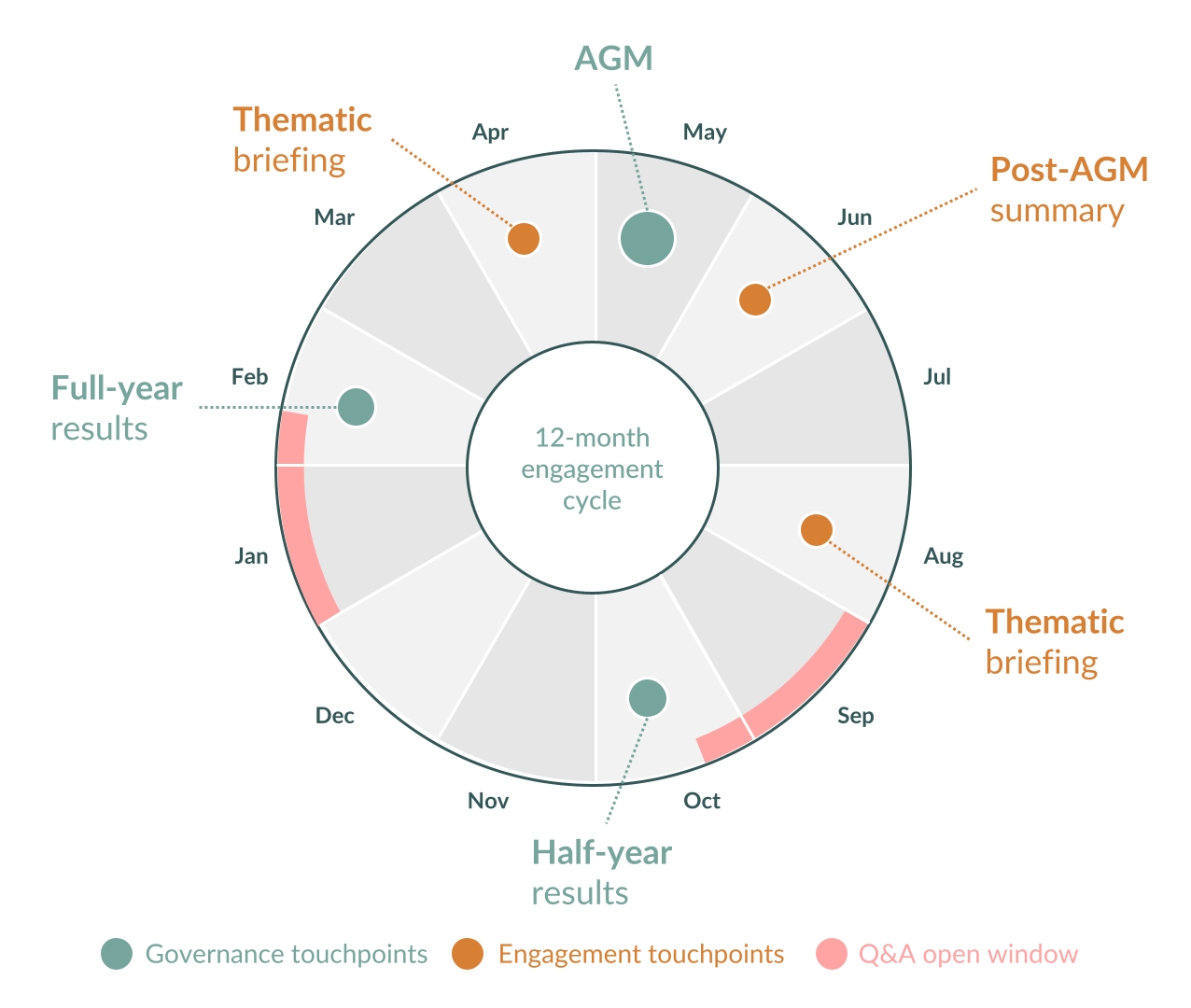
Two or three thematic shareholder briefings a year. A company might hold a session on its strategy, a separate briefing on sustainability or its response to the energy transition, and a third on a topic specific to its sector, such as technology investment, market positioning, or emerging regulatory risk. These sessions carry no formal governance weight, but they give retail shareholders a window into how management thinks and an opportunity to ask questions in a lower-stakes setting than the AGM floor. Critically, they can be held virtually, recorded and hosted permanently on the company’s investor relations website – which means they also serve as discoverable content for investors who could not attend live. The discoverability point matters: a recorded briefing that can be found through a search engine or shared via social media extends the reach of that engagement well beyond those who were on the webcast.
A rolling Q&A channel around the AGM season. Rather than concentrating all retail shareholder questions into a single AGM slot – often time-limited and procedurally constrained – companies could open a structured Q&A window around the time of the AGM. Shareholders submit questions, and the company publishes considered responses, grouped by theme where questions overlap. In practice, this is less resource-intensive than it sounds: most boards spend considerable time ahead of each AGM anticipating and preparing answers to shareholder questions. A structured Q&A channel simply makes that preparation visible and accessible to all shareholders, not just those who attend in person.
The same logic applies around results periods. IR teams could publish a FAQ drawing on the preparatory work they will already have done ahead of a results announcement, covering the questions retail investors are most likely to ask. They could also open a submission channel for retail investors to put additional questions to the team, with responses published on the company’s website, deepening the dialogue beyond the institutional audience.
A post-AGM summary. Even where the AGM itself remains largely physical, a short summary document or short video – covering the key themes raised by shareholders, how the board responded and any commitments made – gives retail investors who could not attend a meaningful account of what happened. It costs relatively little to produce and signals that the company regards its full shareholder register as worth communicating with, not just those who could travel to a venue on a given morning.
Plain English, consistently applied. Much of the friction for retail shareholders is not logistical, but linguistic. Annual reports, results announcements and AGM notices are written for a professional investor audience. Companies that genuinely want retail shareholders to engage will invest in clearer, more accessible communication as a matter of course, not as an afterthought.
Exhibit 2: Shareholder engagement calendar – from a singular annual event to a sustained engagement programme
None of this replaces the AGM. It retains its governance function: the moment at which the board formally reports to shareholders and resolutions are voted on. But it works better – and shareholders are better served – when the AGM is one part of a broader engagement programme rather than the entirety of it.
The reform agenda’s missing piece
The UK government’s consultation rightly identifies that technology has changed what is possible. A well-run hybrid AGM with live voting, digital participation and proper moderation is technically achievable. What technology cannot achieve on its own is a relationship.
The IR profession has spent two decades building sophisticated programmes for institutional investors. The tools and techniques exist. The case for applying them – adapted, simplified – to retail shareholders is straightforward. What has been missing, in many cases, is the internal conversation about whose responsibility that engagement actually is.
In many listed companies, the investor relations function manages institutional engagement. Corporate affairs or company secretarial teams handle AGM logistics. Retail shareholders fall between the two, and because no one explicitly owns that relationship, it tends to go unmanaged.
That is the structural problem the reform agenda has not addressed. Technology can enable better AGMs but it cannot, on its own, create the internal will to treat retail shareholders as year-round stakeholders rather than once-a-year attendees.
The government’s consultation is focused, understandably, on the legal and regulatory framework for AGMs – the walls and the windows. The deeper question – whether anyone has thought about who they are inviting in, and how often – is one that companies themselves need to answer.