bp plc is a client of Edison Group. Edison Group produces and distributes this and other content. Edison does not hold any position in bp plc.
US investors usually think of bp as a London-listed global major. It is. But one of the fastest-growing parts of the company sits much closer to home. bpx energy, bp’s onshore oil and gas business in the lower 48 states, is focused primarily on developing unconventional resources in Texas, and its production has grown strongly this year.
Under CEO Meg O’Neill, bp’s message to investors is that a simpler, more focused company will deliver more. Investors who have followed bp through its directional shifts in recent years will reasonably want evidence, not just intent. O’Neill has said as much herself. In bp’s Q3 results in October, she said the company would keep ‘working with urgency to turn one good set of results into strong performance quarter after quarter’.
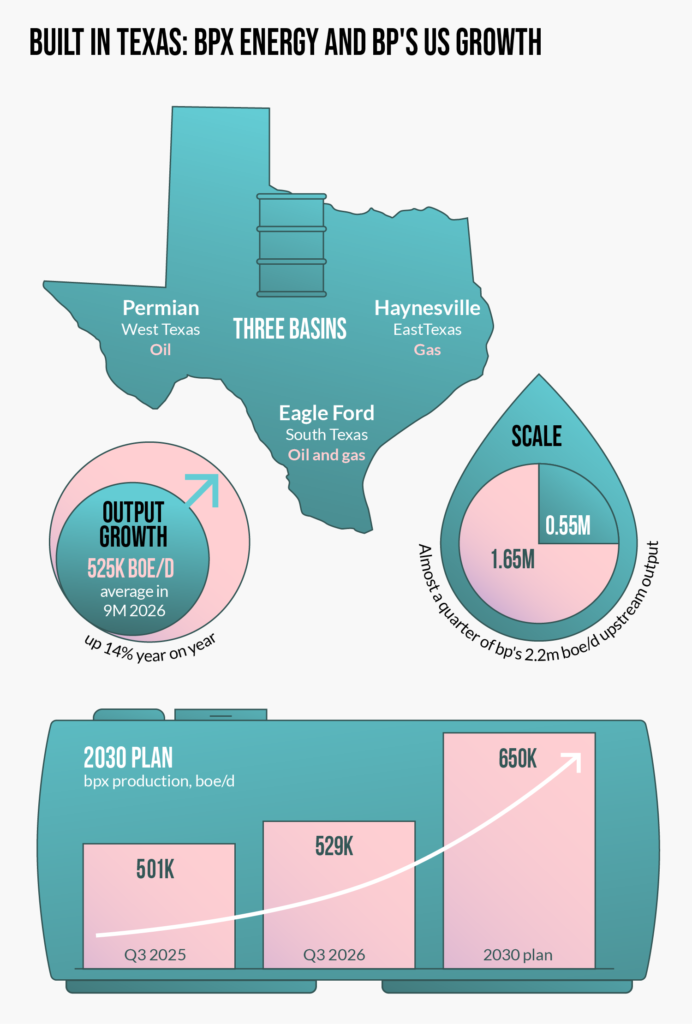
bpx is one of the clearest places to see that delivery is already happening. It is a driver of bp’s broader growth and value proposition. Over the first nine months of 2026, bpx produced an average of 525,000 barrels of oil equivalent per day (boepd), around 14% more than in the same period of 2025. Third-quarter output was 529,000boepd, around 6% higher than a year earlier, though slightly below the second quarter’s 545,000boepd.
A US business at the heart of bp
bpx operates across three of the best-known basins in US onshore energy, each with a different character:
- Permian Basin (West Texas): the most oil-weighted of the three.
- Eagle Ford (South Texas): a mix of oil and natural gas.
- Haynesville (East Texas and Louisiana): natural gas.
That mix matters. It gives bpx the flexibility to direct capital towards oil or gas, depending on where it expects the best returns. In August, O’Neill described this balance, noting that rig decisions are made to ‘deliver the best overall value for bp as a group’. In Q3, bpx moved one rig from the gas-weighted Haynesville back to the Eagle Ford, an example of those choices in practice.
bpx is also material within bp. Its Q3 output was equal to almost a quarter of bp’s total upstream production of 2.2mboepd (Edison calculation from disclosed figures). In the Q3 results, O’Neill singled it out: ‘The culture of ownership the bpx energy team has built in the US over the past three years is showing up in better execution, higher productivity and stronger returns.’
Exhibit 1 – Built in Texas: bpx energy and bp’s US growth
Source: Edison Investment Research
The numbers behind the growth
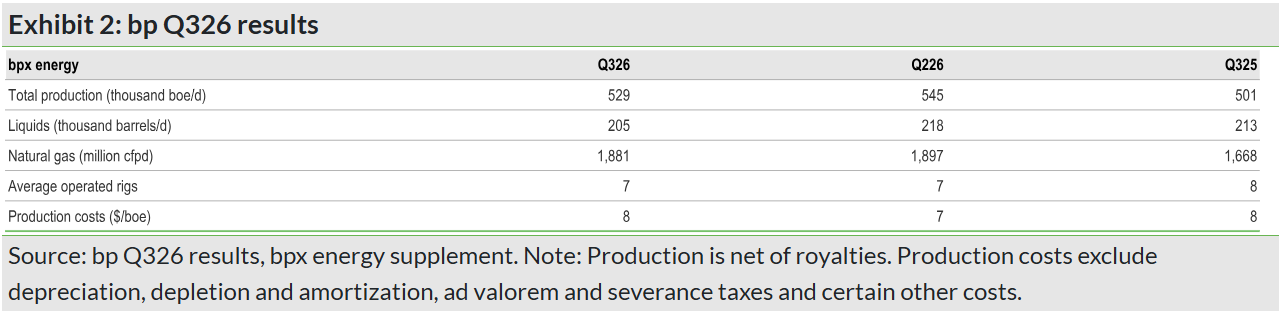
Over the first nine months (9M26), bpx’s growth came from both natural gas and liquids. Gas output averaged 1,849mcfpd, c 20% higher than a year earlier, while liquids production (crude oil, condensate and natural gas liquids) rose around 6% to 206,000 barrels per day. In the Q3, gas was up c 13% y-o-y at 1,881mcfpd, while liquids were around 4% lower at 205,000 barrels per day, with one fewer rig running in the oil-weighted Permian than a year earlier.
Q3 was another unusual one for energy markets. With disruption in the Middle East continuing, Brent crude averaged around $97/bbl, compared with around $69 a year earlier, and higher oil prices and refining margins lifted earnings across bp.
bpx also produced more with fewer rigs. The average number of bpx-operated rigs was seven in Q3, down from eight a year earlier, while production costs came down to $7.86/boe from $8.21. We look at the drivers of that efficiency in detail in the next report.
Operational records are part of the story too. In Q126, bpx set a new Haynesville basin record for 24-hour initial production of 81mcfpd from a well with a 15,000-ft lateral. That well went on to produce 63mcfpd for more than 80 days. bp’s Q3 results gave more detail on what sits behind it: field teams that take ownership of specific wells, using data and AI tools to improve uptime and drilling teams that use standard, repeatable well designs and carry lessons from each well pad to the next.
Short-cycle growth in a long-cycle industry
bpx also brings another dimension to bp’s portfolio: speed. Large offshore developments, such as bp’s deepwater projects in the Gulf of America, can take four to five years from investment decision to first revenue. Onshore wells in basins such as the Permian and Haynesville are short-cycle investments, with revenue arriving soon after the decision to invest.
O’Neill highlighted this contrast in August: ‘the fact that we’ve got a combination of short cycle capital plus the long-dated investment opportunities really does offer an advantage compared to other companies in our sector.’ For investors, that combination means bp can pair the long-life production of its deepwater and international assets with a US onshore business whose activity can be adjusted relatively quickly as market conditions change.
Simpler, stronger and more valuable: Where bpx fits
O’Neill, who became CEO in April 2026, used her first results in August to set out five priorities to deliver what she called ‘a step change in performance’, with the aim of making bp ‘simpler, stronger and more valuable’:
- Strengthening the balance sheet,
- Simplifying the portfolio,
- Investing with greater discipline,
- Driving operational excellence, and
- Hardwiring high performance and accountability.
Under this framework, ‘every dollar of capital has to compete’ and every part of bp ‘has to earn its place’. bpx is well placed against that test. Asked in August where bp could invest for growth, O’Neill said: ‘the US is probably the top country on the list, both with the offshore and the Paleogene and onshore in bpx’. In other words, bp sees its US growth coming from two complementary sources: long-life deepwater developments in the Gulf of America and short-cycle onshore production from bpx.
Looking further ahead, bp plans for bpx production to reach 650,000boepd in 2030. That is around 23% above the Q326 level (Edison calculation). Delivery will depend on commodity prices, capital allocation across bp’s portfolio and continued operational performance. Consistent with O’Neill’s view that ‘growth must be earned’, the pace of investment in bpx will need to keep competing for capital with bp’s other opportunities.
It is important to be clear about what this growth represents. It is specific to bpx. bp’s total reported upstream production was broadly flat on the Q2 at 2.2mboepd, and around 6% lower than a year earlier. bp attributes lower volumes this year to disruption in the Middle East, the sale of the Culzean gas field in the UK North Sea and a reduced equity interest in Latin America. Over 9M26, bp cited higher bpx production alongside the ramp up of major projects, as the main driver of underlying growth in its oil production and operations segment. bp has also guided to lower bpx output in Q4 as activity is phased.
Why this matters for Texas investors
For Texas-based investors, bpx offers a familiar way into the bp investment case. Its assets are in basins many of them already know well, and its performance can be judged against the same yardsticks used for US onshore producers: production growth, rig productivity and unit costs. Those numbers are reported every quarter, so investors can track delivery for themselves.
What makes bpx different from a stand-alone producer is where it sits. It is a growing, short-cycle US business inside a global integrated group that also has deepwater production, refining and trading. As bp works to become simpler and more focused, bpx is already doing what the strategy asks of the whole company: producing more, with less, and earning its place.
To see how bpx is producing more with fewer rigs and lower unit costs, read the next report. Producing more with less: Rig productivity, unit costs and capital spending at bpx energy
Forward-looking statements, including bp’s plans, priorities and production expectations, are based on current expectations and planning assumptions. Actual results may differ materially based on various factors including, but not limited to, commodity prices, operational performance, regulatory changes and global economic conditions.
Shareholder distributions, including dividends and share buybacks, are subject to the discretion of the board and may vary based on factors including, but not limited to, commodity prices, cash flow generation, balance sheet considerations and general business conditions. Past distributions are not indicative of future distributions.