“Edison is the go-to for a new investor to get full understanding of the investment case and business. Edison’s distribution reaches investors that we want to connect with directly.”
Join us for investment knowledge across your choice of sectors and equities.
To continue reading, log in or create a free account below.
Close
Close
Close
Create An Account
If you have an account with us, please click the sign in button below.
Molten Ventures – A diversified portfolio gives access to the growth trends reshaping the global economy
Financials
Molten Ventures – A diversified portfolio gives access to the growth trends reshaping the global economy
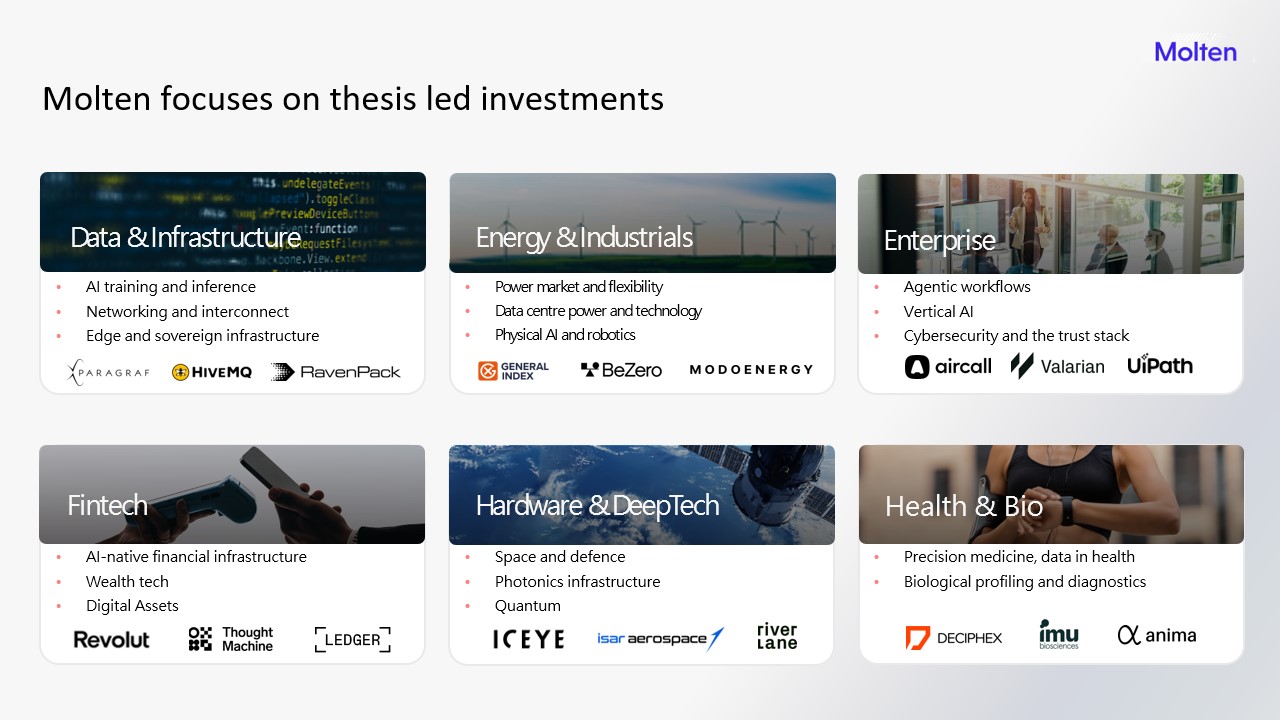
Molten invests in companies at the forefront of the generational shift in technology. Its current focus is on technologies that strengthen UK and European sovereignty and resilience. This includes fintech, hardware and deeptech, energy and industrial technology, and data and infrastructure. Its portfolio and pipeline also include digital consumer technology, healthtech and biotech computational health, AI, space, quantum and enterprise. Across this range, Molten looks for enabling technologies with tangible demand and the potential to scale.
Molten invests across a variety of thematics, targeting the enablement layer of technology and this diversity gives investors exposure to the structural growth trends reshaping the global economy, through a single listed vehicle. This exposure is set to deepen: the new Molten Ventures Growth Fund, which reached a £175m first close in September 2026, will back Series B+ companies across space, AI, fintech, quantum, deeptech and hardware.
A spotlight on defensibility in the age of AI
Molten assesses AI by asking whether it shrinks the markets companies operate in, expands them, or redistributes who captures value within them. The businesses AI threatens most are those whose core product is a workflow it can now approximate for a fraction of the cost. That is a real and specific category. It is not a description of how Molten has built this portfolio.
For every business it holds, Molten assesses vulnerability and opportunity independently, across workflow replication risk, foundation model absorption, pricing pressure and the defensibility of the company’s data and infrastructure. On that basis, approximately 75% of the direct investment portfolio sits in businesses Molten assesses as net beneficiaries of AI, either structurally amplified by it or carrying a durable tailwind. A further 15% relates to companies with real but manageable headwinds, which receive proportionally greater active management focus. In the remainder, AI is not, currently, a material factor either way.
A consistent strand of Molten’s approach is to gain exposure to a powerful technology theme not by betting on which application wins, but by owning the infrastructure and enabling layer the entire theme must run on. For AI, that means focusing on the enabling middleware layer – security and governance, workload intelligence, agentic commerce infrastructure and the data infrastructure for AI memory – rather than the foundation models or the application layer. Ledger provides the security layer for crypto and blockchain, Riverlane builds the error-correction software quantum computing cannot scale without, and Thought Machine and Form3 are the critical infrastructure of modern banking.
As Molten puts it: ‘AI has compressed the cost of going from zero to one. Going from one to 10 is a different problem.’
A spotlight on space and European sovereignty
Space and European technology sovereignty are two interlinked themes, and among the clearest sources of structural tailwind for the European venture ecosystem in which Molten operates.
Space has emerged as a focal point on the geopolitical stage, in terms of both economic prosperity and strategic importance. The European Space Agency approved a record €22bn budget for 2026–28, a more than 30% increase, explicitly aimed at strengthening Europe’s strategic autonomy in space technologies and missions. Molten’s space exposure is anchored by three holdings:
ICEYE is the world’s leading SAR small-satellite operator, increasingly contracted by European and allied governments for sovereign intelligence, surveillance and reconnaissance.
ISAR Aerospace has sovereign European launch capability and among the most credible answers to Europe’s dependency on non-European launch providers.
SatVu is a British Earth observation company capturing high-resolution infrared thermal imagery from space.
Together, these holdings give Molten exposure to both the downstream services layer (data and intelligence) and the upstream access-to-orbit layer that underpins it.
Beyond space, the response to European sovereignty has catalysed a genuine reindustrialisation agenda. An estimated €1.5tn of incremental investment is set to be deployed across European defence, energy, industry and technology by 2035, with EU defence spending alone on track to reach 2.5% of GDP. Molten believes Europe is particularly well placed for this moment: its engineering culture runs deep, and its regulatory frameworks create fertile ground for security and compliance innovation.
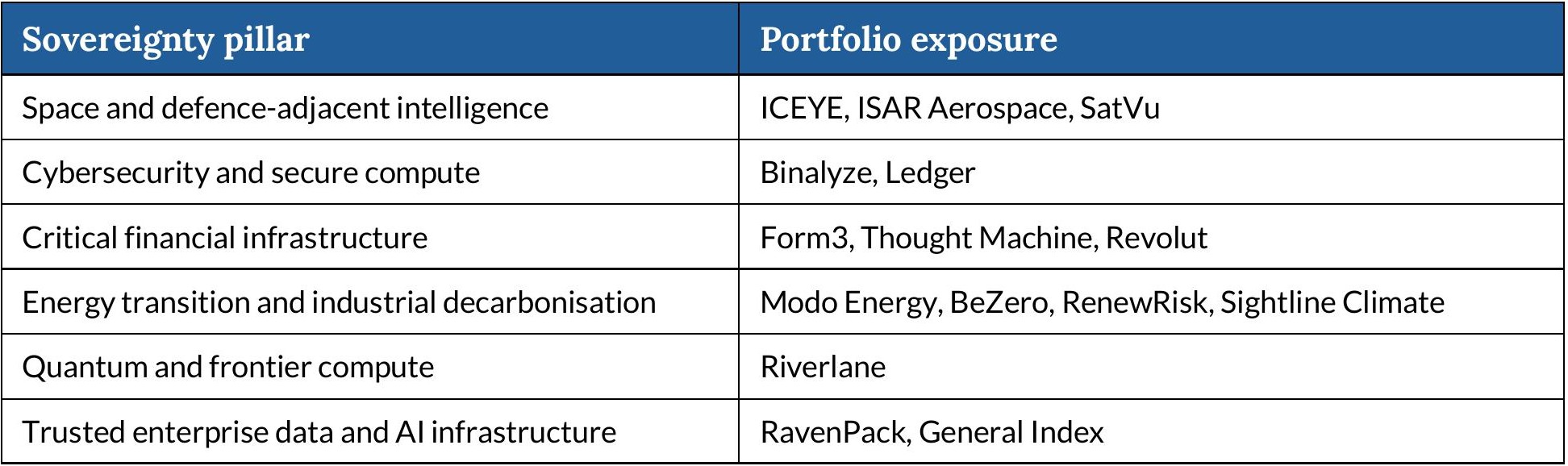
Mapping the portfolio to European sovereignty
Molten’s exposure spans each of the pillars:
A spotlight on SaaS
Enterprise technology is the largest part of the portfolio, with much of it cloud-native software providing mission-critical infrastructure that customers are slow to replace:
Thought Machine: its Vault platform replaces legacy banking infrastructure with cloud-native technology; General Bank of Canada selected it for core banking modernisation in October 2025.
Form3: a real-time payments platform at the core of some of the UK’s largest banks, which secured investment from BlackRock in January 2026.
Aiven: fully managed, open-source data infrastructure on all major clouds.
FintechOS: reported 50% annual recurring revenue growth and was recognised in the 2025 Gartner Magic Quadrant for Retail Core Banking Systems, Europe.
A spotlight on robotics and automation
AI, automation and robotics make up what Molten calls the sixth wave of technological innovation.
Manna: operates autonomous drone fleets delivering food and essentials to homes in minutes. It reached 250,000 drone deliveries in January 2026, with over 100% year-on-year delivery growth through 2025, and joined the Core Portfolio following its $50m Series B.
HiveMQ: the enterprise standard for moving IoT data from connected devices to the cloud, deeply embedded across industrial manufacturing, energy and logistics, and now building towards becoming a leading Industrial AI Platform.
SimScale: brings AI-powered engineering simulation to the browser, at a fraction of the cost of on-premises software.
A spotlight on biotech and computational health
Healthtech is one of Molten’s core investment themes, in a market expected to grow from $114bn to $267bn between 2026 and 2030, a compound annual growth rate of around 22%.
IMU Biosciences: decoding the human immune system using AI and deep, systems-level immune profiling, to unlock breakthroughs in precision medicine.
Deciphex: AI-driven platforms improving the efficiency of pathologist review; it secured full UKAS accreditation for its histopathology laboratory.
PolyModels Hub: applies modelling, simulation and AI to pharmaceutical process development; Molten led its £7m Series A.
A spotlight on distributed ledger and digital currency
Ledger provides industry-leading hardware wallets and software for securely buying, storing and managing digital assets, and gives Molten exposure to crypto and blockchain without a view on any single token or protocol. As Molten puts it: ‘When central banks deploy digital currencies, institutions tokenise securities, and governments move treasury management on-chain, the due diligence burden will favour proven providers over new entrants.’
In March 2026, Ledger launched tokenised investment strategies with partner Midas. Elsewhere in the portfolio, Thought Machine joined the Mastercard Crypto Programme in January 2026.
A spotlight on quantum
Molten’s quantum exposure comes through Riverlane, which builds the error-correction software quantum computing cannot scale without. This is Molten’s way to invest in the quantum theme at the layer every approach depends on. Its March 2026 roadmap could, the company states, accelerate quantum computing’s path to utility-scale by three to five years.
Important events around Molten Ventures’ half-year results (for the six months ended 30 September 2026):
A presentation for analystsand other registered investment professionals will be held at 09:30am GMT on Tuesday, 24 November 2026 (invitation only).
Molten will also be hosting a presentation at 10:30am GMT on Friday, 27 November 2026 via theInvestor Meet Company Platform. The presentation is open to all existing and potential shareholders, with a live Q&A session.
We have collated some additional information which provides a brief explanation of venture capital, the past20 years of Molten, and its proven track record of returns since the IPO in 2016.
Information has been sourced from Molten Ventures’ FY26 annual results as at 31 March 2026, and the Molten Ventures Growth Fund announcement of 7 September 2026.
The hidden infrastructure inside the AI data centre
Virtually all electricity delivered to a data centre ends up as heat that must be removed. In our first note we discussed that the AI build-out is increasingly constrained by the speed at which new capacity can be powered. This note looks at the other side of the same megawatt: getting the heat out. AI has made this considerably harder. Conventional racks typically drew 5–10kW, while AI racks now draw 60kW or more. The result is a large and fast-growing opportunity across the cooling value chain. McKinsey expects c $220bn to be spent on cooling equipment for AI workloads to 2030, with liquid cooling growing at 45–50% a year. Our listed company universe (Exhibit 13) shows that there are many ways to gain exposure, from global large caps to smaller European specialists.