Last close As at 05/08/2026
GBP2.61
▲ −0.50 (−0.19%)
Market capitalisation
GBP597m
Research: Investment Companies
Henderson Far East Income (HFEL) is an income-focused Asian investment trust, which aims to provide shareholders with growing total annual dividends and capital appreciation from a diverse portfolio of Asia-Pacific equities. As a result of efforts initiated this time last year to improve capital growth, the manager has repositioned the portfolio towards structural growth opportunities, while still protecting income. These changes are already enhancing performance. In the year to 31 October 2024, HFEL returned 17.4% on an NAV basis, a marked turnaround from the declines of the previous two years. The trust also delivered its 17th successive year of rising dividends in FY24. Thanks to strong portfolio revenues during FY24, this dividend was fully covered and HFEL’s revenue reserve reached an all-time high. The manager is positive about the portfolio’s revenue prospects, as Asian dividend payouts look set to continue rising for years, thanks to corporate reforms, especially in South Korea and China. The portfolio is positioned to benefit accordingly. The manager is also confident that the portfolio’s exposure to structural growth will keep supporting performance over 2025 and beyond.
Henderson Far East Income |
Portfolio refocus is paying dividends |
Investment trusts |
12 November 2024 |
Analyst
|
||||||||||||||||||||||||||||||||||||||||||||||||||||||||||||||||||||||||||||||||||||||||||||||||||||||||||||||||||||||||||||||
Henderson Far East Income (HFEL) is an income-focused Asian investment trust, which aims to provide shareholders with growing total annual dividends and capital appreciation from a diverse portfolio of Asia-Pacific equities. As a result of efforts initiated this time last year to improve capital growth, the manager has repositioned the portfolio towards structural growth opportunities, while still protecting income. These changes are already enhancing performance. In the year to 31 October 2024, HFEL returned 17.4% on an NAV basis, a marked turnaround from the declines of the previous two years. The trust also delivered its 17th successive year of rising dividends in FY24. Thanks to strong portfolio revenues during FY24, this dividend was fully covered and HFEL’s revenue reserve reached an all-time high. The manager is positive about the portfolio’s revenue prospects, as Asian dividend payouts look set to continue rising for years, thanks to corporate reforms, especially in South Korea and China. The portfolio is positioned to benefit accordingly. The manager is also confident that the portfolio’s exposure to structural growth will keep supporting performance over 2025 and beyond.
|
Time for a change – NAV performance relative to market (one year) |
|
|
Source: HFEL, Edison Investment Research |
The analyst’s view
■
Investors will welcome the recent substantial improvement in HFEL’s outright returns and some will be attracted by the trust’s increased exposure to Asia’s most significant structural growth trends, including corporate reform, technological advances, financial inclusion and renewable energy.
■
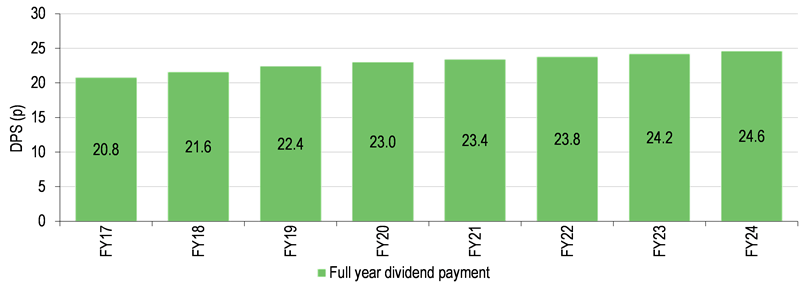
Those who were sceptical about the manager’s ability to continue to deliver rising dividends, while also refocusing the portfolio towards structural growth opportunities, will be reassured by HFEL’s rising portfolio income, the fully funded rise in the FY24 dividend, which marks the 17th consecutive year of dividend increases, and record revenue reserves. The total dividend for FY24 was 24.6p, representing an attractive and competitive dividend yield of 10.8%.
■
HFEL’s shares are currently trading at a premium of 2.7%, slightly above their long-term average premium of 2%. Further improvement in total returns resulting from recent portfolio changes is likely to foster continued demand for HFEL’s shares, which the company is likely meet by periodic share issuance.
HFEL: Repositioning towards growth; protecting yield
Investment in structural growth themes is lifting performance
This time last year HFEL’s board indicated an increased willingness to use revenue reserves to support dividend payments. This gave the lead manager, Sat Duhra, scope to move into other areas of the market to acquire well-priced value names offering performance, strong cash flows and yield or the prospect of future dividend growth, rather than being compelled to focus on stocks that already pay high dividends to fund dividend payments. The intention of this shift in focus is to improve total returns by delivering better capital growth, while also maintaining dividend growth over time. The move allows the manager to effectively capture future earnings growth earlier in a company’s growth cycle and to buy into this performance at better valuations than if he waited for rising dividend payouts to materialise.
In the year since the board’s announcement, Duhra has taken full advantage of this greater flexibility to reposition the portfolio towards structural growth opportunities, while still protecting income. Exhibit 1 illustrates the structural growth themes that underlie this repositioning, the investment opportunities these themes are generating across a broad range of sectors and the portfolio holdings that provide exposure to these opportunities.
Exhibit 1: Re-positioning towards growth themes
Theme |
Infrastructure buildout |
Emerging consumer champions |
Financial inclusion |
Tech infrastructure for global tech ‘arms race’ |
Corporate reform to enhance shareholder return |
Opportunity |
Government commitment to renewable energy in India and China |
Domestic consumer champions with international growth angle |
Hundreds of millions of bank accounts opened in India and Indonesia in last five years |
Asian companies provide tools for themes such as Al, electric vehicle and cloud services |
Value-up initiative in South Korea to boost valuations |
Transition energy sources with significant power demand requirements |
Growth of middle-class driving demand growth |
Digital payments, cross-selling opportunity in insurance, mutual funds etc |
Semi-conductor leadership in region |
Nine-point plan by regulators in China to increase dividends and share buybacks |
|
Portfolio exposure |
LNG, infrastructure funding, grid equipment, renewable energy generators |
Global travel brand, China multi-brand sportswear, China appliances |
Leading banks in India and Indonesia |
Global semi-conductor leaders, server manufacturer, chip design, Apple assembly |
Low valuation, high yield names in China and South Korea |
Example holdings |
Nari Technology, Power Grid Corp of India, GAIL |
Anta Sports, Samsonite, Midea Group |
HDFC Bank, Bank Mandiri, Bank Negara Indonesia |
Samsung, Taiwan Semiconductor Manufacturing Company, Mediatek, Infosys |
Hyundai Motor, Samsung Fire & Marine |
Source: Janus Henderson Investors. Note: As at 31 August 2024.
This repositioning is already enhancing performance, and outright returns have improved considerably over the past year. In the twelve months ended 31 October 2024, HFEL returned 17.4% on an NAV total return basis and 27.8% in share price total return terms, a marked turnaround from the previous couple of years, when returns were negative in both NAV and share price terms. In the previous year ended 31 October 2023, the NAV declined by 2.6% and the share price declined by 9.8%. In the corresponding period in 2022, both the NAV and share price declined by 11.7% (Exhibit 4). Duhra believes that this turnaround suggests the portfolio is now more stable (see Performance section for details).
Ongoing focus on portfolio income and yearly dividend rises
As well as aiming to provide shareholders with capital appreciation, HFEL is also committed to delivering a growing annual dividend, and the manager’s greater focus on growth has not come at the expense of this latter objective. Duhra has sought to balance HFEL’s exposure to growth with the desire to garner current portfolio income or invest in businesses with the potential for significantly higher future dividends. Many of the acquisitions made over the past year have offered both growth and income (see Current portfolio positioning section for details). In fact, according to Duhra, portfolio income was much better than expected during the financial year ending 31 August 2024 (FY24). This has been due, in part, to several very significant upside surprises in dividends paid by portfolio companies. Exhibit 2 shows several technology companies, banks and consumer businesses with recent dividend payouts that exceeded expectations by particularly large margins. In all, dividend income from HFEL’s portfolio holdings rose 23.0% over FY24, while total income, including option premia (see below), rose by 29.7% compared to FY23.
Exhibit 2: Positive dividend surprises across many sectors
HFEL holding |
Country |
Sector |
Forecast dividend (local currency units) |
Actual dividend (local currency units) |
Upside surprise |
NARI Technology |
China |
Smart energy infrastructure |
0.3 |
0.5 |
62% |
Kia Corp |
South Korea |
Auto manufacturing |
3,500 |
5,600 |
60% |
CTBC Financial |
Taiwan |
Regional bank |
1.2 |
1.8 |
50% |
HCL Technologies |
India |
IT services |
12 |
18 |
50% |
HSBC Holdings |
Hong Kong |
Banking & financial services |
1.6 |
2.4 |
48% |
Infosys Ltd |
India |
IT services |
19 |
28 |
47% |
Bank Negara |
Indonesia |
Regional bank |
200 |
280.5 |
40% |
ANTA Sports |
China |
Sports apparel |
0.8 |
1.2 |
40% |
Source: Janus Henderson Investors, Edison Investment Research. Note: As at 30 April 2024.
FY24 was the 17th consecutive year of dividend increases. The total dividend for FY24 was 24.6p, 1.7% higher than the FY23 dividend (24.2p per share). This represents a very attractive dividend yield of 10.8%, based on the current share price, and is well above the average dividend yield of the company’s peer group, the AIC Asia Pacific Equity Income sector; other constituents currently have dividend yields of 4.0–5.5%.
HFEL pays quarterly dividends in February, May, August and November. Consistent with the pattern of the previous four financial years, the first two dividends were each 6.1p per share, the same as the third and fourth interim dividends for FY23. The third and fourth dividends were each 6.20p.
|
Exhibit 3: Dividend history since FY17 |
|
|
Source: Bloomberg, Edison Investment Research |
Portfolio income supported by a call writing strategy
The manager’s efforts to protect and enhance portfolio income are also reflected in his decision to modify HFEL’s option writing strategy. The strategy now focuses largely on writing call options, with much less emphasis on writing puts. In Duhra’s view, this reduces the risk profile of the option strategy, and its potential cost, while also increasing income by using smaller positions over a wider number of underlying holdings. During FY24, the number of options HFEL wrote on underlying positions increased under this new approach, with each representing 0.5–1.0% of notional value as a percentage of NAV. This compared to c 10, somewhat larger positions in previous years. The manager has recently written calls on several tech names that have been performing strongly, including MediaTek, Taiwan Semiconductor Manufacturing Company (TSMC) and Advanced Semiconductor Engineering. This new approach has worked well, given market volatility over the past year, and option income has increased substantially. During FY24, option income rose by over 100%.
The strong increase in portfolio revenues from both dividend payments and option premia over the past year means that the total dividend payment for FY24 was fully covered. In line with usual practice in years of surplus, the company will be adding ‘a considerable amount’ to the revenue reserve, which can be used to smooth dividends through periods of revenue shortfall. At end FY24, this reserve stood at £29.9m, an all-time high.
Corporate reforms to support portfolio revenues over long term
Corporate reform is one of the key themes underpinning HFEL’s investments over the past year (as illustrated in Exhibit 1) and its consequences are likely to be very positive for portfolio income over the medium term. Encouraged by their respective governments, companies in both South Korea and China have initiated corporate reforms to improve capital efficiency. A key element of these reforms is to compel companies to use their high cash balances to lift their historically low payout ratios by increasing dividend payments and share buybacks (Exhibit 1). As illustrated in Exhibit 2, these reforms are already boosting shareholder returns – dramatically in some cases. Companies in other markets, notably Indian and Taiwanese technology companies and Indonesian banks, are beginning to follow suit.
However, in the manager’s view, corporate reform across Asia has only just begun. For him, these developments are ‘multi-year opportunities’, which will take many years to play out before dividend payout ratios across the region approach those of more developed markets. In his view, these developments will, therefore, provide a very supportive backdrop for HFEL’s income-focused strategy over the medium-term. Duhra cites the case of Japan, which began a process of corporate reform around 10 years ago under the auspices of ‘Abenomics’. Reform is ongoing, encouraged by fresh pressure from the Tokyo Stock Exchange over the past year.
HFEL’s manager is excited by the potential of these reforms to lift shareholder returns, especially in South Korea. Both South Korea and China have additional proposals under consideration to encourage capital market development and higher shareholder returns. In anticipation of further increases in their already high dividends, HFEL owns Korean insurers and car makers, which Duhra believes should benefit from their deep valuation discounts and from proposed tax incentives for higher dividends. He has also added exposure to Chinese state-owned enterprises (SOEs), which have been the initial focus of government efforts to increase dividends in China.
Market environment should also help Asian equities
Rising shareholder returns are not the only factor likely to support Asian equity markets over 2025 and beyond. The macroeconomic environment is also favourable, especially following China’s recent significant and generally well-received policy shift, which included a stimulus package intended to boost activity and support the troubled property sector. It remains to be seen whether this package will be sufficient to lift Chinese consumers out of their current doldrums, but Duhra’s trip to Beijing in April revealed a more confident tone with respect to potential property defaults and local government indebtedness. The manager believes that any progress on these fronts reduces China’s overall risk premium. Even without China’s recent stimulus, the growth differential between Asian economies and the rest of the world remains wide. Furthermore, valuations in most markets, excepting some sectors of the Indian market, remain attractive in Duhra’s view. Interest rate cuts by the US Federal Reserve are opening the way for Asian central banks to ease their monetary policy settings, and this should provide further impetus to Asian equities in the coming year.
Manager ‘very confident’ in HFEL’s prospects
Against this supportive backdrop, HFEL’s manager believes that the portfolio changes implemented over the past year have left the portfolio ‘in good shape’, a view supported by the improvement in performance. Duhra is ‘very confident’ that the current balance between exposure to structural growth and high current or prospective income means the portfolio should be able to perform if either growth or value factors are in favour.
All the acquisitions made over the past year remain in the portfolio, a marked shift from the past, when stocks were often held for only short periods. Duhra is keen to stress that he does not anticipate any further major changes to the portfolio in the foreseeable future. He expects to hold the current positions for two to three years to give them time to benefit from their exposure to structural trends, uplifts to shareholder returns and the supportive economic environment.
HFEL’s shares in premium territory but limited by new issuance
HFEL’s shares have mainly traded at a small premium over the past 10 years, but the shares slipped into discount territory in 2023. During H124, the company purchased a total of 0.8m shares to support the share price. However, since April, HFEL’s shares have once again been trading at a premium, thanks to some strong net inflows from retail investors, perhaps thanks in part to the portfolio refocus, and the resultant improvement in outright performance. Between April and end-FY24, the company issued a total of 3.5m shares to meet the demand for shares and, hence, limit the size of the premium. HFEL is currently the only member of its AIC Asia Pacific peer group trading at a premium and one of only a handful of investment trusts to issue shares in calendar year 2024.
Performance
Exhibit 4: Five-year discrete performance data
12 months ending |
Share price |
NAV |
MSCI AC Asia Pac ex-Japan (%) |
MSCI AC Asia Pac ex-Japan HDY (%) |
CBOE UK All Cos (%) |
MSCI AC World |
31/10/20 |
(14.7) |
(10.8) |
12.2 |
(8.4) |
(20.2) |
5.5 |
31/10/21 |
12.1 |
9.5 |
9.5 |
15.4 |
36.0 |
30.0 |
31/10/22 |
(11.7) |
(11.7) |
(17.8) |
(5.8) |
(1.6) |
(4.3) |
31/10/23 |
(9.8) |
(2.6) |
6.4 |
11.3 |
6.1 |
5.4 |
31/10/24 |
27.8 |
17.4 |
21.5 |
26.2 |
16.7 |
25.9 |
Source: LSEG Data & Analytics. Note: All % on a total return basis in pounds sterling.
As mentioned above, HFEL’s performance has improved markedly in the past year. In the 12 months to end-October 2024, the portfolio returned 17.4% on an NAV total return basis and 27.8% in share price total return terms. This compares to a market return of 21.5%, as measured by the MSCI AC Asia ex Japan Index, which we use here as a market proxy for comparative purposes.
The company’s holdings of Taiwanese beneficiaries of the artificial intelligence revolution have been significant contributors to performance over the past year. TSMC was, by far, the largest contributor, but MediaTek and Hon Hai Precision Industry also added. Indian IT service companies HCL Technologies and Infosys have also performed very well, while also increasing dividend payouts. The strong performance from Indian utility and infrastructure names also boosted returns, with contributions from Bharat Petroleum (BPCL), Power Grid Corporation of India (Power Grid), NTPC and Oil and Natural Gas Corporation. The early impact of South Korea’s corporate reforms, which have lifted dividend payments (as discussed above), also supported performance, with significant contributors including Samsung Fire & Marine Insurance, DB Insurance and automakers Hyundai Motor and Kia Corporation. The shares of all four did well and all paid good, increased dividends.
|
Exhibit 5: HFEL’s performance to 31 October 2024 |
|
Price, NAV and index total return performance, one-year rebased |
Price, NAV and index total return performance (%) |
|
|
|
Source: LSEG Data & Analytics, Edison Investment Research. Note: Three-, five- and 10-year performance figures annualised. |
|
The main detractors over the past year were Chinese consumer names, including internet retailers JD.com, Li-Ning, PDD (formerly Pinduoduo) and Alibaba, which have all suffered due to lacklustre consumer demand. Guangdong Investment, a Hong-Kong listed utilities company, also detracted due to persistently disappointing earnings.
An alternative way to gauge the performance impact of the past year’s portfolio refocus is to consider the portfolio’s ability to capture market upside. Over most of the past five years, HFEL’s cumulative upside capture hovered just above 75%, demonstrating that the trust is likely to track the market, but underperform when the market rallies (Exhibit 6). However, over the past year, upside capture has begun to increase and has been at or above 80% in recent months. Portfolio adjustments made during FY24 may improve this metric further over time. The trust’s increased growth focus is reflected in a modest rise in the company’s downside capture in recent months to around 90%, suggesting a marginally increased tendency to track a falling market, but still outperforming it slightly.
|
Exhibit 6: Upside/downside capture over 10 years |
|
|
Source: LSEG Data & Analytics, Edison Investment Research. Note: Cumulative upside/downside capture calculated as the geometric average NAV total return (TR) of the fund during months with positive/negative reference index TRs, divided by the geometric average reference index TR during these months. A 100% upside/downside indicates that the fund’s TR was in line with the reference index’s during months with positive/negative returns. Data points for the initial 12 months have been omitted in the exhibit due to the limited number of observations used to calculate the cumulative upside/downside capture ratios. |
Current portfolio positioning
Exhibit 7: Portfolio geographic changes and active weights (% unless stated)
Portfolio end- |
Portfolio end- |
Change |
Active weight versus Asia Pacific ex-Japan index (pp) |
|
China |
21.3 |
14.3 |
7.0 |
(10.4) |
Taiwan |
14.5 |
14.4 |
0.1 |
(5.5) |
Australia |
13.2 |
15.8 |
(2.6) |
N/A |
South Korea |
12.8 |
16.7 |
(3.9) |
0.9 |
Hong Kong |
11.7 |
11.0 |
0.7 |
6.8 |
India |
11.6 |
10.1 |
1.5 |
(10.6) |
Singapore |
6.9 |
7.6 |
(0.7) |
N/A |
Indonesia |
5.6 |
7.5 |
(1.9) |
3.8 |
Vietnam |
1.3 |
2.5 |
(1.2) |
N/A |
Other |
1.2 |
0.1 |
1.1 |
N/A |
Total |
100.0 |
100.0 |
Source: HFEL, Edison Investment Research. Note: N/A is not stated separately. Numbers subject to rounding.
HFEL’s manager made most of the significant portfolio changes discussed above in October and November 2023. Portfolio shifts since our last note (published at the end of April 2024) have been more limited, although market volatility over the summer provided the opportunity to reduce some strongly performing Indian and tech growth names where the manager believed the prospect of further near-term gains was limited. This has tilted the portfolio towards cheaper, high yield names, which Duhra expects will perform well as Asian central banks begin to reduce interest rates.
At the country level, the most notable change over the past six months has been the rise in exposure to China, although the portfolio remains heavily underweight this market (Exhibit 7), positioning that is only partially countered by an ongoing overweight to Hong Kong. The manager says that he has been most active in this market because the outlook keeps changing. After his April trip to China, he added some SOEs due to the prospect of rising dividends. The Chinese government autumn stimulus measures surprised the market and raised hopes of an improvement in domestic demand. Meanwhile, Duhra is retaining exposure to Chinese consumer names. In May, he added new positions in Chinese internet names, including online retailer Meituan and travel services provider Trip.com, due to their attractive valuations. Both these names did very well after the September stimulus measures and the manager expects these, and other consumer stocks, to be clear winners as and when consumer confidence strengthens. However, he is awaiting clear evidence of recovery before increasing exposure to this sector.
Although the manager has recently trimmed some positions in Indian names, the portfolio’s overall exposure to India has increased in the past six months. This is due in part to a top-up to the position in BPCL. In addition to its ongoing appeal as a high dividend payer, BPCL has been one of the portfolio’s best performers and recently posted stronger-than-expected refining results. The manager also likes Indian utility companies, such as other top performers NTPC and Power Grid, which he sees as rare examples of value in an expensive market. India’s macroeconomic outlook is very positive and the government’s firm commitment to renewable energy should benefit suppliers. Duhra views these factors as providing a very supportive backdrop for growth in the utilities sector, with dividend increases likely to follow.
Exhibit 8: Portfolio sector changes and active weights (% unless stated)
Portfolio end- |
Portfolio end- |
Change |
Active weight versus Asia Pacific ex-Japan index (pp) |
|
Financials |
34.1 |
31.1 |
3.1 |
13.0 |
Technology |
22.6 |
18.5 |
4.2 |
(2.5) |
Consumer discretionary |
16.8 |
19.0 |
(2.2) |
1.8 |
Telecoms |
6.4 |
6.1 |
0.3 |
(3.7) |
Basic materials |
5.2 |
8.0 |
(2.8) |
0.7 |
Real estate |
4.3 |
8.0 |
(3.7) |
1.9 |
Utilities |
3.6 |
3.7 |
(0.1) |
0.8 |
Energy |
3.1 |
3.5 |
(0.4) |
(0.5) |
Consumer staples |
2.2 |
0.0 |
2.2 |
(2.1) |
Industrials |
1.7 |
2.3 |
(0.6) |
(5.8) |
Healthcare |
0.0 |
0.0 |
0.0 |
(3.7) |
Total |
100.0 |
100.0 |
Source: HFEL, Edison Investment Research. Note: Numbers subject to rounding.
At the sector level, financials remain HFEL’s largest position. Indeed, exposure has increased to 34%, from 31% at the time of our last note (Exhibit 8), adding to the trust’s significant overweight. Financial names now dominate HFEL’s top 10 holdings (Exhibit 9), along with semiconductor manufacturers and IT-related businesses. Holdings in Singaporean banks and Australia’s Macquarie Group have earned their place in the portfolio due to their high dividends, as do China’s state-owned banks. The portfolio also includes two Indonesian banks, Bank Mandiri and Bank Negara Indonesia, which are performing well, as the country’s strong economic performance is supporting loan growth and margins. Both banks are providing the portfolio with very high income and further dividend increases are likely. These two holdings account for HFEL’s significant overweight to Indonesia, as shown in Exhibit 7. In September, Duhra purchased another financial name, Resona Holdings, which is a Japanese bank. He is attracted by the bank’s shareholder return policy, which he expects will lift dividends. The lender is also likely to benefit from the normalisation of Japanese interest rates and the unwinding of cross-shareholdings.
There has been a significant rise in exposure to technology, thanks in part to the recent very strong performance of tech stocks. Exposure to consumer discretionary names has declined slightly despite the recent acquisition of Meituan and Trip.com, mentioned above. The manager also opened a new position in First Pacific, a Hong Kong investment holding company focused on consumer food products, as well as telecoms, infrastructure and natural resources in southeast Asia. Duhra likes this business due to its diversified portfolio and progressive dividend policy.
Exhibit 9: Top 10 holdings (at 30 September 2024)
Company |
Country |
Sector |
Portfolio weight % |
|
30 September 2024 |
31 March 2024* |
|||
TSMC |
Taiwan |
Semiconductors |
5.3 |
5.4 |
Macquarie Group |
Australia |
Financials |
3.8 |
N/A |
Overseas-Chinese Banking |
Singapore |
Financials |
3.1 |
N/A |
Media Tek |
Taiwan |
Semiconductors |
3.1 |
3.0 |
Macquarie Korea Infrastructure Fund |
South Korea |
Infrastructure |
2.9 |
N/A |
Hon Hai Precision Industry |
Taiwan |
Electronic components |
2.7 |
N/A |
China CITIC Bank |
China |
Financials |
2.6 |
N/A |
HDFC Bank |
India |
Financials |
2.6 |
N/A |
China Construction Bank |
China |
Financials |
2.6 |
N/A |
Samsung Electronics |
South Korea |
Consumer electronics |
2.5 |
4.6 |
Top 10 (% of holdings) |
31.2 |
34.8 |
||
Source: HFEL, Edison Investment Research. Note: *N/A where not in end-March 2024 top 10.
|
|
Research: TMT
4imprint’s trading update indicates no change to full year guidance and estimates, despite a challenging trading backdrop of wavering corporate confidence in an unstable economic and political environment. This has affected new customer acquisition more than it has affected transactions by existing customers, which is testament to the quality of the latter group. This in turn is a function of the group’s flexible marketing mix, including brand awareness. 4imprint had cash resources of $137m at end October (lease debt only) and has completed its programme to extend its main distribution centre, which should allow for a meaningful uplift in the dividend.