“Edison is the go-to for a new investor to get full understanding of the investment case and business. Edison’s distribution reaches investors that we want to connect with directly.”
The rise of modern anti-obesity medicines has been one of the most striking healthcare and investment stories of the past few years, creating substantial value for the companies that established the category. What began as a diabetes treatment has become a new therapeutic category for obesity in its own right, with scientific, commercial and cultural relevance.
But the investment debate is changing. The first phase was about proving that pharmacological weight loss could be a large enough market to matter. The next is about making that weight loss more durable, tolerable and convenient – and demonstrating that the clinical benefits are valuable enough for healthcare systems to fund treatment on a much broader scale.
For investors, the question is therefore shifting from whether GLP-1 drugs work to where the next layer of value will be created. As the market develops, opportunities are emerging beyond the established leaders, including companies addressing the limitations of current treatments, such as next-generation developers Zealand Pharma and Gubra in Europe, and less obvious second-order beneficiaries, such as IP Group, which retains a royalty interest in the obesity portfolio acquired by Pfizer through its $10bn purchase of Metsera.
The anti-obesity market has moved into a new phase
Glucagon-like peptide-1 (GLP-1) is a naturally occurring gut hormone that helps regulate blood sugar after eating. Drugs that mimic or amplify this signal were first developed for type 2 diabetes, where they improve insulin secretion and glucose control. Their weight loss effects were initially a secondary observation but now form the basis of a fast-growing market that is changing how obesity is managed, and how pharmaceutical and biotechnology companies think about cardiometabolic disease. McKinsey estimates that global prescriptions of GLP-1 therapies grew at roughly 38% a year between 2022 and 2024.
How do GLP-1 medicines work?
It is understood that GLP-1 drugs work by making the body behave as though it has just eaten. They can increase satiety, slow gastric emptying and hence, reduce appetite, which helps patients sustain a calorie deficit. Although the precise details of the mechanism of action of action are yet to be fully elucidated, what distinguishes them from earlier weight-loss drugs is that they act directly on the brain pathways governing food intake and storage. The effect on consumption is substantial. In a mechanistic study, funded by Novo Nordisk, 12 weeks of once-weekly semaglutide reduced total energy intake by 24%, equivalent to roughly 725 calories a day, alongside a lower preference for high-fat foods.
Novo and Eli Lilly dominate, but the competitive landscape is widening
Novo Nordisk (Novo) and Eli Lilly have defined the category. Novo’s semaglutide franchise, branded Ozempic for diabetes and Wegovy for obesity, turned GLP-1s into a household term and helped recognise obesity as a manageable condition. Eli Lilly then raised the competitive intensity with tirzepatide, branded Mounjaro and Zepbound, which activates both GLP-1 and glucose-dependent insulinotropic polypeptide (GIP) receptors (a related receptor). Novo reported DKK82.3bn (c US$13bn) of obesity treatment sales in 2025, while Eli Lilly reported $13.5bn from Zepbound alone. In the SURMOUNT-5 head-to-head study, Eli Lilly reported an average weight reduction of 20.2% with Zepbound versus 13.7% with Wegovy at 72 weeks.
That comparison set the first competitive hierarchy, but it is unlikely to determine the second. The commercial ranking will be based on evidence of outcomes, tolerability, convenience, manufacturing scale and reimbursement. On several of those measures, Novo remains a dominant player, with a large installed patient base, cardiovascular outcomes data and its CagriSema programme, which combines semaglutide with the amylin analogue cagrilintide (which mimic a distinct hormone to promote weight loss) and has demonstrated weight loss above 20% in late-stage studies. Eli Lilly’s oral orforglipron (Foundayo) and its investigational triple agonist retatrutide (targeting the GLP-1, GIP, and glucagon (GCG) hormone receptors) also alters the picture further.
Market forecasts vary widely. IQVIA expects global anti-obesity medicine sales of between $105bn and $200bn from 2027, while Goldman Sachs Research recently raised its 2030 estimate to $114bn, and Morgan Stanley expects the combined diabetes and obesity market to reach $190bn by 2035 against $79bn in 2025. The spread reflects three main factors rather than any disagreement about direction: the speed at which prices erode, how long patients stay on the treatment and how many patients are treated.
How does the GLP-1 opportunity extend beyond weight loss?
GLP-1 receptors can be found across various tissue types, and obesity is closely associated with cardiovascular disease, chronic kidney disease, metabolic liver disease and obstructive sleep apnoea. This is why drug developers, investors and patients are increasingly looking at label-expansion opportunities, long-term adherence and evidence that treatment can reduce both the wider clinical outcomes and economic burdens of obesity. This ultimately moves the proposition from helping someone lose weight to altering the lifetime clinical trajectory of a high-risk cardiometabolic patient. That is a commercially different question, and it is why label expansion matters more to the investment case than incremental weight loss does alone.
Institutional recognition is following, though more cautiously than the evidence. In 2025 the World Health Organization issued its first global guidelines on the use of GLP-1 therapies for obesity treatment in adults. Separately, it added GLP-1 receptor agonists to its Essential Medicines List, but only for people living with obesity and diabetes who also have cardiovascular or kidney disease. Obesity on its own does not yet qualify, and the World Obesity Federation is among those arguing that it should. Access is broadening, but it remains tied to comorbidity.
Which conditions already carry approvals, and what is next?
Wegovy carries a cardiovascular indication on its label following the SELECT trial, which showed a 20% reduction in major adverse cardiovascular events. Zepbound was the first medicine approved for moderate-to-severe obstructive sleep apnoea in adults with obesity. Ozempic gained a chronic kidney disease indication on its label after the FLOW trial reduced the risk of major kidney disease events by 24%. Beyond that, researchers at Harvard Medical School and Brigham and Women’s Hospital have reported a 40% relative risk reduction in heart failure with preserved ejection fraction compared with older diabetes medicines. Work is also under way in metabolic liver disease, where GLP-1 therapies have reached Phase III, and in substance use disorders, where more than 15 clinical trials are running worldwide.
Current treatments leave important gaps
Despite the progress to date, the market remains far from fully addressed. Current injectables are effective for many patients, but there is room to improve efficacy, reduce nausea and vomiting, preserve lean mass, optimise dosing frequency and offer oral alternatives. Novo’s oral Wegovy pill launched in the US in January 2026 and Eli Lilly’s oral Foundayo reached the US market that April. In August 2026 the UK Medicines and Healthcare products Regulatory Agency authorised Foundayo, making the UK the first country in Europe to approve a GLP-1 pill for weight management and type 2 diabetes, though it is not yet available on the NHS pending National Institute for Health and Care Excellence (NICE) evaluation. Goldman Sachs Research has noted that monthly to quarterly injectables may still prove to be the preferred route for many patients, since this is ultimately a consumer market.
Which approaches are defining the next generation of anti-obesity medicines?
Broadly, developers are pursuing three strategies. The first is to recruit additional hormones alongside GLP-1, on the basis that appetite and metabolism are regulated by more than one signal. Eli Lilly’s tirzepatide added GIP, its investigational retatrutide adds glucagon, and amylin has emerged as the most active new target because it governs meal termination rather than central appetite. Novo pairs the amylin analogue cagrilintide with semaglutide in CagriSema, while Roche is moving deeper into optimising the weight-loss experience through its collaboration with Zealand Pharma. Amgen has taken the counterintuitive route of blocking rather than stimulating the GIP receptor in MariTide. The second strategy is to change how the drug is taken, which is where oral small molecules matter. Eli Lilly’s Foundayo set the benchmark, and Viking Therapeutics and Structure Therapeutics are advancing oral candidates behind it. The third is to treat obesity as several conditions rather than one, whether by protecting muscle during weight loss, as bimagrumab is designed to do, or by targeting rare genetic causes, as Rhythm Pharmaceuticals does with setmelanotide.
Europe offers several ways to access the next phase
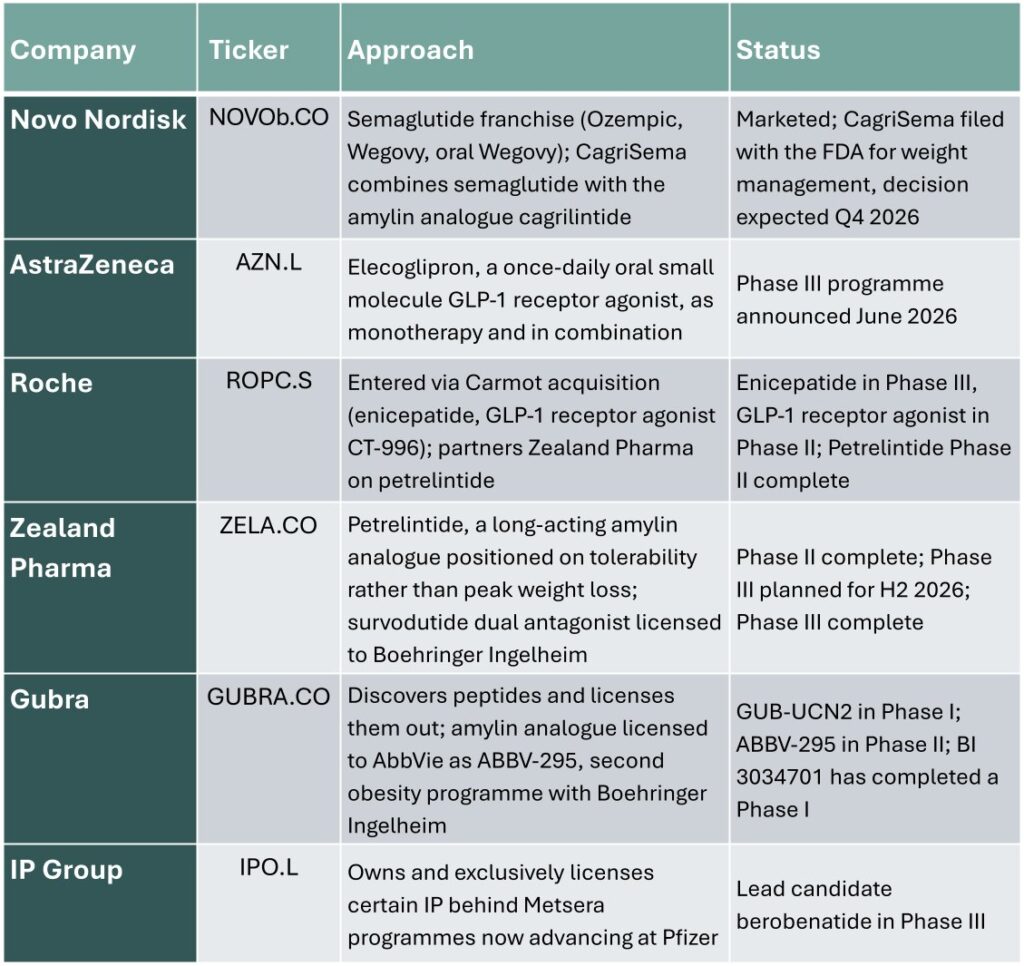
Europe hosts one of the two category leaders in Novo, several of the most differentiated next-generation developers and companies whose exposure is structured as intellectual property and royalties rather than equity in a marketed product.
Exhibit 1: Key European players in anti-obesity medicine development
Source: Company pipeline disclosures and announcements, Edison Investment Research. Note: development stages as at September 2026.
Why has the obesity market become such an active area for dealmaking?
Differentiation has proved easier to buy than to build. Eli Lilly acquired Versanis in 2023 for $1.9bn to secure the muscle-preserving antibody bimagrumab, Novo bought Inversago for $1bn the same year for an oral candidate with a different mechanism and Roche paid $2.7bn for Carmot’s incretin assets in December 2023.
Pfizer’s acquisition of Metsera in November 2025 for up to $10bn was the largest of the cycle, and, according to JP Morgan, it won a bidding process against seven other companies. Having discontinued its own weight-loss pill, danuglipron, in April 2025 over safety concerns in clinical trials, Pfizer described what it was buying as highly differentiated clinical-stage candidates offering weekly, monthly and even quarterly injectable treatment options. That distinction matters more than it first appears as these medicines are taken indefinitely, and many patients stop within the first year, the injection schedule is not a convenience detail but one of the factors determining whether treatment lasts long enough to work. Metsera’s lead candidate, berobenatide, is a long-acting GLP-1 designed to deliver effective weight loss with fewer injections than current weekly treatments, and Pfizer reported in June 2026 that Phase II data supported its potential as a once-monthly option, with relatively low rates of gastrointestinal side effects and discontinuation. A follow-on prodrug now in Phase I could extend that to quarterly maintenance dosing.
IP Group offers an unusual second-order exposure
What is less widely understood is that value in these transactions does not accrue only to the shareholders of the company being bought. When Pfizer acquired Metsera, it acquired the drug programmes, but the intellectual property behind key parts of that pipeline is owned by the London-listed IP Group and exclusively licensed to Zihipp, a business Metsera had acquired in 2023. IP Group’s exposure is therefore a low single-digit royalty, mostly payable in the 2030s, alongside milestones and an earnout related to Zihipp if the drug passes through clinical trials and is successfully commercialised. For IP Group, the opportunity is therefore more than participation in a large market. It is exposure to a programme designed to address some of the market’s most important remaining gaps, particularly dosing convenience and the need for differentiated long-term obesity management.
IP Group’s own valuation assumes a 2028 launch for berobenatide, a 53% probability of success and peak annual sales of $3.5bn, with aggregate peak sales across the Metsera-derived programmes of $8.3bn. On those assumptions, a single year’s royalty at 1% of net sales would be equivalent to roughly 10% of IP Group’s current market capitalisation. The exposure is already revaluing as the science progresses, and it has been a major source of recent net asset value growth. The advancement of the berobenatide and amylin combination into Phase IIb in May 2026 delivered a £27m uplift, taking the carrying value of the Pfizer obesity royalty to £152m at 30 June 2026, or c 15% of IP Group’s net asset value.
What are the risks in second-order exposure?
Almost everything discussed beyond the marketed products is pre-commercial, and outcomes in this field are binary. Valuations clearly therefore rest on estimates of launch dates, probabilities of success and peak sales, and in IP Group’s case those estimates are management’s own estimates. Regulatory approval is not assured and there can be no guarantee that royalties will be received. Royalty structures also push cash flows a long way out, which makes present value unusually sensitive to timing and discount rates. Smaller developers carry a further layer of risk, since part of their valuation reflects the possibility of an acquisition that is not within their control.
Economics could still constrain the size of the market
The pharmaceutical sector has become increasingly dependent on the expected value of anti-obesity medicines. According to Deloitte, they accounted for c 25% of the forecast value of the late-stage drug pipeline in 2025, up from just 1% in 2022 and surpassing oncology as the largest contributor. Deloitte also estimates that the sector’s late-stage internal rate of return would fall from 7.0% to 2.9% if drugs targeting GLP-1/GIP were excluded. This concentration creates a broader sector risk: a significant safety concern or an unexpected fall in weight-loss drug prices could materially reduce expected returns across the pharmaceutical industry.
Affordability and reimbursement may also limit how widely these medicines are used. Two working papers summarised by the National Bureau of Economic Research in April 2026 found no reduction in total healthcare spending after patients started treatment. Spending on care other than GLP-1 drugs increased, and only c 56% of patients were still receiving these medicines after 12 months. This challenges a central argument for broad insurance coverage: that the cost of treating obesity today will be offset by lower spending on related diseases in the future. Unless those savings become visible in the data, payers may be reluctant to expand access, weakening the patient-volume assumptions underpinning the larger market forecasts. The US Congressional Budget Office estimates that authorising Medicare coverage of anti-obesity medicines would add c $35bn to US federal spending between 2026 and 2034, because the near-term cost of treatment would substantially exceed the resulting healthcare savings.
What should investors watch next?
Investors should look out for four things. First, dosing-interval data, in particular whether patients prove to prefer a monthly (or even less frequent) injection to a daily pill. Second, oral market share, since Goldman Sachs Research now expects oral treatments to account for roughly 40% of the 2030 global market. Third, reimbursement decisions, including NICE’s assessment of Foundayo in the UK and the pace of Medicare coverage expansion in the US. Fourth, body composition, because the first therapy to deliver comparable weight loss while preserving lean mass would reset the competitive hierarchy in a way that incremental potency no longer does.
Edison Insight
The anti-obesity market has moved past the question of whether these drugs work. Novo and Eli Lilly are likely to retain the bulk of the market for now, but the more interesting question for investors is where the remaining value sits. Competition has shifted to the gaps the market leaders have not yet addressed: tolerability, dosing convenience, body composition and the indications current treatments do not serve. That is why the field has become one of the most active in pharmaceutical dealmaking, and why exposure can now be found in unexpected places. IP Group is the clearest UK example, holding a royalty and milestone interest in the Metsera-derived pipeline that Pfizer is advancing, while its shares trade at a substantial discount to the group’s own net asset value. That exposure depends on outcomes that remain unproven, but it is exposure to precisely the gaps the market has yet to close.
Megatrends: Healthcare innovation
*IP Groupis a client of Edison Investment Research.