Last close As at 05/08/2026
GBP2.61
▲ −0.50 (−0.19%)
Market capitalisation
GBP597m
Research: Investment Companies
Henderson Far East Income (HFEL) has consistently delivered on its objective to provide a rising dividend. However, like many investors, HFEL’s managers overestimated the potential for a post-pandemic rebound in China. The trust’s resultant overweight to Chinese consumer and other cyclicals led to a fall in portfolio revenues and underperformance in the financial year ended 31 August 2023 (FY23). With a view to improving future returns, HFEL’s board has since indicated an increased willingness to use reserves when necessary to support dividend payments, which it did in FY23. This reduces the requirement to focus primarily on high income names to fund dividend payments, giving lead manager Sat Duhra scope to move into other areas of the market where he can acquire well-priced value names offering performance and yield, or the prospect of dividend growth over time. Duhra has been quick to reduce the trust’s exposure to China and increase positions into well-priced value names in India and Indonesia. Early signs suggest this repositioning is paying off – HFEL outperformed the market in the six months to end March 2024.
Henderson Far East Income |
Repositioning to raise total returns |
Investment trusts |
25 April 2024 |
Analyst
|
||||||||||||||||||||||||||||||||||||||||||||||||||||||||||||||||||||||||||||||||||||||||||||||||||||||||||||||||||||||||||||||
Henderson Far East Income (HFEL) has consistently delivered on its objective to provide a rising dividend. However, like many investors, HFEL’s managers overestimated the potential for a post-pandemic rebound in China. The trust’s resultant overweight to Chinese consumer and other cyclicals led to a fall in portfolio revenues and underperformance in the financial year ended 31 August 2023 (FY23). With a view to improving future returns, HFEL’s board has since indicated an increased willingness to use reserves when necessary to support dividend payments, which it did in FY23. This reduces the requirement to focus primarily on high income names to fund dividend payments, giving lead manager Sat Duhra scope to move into other areas of the market where he can acquire well-priced value names offering performance and yield, or the prospect of dividend growth over time. Duhra has been quick to reduce the trust’s exposure to China and increase positions into well-priced value names in India and Indonesia. Early signs suggest this repositioning is paying off - HFEL outperformed the market in the six months to end March 2024.
|
Time for a change – NAV performance relative to market (one year) |
|
|
Source: HFEL, Edison Investment Research |
The analyst’s view
■
The board’s commitment to supporting the manager through the use of revenue reserves should be welcomed.
■
The manager is positive about the portfolio’s revenue prospects, as Asian dividend payouts are rising.
■
HFEL’s shares are currently trading at a premium of 1.5%, not far from their long-term average premium of 2%. Further improvement in total returns resulting from recent portfolio changes should provide continued support for HFEL’s shares.
HFEL: Targeting a rising dividend and capital returns
A diverse portfolio of Asia-Pacific stocks
Henderson Far East Income (HFEL) is an income-focused Asian investment trust, which aims to provide shareholders with growing total annual dividends and capital appreciation from a diverse portfolio of Asia-Pacific equities. The strategy has no country or sector bias and no formal benchmark.
Until recently, HFEL was managed jointly by Mike Kerley and Sat Duhra. Kerley had managed the trust since 2007 and Duhra joined him as co-manager in 2019. However, with Kerley due to retire in June this year, Duhra has assumed responsibility for the trust’s management and he has overseen a repositioning of the company beginning in late 2023. Details of this re-positioning are discussed below. Duhra is also the lead manager of the JH Asian Dividend income strategy, a position he has held since January 2022. This adopts a similar strategy to HFEL’s and has outperformed its peers over the past one and three years.
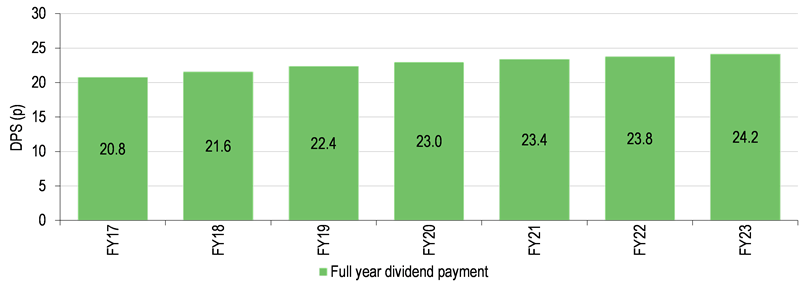
HFEL has consistently met its objective of providing a growing total annual dividend; the dividend has increased for 16 consecutive years. The total dividend of 24.2p paid for the financial year ending 31 August 2023 (FY23) was 1.7% higher than the dividend paid with respect to FY22. This represents a very attractive dividend yield of 10.5%, based on the current share price. This is well above the average dividend yield of the company’s peer group (Exhibit 3).
HFEL pays quarterly dividends in February, May, August and November. The first interim dividend in relation to FY24 was paid on 23 February 2024 and the second is due for payment on 31 May 2024. Consistent with the pattern of the previous four financial years, these two dividends will each be 6.1p per share, the same as the third and fourth interim dividends for FY23.
|
Exhibit 1: Dividend history since FY17 |
|
|
Source: Bloomberg, Edison Investment Research |
FY23 NAV performance hurt by positioning in China
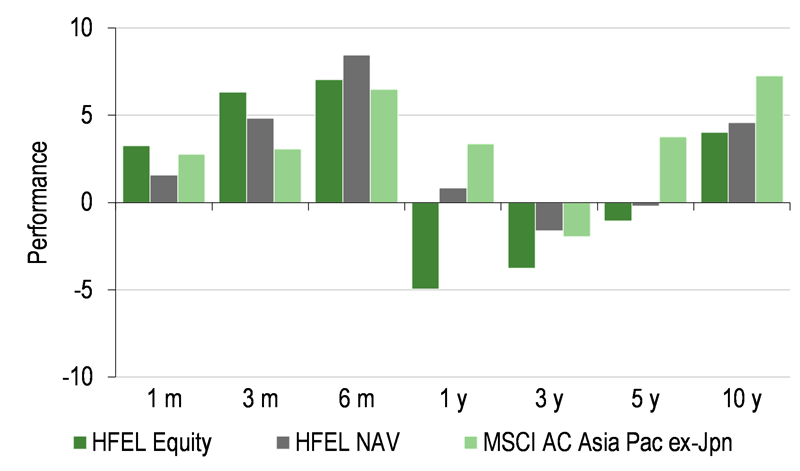
FY23 was a challenging year for HFEL from a capital growth perspective. During the year, the company’s NAV total return fell 13.0% (in GBP terms), while the share price total return was down 14.8%. This compares to a 0.1% increase in the MSCI All Country Asia Pacific ex Japan Index, which we use here as a market proxy for comparative purposes. This performance has dragged down longer-term performance. Over the three-year period to end March 2024, HFEL’s NAV declined by 1.6% on an average annual basis, although this compares favourably with an average annual decline of 2.0% in our market proxy index over the period. Returns have lagged those of HFEL’s closest peers over all periods shown in Exhibit 3.
|
Exhibit 2: HFEL’s performance to 31 March 2024 |
|
Price, NAV and index total return performance, one-year rebased |
Price, NAV and index total return performance (%) |
|
|
|
Source: Refinitiv, Edison Investment Research. Note: Three-, five- and 10-year performance figures annualised. |
|
Exhibit 3: AIC Asia Pacific Equity Income sector at 23 April 2024*
% unless stated |
Market |
NAV TR |
NAV TR |
NAV TR |
NAV TR |
Discount |
Ongoing |
Perf. |
Net |
Dividend |
Henderson Far East Income |
374.6 |
(0.7) |
(9.4) |
(5.0) |
50.9 |
1.5 |
0.97 |
No |
103 |
10.5 |
abrdn Asian Income Fund |
340.9 |
3.6 |
3.3 |
23.5 |
84.5 |
(11.0) |
0.98 |
No |
108 |
5.6 |
Invesco Asia |
201.3 |
(3.7) |
(6.6) |
28.6 |
151.6 |
(12.2) |
0.99 |
No |
104 |
4.6 |
JPMorgan Asia Growth & Income |
298.0 |
2.3 |
(10.4) |
15.4 |
137.4 |
(8.4) |
0.78 |
No |
99 |
4.5 |
Schroder Oriental Income |
629.9 |
4.4 |
5.5 |
28.7 |
126.8 |
(6.1) |
0.87 |
Yes |
105 |
4.6 |
Simple average (5 funds) |
368.9 |
1.2 |
(3.5) |
18.2 |
110.3 |
(6.5) |
0.92 |
104 |
6.0 |
|
HFEL rank in peer group |
2 |
4 |
4 |
5 |
5 |
1 |
3 |
4 |
1 |
|
MSCI AC Asia Pacific ex Japan |
3.6 |
(9.1) |
14.4 |
91.6 |
||||||
MSCI AC Asia Pacific ex Japan HDY |
10.1 |
16.7 |
25.1 |
89.7 |
Source: Morningstar, Edison Investment Research. Note: *Performance data to 22 April 2024 based on ex-par NAV. TR, total return. Net gearing is total assets less cash and equivalents as a percentage of net assets.
The main reason for this disappointing performance was the company’s positioning and stock selection in China. The trust has had a longstanding underweight to China, but the Chinese government’s sudden decision to lift all its very stringent covid restrictions in late 2022 led to widespread, and seemingly very realistic, expectations that the Chinese economy, especially consumer-facing and other cyclical sectors, would rebound sharply in response to the re-opening, just as other major economies had done. So, in early 2023, HFEL’s managers increased exposure to Chinese domestic consumer activity and other areas sensitive to macroeconomic developments, in anticipation of a strong re-opening rebound.
However, this widespread confidence in China’s recovery proved to be misguided. Chinese consumers remained subdued, mainly due to their ongoing concerns about the country’s ailing property sector, and the Chinese authorities’ apparent reluctance to support the housing market. Chinese cyclical stocks were most adversely impacted by the ensuing disappointment, and HFEL’s relative returns suffered accordingly.
While this exposure to China detracted from performance during FY23, other areas of the portfolio made positive contributions to returns over the period. These included positions in financial names Hana Financial group, a South Korean regional bank, Indonesia’s Bank Mandiri and Singapore’s United Overseas Bank. Several of the trust’s Australian holdings were also significant contributors, including mining companies BHP and Rio Tinto, oil and gas producer Woodside Energy, and Goodman Group, a diversified REIT. India’s NTPC, an electricity supplier, was another significant contributor, along with Hong Kong-listed computer hardware producer Lenovo, a leading personal computer brand, which is benefiting from rising demand for servers and the AI-led replacement cycle. Another Hong-Kong based name, luggage supplier Samsonite, was also added. This company has been seeing a strong post-pandemic recovery in demand, and the manager believed the stock offered good value, as it was trading at 11x forward earnings, despite projected earnings growth of 20% per annum for next few years, according to the company, and a dividend yield which the manager estimates will rise from zero to 6% within three years. Samsonite’s share price saw a further, sudden uptick in late February 2024 on reports of takeover interest, and the company itself is considering a dual listing to realise value.
Fall in portfolio revenues left FY23 dividend partially uncovered
In addition to putting downward pressure on the valuation of HFEL’s Chinese portfolio holdings, China’s unexpectedly insipid recovery also undermined the dividend-paying capacity of many of these companies. The trust’s revenue receipts were also detrimentally affected by the managers’ decision to sell some Chinese names in the last three months of the financial year, before these stocks paid dividends, to protect capital as the macro environment in China continued to disappoint. In all, lower dividend receipts, combined with sterling strength, reduced FY23 portfolio dividend revenue in GBP terms by 8.2%, compared to the previous year. This decline meant that HFEL’s FY23 dividend was partially augmented by reserves for only the second time in 10 years. (In FY21, the dividend was uncovered due to a higher number of shares in issue, sterling strength and a lower level of Asian dividend growth in 2020.)
A shift in emphasis to enhance total returns
HFEL’s FY23 performance prompted the board to take action to improve total returns, by delivering better capital growth, while also maintaining dividend growth over time. Specifically, to this end, the board has expressed an increased willingness to use reserves where necessary to support dividend payments. The company’s revenue reserve stood at £21.6m as at end August 2023, sufficient to cover more than half of the FY23 dividend payment, and distributable reserves totalled another £180.5m at end FY23.
This decision occurred at the same time that Duhra assumed lead responsibility for the management of HFEL’s portfolio and is intended to reduce the need to invest in high-income generating stocks, to fund dividend payments in any given year. This effectively gives Duhra greater flexibility to move into new areas of the market, where he can find well-priced value names which offer performance, strong cashflows and the prospect of future earnings and dividend growth, rather than being compelled to focus on stocks that already pay high dividends. This will allow the manager to effectively capture future earnings growth earlier in a company’s growth cycle, and to buy into this performance at better valuations than if he had to wait for rising dividend payouts to materialise.
Duhra has used this additional flexibility to make some significant changes to the portfolio since the end of FY23. Firstly, he has substantially reduced overall exposure to China, by selling high-income cyclical stocks, while taking advantage of depressed valuations in this market to acquire some higher-quality Chinese names where the current dividend yield is still relatively low, but the absolute dividend per share is growing. Purchases have been focused in areas, such as infrastructure, AI and robotics and growing domestic consumption – structural themes which the manager expects to drive equity markets over the long term. Duhra expects to continue identifying opportunities in these areas of the Chinese market, especially given current depressed valuations. The other key portfolio shift has been an increased exposure to similar structural growth trends playing out in India and Indonesia, where the manager believes there is less regulatory risk, fewer structural impediments and clearer growth paths than in China.
Recent performance has picked up
It is still too early to judge whether the manager’s portfolio changes are having their desired effect on performance. However, it is worth noting that, in the six months ended 31 March 2024, HFEL returned 8.5% on an NAV basis, well ahead of the market return of 6.5% (Exhibit 2 illustrates). This certainly suggests that the portfolio may now be on a sounder footing.
Exhibit 4: Five-year discrete performance data
12 months ending |
Share price |
NAV |
MSCI AC Asia Pac ex-Japan (%) |
MSCI AC Asia Pac ex-Japan HDY (%) |
CBOE UK All Cos (%) |
MSCI AC World (%) |
31/03/20 |
(15.4) |
(15.4) |
(10.7) |
(12.5) |
(19.1) |
(6.2) |
31/03/21 |
25.7 |
22.7 |
42.9 |
23.6 |
26.6 |
39.6 |
31/03/22 |
(2.4) |
2.6 |
(6.3) |
3.4 |
13.2 |
12.9 |
31/03/23 |
(3.9) |
(7.9) |
(2.7) |
0.1 |
3.8 |
(0.9) |
31/03/24 |
(5.0) |
0.9 |
3.4 |
9.9 |
8.4 |
21.2 |
Source: Refinitiv. Note: All % on a total return basis in pounds sterling.
Outlook for Asian dividend payouts is improving
As an added bonus, the dividend culture in South Korea, India, Indonesia and other Asian markets is also improving. Payout ratios for Asian companies are still low relative to other markets in general, and corporate managements have also been cautious, for fear of a US recession, despite record levels of cash, low debt, strong cashflows and falling capex. However, with fears of recession now abating, local currency dividends are expected to increase. Higher payout ratios should also be supported over the longer term by Asia’s superior growth prospects, compared to other regions. (The International Monetary Fund expects the region to grow at more than 5.0% in 2024, while growth in the advanced economies will struggle to exceed 2.0%.) As a result of these factors, HFEL’s manager expects future portfolio income to come increasingly from South Korea, India and Indonesia, as well as from Hong Kong, while the trust’s Chinese holdings are expected to contribute more to capital returns, as their earnings grow over time.
HFEL’s shares back in premium territory
HFEL’s shares have mainly traded at a small premium over the past 10 years. This situation changed during 2023. Consistent with the experience of many investment trusts across various strategies and markets over the past year or so, HFEL’s shares slipped into discount territory last year, as investment trust returns in general struggled to match the lower risk returns on offer in cash and bond markets. HFEL’s move into discount territory may have also reflected its poor performance on a total return basis. However, the trust’s shares have recently moved back into premium, perhaps thanks in part to the recent improvement in performance. HFEL is currently the only member of its AIC Asia Pacific peer group trading at a premium (Exhibit 3).
Current portfolio positioning
Increased exposure to India and Indonesia, while protecting income
The reduction in overall exposure to China can be seen from Exhibits 6 and 7 (which compare positioning at end March 2024 to positioning at the time of our last note). The manager has sold Chinese materials, financials and consumer companies and other stocks linked to the macroeconomic environment.
However, to gain exposure to structural themes such as AI, robotics and growing domestic consumption, the manager has acquired some high-quality Chinese names that also offer growing dividends, at attractive valuations. Acquisitions have included infrastructure companies Nari Technology, a provider of software and equipment for power grid upgrades, with higher renewable energy penetration. The manager has also topped up a holding in ANTA Sports, the largest Chinese domestic sportswear company, which also operates international brands in China, and Swire Properties, a leading shopping mall operator in China and Hong Kong.
Exhibit 5: Portfolio geographic changes and active weights (% unless stated)
Portfolio end- |
Portfolio end- |
Change |
Active weight vs Asia Pac ex-Jap index (pp) |
|
South Korea |
16.7 |
14.2 |
2.5 |
5.0 |
Australia |
15.8 |
16.3 |
(0.5) |
(0.9) |
Taiwan |
14.4 |
8.0 |
6.4 |
(1.8) |
China |
14.3 |
23.4 |
(9.1) |
(9.2) |
Hong Kong |
11.0 |
9.5 |
1.5 |
6.6 |
India |
10.1 |
4.1 |
6.0 |
(8.4) |
Singapore |
7.6 |
9.0 |
(1.4) |
4.9 |
Indonesia |
7.5 |
6.5 |
1.0 |
5.7 |
Vietnam |
2.5 |
3.0 |
(0.5) |
N/A |
Other |
16.8 |
N/A |
N/A |
N/A |
Total |
100.0 |
100.0 |
Source: HFEL, Edison Investment Research. Note: N/A is not stated separately. Numbers subject to rounding.
The fall in HFEL’s China exposure has been matched by an almost equally significant increase in exposure to India, which has served to reduce the trust’s underweight to this market. The manager does not share the widely held view that it is ‘too late’ to buy India. In his opinion, the strength of Indian indices is narrowly based, driven by only a few companies. He sees many other dividend-paying names that were struggling until recently due to India’s poor economic performance but are doing much better and offering good value now that the Indian economy is improving. Duhra cites several factors as evidence of this improvement, including rising private capital expenditure, major government-funded expansions to road networks and airports, and power generation, including renewable energy, more efficient tax collection, a banking sector clean-up that has boosted margins and some strengthening in the real estate sector.
Acquisitions in this market have centred on technology stocks. In October, the manager bought two IT services companies, Infosys and HCL Technologies, which he describes as defensive high-quality stocks with the ability to grow dividends. The manager is also pleased with the performance of holdings in several Indian companies including oil and gas refiner BPCL, whose share price has risen sharply thanks to earnings upgrades. This stock is on track to pay 8–9% dividend yield. Positions in two Indian utility companies, NTPC and Power Grid have also done well. Duhra says these are examples of value in a generally expensive market. Both were purchased at around 9x earnings, provide good yields and have made very strong gains in recent months. They have the further advantage of providing exposure to India’s transition to renewable energy.
As a further example of his efforts to find value in this market, the manager waited for the chance to purchase India’s star bank, HDFC, at an attractive level. His opportunity came when investor caution related to the bank’s merger with its finance arm saw the stock’s price/book valuation decline to 2.0x, down from its usual 3.5–4.0x. This holding provides HFEL with exposure to growth in mortgages and domestic credit at around half its previous price.
Exposure to Indonesia has also increased, as mentioned above, albeit to a lesser extent, adding to the significant overweight position in this market, where the manager believes the growth outlook is supported by heavy public investment in infrastructure such as ports and an improving balance of trade. An existing holding in Indonesian Bank Mandiri has been doing well, and the manager has recently added a position in its competitor, Bank Negara, on the view that banks will continue to benefit as the country’s improving economic fundamentals and the rising penetration of banking services support loan growth, margins and dividend payouts. HFEL’s overweights to Hong Kong and South Korea has also increased, and exposure to Taiwan has risen due to an increase in tech names, reducing the trust’s underweight to this market.
|
Exhibit 6: HFEL geographic exposure versus Asia Pacific ex-Japan Index, end March 2024 |
|
|
Source: HFEL, Edison Investment Research |
At the sector level, while exposure to tech has remained stable, changes include modest falls in exposure to consumer discretionary and financials. Holdings in basic material and energy increased.
HFEL is permitted to use gearing up to 30% of gross assets. The company has a £50m multicurrency bank loan facility with SMBC Bank International, which expires in August 2024. This facility, if fully drawn down, would only account for a maximum of 15% of current gross assets. The current level of gearing is 3.0% (as at 31 March 2024).
Exhibit 7: Portfolio sector changes and active weights (% unless stated)
Portfolio end- |
Portfolio end- |
Change |
Active weight vs Asia Pac ex-Jap index (pp) |
|
Financials |
30.5 |
31.4 |
(0.8) |
8.5 |
Real estate |
13.5 |
13.5 |
0.0 |
9.9 |
Basic materials |
10.6 |
9.0 |
1.6 |
4.0 |
Telecoms |
10.4 |
10.3 |
0.1 |
3.8 |
Technology |
9.7 |
10.1 |
(0.4) |
(12.9) |
Energy |
9.0 |
8.0 |
1.0 |
4.1 |
Consumer discretionary |
8.7 |
10.3 |
(1.6) |
(3.3) |
Utilities |
4.3 |
4.5 |
(0.2) |
1.3 |
Industrials |
3.2 |
3.0 |
0.2 |
(6.1) |
Consumer staples |
0.0 |
0.0 |
0.0 |
(4.5) |
Healthcare |
0.0 |
0.0 |
0.0 |
(4.9) |
Total |
100.0 |
100.0 |
Source: HFEL, Edison Investment Research. Note: Numbers subject to rounding.
|
Exhibit 8: HFEL sector exposure versus Asia Pacific ex-Japan Index, end March 2024 |
|
|
Source: HFEL, Edison Investment Research |
Exhibit 9: Top 10 holdings (at 31 March 2024)
Company |
Country |
Sector |
Portfolio weight % |
|
31 Jan 2024 |
31 Jan 2023* |
|||
Taiwan Semiconductor Manufacturing |
Taiwan |
Technology |
5.4 |
3.5 |
Samsung Electronics |
Vietnam |
Financials |
4.6 |
3.8 |
Swire Properties |
Hong Kong |
Real Estate |
3.9 |
N/A |
DB Insurance |
South Korea |
Insurance |
3.4 |
N/A |
Midea Group |
China |
Home appliances |
3.3 |
N/A |
Bank Mandiri Persero |
Indonesia |
Financials |
3.0 |
3.4 |
Media Tek |
Taiwan |
Semiconductors |
3.0 |
N/A |
United Overseas Bank |
Singapore |
Financials |
2.8 |
3.3 |
ANTA Sports Products |
China |
Sportswear |
2.7 |
N/A |
Samsung Fire & Marine Insurance |
South Korea |
Insurance |
2.7 |
N/A |
Top 10 (% of holdings) |
34.8 |
34.3 |
||
Source: HFEL, Edison Investment Research. Note: *N/A where not in end-March 2023 top 10.
Investment process
HFEL comprises c 40–60 stocks from across the Asia-Pacific region. The manager seeks cash-generative companies with good growth prospects that are trading at attractive valuations given the expected cash flows. He then looks to blend holdings within the portfolio that have a high starting yield with those offering superior dividend growth prospects, and capital growth, with the aim of providing an attractive total return.
Duhra, who works out of Janus Henderson’s Singapore regional hub, along with the analysts who support him, meets frequently with companies around the Asia-Pacific region and uses industry research and quantitative screening to help identify companies with high yields and/or high dividend growth prospects. He seeks to understand the business drivers and key risks of potential investee companies, and build proprietary models focusing on cash flow generation, to establish a target price range.
HFEL’s portfolio mainly comprises companies that have a market capitalisation of at least $1bn, with a bias towards mid-cap ($3–10bn) stocks and a tendency to be underweight mega-caps, which can be expensive owing to their high profile in indices and may not pay dividends. The trust generally does not buy non-yielding companies (where the absence of a dividend policy can make forecasting difficult), although some holdings may have relatively low yields of 1–2%.
The resultant portfolio sits some way between the MSCI Asia Pacific ex-Japan and High Dividend Yield (HDY) indices in terms of valuation on P/B and P/E measures, but has estimated dividend per share growth ahead of both indices and earnings per share growth comfortably ahead of the HDY Index and in line with the Asia Pacific ex-Japan Index, a combination that should be able to perform if either growth or value factors are in favour.
HFEL’s approach to ESG
HFEL’s manager focuses on engaging with the management of portfolio companies to promote the benefits for all stakeholders of doing the right thing for the environment and society and in the interests of good governance. HFEL is managed in accordance with Janus Henderson’s corporate ESG principles. To quote from the firm’s literature, ‘We believe there is a strong link between sustainability issues and the companies that will grow and succeed going forward. This applies to us as an organisation and to the companies our investment teams actively engage with in their pursuit of long-term returns for our clients.’ The firm has a corporate ESG policy group, below which sits an ESG advisory group focusing mainly on internal issues, while the ESG investment oversight group ensures principles of sustainability are embedded and adhered to within investment teams.
The manager does not exclude any sector from HFEL on ESG grounds, except munitions. When considering how a company reaches the trust’s long-term ESG goals, the transition is just as important for him as the destination. He wants to invest in companies that are improving the environment, whether they are producing oil or electronics, and he targets best-of-breed businesses generating benefits not just for shareholders but also for other stakeholders and the wider community. There is a constant process of engagement with companies to ensure they keep to their ESG targets, particularly in environmental terms. Governance has always gone hand in hand with an income strategy, because dividends are tangible evidence of good corporate governance.
Many Asian nations are understandably behind western economies in terms of tackling environmental degradation, given they are still undergoing rapid industrialisation.
Fees and charges
Since September 2021, the trust has paid its alternative investment manager, Janus Henderson Fund Management UK, a flat annual management fee of 0.75% on net assets, replacing the previous arrangements of 0.90% of net assets up to £400m and 0.75% thereafter, with no performance fee payable. Ongoing charges for FY23 were 0.97% (FY22: 1.01%). Management fees and other expenses are equally levied against capital and revenue.
Capital structure
HFEL was set up as a London-listed but Jersey-based, closed-end investment company in 2006 and, while it retains its Jersey domicile, during FY19 it moved its tax residence to the UK and joined the investment trust regime.
The company, which has a single share class, has been active in issuing shares when able to do so and there were 163m ordinary shares in issue on 30 November 2023, an increase of 6.6m over the preceding 12 months. However, issuance ceased in FY23 when the trust’s share price moved into discount territory, and the company has since begun buying back shares, purchasing a total of 0.8m so far this financial year.
In Exhibit 11 we list the trust’s largest 5 shareholders, with almost 50% held via retail investor platforms (Hargreaves Lansdown, Halifax Share Dealing and Interactive Investor). This speaks to the attractiveness of the proposition for income-seeking investors and may be one factor keeping HFEL’s share price in premium territory most of the time.
|
Exhibit 10: Major shareholders |
Exhibit 11: Average daily volume |
|
|
|
Source: Bloomberg, at 1 February 2024. |
Source: Refinitiv. Note 12 months to 4 March 2024. |
|
Exhibit 10: Major shareholders |
|
|
Source: Bloomberg, at 1 February 2024. |
|
Exhibit 11: Average daily volume |
|
|
Source: Refinitiv. Note 12 months to 4 March 2024. |
Board
Exhibit 12: Henderson Far East Income’s board of directors
Board member |
Date of appointment |
Remuneration at end FY23, £ |
Shareholdings at end FY23 |
Ronald Gould (chairman) |
October 2021 |
40,950 |
31,324 |
Julia Chapman |
January 2015 |
31,000 |
2,616 |
Timothy Clissold |
September 2018 |
31,000 |
80,000 |
Nicholas George (audit chair) |
April 2016 |
35,700 |
47,550 |
David Mashiter* |
November 2006 |
31,000 |
5,000 |
Susie Rippingall |
December 2023 |
N/A |
N/A |
Carole Ferguson |
December 2023 |
N/A |
N/A |
Source: Henderson Far East Income. Note: * Retired from the board at the AGM held on 24 January 2024.
|
|
Research: TMT
Freelancer’s Q124 results were mixed. Operationally, the company is seeing rising demand for AI specialists as customers seek affordable ways to develop proprietary AI. Notably, in Enterprise, the company delivered a large-scale AI pilot for a tech giant, sourcing 20,000 freelancers in 24 hours across 52 languages. This impressive achievement could lead to a substantial multi-year contract. Major initiatives across Loadshift and Escrow with leading organisations are set to be deployed over the coming months, potentially catalysing performance and diversifying revenue streams. We revise our forecasts to account for a weaker Q1 than anticipated, though positive lead indicators, especially relating to AI, underscore long-term optimism.