Last close As at 05/08/2026
—
— 0.00 (0.00%)
Market capitalisation
—
Research: Investment Companies
The Brunner Investment Trust (BUT) is managed by Matthew Tillett at Allianz Global Investors (AllianzGI), along with deputy managers Christian Schneider and Marcus Morris-Eyton. Tillett is confident that the trust’s shares can trade at a narrower discount to NAV following the exit of a major shareholder, which had acted as an overhang since 2016. He suggests that ‘now is a great opportunity to buy a solid reliable trust that has delivered good performance over the long term’. The manager says that BUT has a ‘philosophy and process that is tried and tested’ with the fund offering investors ‘high quality, large, liquid companies at attractive valuations’. He believes that the trust is well positioned to benefit in an environment where investors place a greater emphasis on the quality and strength of company fundamentals.
The Brunner Investment Trust |
Overhang lifted – potential for a narrower discount |
Investment trusts |
10 May 2021 |
Analysts
|
||||||||||||||||||||||||||||||||||||||||||||||||||||||
The Brunner Investment Trust (BUT) is managed by Matthew Tillett at Allianz Global Investors (AllianzGI), along with deputy managers Christian Schneider and Marcus Morris-Eyton. Tillett is confident that the trust’s shares can trade at a narrower discount to NAV following the exit of a major shareholder, which had acted as an overhang since 2016. He suggests that ‘now is a great opportunity to buy a solid reliable trust that has delivered good performance over the long term’. The manager says that BUT has a ‘philosophy and process that is tried and tested’ with the fund offering investors ‘high quality, large, liquid companies at attractive valuations’. He believes that the trust is well positioned to benefit in an environment where investors place a greater emphasis on the quality and strength of company fundamentals.
|
Exit of major shareholder provides scope for a narrower discount |
|
|
Source: Refinitiv, Edison Investment Research |
Why consider BUT now?
Aviva’s 2016 announcement of its intention to sell its c 20% holding in BUT has been an overhang to the trust’s share price performance in recent years. The last part of Aviva’s position was sold in April 2021, suggesting that BUT has the potential to trade at a narrower discount going forward. Another historical concern for potential investors was the trust’s high-cost debentures, but its balance sheet has been restructured; the expensive debentures were repaid in 2018.
The analyst’s view
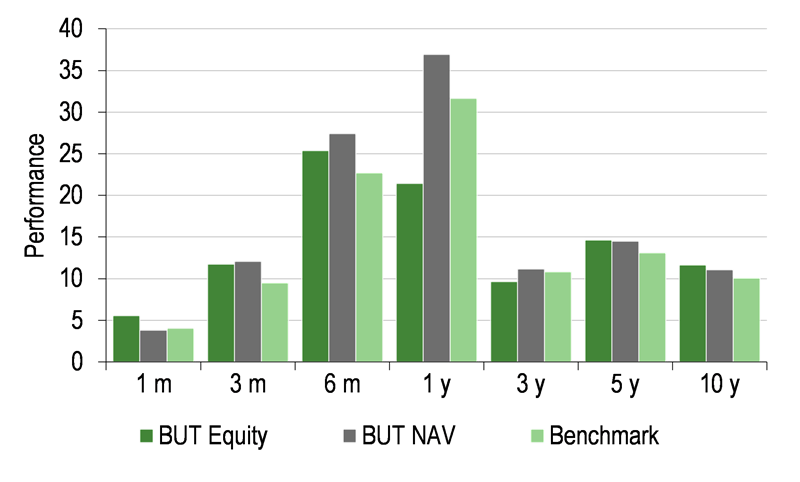
BUT offers a balanced portfolio of high-quality, global equities with the prospects of both capital appreciation and income growth. The trust has a long-term record of outperformance – its NAV total returns are ahead of those of the composite benchmark over the last one, three, five and 10 years – and has generated absolute annualised double-digit NAV and share price total returns over the last decade. BUT could appeal to income-focused investors. It is one of the UK investment trusts with a very long-term record of dividend growth and has paid a higher annual distribution in each of the last 49 consecutive years. AllianzGI has a well-defined investment approach, with stocks selected on a bottom-up basis based on three pillars of quality, growth and valuation, and an assessment of a company’s environmental, social and governance (ESG) credentials is an integral part of the process.
Scope for a narrower discount
Ever since Aviva’s acquisition of Friends Provident in 2015, investors have known that the company intended to dispose of its investment trust holdings. For BUT, where Aviva had a 20% stake, this meant a widening of the discount to c 20% at the time (Exhibit 1). BUT’s discount subsequently narrowed, before widening during the COVID-led market weakness in March 2020. Aviva started selling its holding in the trust in earnest in early 2020 and by the end of the year it had declined to 14.3%; the final disposal occurred in April 2021. The removal of this overhang suggests that there is considerable scope for BUT to be afforded a higher valuation.
Over the last few years, retail investors have migrated towards investment platforms such as Hargreaves Lansdown, and they have less of a focus on discounts than private client wealth managers. The last five years have seen the percentage of BUT’s stablemate The Merchants Trust’s shares held on platforms increase from c 20% to more than 50% and the trust now regularly trades around NAV. BUT’s board aspires for a similar platform ownership (currently just above 20%) and a narrower discount. For potential investors concerned about liquidity, while the Brunner family owns c 29% of BUT’s shares, there are multiple owners, some of whom trade their shares.
|
Exhibit 1: Share price premium/discount to NAV (including income) over 10 years (%) |
|
|
Source: Refinitiv, Edison Investment Research |
The manager’s view: BUT well positioned for the future
Discussing the investment backdrop, Tillett says there has been a rotation within the stock market with a strong recovery in the cyclical areas and in the shares of those companies that had been negatively affected by COVID-19. News about positive trial data in early-November 2020 followed by the vaccine roll-out has been supportive for the market. The manager notes that ‘data from early adopting countries such as Israel and the UK have been encouraging in terms of keeping people out of hospital’. The stock market is forward looking and is anticipating an economic recovery. Tillett comments that there is likely to be a release of huge pent-up demand as economies reopen as many middle-class, white-collar workers have built up their savings during the lockdowns; he suggests that ‘the consumer is in a good position coming out of the recession, which is unusual, while many businesses that were not negatively affected by the pandemic are also in good shape’.
|
Exhibit 1: Interview with Matthew Tillett, lead portfolio manager |
|
|
Source: Edison Investment Research |
In terms of the economic environment, both monetary and fiscal policies are supportive, unlike following the global financial crisis when the focus was on monetary stimulus. As examples, there is a very large infrastructure spending agenda in the US and there is little appetite for austerity in the UK. Stock markets are optimistic about the potential for economic recovery; Tillett does not disagree with this view – barring catastrophic coronavirus variants or evidence that the vaccines are ineffective, he expects the recovery to play out over the next six to 12 months.
With the market pricing in economic recovery, particularly in those sectors that are poised to benefit, the manager stresses the importance of having a longer-term perspective. He suggests that an important question to consider for 2022–25 is ‘will the recovery be sustained, or will the backdrop be similar to pre-COVID in terms of a low growth, stop-start economy?’ Tillett believes that companies delivering disappointing results will be heavily punished by the market; we are annualising the ‘free pass’ that businesses were given due to the pandemic’s extenuating circumstances. He considers that quality will be a more important factor; ‘those companies that can deliver and sustain their profitability should be rewarded – growth at a reasonable price is likely to become a more important strategy’, he adds. Tillett continues to seek companies that are ‘long-term structural winners’. He believes that the excitement of the last three months about the prospect of getting back to normal will pass and that long-term fundamentals will become more important. He suggests that ‘this plays to our advantage, with our focus on quality companies with long-term growth drivers’.
The manager says that the issue of inflation needs to be considered in both the short and long term. In 2021, he expects higher inflation data points due to easy year-on-year comparisons. There are signs of significant input cost inflation in commodities and other raw materials, which individual companies view as a risk factor. Quality companies with a strong market position and pricing power are best placed to deal with this environment as they can pass on higher costs to their customers, while other firms are likely to see their margins come under pressure. Tillett notes that ‘there are some companies in the portfolio that are experiencing cost pressures, but they should be able to pass them on’. The manager explains that there has been a secular change over the last 30 years, a period characterised by deflation and declining interest rates. He suggests there is a case now for more upward pressure on inflation compared with the last decade as the policy environment favours fiscal as well as monetary stimulus. As noted above, consumers are in a strong position, as are banks, so their balance sheets do not need to be repaired (unlike following the global financial crisis) and there is room for credit creation. Tillett comments that there is now less of a deflationary pull due to globalisation; the number of companies moving their operations to China and other lower-cost areas (labour arbitrage) is now less pronounced and there has been reshoring back to the US and Europe for both geopolitical issues and economic factors. While there are other deflationary trends in place such as less demand from an ageing population in the west and ongoing digitalisation, which is increasing transparency and lowering prices, on a net-for-net basis the manager believes that we are now in a less deflationary environment.
Tillett is encouraged to report that in recent months the trajectory of dividend payments in BUT’s portfolio has been positive; cyclical companies which cut their distributions due to COVID-19 are generally restoring payments faster than anticipated. He notes that with economic recovery firms are more confident about reinstating their dividends. Many businesses have found ways to cope with restrictions during the pandemic such as in the housing and construction sectors and have been able to deal with social distancing measures. ‘Companies have returned to pre-COVID levels of trading faster than expected’, the manager concludes.
Recent portfolio activity
While BUT’s holdings are always selected on a stock-by-stock basis, Tillett notes that in recent months ‘boring’ parts of the stock market not viewed as beneficiaries of a cyclical tailwind have lagged. He says this includes the healthcare sector ‘where there are many high-quality business models, companies have pricing power and there is long-term demand growth due to ageing populations’. These stocks fared well during the first phase of the COVID-19 outbreak but have since de-rated. Although there are no new healthcare positions in BUT’s portfolio, the manager has increased the trust’s exposure to the sector including adding to the holding in Denmark-listed Novo Nordisk, which is a leader in diabetes care. Tillett also suggests that the consumer staples sector is another unloved area and is now looking more attractively valued.
The manager has added to BUT’s position in the regulated utility company National Grid, which he describes as ‘very defensive and out of favour’. It is a beneficiary of the energy transition from fossil fuels to renewable energy in both the UK and the US, but Tillett believes this is not fully appreciated by investors. National Grid’s stock price had been held back by a regulatory review, but this has now passed. The manager believes there is good five-year visibility in National Grid’s business and that its asset base can grow faster than consensus expectations. He also added to BUT’s position in IG Group; the company posted positive results but announced the acquisition of tastytrade which was viewed negatively by investors. This firm is a high-growth US online brokerage and trading education platform with a leading position in US-listed derivatives, primarily options and futures. A Grassroots (Allianz Global Investors’ proprietary market research platform) investigation was undertaken to determine how tastytrade stacked up against its competitors; this gave the manager confidence to add to the IG Group holding.
BUT has a new position in US payments company FleetCor Technologies, which operates a closed-loop network serving businesses rather than consumers. Its products include fuel and lodging cards used by truckers and travelling salesmen. Tillett says FleetCor has significant growth potential as B2B payments systems have not experienced the same level of innovation as those servicing consumers. There is plenty of scope to add value for the customer; employee payments can be monitored and there is less chance of fraud, while it provides the potential for firms to manage their working capital more efficiently. The manager says that since FleetCor’s initial public offering in 2010, it has grown its annual earnings at a high-teens rate, and he was able to initiate a position as the company’s share price weakened on concerns about its business being negatively affected by the COVID-19 outbreak. BUT’s position in FleetCor was funded by the sale of its holding in Citigroup. Tillett explains that the bank is very dependent on the yield curve in terms of generating spread income, which is not under its control, while in the US, unlike its domestic peers, Citigroup does not have the local scale to generate higher returns. Its share price rallied during the recent stock market rotation providing an attractive exit point.
Performance: Long-term NAV outperformance
Exhibit 3: Five-year discrete performance data
12 months ending |
Share price |
NAV* |
Benchmark** |
CBOE UK All Companies (%) |
MSCI All World exUK (%) |
30/04/17 |
29.1 |
29.3 |
26.1 |
20.3 |
31.8 |
30/04/18 |
16.4 |
10.9 |
8.0 |
8.1 |
7.8 |
30/04/19 |
4.1 |
6.5 |
9.3 |
2.5 |
12.1 |
30/04/20 |
4.2 |
(5.8) |
(5.4) |
(17.2) |
(0.3) |
30/04/21 |
21.4 |
36.9 |
31.7 |
25.3 |
33.9 |
Source: Refinitiv. Note: All % on a total return basis in pounds sterling. *NAV with debt at market value. **Until 21 March 2017, benchmark was 50% All-Share and 50% All-World ex-UK index. From 22 March 2017, benchmark is 70% All-World ex-UK and 30% All-Share index.
Exhibit 4: Share price and NAV total return performance, relative to indices (%)
|
One month |
Three months |
Six months |
One year |
Three years |
Five years |
10 years |
Price relative to benchmark |
1.5 |
2.0 |
2.2 |
(7.8) |
(3.2) |
6.9 |
15.3 |
NAV relative to benchmark |
(0.2) |
2.3 |
3.8 |
4.0 |
1.0 |
6.3 |
9.4 |
Price relative to CBOE UK All Companies |
1.6 |
0.8 |
(3.0) |
(3.1) |
23.9 |
43.2 |
66.4 |
NAV relative to CBOE UK All Companies |
(0.1) |
1.1 |
(1.4) |
9.3 |
29.2 |
42.5 |
57.9 |
Price relative to MSCI All World ex-UK |
1.4 |
2.7 |
4.7 |
(9.3) |
(11.9) |
(6.9) |
(5.1) |
NAV relative to MSCI All World ex-UK |
(0.2) |
3.0 |
6.4 |
2.3 |
(8.2) |
(7.4) |
(9.9) |
Source: Refinitiv, Edison Investment Research. Note: Data to end-April 2021. Geometric calculation.
BUT’s relative returns are shown in Exhibit 4. Its NAV is ahead of the benchmark over all periods shown (except for the last month), while its share price is lagging over the last one and three years. Tillett explains that the trust’s relative performance in 2021 has benefited from its holdings in mid-cap UK cyclical names such as Tyman (engineered door and window components) and Redrow (house building), along with higher-growth companies such as Estée Lauder Companies (prestige cosmetics). Holdings that have detracted from BUT’s relative performance this year include those in more defensive sectors including healthcare.
|
Exhibit 5: Investment trust performance to 30 April 2021 |
||
Price, NAV and benchmark total return performance, one-year rebased |
Price, NAV and benchmark total return performance (%) |
|
|
|
|
|
Source: Refinitiv, Edison Investment Research. Note: Three-, five- and 10-year performance figures annualised. |
||
|
Exhibit 6: NAV total return performance relative to benchmark over three years |
||
|
||
|
Source: Refinitiv, Edison Investment Research |
||
Peer group comparison
Exhibit 7 shows the 15 companies in the AIC Global sector. Tillett suggests that a direct comparison between the funds is not easy given the wide range of market caps and the different strategies employed. BUT has a balanced approach aiming to generate both capital and income growth, while its quality bias means there is more of a focus on ‘defensive growth rather than super growth’. The trust may benefit if investors become more cautious about unlisted investments or have concerns that the stock market is looking frothy and vulnerable to a pullback.
Tillet opines that an investor in BUT ‘should be able to sleep well at night’, making it ‘an attractive option for wealth managers and investors using retail platforms’. Its NAV total returns are below average over the periods shown (modestly so over the past 12 months), ranking seventh over one year, 12th over three years, and 11th over five and 10 years. At 7 May 2021, BUT had the widest discount in the sector (but as discussed earlier in this report there is potential for this to narrow), its ongoing charge was below the mean, and its gearing was higher than average. The trust offers an above-average dividend yield, ranking sixth (40bp higher than the mean).
Exhibit 7: AIC Global sector at 7 May 2021*
% unless stated |
Market |
NAV TR |
NAV TR |
NAV TR |
NAV TR |
Discount |
Ongoing charge |
Perf. |
Net gearing |
Dividend yield |
Brunner |
413.3 |
35.8 |
33.6 |
94.0 |
171.9 |
(11.8) |
0.6 |
No |
107 |
2.1 |
Alliance Trust |
3,113.0 |
39.8 |
41.0 |
104.8 |
187.6 |
(5.8) |
0.7 |
No |
107 |
1.5 |
AVI Global Trust |
1,043.5 |
56.9 |
37.0 |
118.9 |
137.9 |
(5.6) |
0.9 |
No |
107 |
1.7 |
Bankers |
1,497.8 |
28.3 |
37.6 |
106.1 |
199.4 |
0.7 |
0.5 |
No |
101 |
1.9 |
EP Global Opportunities |
106.3 |
16.3 |
0.7 |
49.1 |
101.4 |
(8.1) |
1.0 |
No |
100 |
2.1 |
F&C Investment Trust |
4,538.7 |
35.5 |
40.3 |
106.5 |
208.6 |
(5.6) |
0.5 |
No |
108 |
1.4 |
JPMorgan Elect Managed Growth |
287.5 |
42.6 |
35.7 |
92.8 |
183.7 |
(4.6) |
0.5 |
No |
100 |
1.6 |
Lindsell Train |
278.0 |
25.8 |
73.3 |
210.7 |
564.6 |
12.8 |
0.8 |
Yes |
100 |
3.0 |
Manchester & London |
237.9 |
12.1 |
47.9 |
146.2 |
96.7 |
(9.4) |
0.8 |
Yes |
100 |
2.4 |
Martin Currie Global Portfolio |
321.7 |
27.8 |
58.2 |
123.4 |
233.4 |
2.7 |
0.6 |
Yes |
108 |
1.1 |
Mid Wynd International Inv Trust |
439.3 |
32.1 |
55.6 |
126.4 |
227.3 |
0.1 |
0.7 |
No |
100 |
0.8 |
Monks |
3,230.0 |
49.3 |
69.8 |
185.8 |
249.5 |
2.4 |
0.5 |
No |
100 |
0.2 |
Scottish Investment Trust |
535.2 |
11.0 |
5.6 |
52.5 |
106.2 |
(9.6) |
0.5 |
No |
107 |
2.9 |
Scottish Mortgage |
17,272.7 |
83.1 |
156.5 |
389.1 |
710.0 |
1.0 |
0.4 |
No |
106 |
0.3 |
Witan |
1,863.7 |
46.0 |
26.3 |
83.8 |
173.8 |
(7.0) |
0.8 |
Yes |
110 |
2.3 |
Average (15 funds) |
2,345.2 |
36.2 |
47.9 |
132.7 |
236.8 |
(3.2) |
0.7 |
104 |
1.7 |
|
BUT rank in sector |
10 |
7 |
12 |
11 |
11 |
15 |
8 |
7 |
6 |
Source: Morningstar, Edison Investment Research. Note: *Performance to 6 May 2021 based on ex-par NAV. TR = total return. Net gearing is total assets less cash and equivalents as a percentage of net assets.
|
|
Investment Companies
Research: Healthcare
SIGA recently reported Q121 results, which featured $3.4m of revenue for the delivery of oral TPOXX to the Public Health Agency of Canada (PHAC). The company also announced that in April it delivered an additional $6.9m worth of product to the agency. Importantly, during the Q121 earnings call, SIGA announced it is working towards sales to one or more new jurisdictions in 2021, with the next sale estimated to occur by the end of June of this year. Precise details on this upcoming contract are unknown.