Last close As at 05/08/2026
—
— 0.00 (0.00%)
Market capitalisation
—
Research: Investment Companies
The Brunner Investment Trust (BUT) has two co-managers, Christian Schneider (CIO global growth) and Julian Bishop (global growth specialist), who are supported by deputy managers Simon Gergel (CIO UK equities, UK dividend and value specialist) and James Ashworth (global growth specialist). BUT may be considered as a ‘fund for all seasons’ given its steady outperformance in recent years in widely different market environments. The trust’s NAV performance also stands out positively compared with its 12 peers in the AIC Global sector, ranking first over the last three years, second over the last five and fourth over one year. BUT’s dual mandate of both income and capital growth and its straightforward portfolio of listed global equities may be an ideal way for investors to gain exposure to overseas companies.
The Brunner Investment Trust |
Strong performance record vs benchmark and peers |
Investment trusts |
15 December 2023 |
Analyst
|
||||||||||||||||||||||||||||||||||||||||||||||||||||||||||||||||||||||||||||||||||||||||||||||||||||||
The Brunner Investment Trust (BUT) has two co-managers, Christian Schneider (CIO global growth) and Julian Bishop (global growth specialist), who are supported by deputy managers Simon Gergel (CIO UK equities, UK dividend and value specialist) and James Ashworth (global growth specialist). BUT may be considered as a ‘fund for all seasons’ given its steady outperformance in recent years in widely different market environments. The trust’s NAV performance also stands out positively compared with its 12 peers in the AIC Global sector, ranking first over the last three years, second over the last five and fourth over one year. BUT’s dual mandate of both income and capital growth and its straightforward portfolio of listed global equities may be an ideal way for investors to gain exposure to overseas companies.
|
Long-term NAV outperformance versus the benchmark |
|
|
Source: Refinitiv, Edison Investment Research. Note: Total returns in sterling. |
Why consider BUT?
As highlighted above, managed by Allianz Global Investors, BUT has a well-resourced, highly experienced team at the helm. Since our last update note in September 2023, Ashworth, who has more than 15 years’ industry experience, has replaced prior deputy manager Marcus Morris-Eyton. The managers seek high-quality companies with consistent above-average returns that generate strong cash flows, which are trading on sensible valuations. They invest with a long-term perspective resulting in a modest sub-20% average annual portfolio turnover, which implies a holding period of more than five years.
As stocks are selected on fundamental considerations, there are divergences between the trust’s and the benchmark’s sector and geographic allocations. BUT’s largest sector active weight is a c 10pp above-benchmark position in industrial stocks, which should be beneficial when there is a pickup in the global economy.
BUT is on course for its 52nd consecutive year of annual dividend growth, an achievement that has earned the trust seventh place in the AIC’s list of 20 dividend heroes, which are funds that have grown their distributions for at least 20 consecutive years.
In terms of the trust’s valuation, its 12.3% discount, which is currently wider than the average of the AIC Global sector, looks somewhat of an anomaly given BUT’s positive performance track record and admirable dividend history.
BUT: Focus on both capital and income growth
A one-stop shop for global equity exposure
In recent years, stock prices have been volatile, with varied stock market leadership, in terms of both styles and sectors. BUT has been able to weather the storm, as evidenced by its NAV outperformance versus the benchmark over the last one, three, five and 10 years, and its strong relative performance versus its peers in the AIC Global sector.
The trust is a plain vanilla listed-equity fund, without derivatives or exposure to private companies, so its valuation is very transparent. In Exhibit 1, we highlight BUT’s upside/downside capture over the last decade. Its upside capture of 108% suggests that the fund will modestly outperform its benchmark in a rising market, while its 105% downside capture implies that the fund will underperform in a falling market, but to a slightly lesser degree.
|
Exhibit 1: BUT’s upside/downside capture over the last decade |
|
|
Source: Refinitiv, Edison Investment Research. Note: Cumulative upside/downside capture calculated as the geometric average NAV total return (TR) of the fund during months with positive/negative reference index TRs, divided by the geometric average reference index TR during these months. A 100% upside/downside indicates that the fund's TR was in line with the reference index’s during months with positive/negative returns. Data points for the initial 12 months have been omitted in the exhibit due to the limited number of observations used to calculate the cumulative upside/downside capture ratios. |
Current portfolio positioning
Exhibits 2 and 3 show that BUT’s largest changes in sector positioning in the 12 months to the end of October 2023 were a 5.2pp higher weighting to technology stocks and a 4.3pp lower allocation to the healthcare sector. The trust’s largest active positions were overweight exposures to industrials (+9.7pp) and financials (+6.2pp), while the largest underweight positions were consumer discretionary (-5.9pp) and consumer staples (-4.2pp) stocks.
Exhibit 2: Portfolio sector exposure versus benchmark (% unless stated)
Portfolio end- |
Portfolio end- |
Change |
Active weight |
|
Financials |
22.3 |
19.7 |
2.6 |
6.2 |
Industrials |
22.0 |
21.2 |
0.8 |
9.7 |
Technology |
18.9 |
13.7 |
5.2 |
0.4 |
Healthcare |
15.8 |
20.1 |
(4.3) |
4.1 |
Consumer discretionary |
7.3 |
10.4 |
(3.1) |
(5.9) |
Energy |
5.5 |
4.9 |
0.6 |
(1.5) |
Consumer staples |
4.3 |
3.8 |
0.5 |
(4.2) |
Utilities |
2.5 |
2.6 |
(0.1) |
(0.6) |
Basic materials |
1.0 |
2.7 |
(1.7) |
(3.6) |
Real estate |
0.4 |
0.9 |
(0.5) |
(2.0) |
Telecommunications |
0.0 |
0.0 |
0.0 |
(2.6) |
100.0 |
100.0 |
Source: BUT, Edison Investment Research. Note: Excludes cash. Numbers subject to rounding.
|
Exhibit 3: BUT’s sector exposure versus its composite benchmark at 31 October 2023 |
|
|
Source: BUT, Edison Investment Research. Note: Excludes cash. Numbers subject to rounding. |
BUT’s long-term geographic exposure is shown in Exhibit 4. Compared with global indices, the trust has a high UK weighting, but that is partly due to its composite benchmark: 70% broad global ex-UK index and 30% UK index (50:50 split until March 2017). Stocks are selected on a bottom-up basis, and detailed analysis shows that BUT has a meaningful above-benchmark allocation to Europe. In recent years, the UK exposure has increased, which is unsurprising given that the UK market has been out of favour with global investors, and as a result is looking very attractively valued on absolute and relative terms.
|
Exhibit 4: BUT’s long-term geographic exposure |
|
|
Source: BUT, Edison Investment Research. Note: Exposure at end of the financial year. Excludes cash. |
At the end of October 2023, BUT’s top 10 holdings, which represented a broad range of businesses, made up 34.3% of the portfolio. This was a higher concentration versus 32.1% 12 months earlier; eight positions were common to both periods.
Exhibit 5: Top 10 holdings (at 31 October 2023)
Company |
Country |
Sector |
Portfolio weight % |
|
31 Oct 2023 |
31 Oct 2022* |
|||
Microsoft |
US |
Software & computer services |
6.6 |
4.7 |
UnitedHealth Group |
US |
Healthcare providers |
4.7 |
5.5 |
Visa 'A' shares |
US |
Industrial support services |
4.0 |
4.0 |
Munich Re |
Germany |
Non-life insurance |
3.6 |
3.5 |
Shell |
UK |
Oil, gas & coal |
3.0 |
2.6 |
Microchip Technology |
US |
Technology hardware & equipment |
2.7 |
2.2 |
TotalEnergies |
France |
Oil, gas & coal |
2.5 |
2.3 |
AJ Gallagher |
US |
Non-life insurance |
2.5 |
N/A |
Schneider Electric |
France |
Energy management & automation |
2.4 |
2.2 |
Schwab (Charles) |
US |
Investment banking & brokerage |
2.3 |
N/A |
Top 10 (% of portfolio) |
34.3 |
32.1 |
||
Source: BUT, Edison Investment Research. Note: *N/A where not in end-October 2022 top 10.
Recent portfolio activity
In September 2023, the managers initiated a position in Thermo Fisher Scientific, a US-listed major life sciences company providing laboratories around the world with a wide range of products and services. The company can supply basic consumable products right up to advanced CRISPR tools that are used in gene editing. Thermo operates in a structural growth market, but demand has waned from the heightened levels during COVID-19. Share price weakness provided the managers with an opportunity to initiate a position in the company at a reasonable valuation.
The Thermo holding was funded from the proceeds of the sale of Yum China Holdings, which operates fast-food restaurants in China, including KFC and Pizza Hut. Financial opacity in the country means that capital deployment in China requires a higher risk premium and a lower valuation versus investment in developed regions, say the managers. A weakening economic outlook in China meant that Yum China’s valuation no longer provided a sufficient margin for error.
BUT’s managers also took some profits in two companies that had performed very well: Adobe Inc, a US software company, whose shares are up by around 75% so far this year; and Greek retailer Jumbo, whose shares have appreciated by around 85%.
Performance: Top NAV total return over three years
The AIC Global sector has 13 funds following a range of different investment strategies. BUT has a commendable relative performance track record, with its NAV total returns ranking first over the last three years, second over the last five years and fourth over the last 12 months.
It is therefore somewhat surprising that BUT has an above-average discount in the sector (no funds are trading at a premium). It has an average ongoing charge, but no performance fee is payable, and a level of gearing that is in line with the mean. BUT’s dividend is modestly above average, and its track record entitles the fund to be classed as one of the AIC’s 20 dividend heroes, which are funds that have a 20-year or greater record of annual dividend increases.
Exhibit 6: AIC Global sector at 13 December 2023*
% unless stated |
Market |
NAV TR |
NAV TR |
NAV TR |
NAV TR |
Discount |
Ongoing charge |
Perf. |
Net gearing |
Dividend yield |
Brunner Investment Trust |
486.7 |
13.7 |
32.2 |
71.8 |
159.6 |
(12.3) |
0.6 |
No |
105 |
2.0 |
Alliance Trust |
3,061.1 |
19.3 |
26.6 |
63.2 |
181.7 |
(6.5) |
0.6 |
No |
106 |
2.3 |
AVI Global Trust |
952.6 |
14.6 |
27.7 |
61.9 |
154.3 |
(11.0) |
0.9 |
No |
103 |
1.7 |
Bankers Investment Trust |
1,230.2 |
6.4 |
11.5 |
49.6 |
149.4 |
(12.6) |
0.5 |
No |
107 |
2.3 |
F&C Investment Trust |
4,758.8 |
9.1 |
20.4 |
56.0 |
177.2 |
(8.4) |
0.5 |
No |
110 |
1.4 |
Keystone Positive Change Inv |
130.5 |
3.7 |
(23.0) |
(21.7) |
(7.0) |
(15.8) |
0.9 |
No |
109 |
0.2 |
Lindsell Train Investment Trust |
167.0 |
2.2 |
(1.0) |
46.3 |
338.7 |
(15.9) |
0.9 |
Yes |
100 |
6.2 |
Manchester & London Inv Trust |
217.8 |
52.6 |
3.1 |
48.2 |
160.1 |
(11.1) |
0.5 |
Yes |
100 |
2.6 |
Martin Currie Global Portfolio |
244.4 |
13.7 |
(1.4) |
50.7 |
156.0 |
(2.3) |
0.7 |
No |
100 |
1.2 |
Mid Wynd International Inv Trust |
408.7 |
9.2 |
12.0 |
64.9 |
207.5 |
(2.8) |
0.6 |
No |
100 |
1.1 |
Monks Investment Trust |
2,276.6 |
7.9 |
(12.4) |
50.9 |
170.5 |
(12.3) |
0.4 |
No |
105 |
0.3 |
Scottish Mortgage Inv Trust |
10,508.8 |
5.7 |
(28.2) |
72.9 |
336.9 |
(13.0) |
0.3 |
No |
113 |
0.5 |
Witan Investment Trust |
1,440.0 |
8.3 |
8.7 |
31.9 |
116.6 |
(9.2) |
0.8 |
Yes |
109 |
2.5 |
Average (13 funds) |
1,991.0 |
12.8 |
5.9 |
49.7 |
177.0 |
(10.3) |
0.6 |
105 |
1.9 |
|
BUT rank in sector |
8 |
4 |
1 |
2 |
8 |
8 |
8 |
8 |
6 |
Source: Morningstar, Edison Investment Research. Note: *Performance to 12 December 2023 based on ex-par NAV. TR, total return. Net gearing is total assets less cash and equivalents as a percentage of net assets.
Morningstar’s style analysis categorises four companies in the AIC Global sector as large-cap blended funds: Alliance Trust, Bankers Investment Trust, BUT and F&C Investment Trust. Comparing the performance of these four companies, BUT’s NAV total returns rank comfortably first over the last three and five years, second over the last 12 months and third over the last decade. The majority of the other nine funds companies are categorised as large-cap growth funds.
Exhibit 7: Share price and NAV total return performance, relative to indices (%)
|
One month |
Three months |
Six months |
One year |
Three years |
Five years |
10 years |
Price relative to benchmark |
2.5 |
(1.3) |
(0.2) |
1.7 |
6.1 |
5.7 |
12.7 |
NAV relative to benchmark |
1.3 |
2.0 |
1.9 |
3.7 |
7.3 |
8.6 |
10.2 |
Price relative to CBOE UK All Companies |
3.8 |
(0.5) |
3.1 |
4.9 |
6.1 |
26.6 |
65.0 |
NAV relative to CBOE UK All Companies |
2.6 |
2.9 |
5.3 |
6.9 |
7.3 |
30.1 |
61.4 |
Price relative to MSCI All World ex-UK |
2.0 |
(1.7) |
(1.5) |
0.6 |
7.2 |
(0.5) |
(8.1) |
NAV relative to MSCI All World ex-UK |
0.8 |
1.6 |
0.5 |
2.6 |
8.4 |
2.3 |
(10.1) |
Source: Refinitiv, Edison Investment Research. Note: Data to end-November 2023. Geometric calculation.
The trust’s relative returns are shown in Exhibit 7. BUT’s NAV and share price total returns are ahead of its composite benchmark over the last one, three, five and 10 years. The significant outperformance compared with the UK market over the last five and 10 years shows the potential benefits of having an exposure to overseas companies.
|
Exhibit 8: Investment trust performance to 30 November 2023 |
|
Price, NAV and benchmark total return performance, one-year rebased |
Price, NAV and benchmark total return performance (%) |
|
|
|
Source: Refinitiv, Edison Investment Research. Note: Three-, five- and 10-year performance figures annualised. |
|
On a stock specific basis, over the last year, the largest contributors to BUT’s performance include: Munich Re (reinsurance, year-to-date share price c +25%); Jumbo (retail, c +85%); and Novo Nordisk (pharmaceuticals, c +40%). On the other side of the ledger, the largest detractors to the trust’s performance include: NVIDIA – not owned (semiconductors, c +240%); Charles Schwab (investment banking and brokerage, c -15%) and Roche (pharmaceuticals, c -25%).
Exhibit 9: Five-year discrete performance data
12 months ending |
Share price |
NAV* |
Benchmark** |
CBOE UK All Companies (%) |
MSCI All World exUK (%) |
30/11/19 |
18.6 |
13.3 |
12.5 |
11.0 |
12.9 |
30/11/20 |
0.2 |
6.5 |
6.0 |
(10.3) |
13.2 |
30/11/21 |
27.3 |
21.7 |
20.1 |
17.4 |
21.0 |
30/11/22 |
(0.7) |
3.1 |
0.9 |
6.5 |
(1.9) |
30/11/23 |
6.7 |
8.8 |
4.9 |
1.7 |
6.0 |
Source: Refinitiv. Note: All % on a total return basis in pounds sterling. *NAV with debt at market value. **Benchmark is 70% All-World ex-UK and 30% All-Share Index.
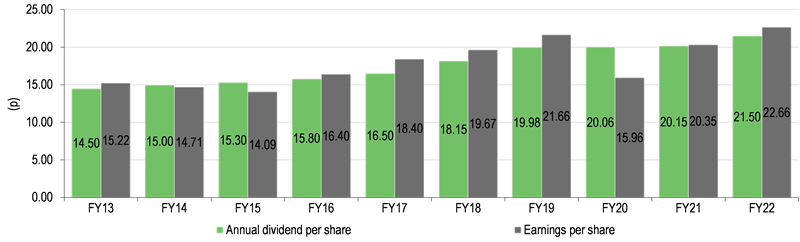
Dividends: Ranked seventh of AIC’s dividend heroes
With 51 consecutive years of higher annual dividends BUT ranks seventh in the AIC’s list of 20 funds that have increased their dividends for more than 20 years in a row; it ranks fourth out of the six AIC Global funds that make the cut. Also, the trust’s average annual dividend growth is higher than the average level of UK inflation over the long term, thereby delivering a real income return for shareholders.
|
Exhibit 10: Dividend and revenue history over the last 10 years |
|
|
Source: BUT, Edison Investment Research |
In H123, BUT’s income of 15.7p per share was 16.3% higher year-on-year. So far, three interim dividends of 5.55p per share have been declared in respect of FY23, which are 7.8% higher year-on-year. If the fourth interim dividend of 6.05p per share is maintained, the total distribution would be 22.7p per share, which would equate to a 5.6% annual uplift.
|
|
Investment Companies
Research: Investment Companies
The Merchants Trust (MRCH) manager, Simon Gergel at Allianz Global Investors, has been at the helm for the last 17 years during a variety of market environments. He has remained true to his investment process, seeking high-quality companies with solid fundamentals that are trading on reasonable valuations. The manager is very encouraged by the current valuation backdrop as, in aggregate, the UK market is trading at the low end of its 20-year range and within the market there is a wide dispersion of valuation multiples. A large proportion of UK stocks, including those of quality businesses, are trading on forward P/E multiples of less than 10x, providing Gergel with a large pond in which to fish. His approach has proved successful with mid- and long-term outperformance of MRCH’s broad UK market benchmark. With the trust’s dual mandate of income and capital growth, it offers an attractive 5.2% dividend yield and has grown its annual dividends for the last 41 consecutive years.