“Edison is the go-to for a new investor to get full understanding of the investment case and business. Edison’s distribution reaches investors that we want to connect with directly.”
Copper’s long-term supply challenge increasingly reflects the pace at which new projects can be financed, permitted and built. Wood Mackenzie expects global copper consumption to rise c 24% to 42.7Mtpa by 2035, driven by economic development, electrification and digitalisation, and estimates that balancing the market will require more than 8Mtpa of additional mine capacity, alongside c 3.5Mtpa of additional scrap supply. Developing that mine capacity could require more than US$210bn of investment, compared with only c US$76bn invested in copper mining over the previous six years. The International Energy Agency estimates that expected mine supply from existing and announced projects could still fall c 25% short of primary copper requirements by 2035.
Bringing new supply online is becoming increasingly difficult. S&P Global estimates that copper projects take an average of 17.5 years to progress from discovery to production, while exploration is increasingly focused on deeper, more technically challenging deposits. Average drilling depth has increased almost 50% since 2010 to c 600m, yet grassroots exploration accounted for only 25% of copper exploration budgets in 2025.Today’s exploration spending is increasingly targeted at established deposits rather than new discoveries, potentially limiting the number of new projects entering the development pipeline and constraining longer-term supply growth.
The constraint therefore lies increasingly in project development and capital allocation. Higher copper prices improve economics, but permitting, infrastructure, metallurgy, capital intensity and geological risk continue to limit the number of projects capable of reaching construction. Development capital is likely to remain selective, favouring assets that combine attractive geology with scale, infrastructure and a credible route through permitting and financing.
Morocco is becoming more relevant in the competition for capital
Morocco is not yet large enough to alter the global copper balance, but it is becoming more relevant as investors seek new sources of supply outside the established producing regions. The country combines a long mining history, established transport and power infrastructure and proximity to European markets with a growing pipeline of copper exploration projects. Tizert also provides a recent domestic example of substantial copper investment and shows that a sizeable modern project can be financed and developed in the country.
These advantages only become meaningful if the geology holds up. Most of the emerging projects remain at the sampling, scout-drilling or resource-definition stage and still need to establish sufficient grade, width, continuity and tonnage. If they do, Morocco should compare more favourably with competing jurisdictions on infrastructure, permitting and development risk, which could improve its ability to attract capital in a market where funding for new copper projects remains selective.
Moroccan project quality will determine access to capital
Grade is one of the clearest early indicators of project quality, particularly before a formal resource, mine plan or feasibility study exists. Higher grades can support stronger margins and reduce the volume of material that needs to be mined and processed. However, grade alone does not determine economics. Resource scale, metallurgy, infrastructure, permitting, mining method and capital intensity ultimately determine whether a project can attract funding.
Morocco is beginning to show two different geological propositions. Several structurally controlled targets are returning relatively high grades over narrower intervals, while sediment-hosted systems offer lower grades but potentially greater lateral extent and tonnage. In both cases, drilling needs to establish sufficient continuity and mineable scale.
Early results justify further Moroccan drilling
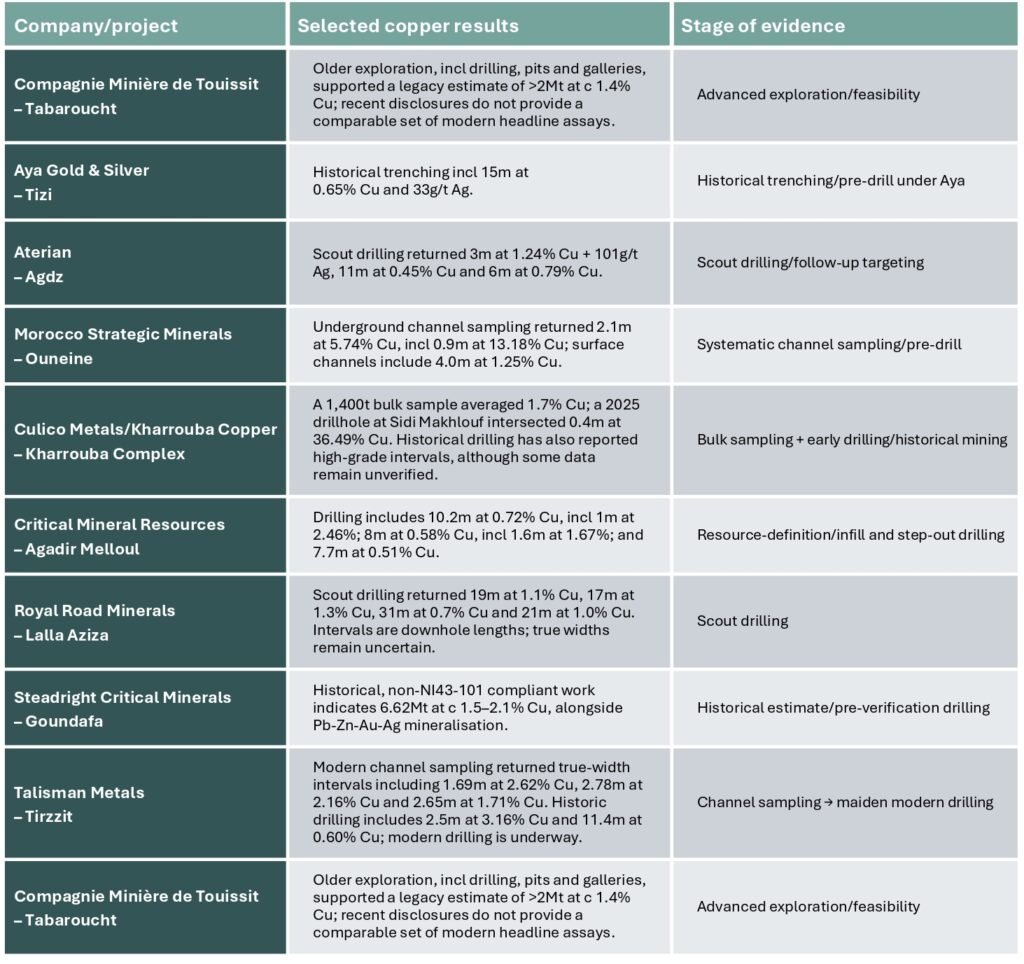
Several projects have now produced results that warrant more systematic exploration. Morocco Strategic Minerals reported underground channel sampling at Ouneine including 2.1m at 5.74% Cu, while Talisman Metals reported true-width channel intervals at Tirzzit including 1.69m at 2.62% Cu and 2.78m at 2.16% Cu. Royal Road has progressed one step further at Lalla Aziza, where scout drilling returned broader downhole intersections including 19m at 1.1% Cu and 17m at 1.3% Cu.
These results are not directly comparable. Channel samples, bulk samples, historical estimates and drill intersections represent different levels of geological confidence, while drill intersections do not necessarily represent true widths. Their significance is that several Moroccan systems now have sufficient geological evidence to justify larger drilling programmes.
Source: Company releases. Note: Results are not directly comparable. Channel samples, bulk samples, historical estimates and drill intersections represent different levels of geological confidence; drill intervals are not necessarily true widths unless explicitly stated.
Scale is the next geological test
The next stage of work is focused on converting encouraging grades into resource-scale mineralisation. For higher-grade targets, drilling needs to establish whether mineralisation extends over sufficient strike, depth and mineable width. For larger sediment-hosted systems, continuity and tonnage need to compensate for lower grades.
This progression is already visible across the project pipeline. Critical Mineral Resources is advancing resource-definition drilling at Agadir Melloul, Royal Road has moved Lalla Aziza into scout drilling and Talisman has begun the first modern drilling programme at Tirzzit. Drilling is therefore beginning to establish which projects have the combination of grade, width and continuity required to progress from exploration targets into defined resources and, eventually, financeable developments.
Tizert provides a development precedent
Tizert is important because it demonstrates that Moroccan copper can progress beyond exploration into large-scale mine development. Managem invested c US$440m in the project, which entered commercial production in 2025. The company reports 614kt of contained copper in proven and probable reserves, more than 1.1Mt in measured and indicated resources and an 18-year mine life.
Tizert’s relevance to the current exploration pipeline is therefore less about headline grade and more about development precedent. It demonstrates that a sufficiently large copper resource can attract substantial capital in Morocco and that a modern project can be financed, built and operated in the country.
That does not de-risk the geology of other Moroccan projects. However, it does strengthen the development case for successful discoveries: explorers able to establish sufficient scale, or offset smaller tonnage with stronger grades and economics, have a clearer domestic precedent for progressing towards development.
The next 12–18 months should provide better visibility
Several Moroccan projects are now moving from surface sampling and historical workings into systematic drilling, while the more advanced assets are progressing towards initial resource estimates and feasibility work.
The milestones that matter are repeated drill intersections, continuity at depth and along strike, resource definition and, later, metallurgy and preliminary development economics. Strong individual assays will continue to attract attention, but evidence that mineralisation forms a coherent and mineable system will become increasingly important.
If drilling confirms both grade and scale, Moroccan copper projects should become easier for strategic investors and development financiers to assess. If it does not, much of the current interest will remain at the exploration stage.
Risks remain geological and financial
The main risk is that early grades do not translate into economic deposits. Selective sampling and narrow high-grade intervals can overstate project potential if subsequent drilling fails to establish sufficient width, continuity or tonnage. Even where a resource is defined, metallurgical complexity, infrastructure requirements or high capital intensity can weaken returns.
The funding environment is another variable. Strong copper prices are currently supportive of exploration and development, but weaker prices or reduced risk appetite could slow projects before they reach sufficient scale to attract strategic capital. With copper mines taking an average of c 17 years from discovery to production, delays at the exploration and feasibility stages also reduce the ability of new projects to contribute to the expected supply requirement in the 2030s.
Edison insight
The long-term copper challenge is increasingly one of bringing enough economically competitive projects into production quickly enough. Demand continues to rise, the announced mine pipeline remains insufficient and long development timelines mean capital needs to be committed well before the projected 2035 supply gap becomes visible in physical markets.
Morocco remains an early-stage participant in that global supply response, but the combination of encouraging exploration results, existing infrastructure and a recent development precedent at Tizert makes it increasingly relevant. Over the next 12–18 months, drilling should show whether early grade indications can be converted into resources with sufficient scale and continuity to compete for development capital. Success would move Morocco closer to becoming a credible source of new copper supply in the 2030s.
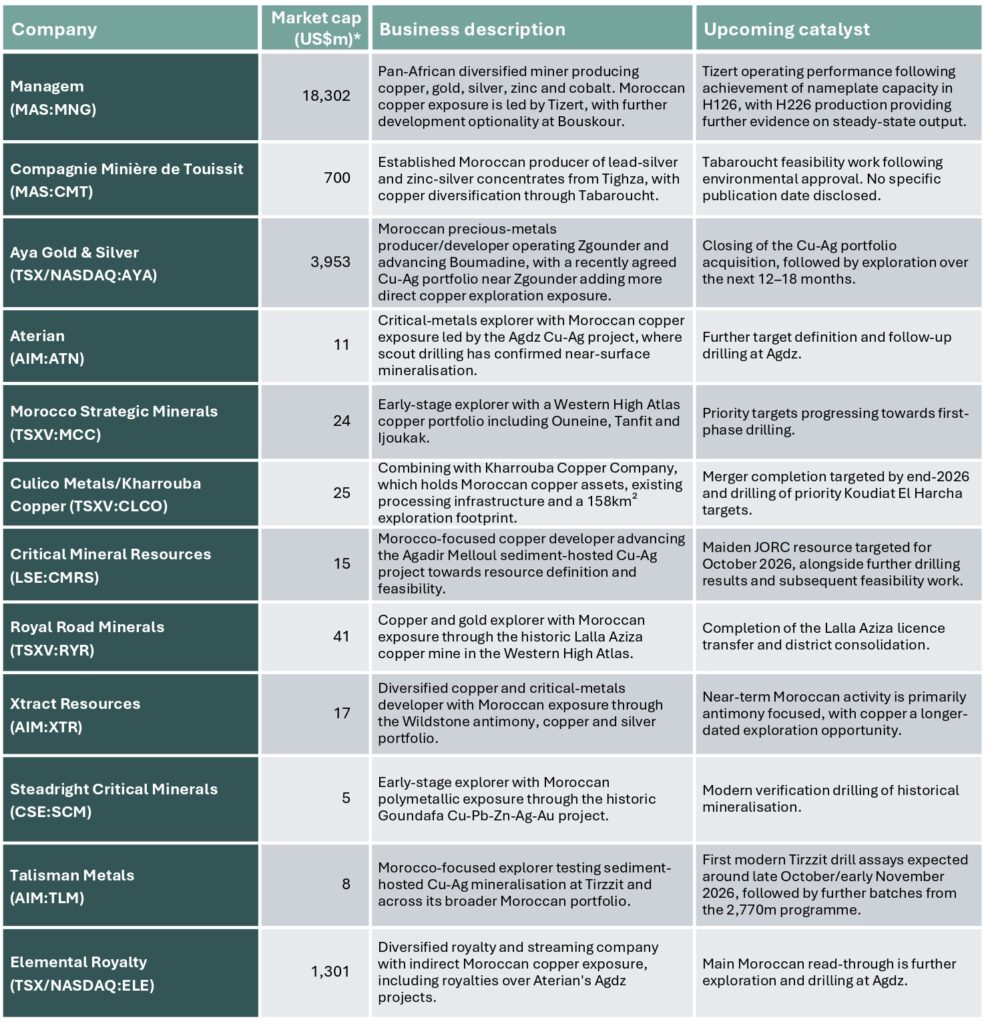
Exhibit 2: Description of selected companies with copper operations in Morocco