Last close As at 05/08/2026
EUR2.93
▲ −0.02 (−0.81%)
Market capitalisation
EUR248m
Research: Healthcare
Oryzon has presented the results of the final analysis from the Phase IIb PORTICO trial, which evaluated the efficacy and safety of vafidemstat in borderline personality disorder (BPD). While top-line results were initially published in January, the final data (presented at the 37th ECNP 2024 congress) show notable improvements across key efficacy measures, reaffirming the potential of the candidate to deliver meaningful benefits to patients with BPD, a highly underserved condition with no approved drugs. Management also confirmed that the data, and a registrational Phase III programme, have been discussed with the FDA at an end-of-Phase II (EoP2) meeting. We view this update as highly encouraging for Oryzon and await the announcement of a formal outcome from the FDA on the proposed Phase III programme, which we anticipate in early-Q424.
Oryzon Genomics |
Final PORTICO data reaffirms potential in BPD |
Clinical update |
Pharma and biotech |
23 September 2024 |
Share price performance
Business description
Next events
Analysts
Oryzon Genomics is a research client of Edison Investment Research Limited |
||||||||||||||||||||||||||||||||||||||||||||||||||||||||
Oryzon has presented the results of the final analysis from the Phase IIb PORTICO trial, which evaluated the efficacy and safety of vafidemstat in borderline personality disorder (BPD). While top-line results were initially published in January, the final data (presented at the 37th ECNP 2024 congress) show notable improvements across key efficacy measures, reaffirming the potential of the candidate to deliver meaningful benefits to patients with BPD, a highly underserved condition with no approved drugs. Management also confirmed that the data, and a registrational Phase III programme, have been discussed with the FDA at an end-of-Phase II (EoP2) meeting. We view this update as highly encouraging for Oryzon and await the announcement of a formal outcome from the FDA on the proposed Phase III programme, which we anticipate in early-Q424.
Year end |
Revenue (€m) |
PBT* |
EPS* |
DPS |
P/E |
Yield |
12/22 |
15.7 |
(6.6) |
(0.07) |
0.0 |
N/A |
N/A |
12/23 |
14.2 |
(6.1) |
(0.06) |
0.0 |
N/A |
N/A |
12/24e |
8.6 |
(4.9) |
(0.05) |
0.0 |
N/A |
N/A |
12/25e |
31.6 |
15.5 |
0.28 |
0.0 |
N/A |
N/A |
Note: *PBT and EPS are normalised, excluding amortisation of acquired intangibles, exceptional items and share-based payments.
Meaningful benefit for an underserved condition
Despite its c 2% prevalence in the general population, BPD is a neglected condition with no approved drugs and no established regulatory endpoints. For PORTICO the selected primary measures were overall improvement in BPD severity (Borderline Personality Disorder Checklist (BPDCL)) and reduction of agitation and aggression (Clinical Global Impression – Severity Agitation/Aggression (CGI-S A/A)). The two key secondary endpoints had similar focuses but with alternate measures: Borderline Evaluation of Severity (BEST) and State-Trait Anger Expression Inventory 2 (STAXI-2) Trait Anger. While the primary endpoints were not met with statistical significance, vafidemstat was favoured over placebo in all measures and the secondary endpoints were met with statistical significance, showing clinically meaningful benefits. The final data also highlight improved statistical significance compared to the top-line results released in January, strengthening the data package for the programme, in our view.
Fate of Phase III programme in the hands of the FDA
The planned Phase III programme comes down to the formal outcome from the FDA. A positive response would trigger immediate preparations for a Phase III PORTICO-2 trial, according to management, and would make Oryzon the only company with a Phase III BPD candidate, to our knowledge. With FDA guidelines stating that formal written minutes will be shared within 30 days of the meeting, an outcome is expected in early-Q424, representing Oryzon’s next catalyst.
Valuation: Maintained at €774.7m or €12.1 per share
For now, we maintain our valuation at €774.7m or €12.1 per basic share. We plan to revisit our assumptions once there is better visibility on the feasibility of a registrational Phase III programme for vafidemstat in BPD. For a more detailed discussion about Oryzon’s current financial position, please see our prior note.
PORTICO final data: Improvements vs top-line results
Primary endpoint measures
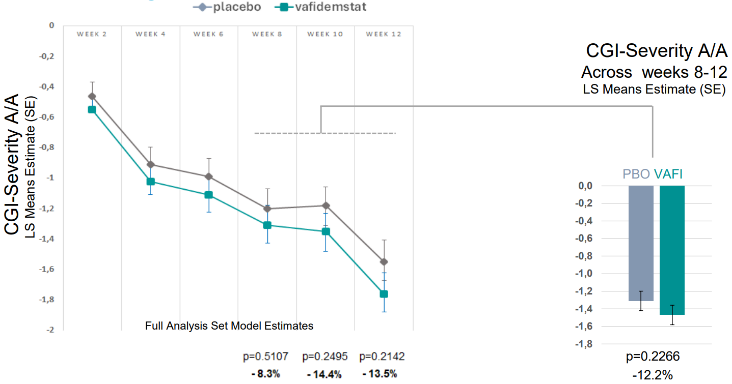
The final analysis of the PORTICO data revealed improvements compared to the top-line results published in January, though the primary endpoints still did not achieve statistical significance. Despite this, we believe that encouragement should be taken from the fact that there was a separation in performance between the vafidemstat and placebo arms (Exhibits 1 and 2). This was true of the BPDCL data (p=0.3839, versus initial measurement of p=0.412), as well as the CGI-S A/A data (p=0.2266, versus initial measurement of p=0.254). Overall, we believe that the positive trends with improved significance, based on both patient-reported (BPDCL) and clinician-reported (CGI-S A/A) measures, add confidence to the results.
|
Exhibit 1: PORTICO BPDCL final analysis |
Exhibit 2: PORTICO CGI-S A/A final analysis |
|
|
|
Source: Company presentation |
|
Exhibit 1: PORTICO BPDCL final analysis |
|
|
Source: Company presentation |
|
Exhibit 2: PORTICO CGI-S A/A final analysis |
|
|
Source: Company presentation |
Secondary endpoint measures
While the secondary endpoints both showed statistically significant benefits in the top-line results, the final data showed improved nominal statistical significance. The results followed the trend favouring vafidemstat over placebo, with notable separation between the arms (Exhibits 3 and 4). The BEST data demonstrated a distinct benefit in overall BPD severity (p=0.0260, versus the initial measurement of p=0.0423), with the maximum relative reduction in the vafidemstat group reported as 38.9% at week 10, with an average reduction of 30.9% across weeks 8–12 (versus initial measurements of 38.3% and 28.9%, respectively). The STAXI-2 Trait Anger final data revealed a clinically meaningful improvement in agitation and aggression (p=0.0071, versus initial measurement of p=0.0259). The relative reduction reached a maximum of 92.1% at week 10, with an average reduction of 58.6% across weeks 8–12 (versus initial measurements of 80.8% and 46.7%, respectively).
|
Exhibit 3: PORTICO BEST final analysis |
Exhibit 4: PORTICO STAXI-2 Trait Anger final analysis |
|
|
|
Source: Company presentation |
|
Exhibit 3: PORTICO BEST final analysis |
|
|
Source: Company presentation |
|
Exhibit 4: PORTICO STAXI-2 Trait Anger final analysis |
|
|
Source: Company presentation |
Additional data and outlook
The final analysis also provided further insights into additional measures used in the PORTICO trial. For example, a trend of improvement in terms of depression was observed, measured by the Beck’s Depression Inventory-II Total Score by weeks 8–12 (p=0.0944), with an average reduction of 42.2% with vafidemstat over placebo. This was consistent with the observation that the vafidemstat group showed a reduced inclination towards self-harm compared to placebo (one patient on vafidemstat versus six patients on placebo). Furthermore, the final analysis of the global treatment effect, as visualised with the Global Statistical Test (GST), highlighted the overall benefit favouring vafidemstat treatment, accounting for various aspects of the condition (eg psychiatric, behavioural, functional) (Exhibit 5). We continue to believe that it is rare to see all data favouring the treatment group to this extent in complex psychiatric indications such as BPD, emphasising the opportunity for Oryzon.
|
Exhibit 5: PORTICO GST final analysis |
|
|
Source: Company presentation |
Importantly, the final results also confirmed the safety of vafidemstat, consistent with all prior clinical studies. It is our opinion that the efficacy and safety data form a robust data package to support vafidemstat for the treatment for BPD, holding potential as a real-world solution in an indication for which there are currently no approved drugs. However, we acknowledge that the feasibility of further clinical development efforts (the planned Phase III PORTICO-2 trial) will come down to the FDA’s interpretation of the results and formal response following the recent EoP2 meeting.
PORTICO trial design
As a reminder, PORTICO was a randomised, placebo-controlled, double-blinded 14-week Phase IIb trial (Exhibit 6). To be included, participants had to have a confirmed BPD diagnosis, reach a defined threshold for agitation and aggression based on the Agitation-Aggression Psychiatric Inventory Clinician Report, and be on a stable regimen of background pharmacotherapy. Psychotherapy alongside treatment was also permitted, provided this was consistent throughout the trial duration. Patients (n=211) were randomised 1:1 to receive either vafidemstat (1.2mg orally once daily, five days on and two days off, n=106) or placebo (once daily, n=105). The trial involved 27 sites, including 14 in the US and 13 in Europe (Germany, Spain, Bulgaria and Serbia).
|
Exhibit 6: PORTICO trial design |
|
|
Source: Company presentation. Note: 1 Patients took placebo capsules during the two days off. |
Building a robust IP estate around vafidemstat
FY24, particularly across the past several months, has seen Oryzon make multiple announcements relating to incremental patents for vafidemstat:
■
September 2024: Oryzon received an ‘Intention to grant’ communication from the European Patent Office relating to a patent application for vafidemstat entitled ‘Methods of treating borderline personality disorder’. Once granted, it will provide protection in Europe until at least 2040, excluding any potential patent term extensions that may provide additional protection.
■
September 2024: Oryzon received ‘Decision to grant’ communications for patents related to vafidemstat in Australia and Malaysia (‘Methods of treating behaviour alterations’), as well as in Mexico (‘Methods of treating borderline personality disorder’). Once granted, these patents will not expire in these regions until at least 2038 and at least 2040, respectively, excluding any potential patent term extensions that may provide additional protection in these regions.
■
July 2024: Oryzon received ‘Decision to grant’ communications from the Japanese Patent Office for two patents entitled ‘Methods of treating borderline personality disorder’ and ‘Methods of treating attention-deficit hyperactivity disorder using KDM1A inhibitors such as the compound vafidemstat’. Once granted, these patents will not expire until at least 2040, excluding any potential patent term extensions that may provide additional protection.
•
It was noted in this release, that the company had already been granted patents in Europe, Korea and Russia relating to the use of vafidemstat to treat aggression and social withdrawal, key characteristics of both BPD and schizophrenia.
Collectively, we believe these patents add to the value proposition of the BPD programme for vafidemstat and note that similar patent applications are pending in other relevant markets. Provided the drug candidate is successful with subsequent clinical development efforts, it will be well-protected across these various key geographies. Oryzon also holds composition-of-matter patents for vafidemstat, expected to expire in the US and EU in 2037 and 2036, respectively, including patent term extension/supplementary protection certificates.
Financials and valuation
Oryzon recently reported its Q224 results. For a more detailed discussion about Oryzon’s current financial position, and other ongoing activities, please refer to our prior update note.
We continue to value Oryzon using a risk-adjusted net present value (rNPV) approach and maintain out latest valuation of €774.7m or €12.1 per share (Exhibit 7). Our assigned probability of success for the BPD programme remains conservative at 20%, though we note the potential upside should this become Phase III-ready. This is contingent on a positive response from the FDA following the company’s recent EoP2 meeting; the outcome (expected from early-Q424) represents Oryzon’s next significant upcoming catalyst.
Exhibit 7: Valuation of Oryzon (rNPV)
Product |
Indication |
Launch |
Peak sales (US$m) |
Value |
Probability |
rNPV |
NPV/share (€/share) |
|
Iadademstat |
2L AML |
2029 |
555 |
541.9 |
30% |
154.5 |
2.4 |
|
1L SCLC |
2030 |
720 |
635.1 |
20% |
120.0 |
1.9 |
||
Vafidemstat |
BPD |
2028 |
1,625 |
830.1 |
20% |
245.0 |
3.8 |
|
Schizophrenia, negative symptoms |
2029 |
702 |
582.1 |
15% |
120.8 |
1.9 |
||
Aggression related to AD |
2029 |
911 |
686.4 |
15% |
137.8 |
2.2 |
||
Net debt at end-June 2024 |
(3.2) |
100% |
(3.2) |
(0.1) |
||||
Valuation |
|
|
|
3,272.3 |
774.7 |
12.1 |
||
Source: Edison Investment Research
Exhibit 8: Financial summary
Accounts: Spanish GAAP. Year end 31 December (€000s) |
2021 |
2022 |
2023 |
2024e |
2025e |
INCOME STATEMENT |
|
|
|
|
|
Total revenues |
10,615 |
15,698 |
14,192 |
8,550 |
31,550 |
Cost of sales |
(746) |
(464) |
(244) |
(317) |
(333) |
Gross profit |
9,869 |
15,234 |
13,948 |
8,233 |
31,217 |
Gross margin % |
93% |
97% |
98% |
96% |
99% |
SG&A (expenses) |
(3,782) |
(3,163) |
(3,390) |
(3,424) |
(3,458) |
R&D costs |
(9,746) |
(13,681) |
(12,177) |
(9,000) |
(11,000) |
Other income/(expense) |
(3,203) |
(3,714) |
(2,777) |
74 |
0 |
Exceptionals and adjustments |
(4) |
0 |
0 |
55 |
0 |
Reported EBITDA |
(6,866) |
(5,323) |
(4,396) |
(4,062) |
16,759 |
Depreciation and amortisation |
(144) |
(167) |
(153) |
(129) |
(110) |
Reported EBIT |
(7,011) |
(5,490) |
(4,549) |
(4,191) |
16,649 |
Finance income/(expense) |
(169) |
(1,067) |
(1,555) |
(755) |
(1,172) |
Other income/(expense) |
0 |
0 |
0 |
0 |
0 |
Reported PBT |
(7,180) |
(6,557) |
(6,104) |
(4,946) |
15,477 |
Income tax expense (includes exceptionals) |
2,493 |
2,325 |
2,751 |
1,878 |
2,315 |
Reported net income |
(4,687) |
(4,231) |
(3,353) |
(3,067) |
17,791 |
Basic average number of shares, m |
53.1 |
53.3 |
57.6 |
62.6 |
64.0 |
Basic EPS (€) |
(0.09) |
(0.08) |
(0.06) |
(0.05) |
0.28 |
|
|
|
|
|
|
Adjusted EBITDA |
(6,862) |
(5,323) |
(4,396) |
(4,117) |
16,759 |
Adjusted EBIT |
(7,007) |
(5,490) |
(4,549) |
(4,246) |
16,649 |
Adjusted PBT |
(6,896) |
(6,320) |
(6,004) |
(5,001) |
15,477 |
Adjusted EPS (€) |
(0.08) |
(0.07) |
(0.06) |
(0.05) |
0.28 |
Adjusted diluted EPS (€) |
(0.08) |
(0.07) |
(0.06) |
(0.05) |
0.28 |
|
|
|
|
|
|
BALANCE SHEET |
|
|
|
|
|
Property, plant and equipment |
682 |
611 |
481 |
379 |
298 |
Intangible assets |
60,254 |
75,843 |
89,895 |
98,418 |
109,939 |
Investments |
29 |
31 |
26 |
26 |
26 |
Deferred tax assets |
1,812 |
2,050 |
2,222 |
2,222 |
2,222 |
Total non-current assets |
62,778 |
78,535 |
92,624 |
101,045 |
112,484 |
Cash and equivalents |
28,725 |
21,317 |
12,257 |
4,903 |
34,154 |
Trade and other receivables |
3,645 |
3,709 |
1,909 |
2,809 |
2,359 |
Inventories |
104 |
10 |
6 |
6 |
6 |
Other current assets |
132 |
129 |
104 |
104 |
104 |
Total current assets |
32,606 |
25,165 |
14,276 |
7,822 |
36,623 |
Deferred tax liabilities |
1,812 |
2,050 |
2,222 |
2,222 |
2,222 |
Long term debt |
13,354 |
10,346 |
6,335 |
3,172 |
3,148 |
Other non-current liabilities |
285 |
0 |
155 |
155 |
155 |
Total non-current liabilities |
15,451 |
12,396 |
8,711 |
5,549 |
5,525 |
Trade and other payables |
3,518 |
5,742 |
4,210 |
2,986 |
3,598 |
Short term debt |
4,306 |
12,920 |
12,194 |
16,194 |
38,056 |
Other current liabilities |
847 |
70 |
11 |
11 |
11 |
Total current liabilities |
8,672 |
18,732 |
16,414 |
19,190 |
41,664 |
Equity attributable to company |
71,262 |
72,572 |
81,775 |
84,127 |
101,919 |
|
0 |
0 |
0 |
0 |
0 |
CASH FLOW STATEMENT |
|
|
|
|
|
Profit before tax |
(7,180) |
(6,557) |
(6,104) |
(4,946) |
15,477 |
Cash from operations (CFO) |
(3,626) |
(1,848) |
(575) |
(5,062) |
18,964 |
Capex |
(175) |
(76) |
0 |
0 |
0 |
Acquistion of intangible assets |
(11,586) |
(14,195) |
(14,503) |
(8,550) |
(11,550) |
Other investing activities |
37 |
(1) |
(1) |
0 |
0 |
Cash used in investing activities (CFIA) |
(11,724) |
(14,271) |
(14,504) |
(8,550) |
(11,550) |
Net proceeds from issue of shares |
0 |
(932) |
(1,880) |
5,420 |
0 |
Movements in debt |
4,123 |
9,642 |
7,901 |
838 |
21,838 |
Other financing activities |
0 |
0 |
0 |
0 |
0 |
Cash from financing activities (CFF) |
4,123 |
8,710 |
6,021 |
6,258 |
21,838 |
Increase/(decrease) in cash and equivalents |
(10,880) |
(7,408) |
(9,060) |
(7,354) |
29,251 |
Currency translation differences and other |
348 |
1 |
(3) |
0 |
0 |
Cash and equivalents at start of period |
39,605 |
28,725 |
21,317 |
12,257 |
4,903 |
Cash and equivalents at end of period |
28,725 |
21,317 |
12,257 |
4,903 |
34,154 |
Net (debt) cash |
11,065 |
(1,948) |
(6,272) |
(14,464) |
(7,050) |
Free cash flow (CFO + Net capex + Intangible assets) |
(15,388) |
(16,118) |
(15,078) |
(13,612) |
7,414 |
Source: Company reports, Edison Investment Research
|
|
Research: Financials
Interim results, for the six months to 31 July (H125), will be published on 8 October. Ahead of that, S&U has alerted the market that based on the H1 performance, full year PBT is unlikely to meet the previous market consensus expectations. We believe this to be primarily a timing issue, reflecting the continuing impact of the temporary FCA restrictions on collections activity in the motor finance business. Once regulatory clarity has been established, we expect a significant recovery. Meanwhile, as previously reported, the property lending division continues to perform strongly. We have reduced our FY25 PBT estimate by 7% to £27m and will review our FY26 forecasts with the interim results.