Last close As at 05/08/2026
EUR2.92
▲ −0.01 (−0.41%)
Market capitalisation
EUR248m
Research: Healthcare
Oryzon Genomics has announced top-line results for the Phase IIb trial (PORTICO) assessing vafidemstat in borderline personality disorder (BPD), and while the primary endpoints (Borderline Personality Disorder Checklist (BPDCL) and Clinical Global Impression – Severity Agitation/ Aggression (CGI-S A/A)) did not reach statistical significance, vafidemstat was favoured over placebo in all efficacy measures, with nominal statistical significance in two key secondary endpoints (Borderline Evaluation of Severity (BEST) and State-Trait Anger Expression Inventory 2 (STAXI-2) Trait Anger). Further, the drug was found to be safe and well-tolerated, consistent with prior studies. Management plans to conduct a detailed analysis of the trial data across the coming months and intends to request an end-of-Phase II (EoP2) meeting with the FDA in early Q224 to discuss a potential registrational Phase III programme. There are currently no approved drugs for this indication and hence gold-standard endpoints are yet to be established. We therefore believe that there is still a significant opportunity for Oryzon in this space, however, further clinical progression will be heavily reliant on the EoP2 meeting request and outcome.
Written by
Oryzon Genomics |
PORTICO update with planned FDA EoP2 |
Clinical update |
Pharma and biotech |
10 January 2024 |
Share price performance
Business description
Next events
Analysts
Oryzon Genomics is a research client of Edison Investment Research Limited |
||||||||||||||||||||||||||||||||||||||||||||||||||||||
Oryzon Genomics has announced top-line results for the Phase IIb trial (PORTICO) assessing vafidemstat in borderline personality disorder (BPD), and while the primary endpoints (Borderline Personality Disorder Checklist (BPDCL) and Clinical Global Impression – Severity Agitation/ Aggression (CGI-S A/A)) did not reach statistical significance, vafidemstat was favoured over placebo in all efficacy measures, with nominal statistical significance in two key secondary endpoints (Borderline Evaluation of Severity (BEST) and State-Trait Anger Expression Inventory 2 (STAXI-2) Trait Anger). Further, the drug was found to be safe and well-tolerated, consistent with prior studies. Management plans to conduct a detailed analysis of the trial data across the coming months and intends to request an end-of-Phase II (EoP2) meeting with the FDA in early Q224 to discuss a potential registrational Phase III programme. There are currently no approved drugs for this indication and hence gold-standard endpoints are yet to be established. We therefore believe that there is still a significant opportunity for Oryzon in this space, however, further clinical progression will be heavily reliant on the EoP2 meeting request and outcome.
Year end |
Revenue (€m) |
PBT* |
EPS* |
DPS |
P/E |
Yield |
12/21 |
10.6 |
(7.2) |
(0.09) |
0.0 |
N/A |
N/A |
12/22 |
15.7 |
(6.4) |
(0.07) |
0.0 |
N/A |
N/A |
12/23e |
15.9 |
(6.6) |
(0.07) |
0.0 |
N/A |
N/A |
12/24e |
19.0 |
(10.0) |
(0.13) |
0.0 |
N/A |
N/A |
Note: *PBT and EPS are normalised, excluding amortisation of acquired intangibles, exceptional items and share-based payments.
Progression in BPD rests on EoP2 meeting outcome
The PORTICO top-line results present a setback for the company, but with a chance to salvage the situation, in our view. While it is disappointing that the study did not meet its primary endpoints, encouragement can be taken from the trial achieving statistical significance on key secondary endpoints. Importantly, results across all efficacy measures favoured vafidemstat over placebo, highlighting the potential for the drug in managing a challenging condition that currently has no approved treatment options. It was noted on the corresponding webcast to discuss the results that the PORTICO data allowed informative insights into effect sized for the various efficacy measures, potentially paving the way for a registrational Phase III programme. Management aims to have conducted a detailed analysis of the full data by end-Q124 and to submit an EoP2 request to the FDA in early Q224. Subject to delays, we expect the EoP2 meeting outcome will likely be in Q324, potentially representing a significant inflection point for Oryzon.
Valuation: Maintained at €900.3m or €15.1 per share
Pending the EoP2 meeting with the FDA and its likely conclusions, we keep our overall valuation for Oryzon unchanged at €900.3m. The per share valuation adjusts slightly to €15.1 (€15.4 previously) due to a higher number of shares outstanding. We plan to revisit our assumptions once there has been an update on the EoP2 meeting.
PORTICO results: Improvements in all BPD measures
Study design
The PORTICO study was a randomised, placebo-controlled, double-blinded 14-week Phase IIb clinical trial. To be included, participants had to have a confirmed BPD diagnosis, reach a defined threshold for agitation and aggression based on the Agitation-Aggression Psychiatric Inventory Clinician Report, and be on a stable regimen of background pharmacotherapy. Psychotherapy alongside treatment was also permitted, provided this was consistent throughout the trial duration. Patients (n=210) were randomised 1:1 to receive either vafidemstat (1.2mg orally once daily, five days on and two days off, n=106) or placebo (once daily, n=104). The trial involved 27 sites, including 14 in the US and 13 in Europe (Germany, Spain, Bulgaria and Serbia).
Primary efficacy measures
The primary endpoints were improvement in BPDCL (a 47-item patient-completed assessment) and improvement in CGI-S A/A (a clinician-completed assessment on overall patient functioning), both from baseline to weeks 8–12. The results showed that treatment with vafidemstat did not demonstrate a statistically significant improvement over placebo as measured by either of the primary endpoints (Exhibits 1 and 2). However, an important trend, observed throughout all the trial data, was a separation in performance between the vafidemstat and placebo arms from week four through to week 12, and this was true of both the BPDCL and CGI-S A/A data, albeit without statistical significance (p=0.412 for the BPDCL Total Score data; p=0.254 for the CGI-S A/A data). While this is not the preferred outcome, we believe it shows a positive trend favouring vafidemstat based on both clinician- and patient-reported measures. It is our opinion that further clinical development in BPD will be subject to the FDA’s interpretation of these results.
|
Exhibit 1: PORTICO BPDCL Total Score data |
Exhibit 2: PORTICO CGI-S A/A data |
|
|
|
Source: Oryzon webcast (7 January 2024) |
|
Exhibit 1: PORTICO BPDCL Total Score data |
|
|
Source: Oryzon webcast (7 January 2024) |
|
Exhibit 2: PORTICO CGI-S A/A data |
|
|
Source: Oryzon webcast (7 January 2024) |
Secondary efficacy measures
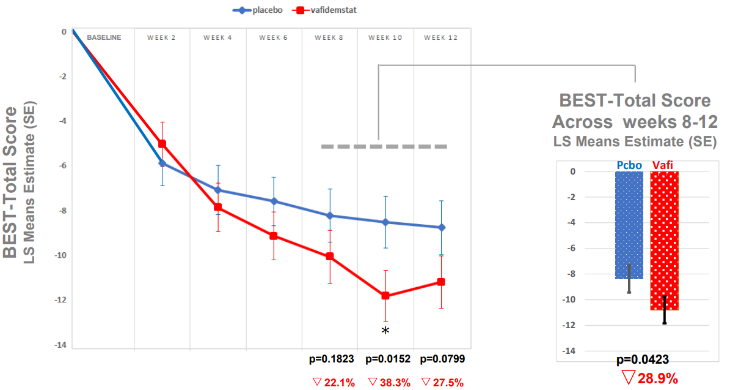
Two of the key secondary endpoints included improvements from baseline to weeks 8–12, as well as change over time, as measured by BEST (a 15-item patient-completed assessment) and STAXI2 Trait Anger (a 54-item patient-completed assessment). Encouragingly, the data showed statistically significant improvements across both measures, following the trend of a distinct separation in performance from week four to week 12 for the two arms (Exhibits 3 and 4). Notably, the BEST data showed a 38.3% benefit in favour of vafidemstat at week 10 (p=0.0152) and an overall average reduction of 28.9% across weeks 8–12 (p=0.0423). Similarly, the STAXI-2 Trait Anger data showed an improvement from week four to week 12, with an 80.8% benefit at week 10 (p=0.0016) and an overall average reduction of 46.7% across weeks 8–12 (p=0.0259).
|
Exhibit 3: PORTICO BEST data |
Exhibit 4: PORTICO STAXI-2 Trait Anger data |
|
|
|
Source: Oryzon webcast (7 January 2024) |
|
Exhibit 3: PORTICO BEST data |
|
|
Source: Oryzon webcast (7 January 2024) |
|
Exhibit 4: PORTICO STAXI-2 Trait Anger data |
|
|
Source: Oryzon webcast (7 January 2024) |
Safety
On the safety front, vafidemstat was found to be safe and well-tolerated. Treatment emergent adverse events (TEAEs) were comparable across the two arms, slightly lower with vafidemstat versus placebo (54.5% vs 65.4% incidence rates). The majority of TEAEs were recovered or resolved by the end of the study and, importantly, there were no patient deaths/suicides. Suicidal ideation was low; there was once case each in the vafidemstat and placebo arms (overall rate of 0.9%). It was noted that one serious AE, a kidney infection, was recorded in the vafidemstat arm. However, the case was independently determined to be unrelated to treatment. The condition was resolved within seven days and the participant completed the trial without altering their dosing. Overall, the safety profile of vafidemstat was consistent with the favourable profile observed with the drug in prior studies.
Outlook
While it is disappointing that statistical significance was not achieved with the two primary efficacy measures, we believe the overall results demonstrate that vafidemstat offers a clinically meaningful benefit for BPD patients. This was corroborated in the corresponding webcast, where management noted that a key opinion leader viewed improvements greater than 25% positively (across any measure of overall severity and agitation/aggression), supportive of the most recent clinical data, suggesting that vafidemstat may have the potential to be an effective treatment option for BPD patients. It was also highlighted that as there are no gold-standard endpoints in BPD, the trial investigated a sizeable number of secondary and exploratory endpoints, in addition to the two primary efficacy measures, and all cases favoured vafidemstat over placebo. Management believes it is rare to see all data favouring the experimental arm versus placebo to this extent in a psychiatric indication such as BPD, emphasising the opportunity for Oryzon. This was exemplified with a forest plot to show the Global Statistical Test (GST) data (Exhibit 5). As BPD is a multisymptomatic condition, the GST analysis was intended to assess whether the treatment was efficacious across various aspects of the condition (eg psychiatric, behavioural, functional).
|
Exhibit 5: PORTICO GST data showing global treatment effect |
|
|
Source: Oryzon webcast (7 January 2024). Note: Negative T-Score favours vafidemstat over placebo. |
Oryzon intends to carry out a detailed analysis of the full data within Q124. This will include an exploration into biomarker correlatives to facilitate future clinical development efforts within this indication. (It was noted that such analyses will also take place for the ongoing EVOLUTION study investigating vafidemstat in schizophrenia). Management then plans to submit a request to the FDA for an EoP2 meeting in early Q224 to discuss a registrational Phase III programme for the treatment of BPD. Subject to delays on these timelines, and in accordance with FDA guidance on EoP2 meetings, we estimate that the EoP2 meeting and outcome will likely be in Q324. We believe that the prospect of continued clinical development in this indication heavily relies on the judgement of the FDA, especially with a lack of regulatory precedent in BPD. Given that BPD is Oryzon’s lead central nervous system (CNS) indication, a positive outcome from an EoP2 meeting could represent a significant catalyst for the company, in our view.
Financials and valuation
We evaluated Oryzon’s H123 financial performance in our recent update note. Based on the available information, we had estimated the Q323 net debt balance to be €6.6m (including gross cash of €8.4m at end-Q323 and the H123 gross debt balance of €15.0m). The capitalisation situation was bolstered in November 2023, with the company securing funding of up to €45m through a revised convertible bond financing agreement, replacing its previous €20m convertible bond agreement (of which €12m had been drawn down) with Nice & Green, a Switzerland-based institutional investor. As per the new agreement, Oryzon can draw down up to €45m in financing through the initial execution of €8m in two tranches of €4m, and additional tranches of up to €5m each, at its discretion. However, it is unclear if the company has made any drawdowns from the new facility yet. The new convertible bonds have a maturity of 48 months and can be converted at 94% of the average closing daily volume-weighted price (between conversions). We also note that the conversion price will not exceed a 9.99% discount to the closing price on the date preceding the conversion of the relevant convertible note. Oryzon also holds the right to redeem notes at a premium of 3%. We highlight that this financing agreement will have a share dilution impact – for reference, if conversion happens at the last closing price of €2.05 the company will have to issue c 22m shares (assuming full conversion), diluting current shareholders by c 37% – although we estimate these funds would support operations to end-FY25, based on current cash burn rates (€5.5m in Q323). With these funds at hand, we believe the company is sufficiently capitalised past crucial milestones such as the EoP2 meeting with the FDA and top-line results from ongoing clinical trials, which, if positive, could potentially lead to a partnership agreement(s) and associated cash inflows.
Despite the less than favourable top-line data from the Phase II PORTICO study, we maintain our overall valuation for the indication at €260.1m. We had been conservative with our estimates for vafidemstat in BPD, assuming a probability of success (PoS) of 20% despite it being a late Phase II programme. Based on the recent development, we have decided to keep the PoS and development timelines unchanged until the results from the EoP2 meeting with the FDA are made available. Overall, our valuation remains unchanged at €900.3m. Our per share valuation adjusts to €15.1 (previously €15.4) given a higher number of shares outstanding (59.7m vs 58.6m previously).
Exhibit 6: Valuation of Oryzon
Product |
Indication |
Launch |
Peak sales (US$m) |
Value |
Probability |
rNPV |
NPV/share (€/share) |
Iadademstat |
2L AML |
2026 |
510 |
810.9 |
30% |
239.9 |
4.0 |
Iadademstat |
1L SCLC |
2026 |
740 |
858.2 |
25% |
210.9 |
3.5 |
Vafidemstat |
BPD |
2027 |
1,640 |
1,340.5 |
20% |
260.1 |
4.4 |
Vafidemstat |
Schizophrenia, negative symptoms |
2027 |
710 |
674.5 |
15% |
94.5 |
1.6 |
Vafidemstat |
Aggression in AD |
2028 |
920 |
716.7 |
15% |
101.4 |
1.7 |
Estimated net debt at end-Q323 |
(6.6) |
100% |
(6.6) |
(0.1) |
|||
Valuation |
|
|
|
4,394.2 |
900.3 |
15.1 |
Source: Edison Investment Research
Exhibit 7: Financial summary
Accounts: Year end 31 December (€000s) |
2021A |
2022A |
2023E |
2024E |
INCOME STATEMENT |
|
|
|
|
Total revenues |
10,615 |
15,698 |
15,855 |
18,995 |
Cost of sales |
(746) |
(464) |
(487) |
(512) |
Gross profit |
9,869 |
15,234 |
15,368 |
18,483 |
Gross margin % |
93% |
97% |
97% |
97% |
SG&A (expenses) |
(3,782) |
(3,163) |
(3,194) |
(3,827) |
R&D costs |
(9,746) |
(13,681) |
(15,600) |
(23,975) |
Other income/(expense) |
(3,203) |
(3,714) |
(1,820) |
0 |
Exceptionals and adjustments |
(4) |
0 |
0 |
0 |
Reported EBITDA |
(6,866) |
(5,323) |
(5,246) |
(9,318) |
Depreciation and amortisation |
144 |
167 |
149 |
131 |
Reported EBIT |
(7,011) |
(5,490) |
(5,396) |
(9,450) |
Finance income/(expense) |
(169) |
(871) |
(1,219) |
(579) |
Other income/(expense) |
0 |
(195) |
0 |
0 |
Reported PBT |
(7,180) |
(6,557) |
(6,615) |
(10,029) |
Income tax expense (includes exceptionals) |
2,493 |
2,325 |
2,409 |
2,367 |
Reported net income |
(4,687) |
(4,231) |
(4,206) |
(7,662) |
Basic average number of shares, m |
53.1 |
55.6 |
58.8 |
59.7 |
Basic EPS (€) |
(0.09) |
(0.08) |
(0.07) |
(0.13) |
|
|
|
|
|
Adjusted EBITDA |
(6,862) |
(5,323) |
(5,246) |
(9,318) |
Adjusted EBIT |
(7,007) |
(5,490) |
(5,396) |
(9,450) |
Adjusted PBT |
(7,176) |
(6,361) |
(6,615) |
(10,029) |
Adjusted EPS (€) |
(0.09) |
(0.07) |
(0.07) |
(0.13) |
Adjusted diluted EPS (€) |
(0.09) |
(0.07) |
(0.07) |
(0.13) |
|
|
|
|
|
BALANCE SHEET |
|
|
|
|
Property, plant and equipment |
682 |
611 |
538 |
482 |
Intangible assets |
60,254 |
75,843 |
89,320 |
1,01,786 |
Investments |
29 |
31 |
31 |
31 |
Deferred tax assets |
1,812 |
2,050 |
2,050 |
2,050 |
Total non-current assets |
62,778 |
78,535 |
91,938 |
1,04,348 |
Cash and equivalents |
28,725 |
21,317 |
925 |
1,269 |
Trade and other receivables |
3,645 |
3,709 |
3,677 |
3,693 |
Inventories |
104 |
10 |
10 |
10 |
Other current assets |
132 |
129 |
129 |
129 |
Total current assets |
32,606 |
25,165 |
4,741 |
5,102 |
Deferred tax liabilities |
1,812 |
2,050 |
2,050 |
2,050 |
Long term debt |
13,354 |
10,346 |
14,486 |
36,877 |
Other non-current liabilities |
285 |
0 |
0 |
0 |
Total non-current liabilities |
15,451 |
12,396 |
16,536 |
38,927 |
Trade and other payables |
3,518 |
5,742 |
4,630 |
5,186 |
Short term debt |
4,306 |
12,920 |
7,077 |
4,562 |
Other current liabilities |
847 |
70 |
70 |
70 |
Total current liabilities |
8,672 |
18,732 |
11,777 |
9,818 |
Equity attributable to company |
71,262 |
72,572 |
68,367 |
60,705 |
|
0 |
0 |
0 |
0 |
CASH FLOW STATEMENT |
|
|
|
|
Profit before tax |
(7,180) |
(6,557) |
(6,615) |
(10,029) |
Cash from operations (CFO) |
(3,626) |
(1,848) |
(5,136) |
(6,991) |
Capex |
(175) |
(76) |
(76) |
(76) |
Acquisitions & disposals net |
0 |
0 |
0 |
0 |
Acquisition of intangible assets |
(11,586) |
(14,195) |
(13,477) |
(12,466) |
Other investing activities |
37 |
(1) |
0 |
0 |
Cash used in investing activities (CFIA) |
(11,724) |
(14,271) |
(13,553) |
(12,542) |
Net proceeds from issue of shares |
0 |
(932) |
0 |
0 |
Movements in debt |
4,123 |
9,642 |
(1,703) |
19,877 |
Other financing activities |
0 |
0 |
0 |
0 |
Cash from financing activities (CFF) |
4,123 |
8,710 |
(1,703) |
19,877 |
Increase/(decrease) in cash and equivalents |
(10,880) |
(7,408) |
(20,392) |
344 |
Currency translation differences and other |
348 |
1 |
0 |
0 |
Cash and equivalents at start of period |
39,605 |
28,725 |
21,317 |
925 |
Cash and equivalents at end of period |
28,725 |
21,317 |
925 |
1,269 |
Net (debt) cash |
14,954 |
3,975 |
(7,320) |
(1,874) |
Free cash flow (CFO+ Net capex on tangible assets) |
(15,388) |
(16,118) |
(18,689) |
(19,532) |
Source: Company reports, Edison Investment Research
|
|
Research: TMT
Nano Dimension has made a non-binding proposal to acquire the 86% of Stratasys that it does not own for $16.50 per share in cash. The deal would be financed mainly from existing cash, with discussions for additional financing currently underway. Stratasys is reviewing the proposal as part of its ongoing strategic review.