“Edison is the go-to for a new investor to get full understanding of the investment case and business. Edison’s distribution reaches investors that we want to connect with directly.”
A market that has outgrown its research infrastructure
The global corporate bond market is larger than it has ever been. Issuance volumes have climbed steadily, the investor base has broadened and corporate debt now plays a central role in portfolio construction across the institutional spectrum. What has not kept pace is the analytical infrastructure that investors and issuers depend on to navigate it.
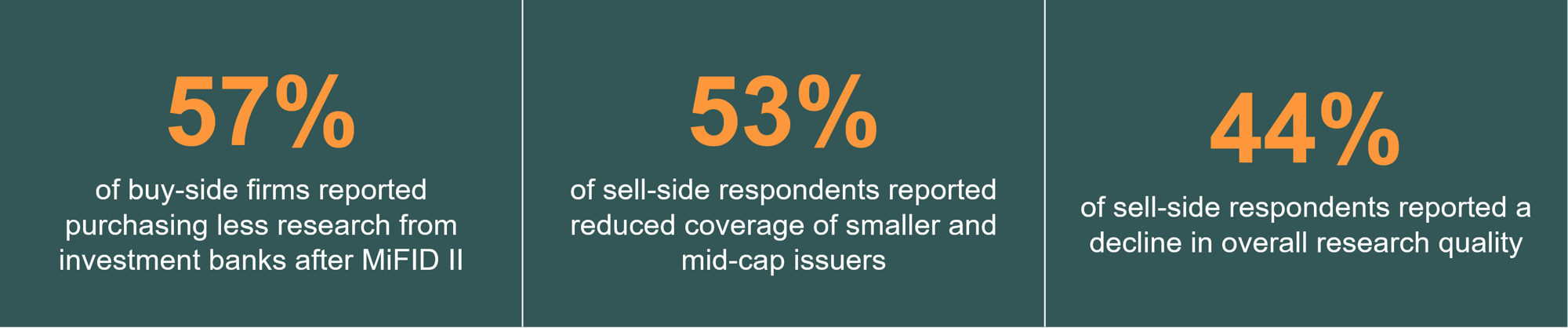
Sell-side credit research, once the backbone of fixed income information flows, has retreated sharply over the past decade. The causes are well documented. The financial crisis prompted wholesale restructuring of investment bank balance sheets, and as banks rebuilt capital and cut costs, research departments – which generate no direct revenue – bore a disproportionate share of the reduction. MiFID II, introduced in 2018, forced the unbundling of research from execution costs, triggering a sharp repricing of research budgets across the buy side. Within a year of MiFID II coming into force, 57% of buy-side firms reported purchasing less research from investment banks than before and sell-side firms reported cuts to both research budgets and analyst headcount across the board. Coverage of smaller and mid-cap issuers suffered most.
The result is a structural coverage gap, most acute precisely where independent analysis would be most valuable: mid-market issuers, newer entrants to the bond market and sectors where information asymmetry between issuers and investors is highest.
Exhibit 1: The MiFID II effect on sell-side research
Source: CFA Institute MiFID II Survey, December 2018 (496 investment professionals surveyed across EU, UK and Switzerland)
What the buy side has done instead
The buy side has not been passive in the face of this retreat. Larger asset managers have built out in-house credit teams, internalising the analytical function that the sell side once provided. For firms with the resources to do so, this has worked: proprietary analysis, free from the conflicts of interest inherent in bank-affiliated research, is in many respects preferable to what it replaced.
But this model has limits. First, it is not available to all. Smaller institutional investors – such as family offices, regional pension funds, insurance companies with limited investment teams – do not have the headcount to replicate even a fraction of what the sell side once produced. For these investors, the information available on a given issuer may be limited to what the issuer itself publishes, what rating agencies have assessed and what fragments of sell-side coverage survive. Second, even for well-resourced in-house teams, the breadth of independent market commentary has narrowed. The sell-side analyst who tracked a sector over a decade, through cycles, credit events and management changes, carried a kind of institutional memory that is difficult to replicate when the mandate is to cover the whole market with a team of five. Third, in-house analysis, however rigorous, is not independent. It reflects the views of a single institution and is not available to the market as a whole.
In a year when bond markets have experienced sustained volatility driven by persistent inflation, shifting rate expectations and geopolitical disruption, the value of analytical depth and genuine independence has rarely been more apparent. Market dislocations reward those with better information. They punish those without it.
The case for independent research
Independent fixed income research produced by analysts with no banking mandate, no trading desk and no institutional position to defend addresses each of these constraints.
Its most obvious virtue is objectivity. A bank-affiliated analyst operates within an institution that may have led the issuer’s bond deal, holds the issuer as a client and has an interest in maintaining the relationship. These conflicts do not necessarily distort individual pieces of analysis, but they create structural pressures that any honest observer of the market would acknowledge. Independent research carries none of these constraints. The analyst’s only obligation is to the quality of the work.
Its second virtue is breadth. Because independent analysts are not bound by trading revenues or league table calculations, they can cover issuers that the sell side has no commercial incentive to follow. This matters most for mid-market corporate bond issuers – companies that are sophisticated enough to access debt capital markets but not large enough to command sustained bank attention. These issuers face a particular challenge: without research coverage, they are less visible to the investors who might otherwise allocate to their paper, and the investors who do hold their bonds are navigating with less information than they would have in a more transparent market.
Its third virtue is continuity. Independent research is not subject to the cycle of bank cost-cutting and coverage rationalisation that has periodically stripped out analytical capacity from the sell side. The analysts remain; the coverage continues; the institutional knowledge accumulates.
An unmet need that the market is beginning to recognise
There is documented appetite for what independent credit research provides. Average buy-side spend on independent research providers grew 29% between 2022 and 2025, and research budgets are expected to open further to new providers and new coverage as market conditions continue to evolve. The experience of buy-side firms that internalised research functions post-MiFID II suggests that in-house analysis, however rigorous, does not fully substitute for independent third-party perspectives – particularly for sectors and geographies where internal coverage is thin. The question for most of these investors is not whether they would use high-quality independent credit research if it existed, but whether it exists in a form that meets their standards and covers the issuers they care about.
This is the gap that Edison’s fixed income research capability is designed to address. With more than 30 analysts covering a broad range of sectors, Edison brings to debt capital markets the same rigorous, unrestricted approach that has established it as a trusted source of independent equity analysis. The research is open-access, distributed across more than 60 platforms and produced without reference to banking relationships or trading revenues. For mid-market issuers seeking broader investor visibility, and for investors navigating a market where information asymmetry remains a material risk, this is precisely the kind of independent analytical resource the market lost and has not yet fully recovered.
A profitable, cash-generative anti-infectives specialist: Cresemba royalties and milestones are funding a late-stage pipeline that Edison values at CHF126.1 per share – c 73% above the current price, with FY26 guidance raised twice.