“Edison is the go-to for a new investor to get full understanding of the investment case and business. Edison’s distribution reaches investors that we want to connect with directly.”
For many listed companies, retail investor engagement has historically been managed as, at best, an obligation and, at worst, an afterthought. Retail investors are present on the register, often in significant numbers, but largely absent from investor relations (IR) strategy. That is beginning to change, and the companies treating retail engagement as a strategic asset rather than a tick-box compliance function are already seeing measurable differences in shareholder behaviour, valuation support and resilience in volatile markets.
The gap between recognition and action
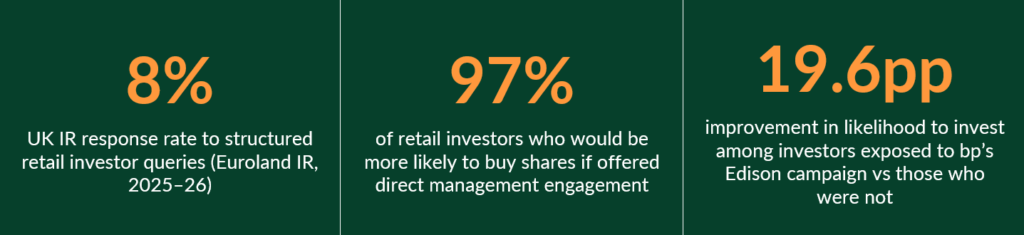
In the past year, Euroland IR posed as retail investors and sent simulated, but realistic queries, to IR teams across the UK, Nordics, Middle East and Asia Pacific. The UK response rate was 8%, and a similar response was observed in every region surveyed. Coupled with the fact that at this year’s Investor Relations Society Conference, only 17% of attending IR professionals described retail engagement as a genuine strategic priority; although, a further 43% acknowledged it as a growing area of focus.
Most IR teams know they should be doing more, but very few have built the programme they need to do it.
Exhibit 1: Retail investor engagement: The gap and the opportunity
Sources: Euroland IR research, 2025–26; New River Strategies Retail Investor Survey, 2026; Edison-bp campaign, 2025
Retail investors are not disengaged; they are underserved
A persistent misconception shapes how many companies approach retail engagement: because few retail investors read earnings reports or listen to earnings calls, they are not interested in engaging with the companies they own. And a New River Strategies’ retail investor survey seems to support this, finding that 83% of retail investors rarely or never read earnings reports and 90% rarely or never listen to earnings calls. However, the same research also found that 65% of retail investors would actively welcome direct communication opportunities with management. Furthermore, 97% said they would be more likely to buy additional shares if that engagement were offered.
Retail investors are not passive; they are simply not being communicated with in formats that are designed for and appeal to them.
What best-in-class looks like
The IR teams moving from obligation to opportunity share three characteristics. First, they are proactive, reaching out to retail investors rather than waiting for enquiries, using digital channels, third-party distribution and independent research to extend their reach beyond the immediate shareholder register. Second, they are channel-appropriate, communicating in formats retail investors actually use, such as short-form video and AI-discoverable content, using direct management engagement rather than regulatory announcements and PDF presentations designed for institutional consumption. And third, they measure what they do, tracking engagement, sentiment shifts and the downstream effects on shareholder behaviour.
Investing in retail shareholder engagement delivers significant returns for the IR team and their company. Analysis of shareholder meeting participation shows that retail shareholders vote at nearly twice the rate when active engagement strategies are deployed compared with those left to engage on their own initiative.
What is possible with active engagement strategies
In 2025, bp partnered with Edison to reach US retail investors through a digital campaign combining independent analyst research, targeted digital distribution and investor sentiment measurement. The first wave, focused on two demographically distinct US markets over six weeks, reached 11.6 million unique investors and delivered 41.8m impressions.
The sentiment data evidenced the impact directly. Recognition of bp as a ‘long-term stable operator’ increased by 8.5pp among investors exposed to the campaign compared with those who were not; financial discipline perception improved by 6.6pp; and stated likelihood to invest improved by 19.6pp. The investment case was not simply communicated – its impact on investor conviction was tracked, measured and evidenced.
The opportunity ahead for IR
The retail investor base is growing in number, sophistication and influence. The new retail investor is younger, more digitally native and more willing to engage directly with listed companies than the traditional stereotype suggests. For IR teams, that is not a challenge to be managed but a capital base to be cultivated.
The companies that build structured retail engagement programmes now will find that loyalty, stability and long-term shareholder support compound over time. The companies that wait and remain perpetually reactive, risk missing the opportunity to engage with a significant and growing source of patient, committed capital.
To find out how Edison helps companies build meaningful engagement with their investor base, visit edisongroup.com.