Noctiluca — 3 videos in collection
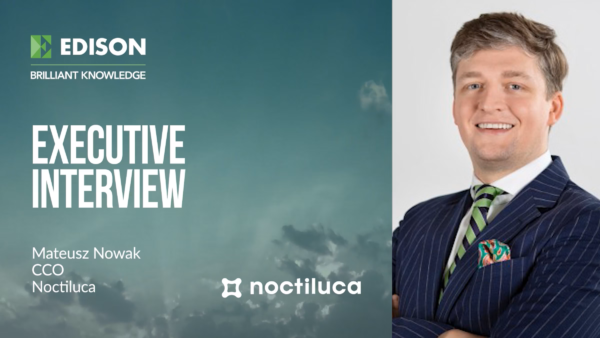
In this interview, we speak with Mateusz Nowak, chief commercial officer and board member of Noctiluca, who discusses the company’s progress towards commercialising NCEIL-4, its advanced material for organic light-emitting diode (OLED) displays. The lead programme has moved from proof-of-concept towards proof-of-performance, with Noctiluca increasing production 100-fold and raising material purity from 99.6% to 99.95%. Independent testing within the lead customer’s supply chain has demonstrated significant improvements in OLED lifetime, while validation has broadened to four applications across a pipeline of 15 partners. Management expects mass-production-line testing during Q426, formal qualification in late Q426/Q127 and, subject to successful customer audits, repeatable commercial deliveries during H227. Nowak also discusses investment in physical vapour deposition (PVD) equipment and manufacturing capacity in Poland, intended to accelerate future product development, together with grant and institutional funding designed to finance the company’s transition towards commercial-scale supply.
Noctiluca is a Polish material science company developing and supplying advanced chemical compounds for OLED displays. Its materials target applications including smartphones, monitors, televisions, wearables and VR and AR devices, with its portfolio spanning emitters and charge-transport and injection materials. The company has been listed on the Warsaw Stock Exchange Main Market since December 2024.
How significant is the progress you have made towards industrial qualification with your lead customer?
Mateusz Nowak: I believe the progress we have made in that relationship is very significant. At the end of Q1, we had almost completed the industrial checklist. Following the second quarter, I can confirm that we have now fully met the industrial requirements. That has meant increasing our production by 100 times in the first half of this year, while at the same time increasing the purity of our product from 99.6% to 99.95%. This is a last-mile challenge, where every incremental improvement becomes increasingly difficult. This is the point where we are moving from proof-of-concept to proof-of-performance.
How is the relationship with your lead customer expanding into its supplier ecosystem?
Mateusz Nowak: Our most important partner has been testing our material for quite some time. At the same time, its leading supplier, a leading OEM, independently started testing our material in Q2. That has developed into the largest testing programme we have ever undertaken with a single partner. The OEM has demonstrated that using NCEIL-4 as an electron injection layer material can improve lifetime by more than 100%, and in some cases by up to 200%. It has also seen a clear benefit from using our material as an ETL [electron transport layer] dopant, delivering lifetime improvements of between 30% and 60%.
We have significantly strengthened the relationship and have now met the entire decision-making structure, from the CTO through to the engineering teams. Those increased interactions have, in our view, saved us around nine months of R&D and more than $1m of unnecessary development costs. Instead of developing in the dark, we now exchange know-how with the customer in both directions, which allows us to move faster. This is the domino effect in action. One qualified customer can open the door to its entire supply chain, and I believe we could see a similar pathway with our other partners.
What are the key milestones from here to repeatable commercial shipments?
Mateusz Nowak: The next steps are very clear. Q2 and Q3 are focused on repeatability testing, where we need to confirm and reproduce the results achieved during the R&D stage. You need to reproduce those results two, three or four times to demonstrate that they are repeatable. In Q4, we expect to move into mass-production-line testing. This in-line validation could initially take 10–20 days, although the overall validation process could extend to around two months. In late Q426 or Q127, we expect formal qualification of the material for mass production. During H127, we would then expect customer audits covering areas including quality, health and safety, supply chains and financials. That would position us in H227 to serve the customer with repeatable commercial deliveries. What this means is that we appear to have shortened the standard business development cycle from three to five years to around two to two-and-a-half years.
How broadly is NCEIL-4 now being validated across the OLED market?
Mateusz Nowak: There is a link between this and the previous question. Moving from R&D into production is never a straight line. In business, we like linear development and events that we can predict one after another. With deep technology, sometimes you take two steps forward and one step back. Fortunately, that has not happened so far with any of the 15 partners in our active pipeline.
At the beginning of the year, we had solid validation from one partner. We now have four separate validations across smartphone applications; IT displays, including monitors and laptops; passive-matrix OLED; and micro-OLED applications for VR [virtual-reality] and AR [augmented-reality]. We also now have two formal joint development projects running with a Chinese IT OLED player and a Chinese micro-OLED matrix manufacturer.
There are many other things happening within the pipeline, but to distil it into one sentence: we have 15 partners testing the material across four applications, demonstrating its broad applicability and four validations showing improved device lifetime. For us, that demonstrates that NCEIL-4 is not a single-shot bet. It has the potential to be a platform solution applicable across the industry.
What operational and manufacturing investment is needed to support scale-up?
Mateusz Nowak: To bring forward a high-performance product, you need the support system capable of delivering it. For us, that means building greater physics and engineering capability in-house in Poland. We want to bring small-scale OLED device construction and testing back to Poland. To do that, we need PVD, or physical vapour deposition, equipment. This essentially gives us the capability to build demonstrator OLED devices incorporating our materials, something we have previously been doing with our Asian partners.
Bringing that capability in-house could shorten the development cycle for a new material from two to three years to around one year. That would potentially allow us to deliver a major new material every year. NCEIL-4 has taken almost three years to develop and then build out the industry’s testing programme around it, so we want to shorten that cycle considerably. We are also expanding our chemical laboratory in Toruń, Poland, which will increase our manufacturing capabilities. Of those two investments, however, I believe bringing PVD equipment in-house is the one that puts us on a completely different trajectory in terms of product development and product delivery.
How does the latest funding support the next stage of Noctiluca’s development?
Mateusz Nowak: There are two parts to the answer. The first is non-dilutive financing through our grant portfolio. We currently have 12 awarded projects with a total project value of approximately PLN30m, translating into around PLN20m of grant funding for Noctiluca. That is more than double our grant base within a year. It is not our business model to live off grants. We are using this source of funding to help us reach commercial sales. It also enables us to increase investment and make those investments faster by having more capital available.
The second element is the term sheet we have signed with institutional investors NCBR Investment Fund and IGS Investment. I believe these two funding pillars can fully finance the planned engineering PVD system and the increased production capability we need, without creating immediate pressure for further dilution. They also give us greater flexibility if the R&D process does not develop completely linearly or slows at certain points.
What we are doing is future-proofing the company. Our product is progressing towards commercialisation, and we are using that momentum to secure longer-term stability. We want to move faster with the PVD equipment and new product releases, but we also need to be ready for large-scale orders and able to service our customers. We have expanded our teams in both Asia and Poland, and with this funding we believe we will be ready to fully service accounts that materialise next year.
What does success in 2026 look like for Noctiluca?
Mateusz Nowak: I hope that 2026 will prove to be a transformational year for us, moving from being a deep-tech technology company towards becoming an industrial player. That is our ambition and our goal.
This transcript has been lightly edited for clarity and readability. Verbal fillers, false starts and minor repetitions have been removed from the interviewees’ responses only. Punctuation, spelling and formatting have also been standardised in line with Edison house style. No substantive changes have been made to the meaning of the discussion.