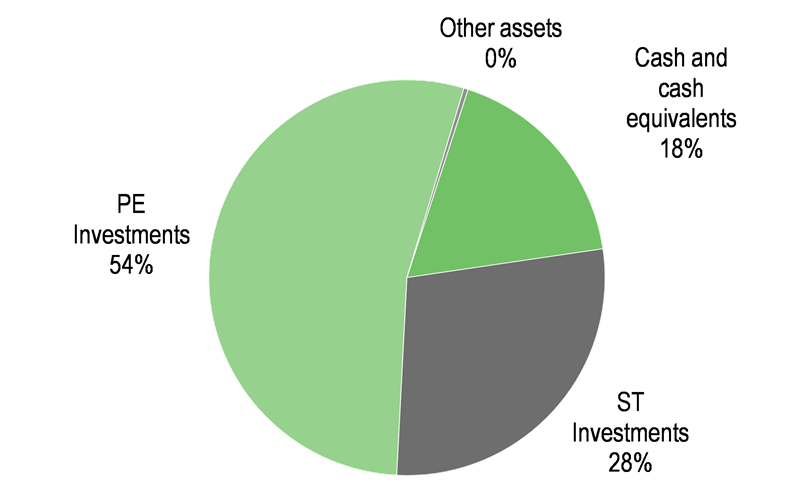
Is Private Equity (ISGSY) makes direct private equity investments in mid-sized Turkish companies with the aim of providing capital gains and attractive dividends. 2016 was a year of considerable uncertainty in Turkey, creating challenging market conditions for ISGSY’s investee companies and for the wider Turkish economy. Despite this, valuations have remained resilient, with a like-for-like fall of 2.5% versus a reduction of c 4% in 2015, which was arguably a less turbulent year. Including a further TRY10m investment in one of its leisure businesses, PE investments comprised 54% of total assets at 31 December 2016, up from 51% at the end of FY15. The discount to NAV remains over 50%, but further political stabilisation following a referendum in April 2017 could cause this to narrow.
Written by
Is Private Equity |
Weathering a storm |
Full year results |
Investment companies |
17 March 2017 |
Share price performance
Business description
Next events
Analysts
Is Private Equity is a research client of Edison Investment Research Limited |
||||||||||||||||||||||||||||||||||||||||||||||||||||||||||||||
Is Private Equity (ISGSY) makes direct private equity investments in mid-sized Turkish companies with the aim of providing capital gains and attractive dividends. 2016 was a year of considerable uncertainty in Turkey, creating challenging market conditions for ISGSY’s investee companies and for the wider Turkish economy. Despite this, valuations have remained resilient, with a like-for-like fall of 2.5% versus a reduction of c 4% in 2015, which was arguably a less turbulent year. Including a further TRY10m investment in one of its leisure businesses, PE investments comprised 54% of total assets at 31 December 2016, up from 51% at the end of FY15. The discount to NAV remains over 50%, but further political stabilisation following a referendum in April 2017 could cause this to narrow.
To 28 February 2017 |
Price total return |
NAV total return* |
LPX Direct Index TR (%) |
BIST 100 Index TR (%) |
One year |
16.7 |
0.4 |
52.1 |
18.2 |
Three years |
(28.0) |
4.2 |
89.1 |
49.7 |
Five years |
24.3 |
78.0 |
257.4 |
62.8 |
Seven years |
140.3 |
128.7 |
365.4 |
104.5 |
Note: ISGSY and BIST 100 Index TR from Bloomberg. Note: LPX Direct is a global index of listed private equity companies that pursue a direct private equity investment strategy. All data are calculated in TRY. *ISGSY NAV is calculated at fair value.
NAV remains flat despite headwinds
NAV of TRY256.2m at 31 December 2016 was up TYR1.1m (0.4%) on the previous year-end. Fair value losses of TRY3.5m on the private equity investments were less than the TRY4.7m seen in FY15, while finance income rose slightly (TRY14.8 vs TRY14.5), helping to offset cost increases of 6.3% to TRY10.3m (FY15: TRY9.7m). Last year witnessed several major terrorist attacks, an intensification of the wars in Iraq and Syria to the south and an attempted coup in Turkey, followed by a period (which is ongoing) of government consolidation of control. In the face of these developments, the steady performance of ISGSY’s NAV was a positive outcome.
Little news on investments
Perhaps unsurprisingly considering the background, there was no new investment activity, beyond a capital increase by Numnum, the restaurant and coffee shop business, which was entirely covered by ISGSY, taking its stake to 83.6%; and a small top-up payment to cover adjustments to the acquisition price of the 20% investment in Tatil Budur, an online domestic tourism company. There were no disposals either, although we note that the company has increased its cash weighting by selling fixed income investments.
Valuation: Slightly narrower discount
A year ago ISGSY was trading at a discount of c 53% to NAV, which has decreased slightly to 52% as of 28 February. Although this change is small, it does reflect a positive trend since October 2016, which is also reflected in the BIST 100 index. While political uncertainty remains high, there are signs that sentiment has improved since the attempted coup: the BIST 100 index has risen around 25% since July 2016.
|
Exhibit 1: Is Private Equity at a glance |
|||||||||||||||||||||||||||||||||||||||||||||||||||||||||||||||||||||||||||||||||||||||||||||||||||||||
|
|||||||||||||||||||||||||||||||||||||||||||||||||||||||||||||||||||||||||||||||||||||||||||||||||||||||
|
Source: ISGSY, Bloomberg, Edison Investment Research. Note: Dividend history has been adjusted to account for bonus issues, the last of which increased the share count from 66.6m to 74.7m and was announced at the AGM on 26 March 2014. |
|||||||||||||||||||||||||||||||||||||||||||||||||||||||||||||||||||||||||||||||||||||||||||||||||||||||
Company description
ISGSY was established in 2000 following the decision by Turkey’s biggest private bank in terms of assets (Is Bank, which had assets of TRY312bn at 31 December 2016) to form a private equity vehicle to invest in and support Turkish SMEs with high growth potential. It was listed on the Borsa Istanbul in 2004 when shares representing 37.7% of the company were offered in an IPO. Is Bank affiliates control 57% of the shares. Is Bank is Turkey’s national bank, having been established by Ataturk in 1924, and the support of this highly respected and substantial institution as a shareholder is valuable.
After an initial period of research and fund-raising, ISGSY made its first two investments in 2002 and has now made a total of 17, with 11 exits, realising US$166.9m on investments totalling US$135.6m. The company calculates an IRR from its exits of 26.5% on a dollar basis. It currently has TRY139.3m of investments in six private companies, TRY45.7m in cash and bonds, and fund and listed equity investments totalling TY72.9m, implying total investible resources of TRY118.6m. ISGSY itself has no debt, although its investee companies do.
The investment case
Central to ISGSY’s investment case is the performance of the Turkish economy, in particular the unlisted SME sector that forms the bulk of it: Eurostat estimates that SMEs now account for 53% of total added value and 74% of all jobs in Turkey. While the national and regional political environment has made for difficult trading conditions for many companies, the economy is estimated to have grown by nearly 3% in 2016 despite this (the IMF estimates 3.28% and the European Commission 2.7%) and remains on a growth trajectory: several major international agencies forecast higher growth in 2017 and 2018.
|
Exhibit 2: Annual GDP growth in Turkey |
|
|
Source: Average of World Bank, IMF, UN, EC and OECD data and projections |
The same observers whose forecasts are used in Exhibit 2 expect inflation to fall from 2017 onwards (Exhibit 3), although we would expect upward revisions to these stances following the increase in inflation in Q416 to c 10%. The OECD expects interest rates to rise in response, forecasting 8.3% in the short term (up from 8% currently). While the Turkish central bank increased borrowing and lending rates in January, it left the policy rate unchanged.
|
Exhibit 3: Turkey inflation projections |
|
Source: Average of World Bank, IMF, UN, EC and OECD data and projections |
While the BIST 100 and the wider Turkish stock market have also shown resilience through 2016, ISGSY offers access to growth that is not directly available through investments listed on the Borsa Istanbul. Other aspects of the investment case include:
■
a seasoned management team, with considerable experience in Turkish private equity and has overseen an IRR of 26.5% on investments in that time in US$;
■
considerable balance sheet resources and no debt, reducing risk and providing flexibility at a time of uncertainty that may present opportunities; and
■
the shares currently trade at c TRY1.65, which represents a 52% discount to the NAV per share of TRY3.43, potentially making them attractive to investors. Cash and short-term investments represent 46% of assets (TRY118.5m, or TYR1.60 per share) and liabilities are only worth TRY0.04 per share, which means the PE investments are effectively priced at 12 kuruş, or 6% of their book value. A recovery in sentiment could see that wide discount narrow significantly.
Investment strategy, process and resources
ISGSY’s strategy is to invest in Turkish SMEs with strong growth prospects, good historical performance, with the potential to become a significant player in their sector and typically with some exposure to foreign markets. ISGSY looks for investments with sustainable growth and operational improvement opportunities. When assessing growth prospects, the team targets companies that operate in growth markets and can capture additional market share. Most investments are equity stakes, although convertible debt or a structured mix of debt and equity are considered. Investments mainly take the form of growth capital and buyouts, but may be project-based restructuring transactions. Other criteria include:
■
Average investment size of TRY10-40m.
■
Operational profitability and realistic growth forecasts.
■
A strong and committed management team, which can make decisions quickly.
■
A business plan with genuinely differentiated products or services.
■
Sustainable competitiveness and market share.
■
Clear exit opportunities.
ISGSY is sector agnostic, but focuses on niche sectors with growth potential and structural drivers based on long-term trends, such as data centres and online travel agencies. It tends to take majority stakes to establish control, but will co-invest if the size of the required investment is above its preferred range. ISGSY will consider taking a minority stake in other circumstances too, but will make secure exit provisions and establish reserved matters to make sure that any decisions taken in running the investee company are in line with ISGSY’s own plans and strategy.
ISGSY has a team of 12 investment professionals with broad experience in consultancy, strategic planning, corporate finance, operational management, venture capital, risk management and industry. They are led by Murat Özgen, who has been at ISGSY since 2002 and became CEO in 2006. The team screens c 150-200 opportunities a year and aims to achieve an IRR of 15-20% in US$ terms over a three- to seven-year investment horizon. If a company passes the initial screening process, a more detailed assessment is carried, out which includes research into the wider sector, competitor analysis and benchmarking, calls with management and to referees as well as financial and commercial analysis. ISGSY seeks to introduce competitiveness, superior management and reporting processes, and to foster leadership in portfolio companies to bring depth to the management team.
The investment team works up its own deal entry forms and investment proposals on each target company before approving (or not) each proposal internally. Successful proposals are then presented to the investment committee, which may make a recommendation to the board of directors that is responsible for the final decision. After a deal has closed, ISGSY places representatives on the investee company’s board and monitors the company until a decision to exit is made and executed. ISGSY does not become directly involved in the day-to-day management of its investees, but does seek to determine strategy, will replace senior management if necessary and help create the most suitable capital structure for the company. ISGSY has made 11 full and two partial exits so far, earning US$ IRRs 42.0% and 21.6% on the partials exits from Nevotek and Radore respectively.
In Exhibit 4 we show ISGSY’s investments and exits since formation. Exit proceeds total US$166.9m from US$72.5m of invested capital, a money multiple of 2.3x. Current investments have a carrying value of US$38m.
Exhibit 4: ISGSY Investments and exits
Year |
Name |
Sector |
Investment ($m) |
Exit date |
Years owned |
Exit ($m) |
IRR |
ROI |
2002 |
ITD |
Telecoms & IT |
1.9 |
2010 |
8 |
4.2 |
11.8% |
128.0% |
Probil |
Telecoms & IT |
3.2 |
2011 |
9 |
4.2 |
3.1% |
31.0% |
|
2003 |
Cinemars |
Consumer |
11.5 |
2006 |
3 |
19.4 |
30.3% |
69.0% |
Nevotek |
Telecoms & IT |
3.0 |
||||||
2004 |
Step |
Consumer |
3.5 |
2008 |
4 |
6.8 |
19.0% |
93.0% |
2005 |
Tuyap |
Consumer |
7.0 |
2007 |
2 |
10.8 |
45.8% |
54.0% |
2006 |
Beyaz |
Services |
4.0 |
2008 |
2 |
8.8 |
58.7% |
119.0% |
2007 |
ODE |
Services |
5.0 |
2012 |
5 |
10.5 |
17.0% |
110.0% |
Ortopro |
Healthcare |
14.5 |
||||||
Turkmed |
Healthcare |
2.5 |
2013 |
6 |
0.2 |
N/A |
-90.0% |
|
2008 |
Dr Frik |
Healthcare |
13.4 |
2011 |
3 |
30.5 |
34.6% |
128.0% |
2009 |
||||||||
2010 |
Havas |
Services |
10.8 |
2012 |
2 |
19.7 |
26.7% |
82.0% |
2011 |
Aras Kargo |
Services |
9.8 |
2013 |
2 |
51.9 |
165.0% |
428.0% |
2012 |
Toksoz Spor |
Consumer |
15.9 |
|||||
Numnum |
Consumer |
15.0 |
||||||
2013 |
||||||||
2014 |
Radore |
Services |
7.9 |
|||||
2015 |
Tatil Budur |
Consumer |
3.6 |
|||||
2016* |
Numnum |
Consumer |
2.7 |
|||||
Tatil Budur |
Consumer |
0.3 |
||||||
Total |
135.6 |
4 |
166.9 |
26.46% |
130% |
Source: ISGSY, Edison Investment Research. Note: *Both 2016 investments were increases to existing investments.
The six current private equity investments are detailed in Exhibit 6 on page 7 and had an average value of c US$9m on investment. Of these only one is a minority stake (Radore) and one is a co-investment (Tatil Budur), meaning that with its co-investor, it has a controlling stake. Significant developments at investee companies in 2016 are detailed below and Exhibit 5 shows the valuation change of the PE portfolio in 2016. The summaries are followed by a table describing the investments.
|
Exhibit 5: Change in value of PE portfolio (TRYm) |
|
|
Source: Company data, Edison Investment Research |
Tatil Budur – online travel: under the original terms of the acquisition of ISGSY’s 20% stake, share price adjustments were to be made after the original consideration was paid. As a result, ISGSY has paid a further TRY0.94m to the former owners of its stake, taking the total amount invested to TRY11.3m. Tatil Budur (referred to in ISGSY’s accounts as Tatil Budur) also saw a valuation increase in the year despite a narrowing of the discount rate range applied and a reduction in assumed growth. This reflects the continued success of the business and is helped by its limited exposure to foreign tourism in Turkey, which has suffered due to security issues and a recently ended travel embargo by Russia. Tatil Budur underwent management changes in 2016 and a new CEO has been recruited. The company has also rebranded with a new logo and restructured its online platform before the start of the early reservation season.
Radore – data centres: Radore continues to grow both in terms of its data centre, capacity utilisation and clientele, continuing a trend from 2015 and remaining one of the largest data centre operators in Turkey.
Numnum – four restaurant brands and one coffee shop brand: The leisure sector in general has been affected by the dip in consumer confidence and macroeconomic developments in Turkey in 2016. ISGSY was the only participant in a capital increase of TRY10m in November 2016 to fund continued expansion of the business. Although the commercially sensitive details of those expansion plans have not been made public, we understand that further restaurants and coffee shops may be opened and that a new brand or dining concept may be in the pipeline. In addition, Numnum aims to focus on efficiency and cost control in 2017. The increase took ISGSY’s stake from 61.7% to 83.6%. Aside from the capital increase, the value of ISGSY’s existing stake in Numnum also grew by 11.7%, reflecting better growth prospects and despite a slight increase in the discount rate used to value the company (details of the valuation assumptions are on pages 10-11.
Toksoz Spor – sports equipment and clothing: the business has been affected by the dip in consumer confidence in Turkey but remains one of the country’s leading online and physical retailers of sporting goods. The company aims to open new stores while closing unprofitable locations in 2017. Online sales grew 159% in 2016 and the company expects this growth to continue in 2017.
Ortopro – orthopaedic implants: having invested in December 2015, ISGSY is restructuring the business, bringing in new management, a new sales strategy and improving the quality of receivables. The previous seller network has been changed and more sales are being made direct to hospitals. From 3% of sales in 2015 and 18% in 2016, Ortopro aims for 50% of sales to be direct to hospitals in 2017. Ortopro is placing more emphasis on foreign sales too: it aims to augment its existing strength in the South American market with a drive into Eastern Europe and the Middle East.
Nevotek – IP convergence: Nevotek specialises in the interconnection of internet protocol (IP) telephony with IP television and connected real estate technology. In 2016 it performed slightly above the previous year with new revenues generated from cloud business. Nevotek has been developing new software aimed at the hospitality sector which it intends to launch in the US in late 2017 or early 2018.
Exhibit 6: ISGSY private equity investments at 31 December 2016
Acquisition date |
Fair value (TRYm) |
Share (%) |
Description |
|
Nevotek |
30 Sep 2003 |
16.0 |
81.24% |
Nevotek, headquartered in Turkey, is a global player in IP convergence, covering IP telephony (IPT), IP TV and connected real estate technology for use in hospitality, healthcare, multi-tenanted real estate and public space management. Its platform allows the rapid development of unified applications across voice, data, video and building management. Nevotek has the largest client base in convergent IP with over 150 channel partners, 200,000 users and clients in 50 countries, including Holiday Inn, Crowne Plaza, Sheraton, US Air Force, W Hotels, Royal Caribbean, Le Meridien and SABIC. Nevotek aims to launch new software targeting the leisure sector in late 2017 or early 2018. |
Telecoms & IT |
||||
Ortopro |
10 Dec 2007 |
23.5 |
83.64% |
Ortopro is a Turkish orthopaedic implant company. It runs a modern production facility with 2,750m2 of closed space in Izmir. In addition to sales of its own brands in Turkey and international markets, Ortopro serves as a contract manufacturer to global orthopaedic companies. In 2016 Ortopro’s exports represented 46% of total revenues. It now offers a complete product portfolio to local hospitals through its retail network and direct sales to more than 50 hospitals. Ortopro creates barriers to entry in its manufacturing product groups from its cost advantages and R&D. The production provides significant cost benefits compared to US and European players due to lower employee costs. Production in Turkey also has the advantage of a skilled labour force and rapid delivery time compared to Far Eastern players. |
Healthcare |
||||
Toksoz Spor |
13 Nov 2012 |
31.6 |
55.00% |
Toksoz Spor is a leading sporting goods retailer and wholesaler in Turkey. It is the distributor of popular global sports brands in the Turkey region. Wholesale customers include hundreds of dealers over all of Turkey’s cities, department stores, other sports retailer chains, sports clubs, universities and sports federations. Toksoz Spor sells more than 100 brands, including the most popular global brands, in its 30 retail stores located in 17 cities. It has become the multi-brand sports retailer with the highest floor area (c 22,000sqm) in Turkey since ISGSY’s investment. |
Consumer |
||||
Numnum |
5 Dec 2012 |
36.2 |
83.57% |
Istanbul Food and Beverage Group (IFBG) is a leading Turkish restaurant service and gastronomy company operating under five major brands: Mikla, Numnum, Trattoria Enzo, Terra Kitchen and Kronotrop. Mikla is an upscale fine dining restaurant, a forefront of the contemporary dining scene of Istanbul, serving new Anatolian cuisine in the historic Pera region. Mikla’s wine menu won an Award of Excellence from the wine magazine Wine Spectator for four consecutive years between 2011 and 2014. In 2015 and 2016 Mikla was rated 96th and 56th best restaurant in the world respectively by the World’s 50 Best Restaurants Association. Numnum is a full-service casual restaurant chain, serving American/Italian cuisine. It operates nine successful stores, four in Istanbul (Levent Kanyon, Umraniye Meydan, Brandium Atasehir and Akasya Acıbadem) and four franchise restaurants in Ankara (Panora, Gordion, Armada and Tepe Prime) and another franchise restaurant in Bursa. Trattoria Enzo opened its doors in 2014 in an upscale shopping mall of Istanbul Akasya AVM, and serves “home-made” Italian food. Terra Kitchen, a casual self-service concept, has the motto “eat well, feel good”. Kronotrop is an upscale speciality coffee roastery and bar located in a trendy venue in Istanbul’s, Cihangir, Maslak and Atasehir districts, and also operates a roasting facility, R&D and training centre in Maslak. |
(Istanbul Food and Beverage Group IFBG) |
||||
Consumer |
||||
Radore |
1 Dec 2014 |
18.3 |
25.50% |
Radore provides data centre services in Turkey, including co-location, dedicated cloud, web hosting and domain sales. Established in 2004, it offers data centre solutions to over 1,750 clients, including both individuals and corporations, to meet the emerging requirements of the growing data processing and internet economy in Turkey. Radore made its first data centre investment in 2005. According to Deloitte Technology Fast 50 rankings, Radore was the fastest growing data centre in Turkey in 2012, 2013 and 2015, and is among the top 10 fastest growing technology companies in Turkey in the same period. Currently hosting more than 2,100 servers, and with the investment supporting a capacity of up to 10,000 servers, Radore is one of the largest independent data centre companies in Turkey in terms of revenues. ISGSY expects the data centre market to expand with international demand, in addition to the growing potential in Turkey. The growth in the sector is expected to be driven mainly through corporates shifting from internal to external data centres. |
Services |
||||
Tatil Budur |
6 Nov 2015 |
13.7 |
20.00% |
Tatil Budur is a leading Turkish tour operator focused on the domestic market. It owns Tatil Budur, which is among the country's largest online holiday booking agencies. It markets and sells its services under six general categories: domestic hotels, corporate travel organisations, outbound tourism, flight tickets, cultural tours and transport services. The main operation is domestic hotel bookings: it has access to 2,500 hotels and ski resorts, on which it either has exclusivity, guaranteed room prices or price contingencies. |
Consumer |
||||
Total |
139.3 |
|||
|
Source: Company data, Edison Investment Research |
||||
Background and outlook
Geopolitics
As previously mentioned, the business environment in Turkey has been affected by geopolitical events over the last two years, and in 2016 in particular. Wars in neighbouring Iraq and Syria have led to the influx of c 3.5 million refugees, bringing a considerable burden on infrastructure and the economy, especially in the south of the country, as well as complicating relations with major trade partners such as the EU and Russia. The shooting down of a Russian military jet in 2015 by the Turkish army led Russia to impose economic sanctions and to cease flights to Turkey by its airlines, which had a significant effect on tourism, particularly to the Mediterranean coast of Anatolia. Turkey’s tourism revenues fell c 30% from 2015 to 2016 from $31.5bn to $22.1bn according to the Turkish Statistical Institute. Terrorist incidents linked to factions in the wars to the south as well as to Kurdish separatist groups have compounded the slowdown in tourism and affected domestic confidence. Most significant of all was an attempted coup in July 2016, which saw civilians take to the streets to put down a rebellion by parts of the army and police force aimed at removing the president from office.
The turbulence in Turkey which has prevailed since mid-2015 is now diminishing. The constitutional referendum set to take place in April is expected by many commentators to bring greater stability.
The economy
The Turkish economy has shown resilience to recent political turmoil, continuing to grow faster than the OECD as a whole and is projected to continue doing so. It is underpinned by favourable demographics, relatively low national debt (32.9% of GDP in 2015 and forecast to fall further) and well-developed financial and manufacturing sectors, particularly in textiles and automotives.
|
Exhibit 7: OECD and Turkish annual real GDP growth (%) |
|
|
Source: OECD |
In the short to medium term there are several challenges for the Turkish economy:
■
Inflation remains a problem for the central bank and had risen to over 10% year-on-year in February 2017 from c 7% a year earlier; this has been driven in part by a weak lira (down 17% in 2016 vs the US$) following the coup attempt.
■
Turkey has depended in the past on foreign investment to fund expansion and was highly attractive immediately after the financial crisis as a result of relatively low interest rates in developed markets. Rate increases in the US may be expected to reduce investment in Turkey, while increases in Turkey may not be conducive to economic growth.
■
The political situation hampers economic reform and increases business uncertainty, deterring investment. We note that if the electorate supports the government in the referendum, it may mark a return to political stability.
■
Current low consumer confidence, high unemployment (c 12% nationally and 20% among those aged 15-24) and high inflation are all headwinds to consumer-facing businesses. That said, economic growth is still expected to be c 3% per annum in 2017 and 2018; macroeconomic improvement would be welcome.
The resilience of the economy in 2016 is encouraging, as is the rapprochement with Russia and the end of its sanctions. Russia, Turkey and Iran have also co-operated to bring many of the factions fighting in Syria to negotiations in Kazakhstan and, while no resolution has yet been reached, holding the talks in itself marks some progress. Domestic and regional political instability may abate in 2017, which would be of benefit to the wider economy and, as noted above, GDP growth is expected. We show the historical interest rate, GDP and inflation data in Exhibit 8.
|
Exhibit 8: Turkish historical economic data |
|
|
Source: Turkish Statistical Institute |
Financials
ISGSY reports according to Turkish Accounting Standards (TAS), as per the Turkish Commercial Code. These require the company to present private equity investments at fair value on the balance sheet and to record changes in fair value in the profit and loss account, in line with practices in most other countries, and the summary balance sheet data in Exhibit 9 below is also IFRS compliant.
Exhibit 9: ISGSY summary balance sheet as at 31 December 2017
TRYm |
31 December 2015 |
31 December 2016 |
% change |
Cash and cash equivalents |
11.6 |
45.7 |
294% |
Short-term investments |
|||
Private sector bonds |
49.5 |
23.6 |
(52%) |
Governments bonds |
27.6 |
22.5 |
(19%) |
Investments funds |
22.7 |
21.8 |
(4%) |
Shares quoted on stock exchange |
4.7 |
5.0 |
6% |
Subtotal |
104.5 |
72.9 |
(30%) |
Other |
0.7 |
0.8 |
|
Current assets |
116.8 |
119.4 |
2% |
Long-term investments |
|||
PE Investments |
131.9 |
139.3 |
6% |
Other |
10.2 |
0.1 |
|
Non-current assets |
142.1 |
139.4 |
(2%) |
Total assets |
258.9 |
258.8 |
(0%) |
Liabilities |
3.8 |
2.6 |
(30%) |
Equity |
255.1 |
256.2 |
(0%) |
Equity and liabilities |
258.9 |
258.8 |
(0%) |
Source: Company data
Private equity investments comprised 54% of total assets, up from 51% a year earlier, following the increased investments in Numnum and Tatil Budur. The biggest changes are reductions in bond holdings and an increase in cash and short-term bank deposits, which provides liquidity and reduces exposure to volatility in Turkish fixed income markets. The relatively low level of PE investment gives ISGSY the flexibility to invest when it identifies further suitable opportunities, and we note that the cash and short-term investments also produce a yield from which the company is able to pay operating expenses without depleting its capital. Almost the entire balance sheet is funded by shareholders’ capital and ISGSY has no borrowings at group level, although investees do have debt.
The PE investments are valued by Ernst & Young with a discounted cash flow model and ISGSY publishes the discount rate and growth rate assumptions used for each portfolio company. These are reproduced below and show that growth rate ranges for the companies have been brought into line with each other (and narrowed in the case of Nevotek), and that discount rates have generally been increased, with Ortopro being the main exception, whose discount rate is now closer to that used for the others. The figures shown in Exhibits 10 and 11 are determined by ISGSY’s auditors.
Exhibit 10: ISGSY internal DCF valuation assumptions
Company |
Discount rate (%) |
Growth rate (%) |
||
2015 |
2016 |
2015 |
2016 |
|
Toksoz Spor |
16.6-17.6 |
17.4-18.4 |
4.5-5.5 |
5.0-6.0 |
Numnum |
16.8-17.8 |
16.9-17.9 |
4.0-6.0 |
5.0-6.0 |
Nevotek |
11.6-12.6 |
11.5-12.5 |
1.6-2.6 |
1.3-2.3 |
Radore |
14.1-15.1 |
15.0-16.0 |
4.5-5.5 |
5.0-6.0 |
Ortopro |
19.1-20.1 |
17.0-18.2 |
4.5-5.5 |
5.0-6.0 |
Tatil Budur |
16.0-22.0 |
19.1-20.1 |
7.5-9.5 |
5.0-6.0 |
Source: Company data, Ernst and Young
ISGSY has also provided a sensitivity table showing the effect of changes to the assumptions on the value of the investments. An increase of 0.5% in the revenue growth assumption would add TRY4.9m to their fair value, while a decrease of 0.5% would reduce it by TRY4.5m (Exhibit 11).
Exhibit 11: Fair value sensitivity of ISGSY’s private equity investments
TRYm |
Increase |
Decrease |
Annual revenue growth 0.5% change |
4.9 |
(4.5) |
EBITDA growth rate 0.5% change |
7.6 |
(7.6) |
Risk adjusted discount rate 0.5% change |
8.9 |
(8.2) |
Source: Company data, Ernst and Young
Profit and loss
We summarise the P&L in Exhibit 12, showing that the main negative contributor to the fair value of the PE assets was the decline in the value of Ortopro and Toksoz Spor, offset by gains in other investments and revenues from short-term investments and interest income. A detailed explanation of the declines in value is not available, but they are likely to be linked to 2016 profitability at those companies and we note the valuation assumption changes, which will have mitigated the declines.
Exhibit 12: ISGSY summary of P&L account
TRYm |
2015 |
2016 |
% change |
Increase/(decrease) in value of Toksoz Spor |
(0.2) |
(3.9) |
|
Increase/(decrease) in value of Numnum |
0.5 |
2.7 |
|
Increase/(decrease) in value of Ortopro |
(1.0) |
(9.9) |
|
Increase/(decrease) in value of Nevotek |
(4.2) |
2.9 |
|
Increase/(decrease) in value of Radore |
0.2 |
2.4 |
|
Increase/(decrease) in value of Tatil Budur |
2.4 |
||
Increase/(decrease) in FV of PE investments |
(4.7) |
(3.5) |
-26% |
Profit on sale of stake in Radore |
0.8 |
||
Other financial income |
14.5 |
14.8 |
|
Revenue |
10.6 |
11.3 |
7.5% |
Administrative expenses |
(9.7) |
(10.3) |
6.3% |
Other expenses (net) |
(0.0) |
0.1 |
|
Profit |
0.8 |
1.1 |
37.2% |
Average cash and short-term investments (TRYm) |
135.5 |
117.3 |
|
Average assets (TRYm) |
264.0 |
258.8 |
|
Yield on cash and investments (annualised) |
10.7% |
12.6% |
|
Administrative expense/total assets |
3.7% |
4.0% |
Source: Company data
Little information is publicly available about the trading performance of the PE investee companies; however, the accounts of Is Yatirim (ISMEN), which consolidates ISGSY’s majority-owned subsidiaries and equity accounts for Radore and Tatil Budur, do provide some colour. There were no significant corporate actions other than the capital increase in Numnum, so these give a sense of the trading results of Numnum, Nevotek, Ortopro and Toksoz Spor. These show gross profits rising, as costs of sales fell by more than revenues. Expenses were roughly flat year-on-year, meaning that the operating loss was reduced slightly, but the associates’ loss and net finance expense both grew, leading to a 16% increase in the loss before tax.
Exhibit 13: ISMEN 2016 P&L data showing consolidated ISGSY investees’ results
TRYm |
2015 |
2016 |
% change |
Revenue |
238.4 |
228.4 |
-4.2% |
Cost of sales |
(170.8) |
(159.1) |
-6.9% |
Gross profit |
67.6 |
69.4 |
2.6% |
Expenses |
(98.4) |
(97.9) |
-0.5% |
Operating profit |
(30.9) |
(28.6) |
-7.4% |
Associates |
(0.7) |
(4.1) |
|
Net finance income |
(7.7) |
(12.9) |
68.5% |
Profit before tax |
(39.2) |
(45.5) |
16.0% |
Source: Is Yatirim Menkul Degerler
At the ISGSY level these results have fed through to the overall decline in the fair value of the private equity investments (before accounting for the capital increase in Numnum) of TRY3.5m, 26% less than the TRY4.7m seen in 2015. Income from other investments (show as other financial income) was also higher than 2015, meaning that revenue was up 7.5%, more than the 6.3% increase in expenses and producing a profit of TRY1.1m for ISGSY.
Valuation
No Turkish private equity companies are currently included on the Morningstar database, which we use to compare company valuations, and for that reason we continue to use a selected group of closed-ended private equity funds that invest in emerging markets (EM) and are on the Morningstar database. Exhibit 14 shows their performance data in sterling. We have also made a comparison with larger and not EM-specific listed PE investors. This shows that ISGSY performed well before 2013, when the Gezi Park protests began in Istanbul, and lends support to the argument that an improvement in the Turkish political situation would be good for ISGSY’s share price, as well as the performance of its portfolio companies.
Exhibit 14: Selection of closed-ended quoted EM private equity companies
Group/investment |
Latest market |
NAV TR |
NAV TR |
NAV TR |
Latest discount |
Adamas Finance Asia Ord |
116.1 |
12.1 |
(59.6) |
(82.5) |
1.0 |
China Assets Ord |
411.0 |
(15.1) |
26.8 |
10.3 |
(74.4) |
East Capital Explorer Ord |
1,968.8 |
19.7 |
6.1 |
2.6 |
(24.4) |
Origo Partners Ord |
8.5 |
(22.8) |
(70.5) |
(84.1) |
(66.3) |
Symphony International Holding Ord |
482.8 |
13.5 |
61.4 |
60.9 |
(26.6) |
Simple average |
597.4 |
1.5 |
(7.2) |
(18.6) |
(38.1) |
Weighted average |
13.5 |
15.1 |
9.5 |
(30.8) |
|
IS Private Equity |
27.7 |
0.4 |
4.2 |
78.0 |
(51.3) |
Source: Morningstar. Note: Prices as at 28 February 2017 in £. China Assets is listed in Hong Kong and East Capital Explorer in Singapore.
ISGSY’s discount, although high at 52%, is fourth in the group and has narrowed from 56% a year ago. A comparison with the LPX Europe and LPX Direct indices (Exhibit 15) shows that while the post-financial crisis recovery in the discount was broadly similar for all three until mid-2013, ISGSY’s has widened considerably since, while the values of the indices have continued to approach NAV. That summer saw the start of overt political unrest in Turkey, which may explain the apparent change in sentiment towards ISGSY. The recovery since October 2016, although slight, may provide some comfort that the market sees signs of improvement in the political situation.
|
Exhibit 15: Discount to NAV progression |
|
|
Source: Bloomberg, Edison Investment Research |
Sensitivities
In the near term, we would point to political events, domestic and foreign fiscal policy and investment as sensitivities. We do not anticipate any exits from investments in the near term, so we would expect those to be longer-term factors, along with Turkey’s general economic health.
Short- and medium-term sensitivities
As is suggested by Exhibit 15, ISGSY is sensitive to the political climate in Turkey, which is likely to be because of the expected effect on its investees, as well as general sentiment towards Turkish investments. Clearly, considerable uncertainty remains, although this may be partially resolved by the referendum in April. The BIST 100, an index of 100 major Turkish stocks, has risen c 20% since early December, reaching two-year highs in March, which may be a sign of confidence returning to the market, perhaps reflected in the slight narrowing of ISGSY’s discount. However, we note that the BIST 100 contains several major companies with overseas revenues that have been helped by the strength of the US dollar.
In a similar vein, inflation and interest rates will affect the performances of ISGSY’s investees as well as the returns on its short-term investments and cash holdings, which have recently formed the majority of income and have covered the company’s expenses. We expect decisions on inflation control to be made by the central bank in the next month and an increase in interest rates would likely benefit ISGSY’s income and help control inflation, which would be favourable for its consumer businesses.
|
|
Research: Investment Companies
Utilico Emerging Markets (UEM) aims to generate long-term total returns from a portfolio invested primarily in operational and cash generative companies in emerging markets infrastructure and utility sectors. UEM typically holds about 60 to 90 high-conviction positions and is broadly diversified by both sector and geography; the manager has a long-term investment approach and aims to generate a 15% pa total return from each holding. More than 95% of the portfolio is invested in well-established businesses with 75% comprising companies paying a dividend. UEM has increased or maintained its dividend every year since launch in 2005.