Trade Estates REIC — New-generation retail assets

Trade Estates REIC (ATHENS: TRESTATES)

Last close As at 05/08/2026

EUR1.94

0.01 (0.41%)

Market capitalisation

EUR237m

More on this equity

Research: Real Estate

Trade Estates REIC — New-generation retail assets

Trade Estates REIC (TRESTATES) offers focused exposure to modern retail parks and new-generation logistics assets in Greece, Cyprus and Bulgaria. Demand for both sectors is driven by structural growth trends in retail spending, and both sectors are undersupplied. In Greece, Trade Estates is dominant in modern retail parks, where active management and deep sector expertise have delivered sustained value creation and enhanced returns. We forecast the company’s rapid growth to continue, supported by organic rental growth and an active pipeline of attractive developments.

Written by

Martyn King

Director, Financials. Property and Insurance

Real estate

Initiation of coverage

30 July 2026

Price €1.93
Market cap €235m

Net cash/(debt) as at 31 March 2026

€(265.2)m

Shares in issue

121.8m
Free float 31.0%
Code TRESTATES
Primary exchange ATHENS
Secondary exchange N/A
Price Performance
% 1m 3m 12m
Abs (3.4) 1.8 22.0
52-week high/low €2.0 €1.6

Business description

Trade Estates REIC is a Greece-based real estate investment company focused on the management and development of new-generation retail parks and logistics centres in Greece, Cyprus and Bulgaria, serving major retail tenants and e-commerce/supply-chain operators. The company aims to deliver attractive shareholder returns through a combination of recurring dividend income and capital growth.

Next events

Interim results

2 September 2026

Analyst

Martyn King
+44 (0)20 3077 5700

Trade Estates REIC is a research client of Edison Investment Research Limited

Note: NAV per share is EPRA net tangible assets (NTA).

Year end Net rental income (€m) EPRA earnings (€m) EPRA EPS (EUc) NAV/share (€) DPS (EUc) Yield (%) P/NAV (x)
12/24 36.5 15.6 12.9 2.59 10.00 5.2 0.75
12/25 38.4 22.4 18.6 2.82 13.00 6.7 0.69
12/26e 42.9 22.3 18.4 3.03 13.02 6.7 0.64
12/27e 46.2 23.8 19.6 3.24 13.51 7.0 0.60

Structural growth trends

In Greece, as elsewhere, consumers increasingly want convenience, value and flexibility, favouring retail destinations that combine easy access, broad choice and click-and-collect/omnichannel services. To meet this demand, Trade Estates combines new-generation omnichannel retail parks with modern logistics infrastructure that support physical shopping and e-commerce fulfilment within an integrated retail ecosystem. As a first mover in retail parks, Trade Estates has built an institutional quality, professionally managed portfolio of scale, in key retail locations, attractive to a broad range of retailers. The backing of Fourlis Group, which founded the company, was a key factor in establishing a strong platform and dominant market position, from which Trade Estates continues to deliver rapid growth and tenant diversification, and strengthen its institutional investor base. Fourlis remains the largest shareholder but no longer has a majority stake.

Clear path to further growth

Trade Estates has delivered strong growth since it was founded in 2021, increasing gross assets and DPS threefold, and we expect this to continue. Organic growth will be driven by long, inflation-linked leases, tight cost control and a low cost of borrowing. The main driver of further growth will be the €250m investment programme, which is around 50% complete. Three additional projects are expected to complete by end-FY28, adding more than €10m to annual rent roll. We look for a c 40% growth in EPRA earnings and funds from operations (FFO) from FY25 to FY30, with a 70% pay-out ratio delivering c 7% annual DPS growth.

Valuation: Attractive yield and total return

Trade Estates yields an attractive 6.7%, DPS is growing and well covered, and NAV has consistently grown. We forecast continuing strong growth as developments complete by end-FY28, representing an average annual total return of 10–11%. Shareholder returns would be significantly enhanced by a narrowing of the c 32% discount to Q126 NAV, for which development progress is a potential catalyst.

Investment summary

Trade Estates’ modern retail parks, offering a cluster of retail offerings and attractive open space, are capturing spend from older, less convenient high street retail space, scattered big box stores and weaker centres. In combination with next-generation logistics infrastructure, they support both physical shopping and e-commerce fulfilment within an integrated retail ecosystem. Stores are chosen because they can drive frequent visits, appeal to a broad customer base and work well alongside anchor tenants, with the retail offering centred on necessity and value-driven shopping. While increasing demand and an undersupply of quality space support rental growth and occupancy, the retail environment is dynamic and the management team has the specialist retail skills needed to actively manage the portfolio to maximise value. Long inflation-linked leases and strong tenants underpin rental growth, turnover rent clauses provide participation in tenant trading growth and the defensive store sales mix offers downside protection. Trade Estates is by far the dominant player in the Greek retail park market and well placed for further growth. In the near term, around half of the company’s current €250m investment programme has been delivered, with three key investments expected to add more than 20% to end-FY25 gross assets of c €600m by end-FY28, supported by moderate gearing and attractive long-term financing.

Financials

Trade Estates has already delivered strong growth since listing in 2023. In the past two years, net rental income growth of 61%, combined with a lower cost ratio, has generated a 72% uplift in adjusted EBITDA.[1] Benefiting from lower net finance costs, FFO has increased 147% and dividends have increased 64% as the company settles into a sustainable pattern of distributions. We forecast further strong growth in the coming years will be driven by an increasing contribution from the recently completed development assets, including more than €3m a year from the Aspropyrgos Logistics Centre, alongside organic rental growth underpinned by inflation-linked uplifts and an active pipeline of further developments. We expect these to add more than €10m to gross rent roll when stabilised, or a blended average gross yield on cost of 6.8%, with a first revenue contribution in FY29. In combination, we forecast a c 40% increase in FFO in FY26–30 and assume a 70% pay-out of FFO, representing c 7% annual DPS growth.

Sensitivities

The key sensitivities and risks to our investment case primarily relate to external macroeconomic conditions and, internally, the company’s success in delivering on its development pipeline. In common with the real estate sector, an economic downturn in Greece or other operating countries would be likely to reduce rental income and/or property fair values.

Compared with rental activity, development and construction has particular risks, including planning delays, cost overruns, late delivery and leasing. Trade Estates has a successful track record of development and its use of joint venture (JV) structures, with experienced developers, mitigates early-stage risks but cannot eliminate them. The successful execution of Trade Estates’ development programme is dependent on access to funding, in addition to the cash flows generated from the operational portfolio.

Valuation

Trade Estates provides a yield of 6.7% (based on the FY25 dividend), the highest yield among Greek real estate investment company (REIC) peers, and a P/NAV of c 0.68x, which is broadly in line with the average. Compared with a wider peer group of European companies with a strong focus on retail parks/‘out of town’ retail and logistics warehouse assets, nearly all of which are materially larger, Trade Estates trades at a slight yield premium and a significantly larger discount to NAV. Since IPO, shareholders have received €0.245/share in dividends and IFRS NAV/share has increased 16% to €2.87, yet its share price is little changed. It has outperformed Greek REIC peers over the past year (up 13% versus an average decline of 4%) but this should be seen as a period of catching up. In our view, significant embedded value remains and we expect a further strong increase. Our forecast returns of c 10–11% per year represent a highly attractive shareholder return versus risk-free rates (Greek 10-year government bond yield of c 3.8%). Shareholder returns would be enhanced by a re-rating of the shares, and we expect progress with the development programme to be a key potential catalyst. The company’s enhanced financial presentation and active investor relations programme should also provide support.

A fast-growing specialist real estate investment company

Trade Estates REIC is a fast-growing Greek real estate investment company, established in 2021 by Fourlis Holdings and listed on the Athens Stock Exchange in 2023, with a strict focus on modern retail parks and new-generation omnichannel logistics, especially in Greece. These are growth sectors well-aligned with consumer trends, but under-supplied with suitable real estate.

While some more diversified Greek peers are also invested in these sectors, it is Trade Estates’ specialisation that really differentiates it. It is not just that the company is invested in growth sectors of the real estate market, but that the assets are actively managed by an experienced management team with deep roots in the retail sector. The retail sector is highly dynamic and maximising the value of the portfolio requires an ability to identify shifts in consumer behaviour and retailer performance. If executed successfully, this supports customer footfall and spending, retailer sales, occupancy, rental growth (including turnover rents) and asset values.

Trade Estates is fully integrated, operating across the real estate value chain, with a successful track record of acquiring, developing and managing a resilient portfolio of large-scale commercial properties across Greece, as well as Bulgaria and Cyprus.

Since it was formed, the company has become the dominant player in the modern retail park market, almost tripling its gross assets and almost doubling net assets. FFO and dividends per share have tripled. A fully funded development pipeline provides visibility of further strong growth through 2028.

Established by Fourlis in 2021 and listed in 2023

Fourlis is a leading retailer in Southeast Europe, holding exclusive long-term franchise and licence agreements with global brands such as IKEA, INTERSPORT and Foot Locker, combining international brand strength with the group’s deep local market expertise. To support these activities, it had built a portfolio of valuable property assets but recognised that these could be worth more, and grow faster, inside a dedicated listed REIC. Trade Estates came to market with a portfolio of assets and a scalable operating platform that would be all but impossible to replicate, providing immediate income to support dividends and a pipeline of opportunities to generate strong growth. From 100% prior to IPO, Fourlis has reduced its share of ownership to a non-controlling 47%, and no longer consolidates Trade Estates. This reduction in share ownership has been achieved by not participating in a growth equity capital raise at IPO and private placements to strategic shareholders. Meanwhile, as Trade Estates has continued to grow, the share of rents accounted for by Fourlis and its related partners has reduced to 44% at end-FY25 from 63% at listing and 94% at inception. It will fall further as new developments come on stream.

Strategy combines omnichannel retail parks with modern logistics

Trade Estates’ strategy is based on combining omnichannel retail parks with modern logistics infrastructure to support both physical shopping and e-commerce fulfilment within an integrated retail ecosystem. Its retail parks are situated in selected urban and suburban areas with characteristics such as high traffic, strong local populations, good road access, visibility and parking. The store sales mix is designed around everyday, practical retail, including categories such as food, home, DIY, sports, fashion, beauty, health and wellness, and family-focused value retail. Stores are chosen because they can drive frequent visits, appeal to a broad customer base and work well alongside anchor tenants. Typical store features include large-format units, easy access, clear visibility, free and convenient parking and a simple retail park layout, making the parks easy for customers to visit and easy for retailers to operate from.

Anchor tenants are the larger, well-known retailers and are the main traffic builders for the park. These may include supermarkets, DIY/home retailers, sports retailers, electronics or other essentials. The nature of these anchor tenants is important because they bring consistent footfall, increase customer confidence in the location, attract smaller retailers to the park and help support stable rental income.

The logistics centres are positioned to serve regional retail distribution, not just local warehousing. Existing centres in Oinofyta and Schimatari, to the north of Athens, supply and support online sales for IKEA and INTERSPORT stores in Greece and abroad. The newer InterIKEA international distribution centre at Aspropyrgos is even more clearly regional: it is intended to serve Southeast Europe and the Middle East, initially including Greece, Bulgaria, Jordan, Israel and Cyprus.

The structural tailwinds that support both the parks and the logistics centres are similar, being the growth of omnichannel distribution, consumer preference for convenience and an under-supply of institutional-quality real estate. Retailers increasingly need both customer-facing stores and distribution infrastructure that can support store replenishment, click-and-collect, returns and faster delivery.

In simple terms, the retail parks are where customers shop, while the logistics centres help ensure products can be stored, moved and delivered to those parks and other retail locations.

Trade Estates is a clear market leader

Greece is underserved by modern retail property stock, as a result of shifting consumer preference and a dearth of new supply over many years. Although data is hard to come by and there is no strict definition of what constitutes a modern retail park, it is quite clear that Trade Estates dominates the market. We believe that its share of available stock could be more than 75%. There will soon be 12 Trade Estates parks in Greece (including the Heraklion 2 and Hellinikon Retail Park developments but excluding the parks in Cyprus and Bulgaria), compared with a total stock of perhaps 12 to 15.

Modern retail parks, and Trade Estates’ portfolio, are characterised by:

  • Big-box retail format – large single-floor stores anchored by major domestic retailers and other national or international brands.
  • Open-air retail park design – customers access stores directly from outdoor parking areas rather than through an enclosed mall structure.
  • Destination and convenience retail – the parks are designed to attract both planned ‘destination’ shopping trips and everyday convenience-driven visits.
  • Strong accessibility by car – typically located near major roads or highways with extensive parking provision.

Of the 10 Greek retail parks currently in the portfolio, six are branded ‘Top Parks’.[2] Smart Park is also part of the Top Parks grouping, but maintains its recognisable brand and unique identity as a shopping destination. The Heraklion 2 retail park planned for development will also be branded Top Parks. The company will continue to focus on the brand, which to shoppers and retail partners represents a recognisable, standardised retail park platform rather than disconnected individual assets.

The operational portfolio

At IPO, the Trade Estates portfolio comprised 13 assets, including nine stabilised (ie established) retail parks and one under development (Top Parks, Patras, which opened in November 2024), and three stabilised logistics centres. The acquisition of Smart Park, Spata, had been agreed prior to listing but was completed after, in late 2023. Including Top Parks, Patras, and Smart Park, Spata, the gross asset value (GAV) at IPO was c €457m. The acquisition of Smart Park, the largest retail park in Greece, for c €110m was significant, transforming Trade Estates into the leading retail park REIC in Greece, and substantially diversifying its tenant base.

Including the newly developed Top Parks, Heraklion, which opened in April 2025, there were 15 operational and income-producing assets at the end of FY25, and 16 including the substantially completed logistics development at Aspropyrgos. Including Aspropyrgos, the fair value was €580m (83% retail parks and 17% logistics warehouse). End-FY25 GAV[3] was €601m and reached €603m at end-Q126.

Again including Aspropyrgos, the end-FY25 annualised rent roll was €45.3m, more than double the level at IPO, with a good level of occupancy (94%) and 9.7-year weighted average unexpired lease term.

In Greece, Trade Estates’ portfolio is well spread across the country’s key consumption and distribution corridors, but with a clear bias towards the largest urban markets. The retail parks are concentrated in Attica/Athens, with additional exposure to Thessaloniki and major regional cities such as Ioannina, Larissa, Patras and Heraklion, giving access to dense catchments, strong road infrastructure and established retail destinations. The logistics assets are also strategically located, particularly around Schimatari and Oinofyta, north of Athens, close to the Athens-Lamia motorway and the capital’s main distribution routes.

The retail parks in Bulgaria and Cyprus were part of the assets contributed by Fourlis Group at the company’s inception and provide a base for broader future expansion opportunities in these markets.

Smart Park is the largest single portfolio asset and a good example of Trade Estates’ ability to create additional value

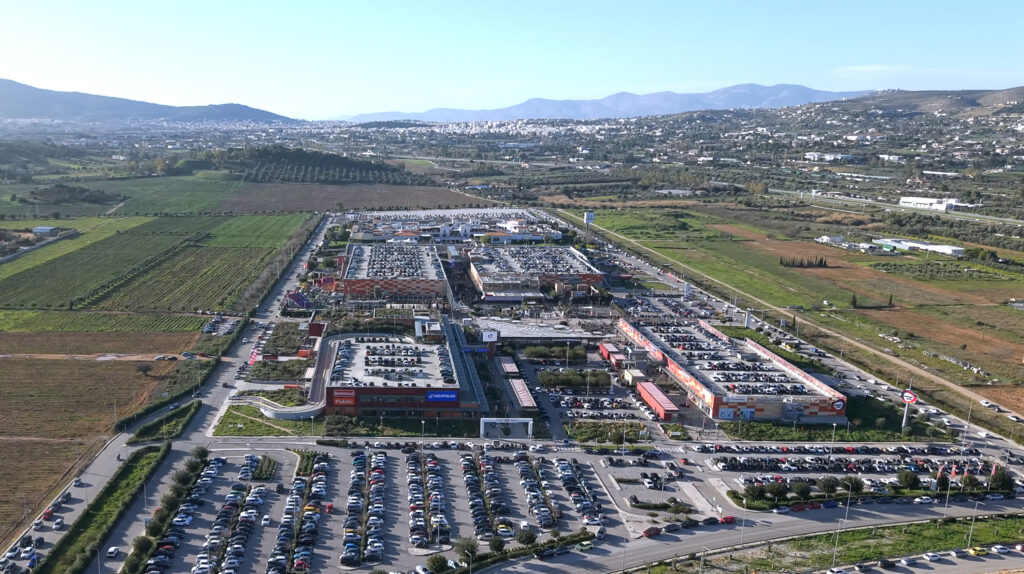
Smart Park is Trade Estates’ single largest asset, representing c 25% of total GAV, and is the largest retail park in Greece. It occupies a site of c 91,000sqm, comprising 51,000sqm of gross lettable area (GLA), 30,000sqm of green space and 1,500 parking spaces. It is situated near to Athens International Airport and the Designer Outlet owned by LAMDA Development. The two destinations offer distinct retail propositions, creating a successful synergistic relationship that enhances overall visitor appeal and footfall, thus creating a highly complementary retail ecosystem. A similar approach will be implemented at The Ellinikon, where Trade Estates is developing its retail park adjacent to the shopping mall being developed by LAMDA Development.

Smart Park is a high-quality asset, dominant in scale, well-located, diversified by tenant, attracting high footfall and enjoying consistently high levels of occupancy (99% at end-2025). It also provides a good example of the company’s ability to acquire strong assets at attractive prices and generate additional value through active asset management.

Smart Park had been developed and operated by REDS, a Greek real estate development company. At the time of the acquisition, the park had made a good recovery from the COVID pandemic and was trading well, but Trade Estates recognised the potential to enhance the park, refresh and optimise the tenant mix, and improve operational management.

Among the measures taken, the site was enhanced to create a family-oriented destination where customers visit not only to shop but also to enjoy events, play areas, cafés and restaurants. During 2024, Smart Park was fully integrated into Trade Estates’ operating platform, with centralised leasing, asset management, marketing and reporting. Supported by platform integration, the company’s retail skills and strong industry relationships, it was able to introduce new international/value retailers into the park, where necessary removing underperformers.

Having acquired Smart Park for €110m, the end-FY25 GAV was €149m. Over the same period, annualised rental income increased to more than €13m from around €11m, and footfall to more than 7m visits per year from 6m.

Strong occupancy and footfall

Occupancy across the retail park portfolio is generally strong, averaging 93% at end-FY25. The Top Parks Heraklion 1, which opened in April 2025, had quickly reached 81% occupancy and management expects to have leased the remaining available space by the end of the current year. Top Parks in Rentis was 87% let at the end of 2025 and negotiations to let available space are underway.

The operational performance of the retail parks is strong. Tenant turnover was more than €550m in 2025 and there were 24m visits to the parks. On a like-for-like basis in 2025, both tenant turnover and footfall grew by more than 7%. This growth continued in Q126, with like-for-like tenant turnover up 5% versus the prior year period, and footfall up by 6%.

Sustainability initiatives are a key part of asset management activity, making the portfolio greener and more aligned with the sustainability goals of tenants. The company has commenced a programme of installing rooftop photovoltaic panels across its assets and superfast electric vehicle charging in all parks.

Three operational logistics assets

The logistics warehouse portfolio comprises three income-generating assets, and a fourth recently completed development (at Aspropyrgos) that was delivered to the tenant in H126 and is expected to open soon. The development of a fifth asset is planned (Elefsina 2, see below).

The two largest income-generating assets, located in the region of Viotia in central Greece, are leased to Trade Logistics and are distribution centres to serve IKEA and INTERSPORT stores in Greece and abroad. Both the Schimatari (47,000sqm of GLA) and Oinofyta (33,000sqm) logistics centres are situated in strong locations, with good access to Athens and major transport links. They are modern, high-quality assets that provide secure, indexed-linked rental income. Of the two, Schimatari appears to be the higher specification asset. It has automated handling systems designed to move large volumes of goods quickly and efficiently, and strong environmental credentials supported by rooftop solar panels. This is reflected in significantly higher rental and capital values than for Oinofyta.

The third operational asset, at Elefsina (not to be confused with the large new development in the same location), is smaller than the Viotia assets (20,000sqm of GLA) and, although fully let to Eltrekka, Greece’s largest supplier of automobile parts, rents are relatively low and the asset generates only a modest share of portfolio income (c €0.3m). The asset nonetheless provides an established logistics footprint in what is a core logistics sub-market, and has a significant redevelopment and expansion potential, with an additional c 20,000sqm of remaining building area.

The Aspropyrgos Logistics Centre has been developed as an international distribution hub, to be operated by Trade Logistics, and to service InterIKEA’s activities across Greece, Cyprus and a range of Southeast Europe and Middle East markets. Its scale, technology and sustainability features set it apart from traditional logistics warehouses. Construction began in mid-2024 and recently reached practical completion. It will become income generating when tenant fit-out works are completed, expected around mid-year. Few details of the lease have been made public, but Trade Estates has said that it expects annual revenues of more than €3m, and we would expect rents to be annually indexed to inflation. Given the strategic importance of the centre to InterIKEA, it seems likely that the initial term would be in line with the upper end of the 10–20 years common in the sector.

A robust and increasingly diversified tenant base

A key objective of the listing of Trade Estates was to grow the portfolio and, in so doing, to diversify its tenant base by expanding the breadth and depth of its retailer relationships. Substantial progress has already been made. With its leading market position in a faster growing segment of the retail market, relatively low occupational costs (management indicates 7–8% of store turnover) and strong trading parks that are attracting increasing footfall and customer spend, Trade Estates is becoming a key partner for value and everyday retailers.

Fourlis and its related partners are still Trade Estates’ largest tenant, but their share of a growing rent roll has reduced noticeably since IPO and the direction of travel is clear. IKEA accounted for c 34% of portfolio gross rent roll at the end of FY25, down from c 46% when the company listed in 2023. Trade Estates does not lease space directly to IKEA, but to Fourlis subsidiary and franchise operator Housemarket. Space let to another Fourlis subsidiary, Trade Logistics, a provider of supply-chain logistics, accounted for 7% of the rent roll, or most of the logistics total.

While this represents a relatively concentrated tenant base, the strategic nature of the Trade Estates properties to the Fourlis long-term partnerships provides covenant strength and a solid underpinning to portfolio occupancy, and supports long-term occupation of the assets.

Not only has the third-party share of rent roll continued to grow, it has become increasingly diversified across a range of leading domestic and international retailers.


The development programme

Since IPO, Trade Estates has completed on three developments (the retail parks at Patra and Heraklion, and the logistics warehouse centre at Aspropyrgos), covering 171,000sqm of land and providing 78,000sqm of GLA, at a cost of €101m.

It has a near-term pipeline of three additional assets, covering 183,000sqm of land, providing 97,000sqm of GLA, with an estimated cost of €148m. These are expected to complete by the end of 2028, with €126m of remaining investment as of April 2026.

In addition, the company has an additional c 60,000sqm of buildable land.

The Hellinikon Retail Park is one of Trade Estates’ most high-profile future developments and forms part of the wider Ellinikon regeneration project on the site of the former Athens airport in southern Athens, combining luxury residential, hotels, entertainment, offices and major retail destinations. The retail park is adjacent to the Ellinikon Mall, the flagship retail and entertainment destination of the development. Consistent with Trade Estates’ strategy, it will be open-air and comprise large-format retail units, anchored to leading international brand tenants. Building permits were issued in March and construction is expected to commence around the middle of 2026, and the intention is that it will open broadly in parallel with the Ellinikon Mall, in the first half of 2029, so that the two assets operate as a complementary retail destination from launch.

Heraklion is the largest city on the island of Crete, with a substantial consumer population, and is the main entry point for tourists visiting the island. Top Parks Heraklion 2 is a planned second retail park asset for Trade Estates on the island, expanding the company’s existing footprint alongside the already operational Top Parks Heraklion. The existing asset is anchored by IKEA (it leases c 70% of the space) and already attracts strong customer traffic to the area. Heraklion 2 will extend Trade Estates’ retail park presence with nearby additional large-format retail space. In combination, the two assets should strengthen Trade Estates’ position in Crete by creating a larger cluster of institutional-grade retail park properties aligned with its wider strategy of owning large-format, open-air retail assets with long-term tenant income. Heraklion 2 is currently in the design phase and Trade Estates has commenced discussions with potential tenants. Construction work is expected to commence in the second half of 2027 and complete by the end of 2028.

The Elefsina Logistics Centre is currently at the pre-development stage as the required permits are sought. Trade Estates expects to commence construction in late 2027 and to be completed by-end 2028, contributing to revenues in FY29. The agreed tenant is Kotsovolos, Greece’s leading consumer electronics and electrical goods retailer, with a large nationwide retail footprint and growing omnichannel/e-commerce operations, making modern logistics infrastructure strategically important.

Both Aspropyrgos and Elefsina are important logistics hubs because they provide fast access to Athens, the Port of Piraeus and Greece’s main motorway network.

A successful record of development

Trade Estates is fully integrated, operating across the real estate value chain and this includes a successful track record of development.

Historically, developments have been undertaken through JVs with developers, with Trade Estates taking an interest of up to 50% before taking full ownership of the property as it approaches or reaches completion.

This structure shares development risks such as cost over-runs and delays, reduces upfront capital requirements and minimises income volatility. The developments at Patra and Aspropyrgos were undertaken in partnership with Dutch developer Ten Brinke, which was key to securing attractive land sites and managing the complex process of planning permissions and permits, with Ten Brinke also bringing significant expertise in design and construction.

In most cases, Trade Estates has contracted to acquire the completed asset in full, at completion, at an agreed yield, thus shielding it from cost escalation but also removing development margin upside. Having built its skill and experience in development, the company is gradually increasing its risk appetite.

The flagship Hellinikon Retail Park will be developed entirely by Trade Estates. The company agreed to acquire the land plot from LAMDA Development in 2022, when the Ellinikon project was at an early stage, at a price of €1,150 per sqm that now appears highly attractive. Recent land plot transactions on the project have been undertaken at more than €2,500 per sqm. Moreover, the majority of the €31m land cost is not payable until later this year, with construction expected to complete by end-2028. The park is immediately adjacent to the Ellinikon Mall and sits above the mall underground parking. From a construction point of view, for Trade Estates, this has removed any of the complex groundworks risk.

The Heraklion 2 retail park is also to be developed by Trade Estates, which acquired the land plot from Ten Brinke at the end of 2025.

Financing development

Trade Estates expects development spending of c €30–35m in each of FY26 and FY27, rising to c €65m in FY28. Of the total €129m, around a quarter is for land and the balance for construction. Most of the investment in land over the 2026–28 period is accounted for by the Hellinikon Retail Park and includes a second instalment of €25m in 2026 and a balance of €3m on completion.

The company plans to fund its development pipeline through a mix of long-term secured/bond debt, available bank facilities, operating cash flow and selective subsidised financing. No equity raising is expected.

As of end-Q126,Trade Estates had borrowings of €284.8m, down slightly from €285.0m[4] at the end of FY25. Given the more comprehensive data that is available for the year-end position, we will focus on FY25.

The borrowings comprise mostly long-term, secured, syndicated bank facilities (referred to as bonds), with an average maturity of more than seven years, and c €13m of short-term bridging finance to partially fund the development of Aspropyrgos. This will be repaid from the recently agreed long-term funding (see below).

Following a successful renegotiation of financing terms during 2025, lending spreads were reduced and the weighted average cost of debt was significantly reduced, to around 3.0% at end-FY25 versus 3.7% at end-FY24.

Two of the facilities at end-FY25 already benefited from highly attractive low-cost funding provided under the EU’s Recovery and Resilience Facility (RRF), and a third facility was approved in May. The facilities in place are a bond loan, which finances Top Parks, Patra (€18.6m), and the Mantenko bond, which finances Top Parks, Heraklion (€11.6m). Approximately one-third of the borrowing under these facilities is on normal commercial terms, but two-thirds is charged at a fixed 1% for 15 years. The fixed-rate portion of these facilities amounts to c €19.0m. The third facility of €29.7m will provide long-term financing for Aspropyrgos Logistics Centre. Similarly, around one-third of the facility is fixed cost, at a rate of just under 3%, above the rate on the earlier facilities but still highly attractive, and the balance is on commercial terms.

Adjusting for the fixed-rate funding, there is currently (before completion of the Aspropyrgos facility) €266.0m of floating rate debt, priced at a margin of 1.25% over EURIBOR. Of this, interest rate swaps of €205m have fixed the EURIBOR rate at a blended maximum rate of c 1.8%, expiring at various dates through 2028. As of Q126, 79% of borrowings were either fixed rate or hedged and the company expects a hedge ratio of c 90% by end-FY26, with a corresponding weighted average fixed cost of debt of c 3.12%.

We expect the company to maintain a high level of interest rate protection by expanding its hedging arrangements and negotiations are advanced for additional debt capacity, primarily project finance for the developments to be refinanced with longer-term debt at completion. Management expects to at least maintain its current 1.25% loan margin, reflected in our forecasts. We assume a benchmark EURIBOR rate of 2.75% from 2027 and beyond, in line with that implied by the market yield curve currently, although this remains volatile.

In our forecasts, to complete its development programme, and allowing for retained earnings, we estimate that borrowing will approach €400m by end 2028. The gross loan to value ratio (LTV) at end-FY25 was 47.4% (43.2% net) and was slightly higher at end-Q126 (47.2% gross and 43.9% net). We forecast a peak gross LTV of c 50% in FY28, which is consistent with management’s expectations. This would put Trade Estates at the higher end of European sector LTVs, but it is supported by a resilient income base, a low average debt cost, management’s intention to maintain a high level of interest rate hedging, relatively long debt duration and a good level of interest coverage.

For 2025, the interest coverage ratio (adjusted EBITDA/interest expense) was a very healthy 3.14%.

Recent financial performance and forecasts

Strong momentum

Trade Estates published FY25 results in March and Q126 results, including an enhanced level of financial disclosure, in May 2026.

In FY25, the company delivered strong results, with gross rental income up 10%. Net rental rose at a slower pace (5%) due to a non-recurring early lease break charge, but excluding this it also increased 10%. The intentional lease break was related to an asset management project at Retail Park, Chalandri.[5]

EBITDA increased in line with rental income while net finance expense fell materially in the year, primarily the result of the lower lending spreads negotiated with lenders and lower market interest rates. As a result, net FFO was 44% above the FY24 level. FFO is the basis on which management determines shareholder distributions, and DPS was increased by 30% (a 72% pay-out ratio). Including property revaluation gains, IFRS NAV per share increased to €2.81 (FY24: €2.59) and, adjusting for dividends paid, the NAV (or accounting) total return was 12.5%. The results are shown in detail in the financial summary. Operationally, footfall across the retail parks rose to 24.0m visits, up 19.5%, while tenant store sales increased to €556m, up 14.8% and 7.4% on a like-for-like basis.

Momentum continued into Q126, with gross rental income up 7.0% y-o-y to €10.5m and total revenues up by 8.8% to €13.3m, adjusted EBITDA up 4.4% to €8.2m and FFO up 14.9% to €5.3m. NAV per share was €2.87.

2026 guidance

For FY26, Trade Estates is guiding for gross rental income to increase 5% to €43m, adjusted EBITDA to increase by 4% and for FFO to be stable at €22m. This allows for higher rental income to be offset by three key factors:

  • Funding for development capex will incur additional borrowing costs with no immediate income benefit.
  • The EURIBOR interest rate benchmark, applicable to floating rate debt, will be higher, as will the cost of new debt drawn in line with development progress.
  • A small impact from an increase in the corporate tax rate in Cyprus from 12.5% to 15.0%. Cyprus accounted for around 8% of group PBT in 2025.

We note that EURIBOR has increased since the guidance was published and market expectations are for a further rise. Our forecasts for FFO (see below) are very slightly below guidance.

We note that in FY25, guidance from the start of the year for gross rent and EBITDA was achieved, while FFO, benefiting from the mid-year debt refinancing, exceeded the increased guidance provided at the Q325 stage.

EPRA disclosure

For FY25, and back-dated to FY24, Trade Estates has provided key financial performance metrics on an EPRA basis and intends to adopt all EPRA best practice recommendations by the end of 2026. The financial measures adopted for FY25 include EPRA earnings, EPRA EPS, EPRA net reinstatement value (NRV), net disposal value (NDV) and EPRA LTV.

The differences to the existing published financial metrics are quite small, but full adoption of best practice will enhance transparency and comparability with other European-listed real estate companies, in a ‘language’ that is commonly recognised by a wide, international pool of investors.

For now at least, FFO remains the key metric on which dividend distributions are based. Both EPRA earnings and FFO make adjustments for non-cash valuation movements, including that of equity accounted investments (associates), and both exclude exceptional items. The c €0.4m difference between EPRA earnings and FFO (lower) relates to the deferred tax adjustment on EPRA adjustments, added back to EPRA earnings but not FFO.


The components of income

Gross rental income comprises base rents (more than 90% of the total) and turnover rents determined by tenant sales performance in the retail parks. Nearly all base rents benefit from annual inflation indexation and one-third also includes an additional margin (varying between c 0.5% and c 2.0%).

Direct property costs less other income (tenant recharges and marketing income) are relatively small, allowing a high (c 98%) underlying pass-through of gross to net rental income.

Greece’s annual property ownership tax (ENFIA) is charged each year on Greek real estate owned on 1 January. It applies to individuals, companies and other legal entities that own rights in Greek property, including full ownership and other real estate rights. The calculation is far from straightforward, being based on the location and various characteristics of each property. Real estate companies pay a supplementary tax, usually 0.10% of the property’s taxable value. Although not directly related to market value, the charge levied on Trade Estates represents c 0.3–0.35% of its portfolio value, and we assume this will remain the case.

Over the past two years, administrative expenses including share-based payments and depreciation but excluding property taxes have represented c 17% of net rental income. We expect a similar cost ratio in FY26 although in absolute terms, we expect higher administrative expenses, primarily staff costs, as the company strengthens its platform to support the next stage of development-led growth and its further ambitions. As that growth comes through we expect to the cost ratio to fall materially.

Greek REICs operate under a special tax regime, whereby they pay semi-annual tax based on the fair value of the investment plus cash reserves. The tax is equal to 10% of the current intervention rate of the European Central Bank (ECB) plus 1 percentage point (so now roughly 32.5bp) calculated on the average of the fair value of the investments plus cash (as per the investment schedule).

However, the above concerns only the assets booked on the balance sheet of the REIC. If there are assets held in subsidiaries, there are two situations:

  1. Foreign subsidiaries: these are taxed under the local corporate income tax regime. In Cyprus the rate has this year increased to 15% from 12.5% and in Bulgaria it is 10%.
  2. Greek subsidiaries: where ownership is at least 70%, the special tax regime, as described above, applies.

Strong growth to continue

Trade Estates has already delivered strong growth since listing in 2023. In the past two years, 61% growth in net rental income, combined with a lower cost ratio, has generated a 72% uplift in adjusted EBITDA (which excludes non-cash share-based payments and depreciation). Benefiting from lower net finance cost, FFO has increased 147% and dividends have increased 63% as the company settles into a sustainable pattern of distributions.

We forecast further strong growth in the coming years will be driven by:

  • An increasing contribution from the recently completed developments, primarily the Aspropyrgos Logistics Centre, which we expect will generate more than €3m of gross rent from mid-2026, but also the maturing of Top Parks Heraklion 1 and Top Parks.
  • Organic rental growth, underpinned by inflation-linked uplifts.
  • The new developments coming on stream, which we expect to add more than €10m to gross rent roll when stabilised, or a blended average gross yield on cost of 6.8%. Specifically, we have assumed the three planned developments are completed by end-FY28, contribute to income on a partial basis during FY29, and make a full contribution from FY30.
  • A further reduction in the cost ratio.

In combination, we forecast a 56% uplift in net rental income from FY25 to FY30, a 61% increase in adjusted EBITDA and, after financing the portfolio growth, a 43% increase in FFO. We have assumed a 70% pay-out of FFO, representing c 7% per year DPS growth.

Trade Estates reported positive property revaluation movements in each of the past three years, yet the average gross yield has expanded from 7.3% at end-FY23 to 7.8% at end-FY25. Portfolio values have not kept pace with rental growth, which is a positive indicator for future performance, despite the recent increase in interest rates and government bond yields. In our forecasts we have assumed that valuations keep pace with rental growth for operational properties and have built in no development gains at completion. We believe this to be conservative. For example, we highlight our assumed rental yield on costs for the flagship Hellinikon Retail Park of 7.0%. If this is successfully achieved, we see significant scope for yield compression as the property opens and rents stabilise, given the quality and location of the asset, at the heart of what promises to be a highly attractive retail destination.

Highly attractive total return

Gearing magnifies the impact of valuation increases on NAV and including retained earnings we forecast NAV per share growth of c 7% per year. Combining the growth in NAV with dividends paid represents an NAV/accounting total return of more than 10% per year in the FY25 to FY30 period.

Valuation

Trade Estates provides a yield of 6.7% (based on dividends in respect of FY25), the highest yield among Greek REIC peers, and 0.68x Q126 EPRA NTA per share, which is broadly in line with the average.

We have excluded PRODEA Investments from our selected Greek REIC peer group, due to its larger size, relatively small free float and our uncertainty about its dividend policy following material portfolio sales and capital return to shareholders.[6] Also split out from the REIC peer group is LAMDA Development, which is not a REIC, is significantly influenced by the Ellinikon development and is non-dividend-paying.[7]

Compared with a wider peer group of European companies with a strong focus on retail parks/‘out of town’ retail and logistics/logistics warehouse assets, nearly all of which are materially larger, Trade Estates trades at a slight yield premium and a significantly larger discount to NAV.

Trade Estates’ share price performance over the past year has been well above Greek REIC peers and European sector peers. It has been listed for a little under than three years (since November 2023), over which time its share price is broadly flat on the €1.92 issue price while NAV per share has increased 16% from €2.48.

Our forecast return of c 10% per year represents a highly attractive shareholder return versus risk-free rates (Greek 10-year government bond yield of c 3.8%) while primarily indexed rents provide significant income protection. Shareholder returns would be enhanced by a re-rating of the shares, and we expect progress with the development programme to be a key potential catalyst. The company’s enhanced financial presentation and active investor relations programme should also provide support.

Within the Greek peer group, Trade Estates is clearly differentiated by its specialist investment strategy whereas peers have more diversified platforms. BriQ is meaningfully exposed to logistics/warehouses (more than 30% by value) but not to retail parks; Premia has a multi-sector income focus, which includes logistics, and with a growing exposure to the hotel sector; Noval combines income generation with a larger development and sustainability angle; and Trastor is a value-add growth story. PRODEA, majority owned by investment company, Invel, sold almost half its portfolio in 2025, using the proceeds to repay debt and pay an exceptional dividend.

Greek economy continues to outperform, but at a slowing pace

The Greek economy has been outperforming the euro-area average since 2021, in part because it suffered badly from the pandemic. It continues to expand at a faster pace, although the European Commission expects the growth rate to slow, along with the rest of the area.

The European Commission forecasts Greek GDP growth to slow from 2.1% in 2025 to 1.8% in 2026 and 1.6% in 2027, compared with euro-area growth of c 0.9% in 2026 and 1.2% in 2027. EU-funded investment, falling unemployment, wage growth, resilient consumption and tourism/services have been the drivers of growth.

The growing economy has had a beneficial impact on government finances, with a budget surplus and a falling debt/GDP ratio. The European Commission expects budget surpluses to continue into 2027 and forecasts public debt falling from 146% of GDP in 2025 to 134% by 2027. That is still a high debt ratio, but well down from more than 200% in 2021, and the direction is favourable.

Where Greece compares less favourably is in terms of inflation. Eurostat says euro-area annual inflation rose to 3.0% in April 2026, while Greece was reported at 4.6%. The European Commission forecasts Greek inflation averaging 3.7% in 2026, before easing to 2.4% in 2027. The Bank of Greece is somewhat more optimistic, expecting the inflation rate to moderate to 3.1% in 2026. Given developments in the Middle East and higher energy prices, the risk to inflation seems on the upside.

Although higher inflation in Greece has no impact on interest rates, which are set at the euro-area level, in June, the key ECB interest rate was increased by 25bp to 2.25% in response to higher oil prices and inflation resulting from the war in the Middle East. The forward curve currently points to the rate reaching roughly 2.75% by end-2026.

Bond yields perhaps provide a better signal for the long-term level of expected real returns and for the valuation of long-term assets such as real estate. Greek bond yields also track the euro area but with a variable risk premium or spread. In the year to date, Greek 10-year yields have risen c 40bp to c 3.8%, directionally similar to other European bonds. The Greek-German spread has widened only modestly, to around 70bp, but remains at half the level of five years ago. Against a broader euro-area 10-year benchmark, Greece’s yield is still higher (the euro-area 10-year yield was recently about 3.6%) but it no longer trades like a stressed euro sovereign and its yield is now close to France and Italy, despite Greece’s much higher debt ratio.

Experienced management team and strong shareholder base

Management

Trade Estates has an experienced management team. The CEO and chairman of the investment committee is Dimitris Papoulis, who has extensive experience in retail, commercial development and investment management across Southeast Europe and has played a key role in the strategic growth of Trade Estates since its formation. The CFO is Demetris Panayi, who joined the company in February 2026 from Noval Property REIC. He has 25 years of expertise in real estate finance, asset management and capital markets across Greece, Europe and the US. We expect him to leverage his experience in the real estate sector and financial markets to further enhance the company’s financial presentation and profile among investors.

Overall, Trade Estates has a team of c 40 employees, including four engineers with oversight of the development activities.

Trade Estates believes that its current management platform can support the planned further strong growth in assets with only limited additions to headcount.

Shareholders

Trade Estates’ IPO in November 2023 was by way of a capital increase, raising €54.1m, and a smaller €1.8m private placement to Autohellas. The total proceeds of €55.9m part-funded the acquisition of Smart Park. The Fourlis holding in Trade Estates was reduced from 100% to 63%. A further private placement by Fourlis in February 2025 reduced its ownership in Trade Estates to 47%. As a minority shareholder, Fourlis no longer consolidates Trade Estates in its accounts. Through the IPO and its aftermath, Trade Estates has ceased to be the real-estate division of Fourlis and is best seen as a strategic financial stake in the growth of the company, which remains a significant commercial partner. It is our opinion that Fourlis will wish to retain a significant investment but that its ownership share could reduce further as Trade Estates continues to grow.

The other key strategically supportive shareholders are Autohellas, which now owns c 13% of the company, and Latsco Hellenic Holdings with c 7%. Autohellas is a listed Greek mobility and auto group best known as the Hertz franchisee/operator in Greece and several other countries. In its 2025 annual report, Autohellas stated it is looking for synergies from Trade Estates’ real-estate platform, especially as mobility shifts towards electric vehicles.

Latsco Hellenic Holdings is an investment vehicle of the Latsco Family Office, the investment vehicle of the Latsis family, led by Marianna Latsis. The Latsis family’s roots are in shipping and energy, but the Latsco Family Office invests across sectors including real estate, infrastructure, energy, private equity and other Greek-economy-linked assets. Latsco participated in the IPO of Trade Estates, which was considered strategically important given its experience in Greek and international real estate markets and its contribution to building a diversified base of supportive shareholders.

We note that Trade Estates' management is also invested in the company with a stake of more than 2%.

The board and governance

The board (full details) is led by Vassilios (Vassilis) Fourlis, who is executive chairman of the company as well as chairman of Fourlis Holdings. As chairman and a key architect of the group’s strategy, he has played a central role in developing Trade Estates into a major property platform supporting leading retail brands across Southeast Europe. Both Autohellas and Latsco have non-executive board representation.


Sensitivities

The key sensitivities and risks to our investment case primarily relate to external macroeconomic conditions and, internally, the company's success in delivering on its development pipeline.

Compared with rental activity, development and construction has particular risks, including planning delays, cost overruns, late delivery and leasing. Trade Estates’ use of JV structures, with experienced developers, mitigates early-stage risks but cannot eliminate them. The successful execution of Trade Estates’ development programme is dependent upon access to funding, in excess of internally generated resources.

Relating to the real estate sector:

  • Macroeconomic/market risks: in common with the real estate sector, a prolonged economic downturn in Greece or other operating countries, driven by macroeconomic or geopolitical developments, would be likely to reduce rental income and/or property fair values. Any significant fall in fair values would negatively affect results and the company’s financial position. Real-estate valuation is in any case subjective and depends on many factors. Tenants may fail to pay rent, terminate leases, or seek to renegotiate leases on less favourable terms, and re-letting may only be possible on less favourable terms. The under-supply of modern retail park and high-quality logistics stock, long leases with strong tenants, and a bias towards value and essential retail are mitigating factors.
  • Development risks: compared with rental activity, development and construction has particular risks, including planning delays, cost overruns, late delivery and leasing. Trade Estates’ use of JV structures, with experienced developers, mitigates early-stage risks but cannot eliminate them. As noted above, it has a strong track record of development.
  • Funding risks: the successful execution of Trade Estates’ development programme is dependent upon access to funding, in excess of internally generated resources. The company is very confident that this will be the case, and on favourable terms. In aggregate, 79% of borrowing is hedged or long-term fixed rate, but interest rate swaps fixing EURIBOR at a maximum 1.8% will mature in 2028. The five-year swap rate is closer to 3% and including a margin of perhaps 1.25%, the marginal cost of borrowing is currently a little over 4%, still below the expected yield on developments.
 Contact details

3 Ch. Sabag S. Khouri Street,
15125 Maroussi,
Athens
Greece
Tel: +30 216 20 22 200
info@trade-estates.gr
www.trade-estates.com

  Revenue by geography

Enlarge

Management team

Executive chairman: Vassilios Fourlis

Vassilios (Vassilis) Fourlis is a leading Greek businessperson and executive chairman of Trade Estates REIC. As chairman and a key architect of the group’s strategy, he has played a central role in developing Trade Estates into a major property platform supporting leading retail brands across Southeast Europe, including IKEA and INTERSPORT. Fourlis is also chairman of Fourlis Holdings, the family-led retail group from which Trade Estates emerged, and is widely recognised for his influence in Greek retail, real estate and corporate governance.

CEO: Dimitris Papoulis

Dimitris Papoulis is the chief executive officer of Trade Estates REIC and chairman of the investment committee. He has extensive experience in retail, commercial development and investment management across Southeast Europe and has played a key role in the strategic growth of Trade Estates since its formation. Prior to joining the company, he served as CEO of South Sofia Ring Mall EOOD and held senior executive positions with Marinopoulos Group, including regional managing director for Starbucks Coffee and GAP. Earlier in his career, he held leadership roles at Hatzioannou Holdings, FFG Platinum and Fashion Box Hellas.

CFO: Demetris Panayi

Demetris Panayi is a finance and investment executive with more than 20 years of expertise in real estate finance, asset management and capital markets across Greece, Europe and the US. Prior to joining Trade Estates REIC as CFO, he served as CFO of Noval Property REIC. Previously he worked at Zeus Capital Management, Lehman Brothers in New York and Deloitte, where he qualified as a CPA. Over the course of his career, he has developed deep knowledge of financial strategy, corporate finance, funding and investment management. At Trade Estates, he oversees the company’s financial strategy, funding, capital markets activity and investor relations.

Principal shareholders
%

Fourlis Group
Autohellas
Latsco Hellenic Holdings

47.1
12.8
7.5

General disclaimer and copyright

This report has been commissioned by Trade Estates REIC and prepared and issued by Edison, in consideration of a fee payable by Trade Estates REIC. Edison Investment Research standard fees are £60,000 pa for the production and broad dissemination of a detailed note (Outlook) following by regular (typically quarterly) update notes. Fees are paid upfront in cash without recourse. Edison may seek additional fees for the provision of roadshows and related IR services for the client but does not get remunerated for any investment banking services. We never take payment in stock, options or warrants for any of our services.

Accuracy of content: All information used in the publication of this report has been compiled from publicly available sources that are believed to be reliable, however we do not guarantee the accuracy or completeness of this report and have not sought for this information to be independently verified. Opinions contained in this report represent those of the research department of Edison at the time of publication. Forward-looking information or statements in this report contain information that is based on assumptions, forecasts of future results, estimates of amounts not yet determinable, and therefore involve known and unknown risks, uncertainties and other factors which may cause the actual results, performance or achievements of their subject matter to be materially different from current expectations.

Exclusion of Liability: To the fullest extent allowed by law, Edison shall not be liable for any direct, indirect or consequential losses, loss of profits, damages, costs or expenses incurred or suffered by you arising out or in connection with the access to, use of or reliance on any information contained on this note.

No personalised advice: The information that we provide should not be construed in any manner whatsoever as, personalised advice. Also, the information provided by us should not be construed by any subscriber or prospective subscriber as Edison’s solicitation to effect, or attempt to effect, any transaction in a security. The securities described in the report may not be eligible for sale in all jurisdictions or to certain categories of investors.

Investment in securities mentioned: Edison has a restrictive policy relating to personal dealing and conflicts of interest. Edison Group does not conduct any investment business and, accordingly, does not itself hold any positions in the securities mentioned in this report. However, the respective directors, officers, employees and contractors of Edison may have a position in any or related securities mentioned in this report, subject to Edison's policies on personal dealing and conflicts of interest.

Copyright 2026 Edison Investment Research Limited (Edison).

Australia

Edison Investment Research Pty Ltd (Edison AU) is the Australian subsidiary of Edison. Edison AU is a Corporate Authorised Representative (1252501) of Crown Wealth Group Pty Ltd who holds an Australian Financial Services Licence (Number: 494274). This research is issued in Australia by Edison AU and any access to it, is intended only for "wholesale clients" within the meaning of the Corporations Act 2001 of Australia. Any advice given by Edison AU is general advice only and does not take into account your personal circumstances, needs or objectives. You should, before acting on this advice, consider the appropriateness of the advice, having regard to your objectives, financial situation and needs. If our advice relates to the acquisition, or possible acquisition, of a particular financial product you should read any relevant Product Disclosure Statement or like instrument.

New Zealand

The research in this document is intended for New Zealand resident professional financial advisers or brokers (for use in their roles as financial advisers or brokers) and habitual investors who are “wholesale clients” for the purpose of the Financial Advisers Act 2008 (FAA) (as described in sections 5(c) (1)(a), (b) and (c) of the FAA). This is not a solicitation or inducement to buy, sell, subscribe, or underwrite any securities mentioned or in the topic of this document. For the purpose of the FAA, the content of this report is of a general nature, is intended as a source of general information only and is not intended to constitute a recommendation or opinion in relation to acquiring or disposing (including refraining from acquiring or disposing) of securities. The distribution of this document is not a “personalised service” and, to the extent that it contains any financial advice, is intended only as a “class service” provided by Edison within the meaning of the FAA (i.e. without taking into account the particular financial situation or goals of any person). As such, it should not be relied upon in making an investment decision.

United Kingdom

This document is prepared and provided by Edison for information purposes only and should not be construed as an offer or sol icitation for investment in any securities mentioned or in the topic of this document. A marketing communication under FCA Rules, this document has not been prepared in accordance with the legal requirements designed to promote the independence of investment research and is not subject to any prohibition on dealing ahead of the dissemination of investment research.

This Communication is being distributed in the United Kingdom and is directed only at (i) persons having professional experience in matters relating to investments, i.e. investment professionals within the meaning of Article 19(5) of the Financial Services and Markets Act 2000 (Financial Promotion) Order 2005, as amended (the "FPO") (ii) high net-worth companies, unincorporated associations or other bodies within the meaning of Article 49 of the FPO and (iii) persons to whom it is otherwise lawful to distribute it. The investment or investment activity to which this document relates is available only to such persons. It is not intended that this document be distributed or passed on, directly or indirectly, to any other class of persons and in any event and under no circumstances should persons of any other description rely on or act upon the contents of this document.

This Communication is being supplied to you solely for your information and may not be reproduced by, further distributed to or published in whole or in part by, any other person.

United States

Edison relies upon the "publishers' exclusion" from the definition of investment adviser under Section 202(a)(11) of the Investment Advisers Act of 1940 and corresponding state securities laws. This report is a bona fide publication of general and regular circulation offering impersonal investment-related advice, not tailored to a specific investment portfolio or the needs of current and/or prospective subscribers. As such, Edison does not offer or provide personal advice and the research provided is for informational purposes only. No mention of a particular security in this report constitutes a recommendation to buy, sell or hold that or any security, or that any particular security, portfolio of securities, transaction or investment strategy is suitable for any specific person.

London │ New York │ Frankfurt

20 Red Lion Street

London, WC1R 4PS

United Kingdom

More on Trade Estates REIC

View All

Latest from the Real Estate sector

View All Real Estate content

Research: Industrials

Aamal Company — Improved momentum, but earnings lag

Aamal’s H126 results showed resilience as revenue declined 1.9% y-o-y to QAR1,050.2m and gross profit was broadly flat at QAR262.1m. Revenue momentum improved materially in Q2 after the weaker first quarter. Operating profit fell 6.6% to QAR174.5m impacted by pressure in Trading and Distribution. Higher finance costs, lower contributions from equity-accounted investees and increased impairment allowances and a 50.5% y-o-y increase in head-office costs to QAR20.2m weighed on profitability, while operating cash flow declined to QAR73.2m from QAR287.1m, driven mainly by a receivables outflow. Attributable net profit declined 12.9% to QAR192.7m, with EPS of QAR0.031as earnings conversion remained soft.

Continue Reading
Cookie Policy Overview
Edison Group

This website uses cookies so that we can provide you with the best user experience possible. Cookie information is stored in your browser and performs functions such as recognising you when you return to our website and helping us understand which section of the website you find more interesting and useful. See our Cookie Policy for more information.

Strictly necessary and functional

These cookies are used to deliver our website and content. Strictly necessary cookies relate to our hosting environment, and functional cookies are used to facilitate social logins, social sharing and rich-media content embeds.

Advertising

Advertising Cookies collect information about your browsing habits such as the pages you visit and links you follow. These audience insights are used to make our website more relevant.

Performance

Performance Cookies collect anonymous information designed to help us improve the site and respond to the needs of our audiences. We use this information to make our site faster, more relevant and improve the navigation for all users.