Neovacs
Written by
Neovacs |
US trial generates strong interest |
Update on trials and H1 |
Pharma & biotech |
23 November 2016 |
Share price performance
Business description
Next events
Analysts
Neovacs is a research client of Edison Investment Research Limited |
|||||||||||||||||||||||||||||||||||||||||||||||
Neovacs is running a Phase IIb trial on its lead immunotherapy project, IFN-Kinoid (IFN-K) for lupus. The US arm is now recruiting and is expanding from five to 15 centres due to strong interest. We now expect results from end 2017, formerly mid-2017. In Korea, CKD may start sales in 2018, but the main impact is likely to be in 2019. Partnering for other territories is now expected from mid-2018. The important VEGF-Kinoid for cancer and AMD might start Phase I in H117. Cash at the end of June 2016 was €9.2m.
Year |
Revenue (€m) |
PBT* |
EPS* |
DPS |
P/E |
Yield |
12/14 |
0.2 |
(9.8) |
(34.4) |
0.0 |
N/A |
N/A |
12/15 |
1.2 |
(11.4) |
(32.0) |
0.0 |
N/A |
N/A |
12/16e |
0.2 |
(16.5) |
(33.8) |
0.0 |
N/A |
N/A |
12/17e |
0.0 |
(14.8) |
(25.6) |
0.0 |
N/A |
N/A |
Note: *PBT and EPS are normalised, excluding amortisation of acquired intangibles, exceptional items and share-based payments. 2017 revenues only if Phase II is successful.
Ph IIb data from late 2017; partnering from mid-2018
The US arm of the 178-patient study is being expanded from five to 15 centres due to strong clinical interest. Neovacs indicates that it expects to complete overall recruitment in Q117. With a 34-week (nine-month) follow-up, we now expect trial data in late 2017 or Q118, formerly mid-2017. We still expect CKD to launch in Korea in 2018, but the main launch will be in 2019. Neovacs intends to partner IFN-K, probably from mid-2018. We estimate that this could enable regulatory filings by 2021 and possible US and EU marketing from 2022, formerly 2021.The trial assesses the interferon signature, seen as a key lupus marker, and measures BILAG clinical response scores.
H1 results with €12m operating cash use guidance
Results to 30 June 2016 showed income of €0.1m, costs of €8m and a tax credit of €1.2m. This gave an overall H116 loss of €6.8m. The main costs of €6m were associated with the Phase IIb clinical study, up from €4m in H115 and €9.4m for 2015. We expect development expenditure to remain high during H216 and 2017 given the rebuilt pipeline. There was a H116 cash outflow of €6.6m before working capital gains of €2m. The H116 rights issue at €0.85/share raised €8.2m gross, giving €9.2m cash as of 30 June 2016.
Valuation: Well-placed for deals and value creation
IFN-K is assumed to be Phase III funded and marketed by a partner. The IFN-K probability used remains at 30% with a 15% royalty on partnering assumed and a €25m deal fee in 2018, plus regulatory milestones of €100m. With the trial delay and rebased to 1 January 2017, our model now gives an indicative value of €50.2m, previously €54.9m in August 2016. This equates to €1.18/share, or €1.05 fully diluted (previously €1.29 and €1.15 respectively). Further funding needs are expected to be at least €10m in 2017, implying further dilution.
Recruitment ongoing
Neovacs has a strong pipeline, Exhibit 1, led by Interferon alpha kinoid (IFN-K), which is now in the middle of an international, 178-patient Phase IIb study. Data are now expected from late-2017, formerly June 2017. This study includes a US arm, which is being expanded from five to 15 centres. In 2015, Neovacs entered into a manufacturing joint venture, Neostell, with a key supplier, Stellar Biotechnologies, to produce IFN-K. Capital of €0.4m will be invested if the IFN-K Phase IIb is positive. In late December 2015, Neovacs partnered IFN-K with Chong Kun Dang (CKD) Pharmaceutical Corp. If the current Phase IIb is successful, CKD plans to market IFN-K in Korea on a registry basis from 2018. Neovacs is based in southern Paris. It has 24 employees. Equity capital invested to June 2016 is €83m.
Exhibit 1: Neovacs pipeline June 2016
Product |
Indication |
Stage |
Development notes |
IFNα-Kinoid |
Lupus |
Phase I/II completed |
The Phase I/II in 28 patients was announced in 2011 and published in 2013 (Lauwerys et al 2013). The primary safety outcome was met. Other data are discussed below. |
Phase IIb |
This trial is underway and plans to enrol 178 patients. Of these, about 160 patients will be recruited in the EU, Asia and Latin America. A US five-centre arm, now expanded to 15 centres, is part of this trial. Up to 20 patients are expected to be recruited. Overall data are due from late-2017, possibly in Q118. |
||
IFNα-Kinoid |
Dermatomyositis |
Phase I/IIa |
Multi-centre trial with 15 adults expected to begin in 2017, formerly late 2016. |
IFNα-Kinoid |
Type I diabetes |
Research |
Type I is an autoimmune disease. No other data. Trial planned for 2017. |
VEGF-Kinoid |
AMD |
Preclinical |
Immunisation with VEGF-Kinoid prevented the disease in a preclinical model. Trials from 2017 possible. |
VEGF-Kinoid |
Solid tumours |
Preclinical |
Anti-VEGF products are widely used in the treatment of solid tumours. Trials from 2017 possible. |
IL-4-Kinoid |
Allergies |
Preclinical |
Seminal studies suggest that anti-IL-4 immunotherapies may control allergic reactions. |
Source: Edison Investment Research based on Neovacs announcements
IFN-K background
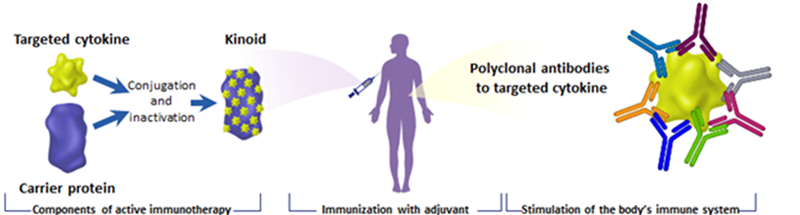
Neovacs uses kinoids, a novel type of vaccine that aims to create a long-lasting immune response against the natural immune response signalling molecules (cytokine and others) driving medical conditions. Kinoid technology, Exhibit 2, is detailed in our August 2016 note Lupus signature.
|
Exhibit 2: Production and use of kinoids to control cytokine levels |
|
|
Source: Neovacs |
The patient is immunised by intramuscular injection of the Kinoid to produce polyclonal antibodies to eliminate naturally produced cytokines like INFα. A key observation is that the antibodies need to be neutralising against the cytokine. If not, the disease may not be affected. In IFN-K Phase II data, management observed that the antibodies were “strongly” neutralising with antibodies against all subtypes of INFα generated. The immune response in some patients generates a range of antibodies and can last for at least four years.
IFN-K for lupus might be protected by a patent application (WO 2012136739 A1) filed on 4 April 2012. A patent WO 2004024189 A1 (granted in the US but not Europe) filed on 16 September 2003 covers IFNα linked to KLH and WO2002011759 (8 August 2001) claims IFN or VEGF linked to KLH.
IFN-Kinoid (IFN-K) in lupus
IFN-K is the lead product now in a 178-patient Phase IIb targeting Systemic Lupus Erythematosus (SLE), the most common form of Lupus. Lupus is an autoimmune disease of the connective tissues of various organs. There is no cure at present.
The 178-patient Phase IIb (NCT02665364) started in September 2015. Five doses of IFN-Kinoid are given: 240µg on days 0, 7 and 28 then a booster shot of 120µg in week 12 and week 24. The co-primary endpoint at week 36 (about nine months) is a reduction in a 21-gene interferon signature (IS) profile determined by Neovacs, plus the change in the clinical BILAG-Based Composite Lupus Assessment (BICLA) score. Our 1 August note, Lupus signature, has details.
The trial patients will mostly be recruited in Europe, Russia and Latin America. The study was extended in April 2016 to include US patients under an FDA IND. The number of US patients may have increased from the 12 originally envisaged as the number of sites is, from November 2016, being increased from five to 15. The first US patient enrolled in the trial in November 2016.
As recruitment is still ongoing, it now seems more realistic that overall recruitment might complete in Q117 (formerly June 2016), implying that the trial might read out by late 2017, but this could easily slip into 2018; Neovacs management anticipates data by late 2017.
Neovacs’ Korean partner, CKD, may launch IFN-K in South Korea in H218. CKD paid €1m upfront in 2015, with a further €4m now anticipated in 2018 if the Phase IIb is successful. A Korean IND has been granted and five Korean centres are participating in the Phase IIb. The Korean system can allow conditional approval from 2018. Management expects that over 1,000 patients will be treated between 2018 and 2020.
Competition
Benlysta, a monoclonal antibody, is the only biological agent to be approved so far for SLE, in 2011. It reduces the production of autoantibodies. Benlysta sales have been hampered by a high price of around $35,000 per year, modest efficacy and a restrictive label. Worldwide sales for Benlysta in 2015 were £230m; growth was 25% over 2014. Of these sales, 90% were in the US.
Phase III data from Anthera on blisibimod show that it failed its clinical endpoint; another example of the problems is developing lupus therapies, although secondary endpoint biological markers showed statistically significant treatment effects. This leaves anifrolumab from AstraZeneca as the most immediate potential competitor (Exhibit 3). Anifrolumab is a monoclonal against the IFNα receptor. Anifrolumab will have Phase III data by late 2018, so could be marketed from 2020.
Exhibit 3: Ongoing efficacy studies for SLE* (Phase III)
Company |
Product |
Duration |
n |
Primary endpoint |
Data |
NCT ID |
AstraZeneca |
Anifrolumab |
52 wk |
450 |
SRI≥4, high and low dose) |
Sep-18 |
NCT02446912 |
52 wk |
360 |
SRI≥4 (single dose level) |
Oct-18 |
NCT02446899 |
||
Anthera |
Blisibimod |
52 wk |
442 |
SELENA-SLEDAI ≥10. |
Nov 2016, endpoint not met |
NCT01395745 |
52 wk |
350 |
SRI-6 |
Dec 2018 (under review) |
NCT02514967 |
||
ImmuPharma |
Rigerimod/IPP-201101 |
52 wk |
200 |
SRI≥4, |
Dec-17+ (first patient June 16) |
NCT02504645 |
Source: Edison Investment Research. Note: *Excludes studies for lupus nephritis, investigator-sponsored, Japanese bridging and open-label extensions.
Neovacs’ partner will need to fund and run at least two substantial Phase III studies, at least one in the US, to be competitive. It is now possible that any deal completion might be dependent on the result of the Anifrolumab studies as these will affect the IFN-K market potential; if the trial is clearly positive, AstraZeneca will have a period of at least two years to build its market.
The main market for lupus is the US with an Edison estimate of 159,000 prevalence cases. The main subsegment is African-American women with about 40,000 cases. In Europe, there may be 170,000 prevalence cases, but data are harder to get and more uncertain.
In Korea, various surveys indicate 9,000-11,000 treated patients with a prevalence of about 13,250. Neovacs management estimates 20,000 cases overall in the population. Treatment is in specialist centres so the market should develop quickly.
Further IFN-K indications
Potential further indications for kinoid technology are autoimmune diseases like dermatomyositis, an autoimmune skin condition with a prevalence of about 70,000 cases. There is no cure. Neovacs plans a 15-patient Phase I trial. This is now unlikely to start before 2017.
Neovacs is in preclinical development with Vascular Epithelial Growth Factor Kinoid (VEGF-K). VEGF stimulates the formation of new blood vessels in cancer growth and in wet acute macular degeneration (AMD).
The cancer market is dominated by Roche’s Avastin (bevacizumab) with 2015 sales of CHF6.68bn (US$6.9bn). Several biosimilar products are likely to launch over 2019-20. Trials here would be prolonged as overall survival will need to be demonstrated by comparison to established products,
In AMD, VEGF-K could find a ready market if it proves as effective as Lucentis (ranibizumab). This is sold in the EU by Novartis, US$2.06bn in 2015 and by Roche in the US, 2015 sales of CHF1.5bn ($1.6bn). Eylea (aflibercept, Regeneron) had sales of US$2.68bn in 2015 in the US and, through Bayer, €1.23bn (US$1.4bn), up 62%. Trial readout in AMD is much faster than in cancer, although long-term studies will be needed in Phase III. However, any AMD product is still many years form market and Lucentis biosimilar products will also change the market dynamics after the patents expire over 2020-22.
Sensitivities
The hypothesis that the disease is exacerbated in about 80% of lupus patients due to over production of interferon alpha leading to an interferon signature (IS) has received support from two large Phase II AstraZeneca studies. The use of IS in the IFN-K Phase IIb should reduce risk as a high IS profile is seen in about 87% of patients and other data indicate better outcomes in this group. However, the IS case is not yet fully established. To progress to Phase III, Neovacs intends to partner the project from 2018 using the Phase IIb data. The €5m Korean deal shows that the project can attract partners at a good value. Substantive Phase III trials will be required for the crucial US FDA approval. AstraZeneca’s Anifrolumab is in Phase III and these data may now appear about six months after Phase II IFN-K data. Hence, any IFN-K partner may delay a deal until the relative market potential can be assessed. IFN-K will require a different commercial strategy as it is a one-off treatment rather than a chronic therapy with reoccurring income.
Valuation
Our valuation has been revised from August 2016 based on the following changes.
■
The launch date of IFN-K has been moved from 2021 to 2022. As a result, loss of biological exclusivity in the US and EU has been moved to 2033 and 2031 respectively, with the discounted period extended to 2033.
■
No milestone payments are now assumed in 2017 from CKD; previously, €1.8m was assumed to be received in 2017. Both regulatory milestones valued at €4m are now assumed in 2018, with a 50% probability assigned for valuation. The 2015 deal had a total $5m milestone value.
■
A €25m global partnering deal (excluding Korea) is still assumed in 2018, but this is now more likely from mid-2018 onwards.
■
Expenses have been revised given management guidance and H116 financial results.
■
The model has been rebased to January 2017.
■
The value of other projects has been fixed at €18m. This was formally set at 10% of the IFN-K value. The timing of other developments remains unclear.
The revised pre-dilution value has been adjusted to €1.18 per share as against €1.29 per share in August 2016. Exhibit 4 shows the revised value, with the value as of August 2016 as a comparison.
Exhibit 4: Neovacs indicative value as of January 2017 based on the period 2017-33
Probability |
Royalty |
Nov-16 |
Aug-16 |
|||
NPV (€m) |
Value/share |
NPV (€m) |
Value/share |
|||
IFN-K |
30% |
15% |
181.41 |
183.87 |
||
Cost of goods (70% of JV) |
-7.90 |
-7.89 |
||||
Expenses |
-149.79 |
-145.07 |
||||
Tax, interest and working capital |
4.72 |
3.17 |
||||
Interest and working capital |
3.75 |
2.43 |
||||
Other projects |
18.00 |
18.39 |
||||
Total |
50.19 |
54.90 |
||||
Shares |
42.59 |
42.59 |
||||
Prefunding and warrants per share |
1.18 |
1.29 |
||||
Warrants and options |
5.01 |
5.01 |
||||
Diluted value per share |
1.05 |
1.15 |
||||
Source: Edison Investment Research. Note: NPV figures are discounted at 12.5% after probability adjustment.
There are 2.18m remaining share options with various expiry dates up to 2025; this includes founder options that could convert to 20,500 shares. In addition, in 2015 Neovacs issued 7.5m warrants linked to the 2015 US investment, which can convert to 2.83m shares by 1 July 2020. This gives 5.01m potential new shares if all are exercised.
Financials
In H116, Neovacs had minimal income. Reported costs rose to €8m, offset by a €1.2 m tax credit; this is paid in 2017, although the French government now pays some elements of tax credits in advance. We estimate operating costs for 2016 of about €16.8m. This implies a loss after tax credits of possibly €3.9m of about €12.6m. Cash flows are affected by working capital movements including the tax credit. In H1, we note that the CKD milestone of €1m reported in 2015 was received and that creditors increased overall by €1m. The remaining tax credit from 2015 of €1.8m was also received but this is partly balanced by a new tax credit due of €1.3m. These working capital movements gave an overall net cash gain of €2m.
Assuming €1m of the 2017 tax credit is received in advance in H216, the operating cash outflow in 2016 could be about €12m, as guided by management. Neovacs raised €8.2m gross from a rights tissue in June 2016. This gave €9.2m in cash and cash equivalents as of 30 June. We estimate that Neovacs will have an estimated €3.6m of cash in December 2016. Assuming that the cash burn rate falls in 2017 as the Phase IIb study enters the follow-up period, Neovacs may require a further €10m of funding in 2017. This now assumes that the €4m CKD milestones are paid in 2018. Any other deal upfront fees are now assumed to be received in the second half of 2018. Further funding needs will vary depending on the completion and value of partnering deals in 2018.
Exhibit 5: Financial summary
€'000s |
2014 |
2015 |
2016e |
2017e |
||
Year end 31 December |
GAAP |
GAAP |
GAAP |
GAAP |
||
PROFIT & LOSS |
|
|
||||
Revenue |
|
|
161 |
1,181 |
200 |
0 |
Cost of Sales |
0 |
0 |
0 |
0 |
||
Gross Profit |
161 |
1,181 |
200 |
0 |
||
EBITDA |
|
|
(9,604) |
(11,227) |
(16,419) |
(14,687) |
Operating Profit (before GW and except.) |
|
(9,604) |
(11,227) |
(16,419) |
(14,687) |
|
Intangible Amortisation |
(50) |
(52) |
(211) |
(211) |
||
Other |
0 |
0 |
0 |
0 |
||
Operating Profit |
(9,653) |
(11,279) |
(16,631) |
(14,898) |
||
Net Interest |
(158) |
(157) |
(100) |
(100) |
||
Exceptionals |
(7) |
4,188 |
0 |
0 |
||
Profit Before Tax (norm) |
|
|
(9,762) |
(11,384) |
(16,519) |
(14,787) |
Profit Before Tax (FRS 3) |
|
|
(9,818) |
(7,248) |
(16,731) |
(14,998) |
Tax |
2,306 |
2,565 |
3,900 |
3,900 |
||
Profit After Tax (norm) |
(7,457) |
(8,819) |
(12,619) |
(10,887) |
||
Profit After Tax (FRS 3) |
(7,513) |
(4,683) |
(12,831) |
(11,098) |
||
Average Number of Shares Outstanding (m) |
21.7 |
27.5 |
37.3 |
42.6 |
||
EPS - normalised (c) |
|
|
(34.4) |
(32.0) |
(33.8) |
(25.6) |
EPS - normalised fully diluted (c) |
|
|
(31.6) |
(27.3) |
(30.0) |
(23.0) |
EPS - FRS 3 (c) |
|
|
(34.7) |
(17.0) |
(34.4) |
(26.1) |
Dividend per share (c) |
0.0 |
0.0 |
0.0 |
0.0 |
||
BALANCE SHEET |
||||||
Fixed Assets |
|
|
371 |
433 |
1,073 |
1,102 |
Intangible Assets |
9 |
7 |
6 |
5 |
||
Tangible Assets |
73 |
51 |
125 |
155 |
||
Investments |
289 |
375 |
942 |
942 |
||
Current Assets |
|
|
8,985 |
11,120 |
7,659 |
6,648 |
Stocks |
0 |
0 |
0 |
0 |
||
Debtors |
2,819 |
4,446 |
4,692 |
4,795 |
||
Cash |
5,625 |
6,087 |
2,261 |
1,147 |
||
Other current assets |
542 |
586 |
706 |
706 |
||
Current Liabilities |
|
|
(2,012) |
(4,923) |
(6,028) |
(6,028) |
Creditors |
(1,978) |
(4,166) |
(4,835) |
(4,835) |
||
Short term borrowings |
(34) |
(757) |
(1,193) |
(1,193) |
||
Long Term Liabilities |
|
|
(4,568) |
(260) |
(257) |
(10,257) |
Long term borrowings |
(1,289) |
0 |
0 |
(10,000) |
||
Other long term liabilities |
(3,280) |
(260) |
(257) |
(257) |
||
Net Assets |
|
|
2,776 |
6,369 |
2,447 |
(8,535) |
CASH FLOW |
||||||
Operating Cash Flow |
|
|
(10,175) |
(10,098) |
(10,487) |
(14,862) |
Net Interest |
(158) |
(157) |
(100) |
(100) |
||
Tax |
2,306 |
2,565 |
3,900 |
3,900 |
||
Capex |
(25) |
(19) |
(100) |
(50) |
||
Acquisitions/disposals |
0 |
0 |
0 |
0 |
||
Financing |
9,666 |
8,171 |
8,171 |
0 |
||
Indicative debt |
9,998 |
|||||
Dividends |
0 |
0 |
0 |
0 |
||
Net Cash Flow |
1,613 |
462 |
1,384 |
(1,114) |
||
Opening net debt/(cash) |
|
|
(2,897) |
(4,303) |
(5,330) |
(1,068) |
HP finance leases initiated |
0 |
0 |
0 |
0 |
||
Other |
(208) |
566 |
(5,646) |
(10,000) |
||
Closing net debt/(cash) |
|
|
(4,303) |
(5,330) |
(1,068) |
10,046 |
Source: Neovacs accounts, Edison Investment Research
|
|