Last close As at 06/08/2026
—
— 0.00 (0.00%)
Market capitalisation
—
Research: Investment Companies
Aberdeen New Thai Investment Trust (ANW) is the only London-listed investment trust specialising in Thai equities. It aims to deliver a high level of long-term capital growth, employing a bottom-up approach to invest in a relatively concentrated portfolio of around 40 stocks, representing the manager’s highest-conviction ideas. The trust has delivered strong absolute returns over the past 10 years, with an annualised NAV total return of 15.4%. Thai companies are well-placed to benefit from the rapid growth of its less-developed neighbours of Cambodia, Laos, Myanmar and Vietnam (CLMV), which offer a large and significantly underpenetrated market for goods and services.
Written by
Aberdeen New Thai Investment Trust |
Fast-growing region supports growth prospects |
Investment trusts |
11 November 2019 |
Share price/discount performance
Three-year performance vs index
Gearing
Analysts
|
|||||||||||||||||||||||||||||||||||||||||||||||||||||||||||||||||||||||||||||||||||||||||
Aberdeen New Thai Investment Trust (ANW) is the only London-listed investment trust specialising in Thai equities. It aims to deliver a high level of long-term capital growth, employing a bottom-up approach to invest in a relatively concentrated portfolio of around 40 stocks, representing the manager’s highest-conviction ideas. The trust has delivered strong absolute returns over the past 10 years, with an annualised NAV total return of 15.4%. Thai companies are well-placed to benefit from the rapid growth of its less-developed neighbours of Cambodia, Laos, Myanmar and Vietnam (CLMV), which offer a large and significantly underpenetrated market for goods and services.
|
Thailand and its neighbouring countries have superior growth prospects |
|
|
Source: IMF October 2019 World Economic Outlook, Edison Investment Research |
The market opportunity
Thailand’s economy is facing near-term challenges as the ongoing US-China trade dispute has taken a toll on its export sector, a key component of its GDP. However, the medium- and long-term prospects remain positive and the IMF expects Thailand and CLMV to grow significantly faster than advanced economies between 2019 and 2024. A fundamental and specialist investment approach may be well-placed to capture opportunities from this region.
Why consider investing in ANW?
■
Managed by a well-resourced team of Asian equity professionals, including three Thailand specialists based in Bangkok.
■
Quality-focused portfolio of companies with sustainable long-term growth, which should be relatively resilient in uncertain economic environments.
■
Strong record of NAV growth.
■
Proactive board, committed to promoting the trust and shareholders’ interests.
Scope for discount to narrow
ANW currently trades at a 14.2% discount to cum-income NAV, which is slightly narrower than its three-year average of 14.8%. The board introduced a number of measures in 2018 to broaden the appeal of the fund and help support a narrowing of the discount. These include the introduction of an interim dividend and an increase in the total payout. ANW’s 3.4% yield is the highest among peers.
Exhibit 1: Trust at a glance
Investment objective and fund background |
Recent developments |
|||||||||||||||||||||||||||||||||||||||||||||||||||||||||
ANW’s investment objective is to provide a high level of long-term, above-average capital growth through investment in Thailand. The trust holds a concentrated portfolio of equities listed on the Stock Exchange of Thailand (SET). Constructed through bottom-up stock selection, ANW’s portfolio is diversified across a broad range of industries, with exposures not linked to SET index allocations. |
■ 18 October 2019: announced the appointment of Anne Gilding as an independent non-executive director with immediate effect. ■ 14 October 2019: interim results to 31 August 2019. NAV total return +14.6% vs SET index total return +15.2%. Interim dividend of 8.00p declared. ■ 29 April 2019: annual results to 28 February 2019. NAV total return -5.1%; SET index total return -3.9%. Final dividend of 11.00p declared. |
|||||||||||||||||||||||||||||||||||||||||||||||||||||||||
Forthcoming |
Capital structure |
Fund details |
||||||||||||||||||||||||||||||||||||||||||||||||||||||||
AGM |
June 2020 |
Ongoing charges |
1.26% |
Group |
Aberdeen Standard Investments |
|||||||||||||||||||||||||||||||||||||||||||||||||||||
Final results |
April 2020 |
Net gearing |
4.3% |
Manager |
Asian Equities Team |
|||||||||||||||||||||||||||||||||||||||||||||||||||||
Year end |
28 February |
Annual mgmt fee |
0.9% |
Address |
Bow Bells House, 1 Bread Street, London EC4M 9HH |
|||||||||||||||||||||||||||||||||||||||||||||||||||||
Dividend paid |
Interim and final |
Performance fee |
None |
|||||||||||||||||||||||||||||||||||||||||||||||||||||||
Launch date |
December 1989 |
Trust life |
Indefinite (subject to vote) |
Phone |
+44 (0)500 000 040 |
|||||||||||||||||||||||||||||||||||||||||||||||||||||
Continuation vote |
No – see page 7 |
Loan facilities |
£15m multi-currency facility |
Website |
||||||||||||||||||||||||||||||||||||||||||||||||||||||
Dividend policy and history (financial years) |
Share buyback policy and history (financial years) |
|||||||||||||||||||||||||||||||||||||||||||||||||||||||||
From FY19 the board introduced an interim dividend. Dividends payable June/July and November. |
Renewed annually, the trust has authority to repurchase up to 14.99% and allot up to 10% of issued share capital. |
|||||||||||||||||||||||||||||||||||||||||||||||||||||||||
|
|
|||||||||||||||||||||||||||||||||||||||||||||||||||||||||
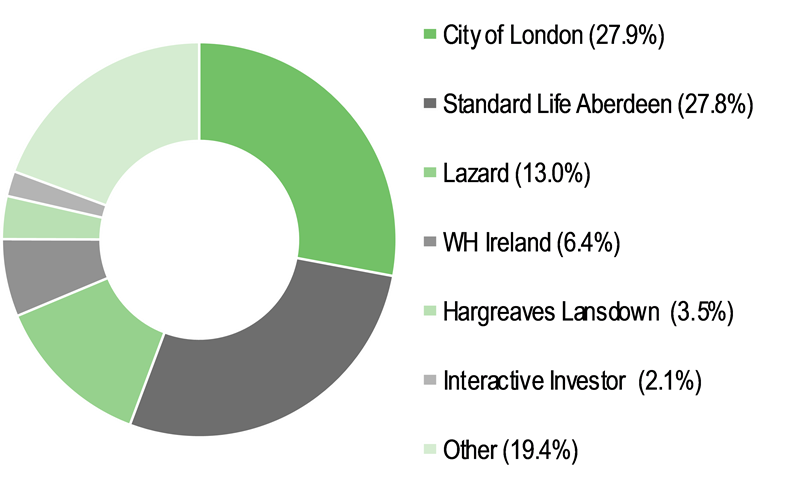
Shareholder base (as at 21 October 2019) |
Portfolio exposure by sector (excluding cash, as at 30 September 2019) |
|||||||||||||||||||||||||||||||||||||||||||||||||||||||||
|
|
|||||||||||||||||||||||||||||||||||||||||||||||||||||||||
Top 10 holdings (as at 30 September 2019) |
||||||||||||||||||||||||||||||||||||||||||||||||||||||||||
|
||||||||||||||||||||||||||||||||||||||||||||||||||||||||||
Source: Aberdeen New Thai Investment Trust, Edison Investment Research, Bloomberg, Morningstar, Refinitiv. Note: *N/A where not in September 2018 top 10.
Market outlook: Strong longer-term prospects
Thailand’s economy is slowing, which partly reflects cyclical factors but also the impact of the US-China trade dispute, which has tipped the world into a trade recession. Exports, which account for around two-thirds of Thailand’s GDP, have been contracting and drought has contributed to weak domestic consumption. Thailand’s Q219 GDP growth of 2.3% year-on-year was the slowest in nearly five years and the Bank of Thailand (BoT) has lowered its GDP forecast for 2019 to 3.3%. It cut interest rates this August, while signalling further potential cuts in 2020. The BoT also approved a THB316bn (c £7.5bn) stimulus package, aimed at boosting consumption and tourism. Measures include debt relief and loans for drought-affected farmers, an extended free visa-on-arrival provision for several countries for a further six months, and spending money and rebates for domestic tourists who travel outside their home provinces. As shown in Exhibit 2 (RHS), Thai equities are not obviously inexpensive. Their mid-teens forward P/E multiple, however, is not demanding relative to other developing Asian markets (excluding China). Geopolitical developments are likely to continue to influence Thailand’s near-term economic and equity market outlook; however, prospects for the longer-term remain positive and over the past 10 years, Thai equities have significantly outperformed Asia and global markets (Exhibit 2 LHS). The Thai economy benefits from a number of positive secular trends, including urbanisation and rising incomes. Thai companies are also well-positioned to benefit from the rapid development of its CLMV neighbours, which as shown in the chart on the front page, are growing significantly faster than Thailand.
|
Exhibit 2: SET Index relative performance and valuation |
|||||||||||||||||||||||||||||||
Performance vs index |
Valuation metrics |
||||||||||||||||||||||||||||||
|
|
||||||||||||||||||||||||||||||
|
Source: Refinitiv, Edison Investment Research. Note: Valuation data as at 8 November 2019. |
|||||||||||||||||||||||||||||||
Fund profile: Unconstrained and high-conviction
Launched in December 1989, ANW is the only investment trust specialising in Thai equities. Its investment objective is to provide shareholders with a high level of long-term, above-average capital growth through investing in companies listed in Thailand. The fund also provides investors with indirect exposure to Thailand’s fast-growing neighbours including Cambodia, Laos, Myanmar and Vietnam as many Thai companies have a significant and increasing presence in these countries. The manager follows a disciplined bottom-up approach to build a diversified portfolio of around 40 stocks, representing the Asian team’s highest-conviction investment ideas. Gearing is permitted up to 15% of NAV and the trust can invest up to 10% of NAV in unlisted companies, which have visible plans to list. The portfolio is typically very different from its SET Index benchmark, and historically has had a high active share of over 75%. As a result, the trust’s performance can diverge significantly from the benchmark.
The fund manager: Asian team
The manager’s view: Short-term challenge, long-term promise
The team thinks the near-term outlook for the Thai economy remains challenged given the weakness of the export sector, while relatively high levels of household debt (at nearly 80% of GDP) hampers private consumption. However, it believes ANW’s holdings should be relatively resilient in uncertain conditions, given their high-quality characteristics. Furthermore, the team also believes the government is likely to introduce more stimulus measures to help stabilise the economy. The new government’s budget should be revealed over the coming months and the team expects infrastructure spending to continue to be an area of focus, highlighting that the BoT forecast public investment to increase by 6.3% in 2020 (following 2.5% forecast for 2019). The manager notes that the return of General Prayut Chan-O-Cha as prime minister signals the continuation of business-friendly government policies. His previous government articulated Thailand’s current 20-year vision, which includes significant investment in infrastructure, digital technology and healthcare.
The team believes ANW is also an excellent play on the CLMV region. It is growing faster than Thailand and has a population of c 165m people, offering Thai companies a large and underpenetrated market for their goods and services. Access for foreign equity investors to CLMV is limited, but many of the ANW’s companies have a significant and growing exposure to the opportunities in these countries. Examples cited by the manager include AEON Thana Sinsap, TOA Paint, Mega Life and Osotspa, which already have CLMV revenues of between 10–30%. In its view, Thai companies can represent excellent proxies to investing directly in these countries, given their superior access to capital markets, longer-established brands and better corporate governance.
Asset allocation
Investment process: Quality focused
The manager follows a disciplined bottom-up investment process to identify quality companies that are mispriced relative to their long-term intrinsic value. ANW is managed by Aberdeen Standard Investment’s well-resourced Asian team which consists of over 40 equity investment professionals in the region, including three Thailand specialists, based in Bangkok. The team supports an intensive schedule of meetings with managements to enable in-depth knowledge of companies and detailed fundamental analysis. It believes the market often underestimates the sustainability of returns from high-quality companies. The team evaluates firms on multiple criteria, including management pedigree and track record of capital allocation, sustainable competitive advantages, balance sheet strength, and environment, social and governance (ESG) credentials. The manager believes that ESG factors are financially material, and have an impact on corporate performance, and that its engagement with companies enhances the value of its investments for shareholders.
Following a board review in May 2018, in consultation with the manager, the trust is permitted to invest up to 10% of NAV in unlisted companies which have visible plans for initial public listing (IPO). Gearing is permitted up to 15% of NAV. As at end-September 2019, the portfolio had 1.5% in unlisted equities and had net gearing of 4.3%.
Current portfolio positioning
As shown in Exhibit 3, the portfolio is well diversified across 13 sectors. Over the past 12 months to end-September 2019, the most significant change is a 4.0pp increase in exposure to the food & beverages sector. This reflects the participation in the listing of Osotspa in October 2018. The company is Thailand’s leading energy drinks producer with a portfolio of strong brands including M-150 and Lipo. These brands have wide recognition in the region, which in the manager’s view can support Osotspa’s expansion plans in CLMV markets. ANW was a cornerstone investor in the company at an attractive valuation prior to its IPO and the shares have nearly doubled in price since listing. Coca-Cola bottler, Haad Thip has also been a strong performer over the past year. The company has over 80% market share in southern Thailand and is benefitting from an increasingly hot and dry climate, and tourism in Phuket and Koh Samui.
Exhibit 3: Portfolio sector exposure vs SET Index benchmark (% unless stated)
Portfolio end- |
Portfolio end- |
Change |
Index |
Active weight |
Trust weight/ index weight (x) |
|
Energy & utilities |
16.5 |
15.6 |
0.9 |
22.8 |
(6.3) |
0.7 |
Construction materials |
12.8 |
10.9 |
1.9 |
4.6 |
8.2 |
2.8 |
Banking |
12.4 |
14.0 |
(1.6) |
11.3 |
1.1 |
1.1 |
Property development |
10.8 |
11.3 |
(0.5) |
6.0 |
4.8 |
1.8 |
Food & beverages |
7.8 |
3.8 |
4.0 |
6.2 |
1.6 |
1.3 |
Commerce |
6.9 |
6.4 |
0.5 |
9.9 |
(3.0) |
0.7 |
Finance & securities |
6.5 |
6.2 |
0.3 |
2.9 |
3.6 |
2.2 |
Insurance |
5.7 |
7.5 |
(1.8) |
1.0 |
4.7 |
5.7 |
Automotive |
5.1 |
6.5 |
(1.4) |
0.4 |
4.7 |
12.8 |
Info. & comms. technology |
4.6 |
4.8 |
(0.2) |
9.1 |
(4.5) |
0.5 |
Healthcare services |
3.7 |
4.3 |
(0.6) |
4.5 |
(0.8) |
0.8 |
Property fund |
3.6 |
2.1 |
1.5 |
2.9 |
0.7 |
1.2 |
Electronic components |
2.3 |
3.0 |
(0.7) |
0.8 |
1.5 |
2.9 |
Packaging |
0.0 |
1.1 |
(1.1) |
0.3 |
(0.3) |
0.0 |
Media & publishing |
0.0 |
0.0 |
0.0 |
1.3 |
(1.3) |
0.0 |
Transportation & logistics |
0.0 |
0.0 |
0.0 |
9.8 |
(9.8) |
0.0 |
Other |
0.0 |
0.0 |
0.0 |
6.2 |
(6.2) |
0.0 |
Cash |
1.3 |
2.5 |
(1.2) |
0.0 |
1.3 |
N/A |
100.0 |
100.0 |
100.0 |
Source: Aberdeen New Thai Investment Trust, Edison Investment Research
ANW took advantage of share price weakness to purchase a new position in construction materials retailer, Siam Global House. The stock has traditionally traded at valuations that were viewed by the manager as unattractive. Siam Global House has a strong network of stores in the north and northeast of Thailand, targeting lower-income customers who are building/improving their own homes. They are typically from rural areas and this profile complements ANW’s other home improvement retailer, HomePro, which targets middle- to higher-income urban customers.
The trust has also recently initiated a position in unlisted company Asset World Corporation (AWC) as a cornerstone investor. AWC has a portfolio of hotel, commercial and retail property in Bangkok, which the manager believes is very attractive. AWC’s tenants include Marriott and the luxury Athenee Hotel, and the manager expects growth to be driven by improvements to the portfolio properties as well as through future acquisitions. AWC’s owner is one of Thailand’s most successful businessmen whose companies include Thai Beverage. It aims to raise up to THB48bn (around £1.2bn) later this year, potentially making it Thailand’s largest IPO.
The manager has also continued to take profits in oil exploration and production company PTTEP to switch into its parent company PTT, which it believes to be more defensive owing to its more diversified businesses and lower dependence on the price of oil. The manager expects PTT to list its forecourt retailing business, which it thinks can realise value for shareholders. ANW has also sold its position in media company BEC World, which has been a source of funds for some time as prospects for advertising revenues continue to weaken.
Performance: Solid history of NAV growth
As shown in Exhibit 5 (RHS), ANW has delivered strong long-term performance to shareholders; over 10 years to end-September 2019, the trust’s annualised NAV and share price total returns have increased 15.4% and 16.3%, respectively. Exhibit 5 shows the trust has also outperformed the MSCI Asia ex-Japan index over one and three years, and by a significant margin over 10 years. However, ANW’s NAV performance has lagged the SET Index benchmark over all periods shown. This partly reflects the portfolio’s consistent underweight (or zero exposure) to many of the largest stocks in the benchmark, owing to factors such as the manager’s negative view on a company’s corporate governance track record, and the tendency to find better investment opportunities in less well-researched mid- and small-cap companies. The high tracking error against the benchmark means the trust’s performance can diverge meaningfully from the index.
Exhibit 4: Five-year discrete performance data
12 months ending |
Share price |
NAV |
SET Index |
MSCI AC Asia ex-Japan (%) |
MSCI World |
31/10/15 |
(14.3) |
(15.5) |
(13.8) |
(3.6) |
6.0 |
31/10/16 |
36.7 |
37.7 |
42.5 |
35.2 |
28.8 |
31/10/17 |
12.6 |
13.3 |
15.0 |
20.3 |
13.5 |
31/10/18 |
2.9 |
2.9 |
4.1 |
(10.0) |
5.7 |
31/10/19 |
7.3 |
3.1 |
7.3 |
12.1 |
11.9 |
Source: Refinitiv. Note: All % on a total return basis in pounds sterling.
|
Exhibit 5: Investment trust performance to 31 October 2019 |
|||||||||
Price, NAV and benchmark total return performance, one-year rebased |
Price, NAV and benchmark total return performance (%) |
||||||||
|
|
||||||||
|
Source: Refinitiv, Edison Investment Research. Note: Three-, five- and 10-year performance figures annualised. |
|||||||||
|
Exhibit 6: Share price and NAV total return performance, relative to indices (%) |
|||||||||
|
One month |
Three months |
Six months |
One year |
Three years |
Five years |
10 years |
||
Price relative to SET Index |
0.9 |
0.0 |
0.5 |
(1.2) |
(3.5) |
(6.3) |
(1.7) |
||
NAV relative to SET Index |
(1.0) |
(2.1) |
(1.5) |
(4.3) |
(6.8) |
(11.5) |
(8.7) |
||
Price relative to MSCI AC Asia ex-Japan |
(1.7) |
0.0 |
11.5 |
3.7 |
9.0 |
(4.0) |
97.3 |
||
NAV relative to MSCI AC Asia ex-Japan |
(3.5) |
(2.1) |
9.3 |
0.4 |
5.3 |
(9.4) |
83.3 |
||
Price relative to MSCI World |
(2.2) |
(5.0) |
1.1 |
(1.9) |
(3.0) |
(17.7) |
38.7 |
||
NAV relative to MSCI World |
(4.0) |
(7.0) |
(0.9) |
(5.0) |
(6.2) |
(22.3) |
28.8 |
||
|
Source: Refinitiv, Edison Investment Research. Note: Data to end-October 2019. Geometric calculation. |
|||||||||
|
Exhibit 7: NAV total return performance relative to benchmark over three years |
|||||||||
|
|||||||||
|
Source: Refinitiv, Edison Investment Research |
|||||||||
Capital structure and fees
ANW is a conventional investment trust with one class of share; currently there are 16.5m ordinary shares in issue. During the current financial year (FY20) share repurchases have been de minimis. In FY19, 0.3% of shares were repurchased for a total consideration of £1.6m. ANW has a £15m three-year multi-currency facility with Industrial and Commercial Bank of China and as at end-September 2019, £5.7m was drawn and the trust had net gearing of 4.3%. An annual management fee of 0.9% is payable to Aberdeen Standard Investments, reduced from 1.0% from May 2018, which has resulted in a fall in ongoing charges in FY19 to 1.26%, from 1.35% in FY18.
Dividend policy and record
In May 2018, the board introduced an interim dividend, payable in November, in addition to the annual dividend, payable in June or July. At the same time, the board also approved the allocation of management fees and interest costs to be apportioned 75:25 to the capital and income accounts respectively (previously all from income). The new allocation reflects the composition of expected total return for the trust over the long term and increases the proportion of net earnings available to pay dividends. This has allowed the dividend per share to rise substantially; for FY19 the total dividend of 18.0p per share is a 62% increase over the previous year (FY18: 11.1p). The board has declared an FY20 interim dividend of 8.0p per share (FY19: 7.0p).
Peer group comparison
ANW is a member of the AIC Country Specialists: Asia Pacific sector - Exhibit 9 shows this peer group of 10 funds with market capitalisations above £50m. There are a broad range of geographic mandates within this group and direct comparisons between funds may not be relevant. ANW is one of the smallest funds among peers, ranking ninth. It has the highest NAV total return over 10 years, which is significantly above the returns achieved by the other members of the group. Over one, three and five years, the fund ranks seventh, fourth and eighth, respectively. ANW has the highest dividend yield although its discount to cum-fair NAV is one of the widest, ranking seventh.
Exhibit 9: AIC Country Specialists: Asia Pacific peer group as at 8 November 2019*
% unless stated |
Market cap £m |
NAV TR |
NAV TR |
NAV TR |
NAV TR |
Discount (cum-fair) |
Ongoing charge |
Perf. |
Net gearing |
Dividend yield (%) |
Aberdeen New Thai |
95.4 |
8.0 |
26.1 |
44.3 |
331.5 |
(14.2) |
1.26 |
No |
100 |
3.3 |
Aberdeen New India |
288.1 |
19.9 |
25.0 |
67.4 |
193.6 |
(12.3) |
1.2 |
No |
106 |
0.0 |
Fidelity China Special Situations |
1,224.4 |
12.4 |
19.5 |
86.2 |
|
(8.7) |
0.93 |
Yes |
120 |
1.7 |
India Capital Growth |
84.6 |
(2.1) |
(7.1) |
32.5 |
74.3 |
(16.6) |
2.02 |
No |
100 |
0.0 |
JPMorgan Chinese |
239.9 |
37.7 |
57.0 |
102.3 |
195.9 |
(11.4) |
1.34 |
No |
106 |
1.1 |
JPMorgan Indian |
779.1 |
15.8 |
9.6 |
49.6 |
128.5 |
(8.4) |
1.09 |
No |
100 |
0.0 |
Vietnam Enterprise |
1,101.2 |
15.3 |
51.7 |
147.4 |
165.6 |
(10.6) |
2.23 |
No |
100 |
0.0 |
VietNam Holding |
95.6 |
0.0 |
(1.2) |
64.4 |
120.7 |
(17.8) |
2.23 |
Yes |
100 |
0.0 |
VinaCapital Vietnam Opp Fund |
627.5 |
3.3 |
28.5 |
91.8 |
171.9 |
(15.0) |
1.70 |
Yes |
100 |
2.5 |
Weiss Korea Opportunity |
116.3 |
9.4 |
8.7 |
38.3 |
|
(6.3) |
1.89 |
No |
100 |
2.9 |
Simple average |
465.2 |
12.0 |
21.8 |
72.4 |
172.7 |
(12.1) |
1.59 |
103 |
1.1 |
|
Rank (out of 10) |
9 |
7 |
4 |
8 |
1 |
7 |
7 |
4 |
1 |
Source: Morningstar, Edison Investment Research. Note: *Performance data to 7 November 2019. TR = total return. Net gearing is total assets less cash and equivalents as a percentage of net assets.
The board
The board consists of four independent non-executive directors and is chaired by Nicolas Smith (appointed March 2013 and assumed his current role in June 2013). It recently announced the appointment of Anne Gilding, with effect from 18 October 2019. She has led the development of global communications, branding and marketing solutions for a broad range of companies, including Impax Asset Management, BMO, GAM, Vernalis and UBS. Senior independent director, Claire Dobie (appointed in December 2013 and assumed her current role in June 2016) will retire on 3 December 2019. The other members of the board and their dates of appointment are Andy Pomfret (September 2014) and Sarah MacAulay (December 2016)
|
|
Investment Companies
Research: Investment Companies
Fidelity China Special Situations (FCSS) offers investors direct exposure to China for a portion of their portfolio, aiming to deliver long-term capital growth from investing in companies listed in China, and Chinese companies listed elsewhere. Since the trust’s inception in April 2010, FCSS’s NAV total return has increased by nearly 11% pa. The portfolio has a bias towards mid- and small-cap companies, which tend to be less well researched and potentially mispriced. The manager, Dale Nicholls, is focused on opportunities related to rising domestic consumption, which in his view is unlikely to be disrupted by the ongoing US-China trade dispute.