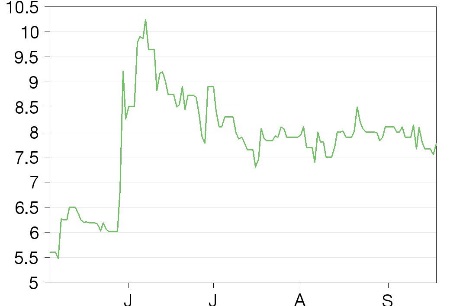
ASLAN announced it would be amending the protocol for its ongoing Chinese pivotal trial of varlitinib in biliary tract cancer (BTC). The patients being enrolled in China had more severe disease than expected based on historical controls, which manifested as a weaker than expected response to treatment on the trial. Due to delays, the Chinese study may not complete before the ongoing TREETOP study, which would then serve as a pivotal study for approval in China and is expected to complete in 2019.
Written by
ASLAN Pharmaceuticals |
Enrolment for China study adjusted |
Clinical update |
Pharma & biotech |
19 September 2018 |
Share price performance
Business description
Next events
Analysts
ASLAN Pharmaceuticals is a research client of Edison Investment Research Limited |
|||||||||||||||||||||||||||||||||||||||||||||||||||
ASLAN announced it would be amending the protocol for its ongoing Chinese pivotal trial of varlitinib in biliary tract cancer (BTC). The patients being enrolled in China had more severe disease than expected based on historical controls, which manifested as a weaker than expected response to treatment on the trial. Due to delays, the Chinese study may not complete before the ongoing TREETOP study, which would then serve as a pivotal study for approval in China and is expected to complete in 2019.
Year end |
Revenue ($m) |
PBT* |
EPS* |
DPS |
P/E |
Yield |
12/16 |
11.5 |
(7.6) |
(0.07) |
0.00 |
N/A |
N/A |
12/17 |
0.0 |
(38.8) |
(0.31) |
0.00 |
N/A |
N/A |
12/18e |
0.0 |
(40.8) |
(0.26) |
0.00 |
N/A |
N/A |
12/19e |
0.0 |
(61.1) |
(0.36) |
0.00 |
N/A |
N/A |
Note: *PBT and EPS are normalised, excluding amortisation of acquired intangibles, exceptional items and share-based payments.
Patients’ disease more severe than expected
At the time of the announcement, 27 patients had been enrolled on the study, However, due to unknown reasons, these patients had much more severe disease than as initially expected. This manifested itself as much poorer outcomes to prior treatment: only 7% of patients had a response to prior treatment, and their progression-free survival (PFS) was 2.7 months. This is compared to 26% and eight months respectively from a study in the UK. The cause of the different responses is unclear but could be a combination of enrolment bias, demographic factors or different care parameters.
Severe disease complicates data interpretation
The severity of these patients’ disease complicates the interpretation of the study, as it is single arm and requires comparison to historical controls. Of 14 patients evaluable at six weeks, only one had a partial response and six had stable disease. This is worse than seen in the company’s previous dosing study (three of 15 partial responses, and 10 of 15 stable disease) even with non-optimised treatment. With these results, continuing the protocol without amendment would be futile.
Good news: This trial does not need to be pivotal
Although the company intended to use this study as a pivotal study in China, owing to recent regulatory reforms, the ongoing placebo-controlled pivotal TREETOP study can be used instead if needed. That said, the company intends to complete the Chinese trial regardless, which will be invaluable to understanding the nature of BTC treatment and the market in China.
Valuation: $389m or $12.13 per ADS
We have slightly adjusted our valuation of ASLAN to $389m from $399m. This is driven by increased development costs and a longer timeline in China (2020 approval vs 2019 before), as well as lower net cash, and is partly offset by advancing our NPVs.
Protocol amendments to ensure quality patients
ASLAN announced on 17 September 2018 that it would be amending the protocol for its ongoing Chinese clinical study of varlitinib for the treatment of BTC. The study was open label with a single arm, enrolling 68 patients, but slated as a pivotal study following feedback from the National Medical Products Administration (NMPA; formerly the CFDA). The goal of these protocol amendments is to ensure that patients enrolled on the study represent a realistic depiction of individuals that have completed their first-line therapy. The company found that on average the patients that were enrolled in the study to date had significantly more severe disease than in historical controls. In total, 27 patients were enrolled to date, of which only 7% had a response to first-line therapy and PFS was 2.7 months. This is compared to 26% response and an eight-month PFS seen in historical data.1 It is unclear at this point why the patients enrolled were more severe than expected; it could reflect selection bias, differences in treatment, environmental or demographic factors, or some combination of the above. There are very few historical clinical data on BTC in China. However, it is clear the company believed it would not be able to get an accurate depiction of valitinib’s capacity to alter outcomes in this severe background. Given that the study has a single arm, it relies on such historical controls for its conclusions.
Valle J, et al. (2010) Cisplatin plus Gemcitabine versus Gemcitabine for Biliary Tract Cancer. New Eng J Med 362, 1273-1281.
Despite the fact that the patients enrolled to date were not ideal, the company provided an update of the data gathered to date. Overall, 14 of the 27 patents enrolled to date had completed their six-week evaluation at the time of the announcement. Of these one had a partial response and six had stable disease. This is substantially lower than the company previously reported for varlitinib in its dose-ranging Phase Ib study (three of 15 partial responses, and 10 of 15 stable disease), and responses should be better for an optimised dose.
The precise parameters of the protocol amendment were not released, but the company did state that the amendments will take approximately four months to be finalised at all clinical sites. The company will continue to enrol over this period. We expect a significant fraction of patients to date will be culled from the analysis, necessitating additional data. The company estimated a total cost of the trial of US$6m. It stated that it will provide a clearer picture of timelines in early 2019.
Changes come in the background of regulatory shifts
ASLAN’s Chinese clinical study has already undergone previous amendments reflecting the ongoing regulatory reforms in the country. It was initiated as a 25-person bridging study to compliment the data from the double-blind, placebo-controlled TREETOP study. The Chinese authorities have historically required that such bridging studies accept foreign data to ensure that drugs will behave similarly in Chinese populations. Over the intervening period, the NMPA has liberalised its approach and does not necessarily require bridging studies and applications can rely on purely foreign clinical studies as long as it provides data on ‘the existence of ethnic differences’. These changes were made to encourage the entry of foreign medicines into the Chinese market. The interpretation of these standards has been somewhat unclear, but it signals an increased willingness on the part of regulators to consider foreign data up to international standards.
Although the Chinese bridging study would no longer be technically required, following a discussion with the CDA ASLAN made the strategic decision In January 2018 to expand the study to 68 patients, which the authorities assured the company could serve as a pivotal study. This study would therefore have been the main data package to the agency, and therefore could provide an accelerated pathway to market (because TREETOP would not need to be completed first). The main change to the protocol was the number of patients enrolled, and it could remain open label and single arm.
However, following these most recent delays, the timing of the Chinese study has been pushed back such that we expect it to complete at roughly the same time as TREETOP. It may still serve as the pivotal study in China depending on the data and if it completes first, but this is not a necessity. With the new openness of the CDA to foreign data, TREETOP could feasibly serve as a pivotal study with or without the Chinese study in theory. Despite this, the company made the decision to amend its protocols to ensure the Chinese study yields meaningful data. We believe this is prudent for a number of reasons. First, it provides a hedge against the uncertainty of the Chinese regulators and provides a data package that should be satisfactory regardless of how the new mandates are interpreted. Additionally, it will provide real-world data on how BTC is treated in China, how these patients respond, and how varlitinib can impact outcomes. As we mentioned above, there is very little information available on this disease in this population. All of these details will be essential for the eventual commercialisation of the product in China, regardless of their regulatory impact.
Valuation
We have slightly adjusted our valuation of ASLAN to $389m from $399m (although our per-ADS value remains unchanged at 12.13 due to an updated ADS count). This change is driven by the additional development costs for the trial in China, as well as a slight delay in Chinese commercialisation (launch in 2020 vs 2019), and lower net cash. These factors are largely offset by advancing our NPVs to the most recent period. Given the Chinese trial does not necessarily need to support approval, we are keeping our probability of success for this region on a par with other regions where the TREETOP study will be pivotal.
Exhibit 1: Valuation of ASLAN
Program |
Indication |
Region |
Clinical stage |
Prob. of success |
Launch year |
Peak sales ($m) |
Margin/ royalties |
rNPV ($m) |
Varlitinib |
2nd-line BTC |
US + Europe |
Phase II/III |
30% |
2020 |
277 |
59% |
125.2 |
East Asia |
Phase II/III |
30% |
2020 |
195 |
53-58% |
74.6 |
||
R&D |
-7.1 |
|||||||
1st-line GC |
US + Europe |
Phase II/III |
20% |
2021 |
182 |
57% |
32.7 |
|
East Asia |
Phase II/III |
20% |
2021 |
302 |
54-60% |
53.0 |
||
R&D |
-5.9 |
|||||||
Upfront and sales milestones payable |
-9.8 |
|||||||
ASLAN003 |
1st-line AML |
US + Europe |
Phase II ready |
10% |
2022 |
308 |
59% |
39.1 |
R&D |
-2.2 |
|||||||
ASLAN002 royalties |
1st-line BC + GC |
US + Europe |
Phase II |
15% |
2022 |
909 |
5% |
17.4 |
ASLAN004 |
Refractory AD |
US + Europe |
Phase I |
15% |
2024 |
587 |
55% |
43.4 |
R&D |
-6.6 |
|||||||
Unallocated costs |
-9.8 |
|||||||
Total |
344.1 |
|||||||
Net cash and equivalents (Q218) ($m) |
44.5 |
|||||||
Total firm value ($m) |
388.6 |
|||||||
Total basic ADSs (m) |
32.0 |
|||||||
Value per ADS ($) |
12.13 |
|||||||
Source: ASLAN reports, Edison Investment Research
Financials
ASLAN reported an operating loss of NT$340m for Q218. We have increased our expected R&D spending for 2018 ($31.3m from $30.5m) and 2019 ($36.3m from $34.8m) based on the cost of the Chinese protocol amendment. Combined with the later revenue from China, this has increased our future financing requirement to $100m (from $82m), which we include as illustrative debt ($60m in 2019, $40m in 2020).
Exhibit 2: Financial summary
US$000s |
2016 |
2017 |
2018e |
2019e |
||
31-December |
IFRS |
IFRS |
IFRS |
IFRS |
||
INCOME STATEMENT |
||||||
Revenue |
|
|
11,547 |
0 |
0 |
0 |
Cost of Sales |
(125) |
0 |
0 |
0 |
||
Gross Profit |
11,422 |
0 |
0 |
0 |
||
R&D |
(13,165) |
(30,001) |
(31,276) |
(36,313) |
||
SG&A |
(6,956) |
(9,139) |
(10,966) |
(26,186) |
||
EBITDA |
|
|
(7,204) |
(37,803) |
(40,472) |
(60,657) |
Normalised operating profit |
|
|
(7,280) |
(38,013) |
(40,700) |
(60,882) |
Amortisation of acquired intangibles |
0 |
0 |
0 |
0 |
||
Exceptionals |
0 |
0 |
0 |
3 |
||
Share-based payments |
(1,420) |
(1,127) |
(1,542) |
(1,619) |
||
Reported operating profit |
(8,700) |
(39,140) |
(42,242) |
(62,498) |
||
Net Interest |
(477) |
(54) |
(302) |
(176) |
||
Joint ventures & associates (post tax) |
0 |
0 |
0 |
0 |
||
Exceptionals |
127 |
(699) |
247 |
0 |
||
Profit Before Tax (norm) |
|
|
(7,629) |
(38,765) |
(40,755) |
(61,058) |
Profit Before Tax (reported) |
|
|
(9,049) |
(39,892) |
(42,297) |
(62,675) |
Reported tax |
0 |
0 |
0 |
0 |
||
Profit After Tax (norm) |
(7,629) |
(38,765) |
(40,755) |
(61,058) |
||
Profit After Tax (reported) |
(9,049) |
(39,892) |
(42,297) |
(62,675) |
||
Minority interests |
0 |
0 |
0 |
0 |
||
Discontinued operations |
0 |
0 |
0 |
0 |
||
Net income (normalised) |
(7,629) |
(38,765) |
(40,755) |
(61,058) |
||
Net income (reported) |
(9,049) |
(39,892) |
(42,297) |
(62,675) |
||
Basic average number of shares outstanding (m) |
105 |
124 |
154 |
170 |
||
EPS - basic normalised (US$) |
|
|
(0.07) |
(0.31) |
(0.26) |
(0.36) |
EPS - diluted normalised (US$) |
|
|
(0.07) |
(0.31) |
(0.26) |
(0.36) |
EPS - basic reported (US$) |
|
|
(0.09) |
(0.32) |
(0.27) |
(0.37) |
Dividend (US$) |
0.00 |
0.00 |
0.00 |
0.00 |
||
BALANCE SHEET |
||||||
Fixed Assets |
|
|
593 |
689 |
23,401 |
21,347 |
Intangible Assets |
84 |
84 |
22,845 |
20,791 |
||
Tangible Assets |
384 |
444 |
366 |
366 |
||
Investments & other |
125 |
161 |
190 |
190 |
||
Current Assets |
|
|
53,121 |
50,645 |
23,224 |
28,563 |
Stocks |
0 |
0 |
0 |
0 |
||
Debtors |
1,294 |
0 |
0 |
0 |
||
Cash & cash equivalents |
51,737 |
50,573 |
23,028 |
28,367 |
||
Other |
90 |
72 |
196 |
196 |
||
Current Liabilities |
|
|
(3,804) |
(5,979) |
(5,683) |
(9,971) |
Creditors |
(3,804) |
(5,979) |
(5,683) |
(9,971) |
||
Tax and social security |
0 |
0 |
0 |
0 |
||
Short term borrowings |
0 |
0 |
0 |
0 |
||
Other |
0 |
0 |
0 |
0 |
||
Long Term Liabilities |
|
|
(8,336) |
(9,841) |
(10,057) |
(70,110) |
Long term borrowings |
(8,336) |
(9,679) |
(9,576) |
(69,629) |
||
Other long term liabilities |
0 |
(162) |
(481) |
(481) |
||
Net Assets |
|
|
41,575 |
35,513 |
30,885 |
(30,171) |
Minority interests |
0 |
0 |
0 |
0 |
||
Shareholders' equity |
|
|
41,575 |
35,513 |
30,885 |
(30,171) |
CASH FLOW |
||||||
Op Cash Flow before WC and tax |
(7,204) |
(37,803) |
(40,472) |
(60,657) |
||
Working capital |
1,524 |
3,274 |
(1,130) |
26,827 |
||
Exceptional & other |
(109) |
(5) |
(351) |
1,880 |
||
Tax |
0 |
0 |
(9) |
0 |
||
Net operating cash flow |
|
|
(5,789) |
(34,534) |
(41,963) |
(31,950) |
Capex |
(374) |
(291) |
(153) |
(225) |
||
Acquisitions/disposals |
(81) |
(9) |
(22,538) |
(22,538) |
||
Net interest |
0 |
0 |
0 |
0 |
||
Equity financing |
31,364 |
33,061 |
36,070 |
0 |
||
Dividends |
0 |
0 |
0 |
0 |
||
Other |
(68) |
(36) |
(30) |
0 |
||
Net Cash Flow |
25,052 |
(1,809) |
(28,614) |
(54,713) |
||
Opening net debt/(cash) |
|
|
0 |
(25,052) |
(22,544) |
4,898 |
FX |
0 |
0 |
887 |
0 |
||
Other non-cash movements |
0 |
(699) |
284 |
0 |
||
Closing net debt/(cash) |
|
|
(25,052) |
(22,544) |
4,898 |
59,611 |
Source: ASLAN reports, Edison Investment Research
|
|
Research: Healthcare
Kazia Therapeutics has commenced the Phase II program for GDC-0084 in glioblastoma (GDC-0084 was in-licensed from Genentech in 2016). Initial data from the Phase IIa dose optimization component are expected in H119, with a subsequent Phase IIb study expected to read out in 2021. The Phase I study of Cantrixil in ovarian cancer is in the final stages of determining the maximum tolerated dose (MTD). Our valuation range is unchanged at $56m to $101m ($11.10–20.16 per share).