Last close As at 06/08/2026
—
— 0.00 (0.00%)
Market capitalisation
—
Research: Industrials
Carbios
Written by
Carbios |
Disciplined scale up |
Company update |
Alternative energy |
28 September 2016 |
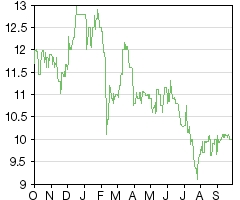
Share price performance
Business description
Next event
Analysts
Carbios is a research client of Edison Investment Research Limited |
|||||||||||||||||||||||||||||||||||||||||||||||
Carbios is demonstrating a disciplined scale up as it moves from research to industrialisation and commercialisation. Its depolymerisation technology could provide an answer to the key challenges of the plastics economy. Carbios has achieved key technology milestones and set up its first JV earlier than expected. We estimate the company is funded through 2017. Our base case fair value estimate is €26 per share.
Year end |
Revenue (€m) |
PBT* |
EPS* |
DPS |
P/E |
Yield |
12/14 |
0.7 |
(3.3) |
(59.3) |
0.0 |
N/A |
N/A |
12/15 |
0.8 |
(4.0) |
(81.3) |
0.0 |
N/A |
N/A |
12/16e |
0.6 |
(5.5) |
(111.7) |
0.0 |
N/A |
N/A |
12/17e |
0.7 |
(4.4) |
(93.1) |
0.0 |
N/A |
N/A |
Note: *PBT and EPS are normalised, excluding amortisation of acquired intangibles, exceptional items and share-based payments.
Regulation and demand support plastics technology
Carbios’s biodegradation, biorecycling and bioproduction technology could provide disruptive solutions to the plastic economy. The company is developing processes for enzyme-based de-polymerisation of plastics for absorption into nature or re-polymerisation for renewed use. This could enable a circular economy of plastics. Tightening regulation combined with structural growth of plastics consumption support the company’s market prospects, particularly its key end markets: bags, bottles, agricultural films and rigid packaging.
Consistent progress: Research to commercialisation
Carbios has demonstrated strong execution with conclusion of the research phase, proof of technology, a string of successful technology deliveries, first production batches and an earlier than expected signature of its first joint venture in H116, in partnership with Limagrain.
Financials: Funded through pre-commercial stage
Carbios is still at the pre-revenues stage. It is funded by research grants until the end of the Thanaplast project in 2017. We forecast an increase in losses as the scale up leads to a growing cost base. For 2016, we forecast a net loss of €4.2m. With cash of €8.8m as of end June 2016 and forecast net cash outflow of €8m for 2016-17, we estimate the company is funded through 2017. It will then have to secure follow-on funding and/or produce commercial revenues.
Valuation: €23-37 per share
As Carbios is at a very early stage, we find a DCF methodology with risk-weighted cash flows is appropriate in order to reflect uncertainty over size and timing of cash flows. We value Carbios on a SOTP approach for the most important processes. We model each process to 2030. This yields a fair value of €23-37 per share based on a range of discount rates, with the base case value of €26 (WACC of 20%). PET, as the most advanced process, is the most important component, accounting for 53% of our fair value.
Investment summary
Company description: Solutions for plastics
Carbios develops enzyme-based processes for biodegradation, biorecycling and bioproduction of plastics, based on de-polymerisation of monomers and subsequent re-polymerisation. This will lead to self-destroying plastics that can either be absorbed in nature without residues or re-polymerised for renewed usage. Situated between industry and academia, it is the leader of the Thanaplast consortium, which is scheduled to run from 2012 to 2017. It has well-recognised partners from research and industry such as CNRS (the French National Centre for Scientific Research), INRA (National Institute of Agricultural Research), as well as Limagrain and Barbier The company’s most advanced molecules are PET (polyethylene terephthalate) and PLA (polylactic acid). It targets packaging as its key end market, namely bags, bottles, agricultural films and rigid plastics. Tightening regulation on plastics is supportive of alternative processes.
Consistent progress towards industrialisation
Carbios follows a well-defined path of development, whereby it will move from research to pre-pilot, pilot, industrialisation and ultimately, commercialisation. The company targets a licensing and joint venture strategy in order to minimise capex and pursue an asset light model. We note consistent progress on execution. Over the past 12 months, Carbios has successfully concluded the research phase, commissioned first production facilities and is moving into the pre-pilot stage. Earlier than expected, it signed its first joint venture with the creation of Carbiolice (2016) in partnership with Limagrain and Bpifrance. This is encouraging for its prospects for commercial development.
Valuation: €23-37 per share
We value Carbios on a DCF/SOTP methodology with risk-weighted cash flows for most important processes. Based on process-specific royalty rates and market shares, we model PET, PLA, plastic bags, mulching films and rigid packaging as the key end markets until 2030, when we assume they will have reached sufficient maturity for visible revenues. This yields a valuation range of €23-37 per share based on different discount rates, with the base case valuation of €26 at a 20% WACC. PET is the most important component, accounting for 53% of our fair value. Each 100bps change to our base case WACC has a 17.3% impact on our fair value. Each 25bps change to our mature market share assumption changes our fair value by 4.5%, while each 50bps change to all our royalty rates moves our fair value by 8.9%. Each 10% change to our achieved unit price across all businesses changes our fair value by 8.5%.
Financials: Funded through the pre-commercial stage
Carbios is currently at the pre-revenues stage and is funded by research grants. Consequently, it is still loss making, reporting a net loss of €3.1m in 2015. Results were characterised by a growing cost base as Carbios accelerates its scale up, so we forecast further increases in losses to €4.2m. As of June 2016, Carbios had €8.8m of cash. We forecast cumulative free cash outflows of €8m for 2016 and 2017. We estimate Carbios is funded through the end of the Thanaplast project in 2017. It will then have to consider follow-on financing options and/or produce commercial revenues.
Sensitivities: Technology, execution
Technology risk is by far the most important sensitivity. Industrial and commercial execution are further important sensitivities. For all of this, timing is critical as it can affect financing. Refinancing risk will feature from the end of the Thanaplast project. From commercialisation, there will be sensitivities to IP risk, regulation and commodities.
Company description: Solutions for plastics
Biodegradation, biorecycling and bioproduction of plastics
Carbios develops biological processes for biodegradation, biorecycling and bioproduction of plastics. It is a link between academia and industrial applications: The company is the leader of the Thanaplast consortium, which is scheduled to run from 2012-2017 with the objective to develop such processes. Other partners in Thanaplast are CNRS (the French National Centre for Scientific Research) and INRA (National Institute of Agricultural Research), as well as Limagrain and Barbier.
Carbios’s process is based on depolymerisation and subsequent re-polymerisation through enzyme-based technology. After a process of enzyme selection, enzymes break up complex molecules into their original virgin monomers. These can then be absorbed back into nature without any residue or other negative impact. This will lead to self-destroying plastics, a process that can be time controlled. Alternatively, monomers can be re-polymerised into new polymers for renewed usage.
|
Exhibit 1: Carbios technology |
|
|
Source: Carbios |
This is potentially disruptive technology for the plastics sector. As polymers are very specific, each plastic requires specific enzymes. This makes for very precise processes with the advantage that they can be tailored very well and also that effective IP protection can be achieved. Ultimately, the company hopes to develop processes that facilitate a circular economy of plastics, which is one of the dominant strategic development targets of the plastic sector. It could enable infinite recycling and re-usage of plastics and thereby provide a solution to one of the major global challenges.
Carbios targets packaging as the key end market. Chiefly, this means plastic bags, bottles and rigid packaging, as well as agricultural mulching films. The most advanced process for the company is based on PET, while PLA is another key molecule.
Well defined process from research to commercial development
Carbios is looking to develop in three stages: research, industrialisation and commercialisation. During the research stage it has been selecting enzymes. Subsequently, it is looking to scale up to pre-pilot and pilot stage, followed by large-scale production – all of this during the industrialisation stage. Once it has successfully produced at scale, it is targeting commercialisation. In order to control capex outlay and maintain an asset light and high return on capital business model, the company is looking to license out its technology. It targets a long-term licensing and royalty-based business model. We find that credible as we are aware of peers pursuing similar structures. Since its IPO in 2013, Carbios has successfully delivered proof of concept for biodegradation, bioproduction and biorecycling at lab stage. It is about to enter the pre-industrialisation stage for the first of its processes.
Management
Management brings a combination of engineering, biochemistry and intellectual property law backgrounds, all of which is very relevant to Carbios’s business. The CEO, Jean-Claude Lumaret, comes from a chemical engineering background. Besides his scientific expertise, he has longstanding experience as a patent attorney, in the EU and elsewhere. For 30 years Mr Lumaret had previously been in senior functions with Groupe Roquette, one of the sector leaders in France. The Director of Strategy and Development, Emmanuel Maille, has a scientific background in biochemistry and is also an entrepreneur with previous start-up experience. His academic background is in biotechnology, enzymology and metabolic engineering. He has worked in the biotechnology sector since 2011. The Chief Science Officer, Alain Marty, is a highly recognised professor in biotechnology, enzymology and bioengineering. He has produced cutting-edge research and combined it with industrial application. He had high-profile academic responsibilities with INSA Toulouse and INRA.
Carbios has a board of advisors and a four-member scientific advisory board. The high-profile members are known for their expertise in the polymers sector. The board comprises former senior managers in the pharma sector, finance and industry, as well as an award-winning writer turned reporter and sustainability advisor who was an advisor to former president François Mitterand. All have held senior positions in blue-chip companies and/or major public institutions. In our view, there is a good mix of specific expertise in the pharma, biotech and food sectors, as well as financial knowledge and consideration of the broader impact on society. There is one woman on the board, who also heads up the scientific advisory board.
Solid progress towards industrialisation
Since our initiation note, Carbios has made consistent progress that has brought it closer to industrialisation. It has concluded the enzyme production stage. It has achieved further successful depolymerisation of commercial PET material into its original monomers with characteristics and quality identical to that of a hydrocarbons-based process. In line with its strategy of simultaneous process development, it has produced PLA-based biodegradable plastic. With that the company finalised its third key development phase as defined in the Thanaplast programme schedule. Carbios has also launched a pre-pilot production platform for biodegradable plastics. It is now moving into phase four as defined by its milestone achievement schedule, ie pre-pilot stage. At the same time, the company has strengthened its IP with four new patent applications and the acquisition of a new suite of patents. It has validated its in vivo enzymatic polymerisation process of lactic acid into PLA. This will allow for the PLA process to move to the pre-pilot stage. It is also worth noting that the lessons from this process can be transferred to other processes. Importantly, Carbios has announced its first joint venture, Carbiolice, in partnership with Limagrain and Bpifrance.
Exhibit 4: Key developments
Date |
Event |
Impact |
H115 |
Conclusion of enzyme production phase |
Progress towards next phase |
September 2015 |
Launch of pilot facilities for bioplastics production |
Step ahead on scale and execution |
November 2015 |
Validation of conclusion of stage three |
Cash inflow, proof of progress |
December 2015 |
100% depolymerisation of commercial PET material |
Evidence on technology |
May 2016 |
New patent grants |
Supports IP protection |
June 2016 |
First joint venture, Carbiolice |
Lends credibility to industrialisation |
July 2016 |
Direct production of PLA from lactic acid |
Improves competitiveness of process |
September 2016 |
Operational start of first JV, Carbiolice |
Proof of execution |
Source: Carbios and Edison Investment Research
Sensitivities
Carbios is at an early stage of technology as well as corporate development. It deals with highly sensitive organisms and innovative processes. As such, technology risk is by far the most important sensitivity. Success at lab stage is still a sensitivity, particularly the less advanced processes. The first steps of scale up from research to the first industrial stages entail risks including process stability, output quality and execution. To mention one, enzyme production at large scale is a challenge. Timing is also very important, as conclusion of key stages is the base for milestone payments and thereby important components of funding for the company. At this stage, we see technology and execution as by far the most important value drivers.
In 2017, the Thanaplast project will come to an end and with it related funding. In the run up to that point, refinancing risk will increase. Subsequently there will be interest rate risk as the company will likely become more exposed to market and commercial funding as opposed to public financing.
As a company that is developing potentially disruptive technology, IP is an important sensitivity. This is compounded through the targeted licensing business structure once the company moves to commercial stage. We note that Carbios is very active in securing patent protection at early stages, which is a positive. Management’s background in the area is also helpful (see above, management). However, enforcement will be key for the company’s success as well.
We note that there is significant risk with regards to execution, not only on technology and industrial expansion as above, but also on commercial development. Success in business development in order to secure licensing partners is not yet proven. Also, timing of future deals can have a major impact on the company’s finances. It is also worth noting that even though the company targets certain licence structures and parameters, licence conditions can ultimately vary a great deal. This could affect fab sizes, upfront payments, royalty rates and thus the entire earnings outlook for any given licence. It could have a bearing on the viability of entire product strings. None of these factors can yet be fully ascertained as the company is still very far away from testing its first licenses.
Once the company operates in the commercial stage, it will be exposed to commodity driven prices for its output products. These are particularly PET and PLA in the first instances. We note this particularly in the context of oil price volatility.
The company is also exposed to regulatory risk. Tightening waste regulations in particular offer more incentives for recycling and the prospect of opening up potentially vast markets. However, investors should keep in mind the potential variability of policy and regulation that could have an impact on certain end markets, even if the broader regulatory picture stays supportive.
Valuation
Carbios is an early stage company; it has just come out of the research stage and is about to enter a first phase of industrialisation. With that, cash flows are highly uncertain in terms of size and timing as they are governed by technology, execution and commercialisation risk as well as risk related to market development and product adoption that is still very far out. We note that there is a heavy weighting to cash flows that are still very far in the future. We therefore find a DCF methodology with risk-weighted cash flows an appropriate methodology.
With our DCF approach, we value the company on a SOTP basis for its most advanced processes. These are PLA, PET, plastic bags, mulching films and rigid plastics. We run a cash flow model on each of these to 2030, by which time all of them should have achieved a reasonable degree of maturity so that they can generate visible revenues. For each of the processes, we assume the company will be able to generate licence revenues very shortly after completing its industrialisation phase. The table below shows our key assumptions per process.
Exhibit 5: DCF assumptions by process
PET |
PLA |
Plastic bags |
Films |
Rigid plastics |
|
Global market volume, 2015 (mt) |
17.14 |
0.85 |
12.30 |
1.02 |
1.02 |
Global market volume, 2030 (mt) |
33.61 |
6.28 |
20.61 |
1.27 |
1.27 |
Carbios market share, 2030 (%) |
8 |
15 |
3 |
25 |
5 |
Mature royalty rate (%) |
5 |
2.5 |
3.5 |
3.8 |
5 |
Unit price 2015 (€/kg) |
1,000 |
1,378 |
2,500 |
3,000 |
2,500 |
Source: Edison Investment Research
We have also applied probability weights to our cash flows, as a function of the maturity of each process as shown in Exhibit 6.
Exhibit 6: Cash flow weights
Process |
Weight (%) |
PET |
50 |
Plastic bags |
5 |
Films |
25 |
Rigid packaging |
5 |
Average |
21 |
Process |
PET |
Plastic bags |
Films |
Rigid packaging |
Average |
Weight (%) |
50 |
5 |
25 |
5 |
21 |
Source: Edison Investment Research
Valuation range of €23-37 per share with upside as cash flows de-risk
Under this approach, we derive a fair value range of €23-37 per share for a range of WACCs between 15% and 25%, with a base case valuation of €26 at a 20% WACC. PET represents the single most important component of our valuation, given that it is the most mature process. It accounts for 45% of our total value, while plastic bags account for 37%.
|
Exhibit 7: Value components |
|
|
Source: Edison Investment Research |
In order to consider the cash flow variability as a result of a number of uncertain parameters, we have looked at sensitivities to our most important assumptions. Each 100bps change to our base case WACC of 20% has a 17.3% impact on our fair value. Each 25bps change to our mature market share assumption changes our fair value by 4.5%, while each 50bps change to all royalty rates moves our fair value by 8.9%. Each 10% change to our achieved unit price across all businesses changes our fair value by 8.5%.
|
Exhibit 8: Valuation range based on different chances of success and WACC assumptions |
|
|
Source: Edison Investment Research |
Peer group comparison
Because of the unique nature of Carbios’s process and product, it is very difficult to find a relevant peer group. The table below shows what we consider a reasonable peer group, though we caution there are significant differences in terms of strategies, products, size and maturity. This particularly holds true for the large-cap companies. In our view, the below peer group from the biotech and speciality chemicals spaces is most relevant.
Exhibit 9: Peer group comparison
Market cap (€m) |
EV/sales year one (x) |
EV/sales year two (x) |
|
Carbios |
38 |
57.7 |
48.6 |
Global Bioenergies |
85 |
13.8 |
8.6 |
Deinove |
31 |
36.9 |
40.0 |
Metabolic Explorer |
53.3 |
33.5 |
11.2 |
Novozymes |
89 |
6.4 |
6.1 |
BASF |
67,242 |
1.5 |
1.4 |
Bloomberg Chemicals Index |
1.6 |
1.5 |
Source: Bloomberg, Edison Investment Research. Note: Prices as at 28 September 2016.
Financials
Earnings
Carbios is still at pre-revenues stage and currently funded by research grants. Its earnings are characterised by a growing cost base as it scales up and moves towards industrialisation. As a result, it is currently loss making. We expect losses to grow further as industrialisation brings rising costs until the cost base stabilises and the company reaches the commercialisation stage around 2018. Carbios reported 2015 results that were characterised by faster than expected expansion. It received subsidies for completion of stage three and launch of stage four of the Thanaplast project. A net loss of €3.1m was above our forecast of €2.7m on the back of accelerated R&D spend to facilitate faster expansion.
Exhibit 10: 2015 results
€000s |
2014 |
2015 |
2016e |
Revenues |
664 |
837 |
600 |
% change y-o-y |
-26.2% |
26.1% |
-28.3% |
EBITDA |
(3,283) |
(3,896) |
(5,344) |
EBIT |
(3,364) |
(4,062) |
(5,596) |
Net interest |
48 |
78 |
103 |
Net income |
(2,210) |
(3,071) |
(4,188) |
% change y-o-y |
2.3% |
39.0% |
36.4% |
Source: Carbios accounts, Edison Investment Research
For 2016, we expect a further step up in R&D spend while the company’s revenues will consist of the final subsidy payments under the Thanaplast project, and R&D services to the JV for support in its industrial development. We expect a further increase in subsidy revenues as they are a function of spend. As cost acceleration will likely still surpass that of subsidies, we expect a further increase in losses. We forecast an EBITDA loss of €5.3m in FY16. In the absence of interest-bearing liabilities and with a positive impact of R&D tax credits, this translates into a net loss of €4.2m, up from €3.1m in 2015.
|
Exhibit 11: Revenue and earnings evolution |
|
|
Source: Carbios accounts, Edison Investment Research |
Cash flow and funding
We expect growing investment in research and development first and foremost, but also labs and production assets to drive further high levels of capex. Our forecast is for capex of €0.57m in 2016. With that, we forecast a free cash outflow of €4.7m in FY16. Based on management’s expectation that certain operating assets will have to be replaced, there will be an acceleration of capex in 2017 in our view. With that, we expect cumulative free cash outflows of €8m to the end of the Thanaplast project in 2017.
Carbios closed 2015 with €9m of cash we expect that it can fund its expansion through to the end of 2017. It will then have to either secure follow-on funding or produce revenues from commercialisation. The recent announcement of the first joint venture, Carbiolice (see above), provides comfort. Even though there will not be commercial revenues in the immediate future, it still lends credibility to commercialisation and may be helpful for further business development and even potential funding.
|
Exhibit 12: Cash flow and funding |
|
|
Source: Carbios accounts, Edison Investment Research |
Exhibit 13: Financial summary
Year end 31 December |
€000s |
2013 |
2014 |
2015 |
2016e |
2017e |
|
|
IFRS |
IFRS |
IFRS |
IFRS |
IFRS |
||
PROFIT & LOSS |
|||||||
Revenue |
|
|
900 |
664 |
837 |
600 |
653 |
Cost of Sales |
(3,164) |
(2,912) |
(3,145) |
(4,089) |
(2,862) |
||
Gross Profit |
(2,264) |
(2,248) |
(2,308) |
(3,489) |
(2,209) |
||
EBITDA |
|
|
(3,077) |
(3,283) |
(3,896) |
(5,344) |
(4,119) |
Operating Profit (before amort. and except.) |
|
|
(3,116) |
(3,364) |
(4,062) |
(5,596) |
(4,387) |
Intangible Amortisation |
0 |
0 |
0 |
0 |
0 |
||
Exceptionals |
9 |
15 |
(23) |
0 |
0 |
||
Other |
0 |
0 |
0 |
0 |
0 |
||
Operating Profit |
(3,107) |
(3,349) |
(4,085) |
(5,596) |
(4,387) |
||
Net Interest |
(0) |
48 |
78 |
103 |
27 |
||
Profit Before Tax (norm) |
|
|
(3,116) |
(3,316) |
(3,984) |
(5,493) |
(4,360) |
Profit Before Tax (FRS 3) |
|
|
(3,107) |
(3,301) |
(4,007) |
(5,493) |
(4,360) |
Tax |
961 |
1,091 |
936 |
1,305 |
868 |
||
Profit After Tax (norm) |
(2,155) |
(2,225) |
(3,048) |
(4,188) |
(3,492) |
||
Profit After Tax (FRS 3) |
(2,146) |
(2,210) |
(3,071) |
(4,188) |
(3,492) |
||
Average Number of Shares Outstanding (m) |
3.8 |
3.8 |
3.8 |
3.8 |
3.8 |
||
EPS - normalised fully diluted (c) |
|
|
(57.8) |
(59.3) |
(81.3) |
(111.7) |
(93.1) |
EPS - (IFRS) (€) |
|
|
n/a |
(0.6) |
(0.8) |
(1.1) |
(0.9) |
Dividend per share (c) |
0.0 |
0.0 |
0.0 |
0.0 |
0.0 |
||
Gross Margin (%) |
N/A |
N/A |
N/A |
N/A |
N/A |
||
EBITDA Margin (%) |
N/A |
N/A |
N/A |
N/A |
N/A |
||
Operating Margin (before GW and except.) (%) |
N/A |
N/A |
N/A |
N/A |
N/A |
||
BALANCE SHEET |
|||||||
Fixed Assets |
|
|
243 |
1,048 |
1,665 |
1,983 |
2,717 |
Intangible Assets |
72 |
130 |
231 |
471 |
732 |
||
Tangible Assets |
14 |
740 |
1,258 |
1,336 |
1,809 |
||
Investments |
157 |
178 |
176 |
176 |
176 |
||
Current Assets |
|
|
16,113 |
12,684 |
10,377 |
5,994 |
2,093 |
Stocks |
0 |
20 |
12 |
22 |
16 |
||
Debtors |
1,401 |
1,402 |
1,224 |
1,538 |
1,003 |
||
Cash |
14,598 |
11,099 |
9,011 |
4,304 |
944 |
||
Other |
114 |
163 |
130 |
130 |
130 |
||
Current Liabilities |
|
|
(1,110) |
(196) |
(337) |
(360) |
(235) |
Creditors |
(1,110) |
(196) |
(337) |
(360) |
(235) |
||
Short term borrowings |
0 |
0 |
0 |
0 |
0 |
||
Long Term Liabilities |
|
|
(680) |
(474) |
(571) |
(531) |
(481) |
Long term borrowings |
(457) |
(152) |
(222) |
(182) |
(132) |
||
Other long term liabilities |
(223) |
(322) |
(349) |
(349) |
(349) |
||
Net Assets |
|
|
14,566 |
13,062 |
11,134 |
7,086 |
4,094 |
CASH FLOW |
|||||||
Operating Cash Flow |
|
|
(1,532) |
(3,546) |
(2,595) |
(4,341) |
(2,835) |
Net Interest |
(0) |
48 |
78 |
103 |
27 |
||
Tax |
0 |
0 |
0 |
0 |
0 |
||
Capex |
(187) |
(867) |
(786) |
(570) |
(1,001) |
||
Acquisitions/disposals |
0 |
0 |
0 |
0 |
0 |
||
Financing |
13,500 |
1,171 |
1,145 |
100 |
450 |
||
Dividends |
0 |
0 |
0 |
0 |
0 |
||
Net Cash Flow |
11,781 |
(3,194) |
(2,158) |
(4,707) |
(3,360) |
||
Opening net debt/(cash) |
|
|
(2,360) |
(14,141) |
(10,947) |
(8,789) |
(4,122) |
HP finance leases initiated |
0 |
0 |
0 |
0 |
0 |
||
Other |
0 |
0 |
0 |
40 |
50 |
||
Closing net debt/(cash) |
|
|
(14,141) |
(10,947) |
(8,789) |
(4,122) |
(812) |
Source: Carbios accounts, Edison Investment Research
|
|||||||||||||||||||||||||||||||||||||||
|
|