bp plc is a client of Edison Group. Edison Group produces and distributes this and other content. Edison does not hold any position in bp plc.
Our first two reports looked at bpx energy on its own terms: production growth across the Permian, Eagle Ford and Haynesville, and efficiency gains that allowed it to produce more with fewer rigs, lower unit costs and less capital.
For investors, the next question is how this fits into the bigger picture. bpx is not separately listed. Owning a piece of bpx means owning bp, a global integrated energy company with upstream, downstream and trading businesses around the world. This report looks at the role bpx plays within bp and at the group-level numbers investors will weigh alongside it.
A company positioning for growth
Since becoming CEO in April 2026, Meg O’Neill has set out five priorities aimed at making bp ‘simpler, stronger and more valuable’. Strengthening the balance sheet comes first, followed by simplifying the portfolio, investing with greater discipline, driving operational excellence, and hardwiring high performance and accountability. bp will set out the next phase of its plans at a strategy and outlook update in New York on 15 December.
Growth is part of that plan, but it comes with conditions. ‘Growth must be earned through a track record of delivering consistent positive returns and cash flow,’ O’Neill said. ‘As we build that track record, we build our capacity, confidence and credibility to invest further.’
That is where bpx is relevant. Its production growth, falling rig count and lower unit costs are published every quarter, which makes it one of the easiest parts of bp for investors to hold to that standard. bp’s Q3 results made the same point: O’Neill said the bpx team’s culture of ownership ‘is showing up in better execution, higher productivity and stronger returns’.
What bpx brings to bp
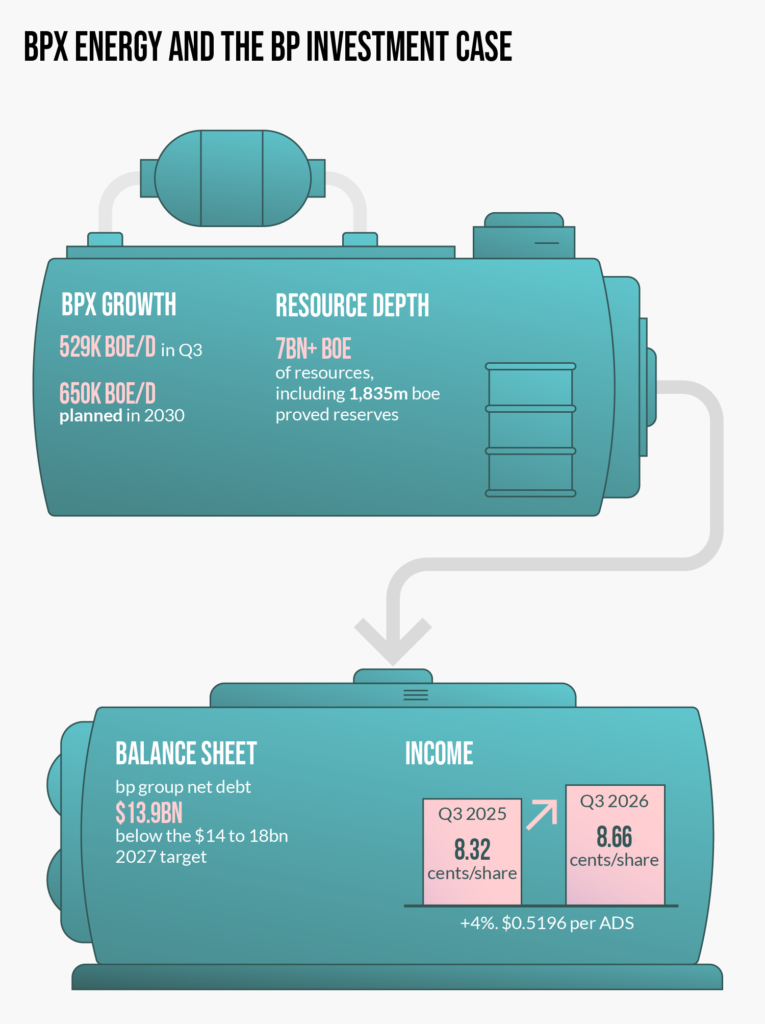
- Visible growth. bpx produced 529,000boepd in Q326 and averaged 525,000boepd over the first nine months, c 14% more than a year earlier. bp plans for bpx production to reach 650,000boed in 2030, c 23% above the Q3 level (Edison calculation).
- A deep resource base. At its 2025 capital markets update, bp put bpx’s resources at more than 7bn barrels of oil equivalent, giving it room for long-term growth and the flexibility to direct activity toward oil or gas as prices change. Of that, 1,835m barrels of oil equivalent were classified as net proved reserves at the end of 2025.
- Short-cycle flexibility. Onshore wells generate revenue soon after the investment decision, and activity can be adjusted as conditions change. This complements bp’s long-cycle projects: O’Neill said bp’s major projects sanctioned for start-up between 2028 and 2030 ‘are progressing according to schedule’.
- A familiar US anchor. For US investors, bpx offers exposure to basins and operating metrics they already know, inside a company whose other businesses are spread across the world.
None of this means bpx has an automatic claim on capital. O’Neill has said bp needs to ‘compete in the weight class we are in’, and bpx has to keep competing for investment with bp’s other opportunities. The efficiency gains described in our previous report are what strengthen its case.
Exhibit 1 – bpx energy and the bp investment case
Source: Edison Investment Research
The bp group picture
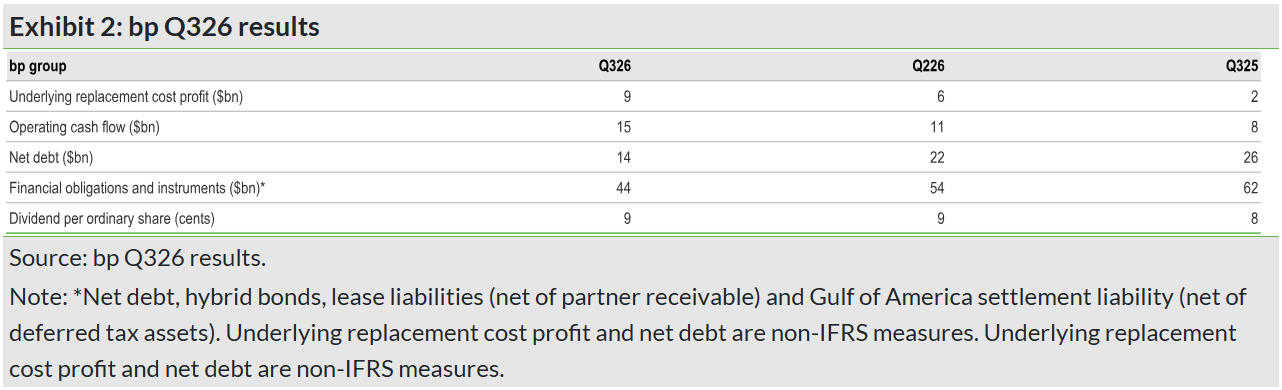
bp’s Q3 underlying profit rose 48% from the Q2 to $8.5bn, which bp attributed mainly to significantly higher realized refining margins and a significantly higher gas marketing and trading result. Operating cash flow was $14.8bn. Total financial obligations fell by $9.3bn in the quarter to $44.3bn, and net debt of $13.9bn is already below the $14–18bn range bp had targeted for the end of 2027.
bp now expects financial obligations to fall to around $33–35bn by the end of 2026, based on Q4 assumptions including Brent at $110 a barrel and around $8bn of divestment proceeds, most of which arrived when bp completed the sale of a 65% stake in Castrol in early November and the sale of a 5% stake in Norwegian producer Aker bp which was announced on 5 November 2026. bp has said it remains ‘still too leveraged’, and it now intends to prioritize excess cash flow to address its remaining Deepwater Horizon liabilities in full.
bp held its Q3 dividend at 8.660c per ordinary share, following a 4% increase at the Q2. US holders are expected to receive $0.5196 per American depositary share before fees, payable on 18 December. The share buyback, suspended in February 2026 so that excess cash could go to strengthening the balance sheet, has not been reinstated.
bp has now set out a clear philosophy for capital allocation, built on three priorities. The first is a ‘committed dividend’, which bp describes as the first call on its cash flow and one that shareholders need confidence it will deliver through the cycle. The second is disciplined investment through the cycle to improve asset performance and maximize cash flow, with growth capital going where bp sees ‘accretive and distinctive returns’. The third is sharing upside with shareholders, with share buybacks a tool bp can use ‘as and when appropriate’. bp will provide more detail on this frame on 15 December. Future dividends and any other shareholder distributions remain subject to the discretion of bp’s board.
How the pieces fit together
It is worth being precise about the relationship. bp’s group results in Q3 were driven mainly by sharply higher refining margins and trading, helped by improved operational performance. bpx’s contribution is of a different kind. It gives bp a growing, efficient, short-cycle US business in which capital can be put to work and start producing quickly, with performance that investors can measure every quarter.
O’Neill has said that the most important measure of whether bp is becoming more valuable is total shareholder return, delivered ‘through share price appreciation and dividends cash distributions’. bpx is one of the places bp can invest to support that, alongside its deepwater growth in the Gulf of America and its other upstream and downstream businesses. ‘Ultimately, the growth that matters most is shareholder value,’ she said, ‘growing value per share over the long term.’
What to watch
A balanced view needs to recognize the risks as well as the opportunity.
- Commodity prices. US natural gas prices remain low. bpx’s realized gas price recovered to $2.33/mcf in Q3 from $1.64 in Q2, but bp has lowered its 2026 Henry Hub pricing assumption, citing strong expected growth in US supply. Prices affect where bpx deploys its rigs and how quickly it can grow.
- Capital competition. bpx’s growth plans will need to keep competing for capital with bp’s other opportunities, and the pace of investment may change.
- Sustaining efficiency. bpx’s production costs have fallen from more than $10pboe in early 2023 to below $8 in 2026. Costs still move from quarter to quarter, and bp has flagged activity phasing at bpx as one factor in its Q4 production guidance. The test is whether bpx can keep that trend going as it grows.
- Group delivery. bp has now met its net debt and structural cost reduction targets, but has acknowledged a rise in tier 1 and tier 2 process safety events this year and that cost savings are not yet fully visible in its cost base. Its balance sheet plans depend on commodity prices and divestment proceeds.
Some investors remain sceptical after bp’s previous changes of direction and several changes of leadership in recent years, and that caution is understandable. bp’s answer is measurable delivery, reported every quarter.
Why this matters for Texas investors
For Texas investors, bpx is the part of bp that is easiest to judge from close to home. They know the basins, and they know what good looks like on rig productivity and cost per barrel. On the latest figures, bpx is growing, and doing so with fewer rigs, lower unit costs and less capital.
bp’s investment case rests on more than bpx. It depends on the whole group delivering on O’Neill’s five priorities, from the balance sheet to operational performance. But as bp works to become simpler, stronger and more valuable, bpx is already showing what disciplined, efficient growth looks like, and giving investors a clear set of numbers to track as that story unfolds.
Forward-looking statements, including bp’s plans, priorities and production expectations, are based on current expectations and planning assumptions. Actual results may differ materially based on various factors including, but not limited to, commodity prices, operational performance, regulatory changes and global economic conditions.
Shareholder distributions, including dividends and share buybacks, are subject to the discretion of the board and may vary based on factors including, but not limited to, commodity prices, cash flow generation, balance sheet considerations and general business conditions. Past distributions are not indicative of future distributions.