bp plc is a client of Edison Group. Edison Group produces and distributes this and other content. Edison does not hold any position in bp plc.
In our first report, we introduced bpx energy, bp’s onshore oil and gas business in the lower 48 states, and showed how quickly it is growing. Production averaged 525,000boepd over the first nine months of 2026, around 14% more than a year earlier.
For income-focused investors, growth raises a fair question: what does it cost? Growth that absorbs ever more capital can compete with other uses of cash. Growth that comes from using capital more productively is a different proposition. bpx’s latest figures suggest it is in the second category.
The nine-month picture
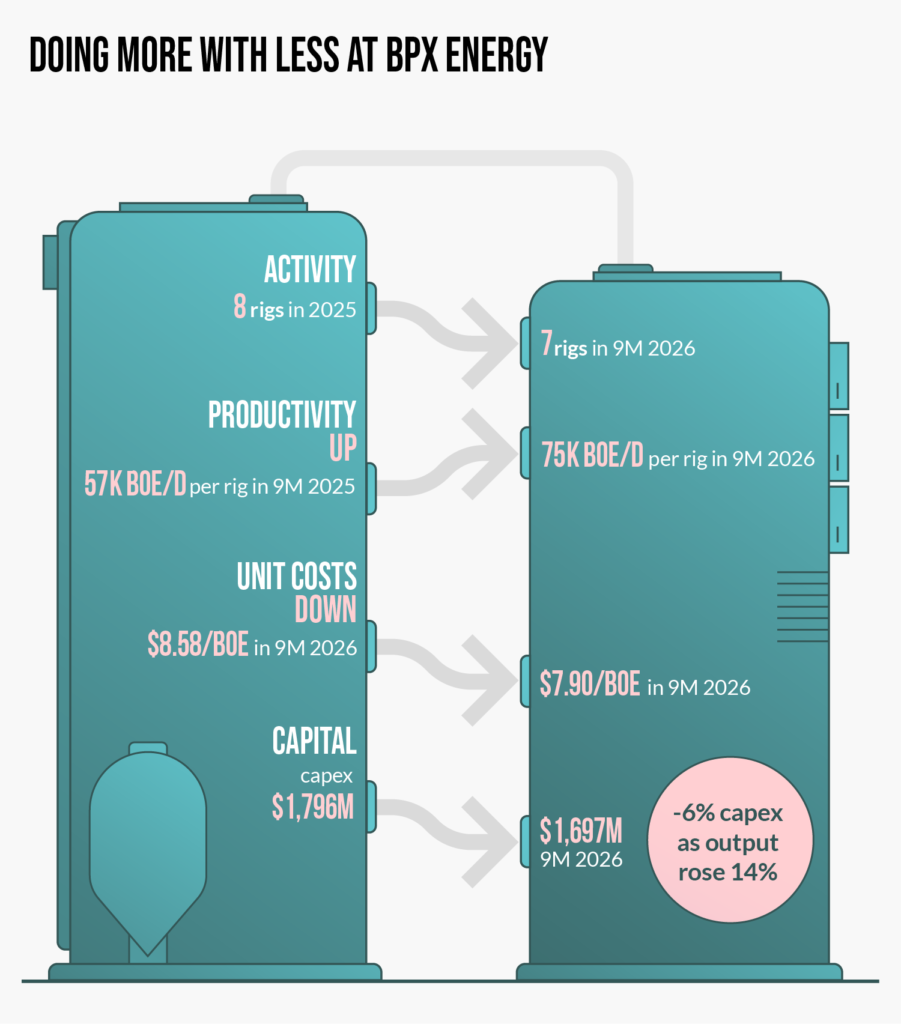
Quarterly numbers can be noisy, so it helps to look at the first nine months of the year (9M26) as a whole. Compared with the same period of 2025, bpx ran fewer rigs, spent less capital and cut its production costs per barrel, while producing substantially more.
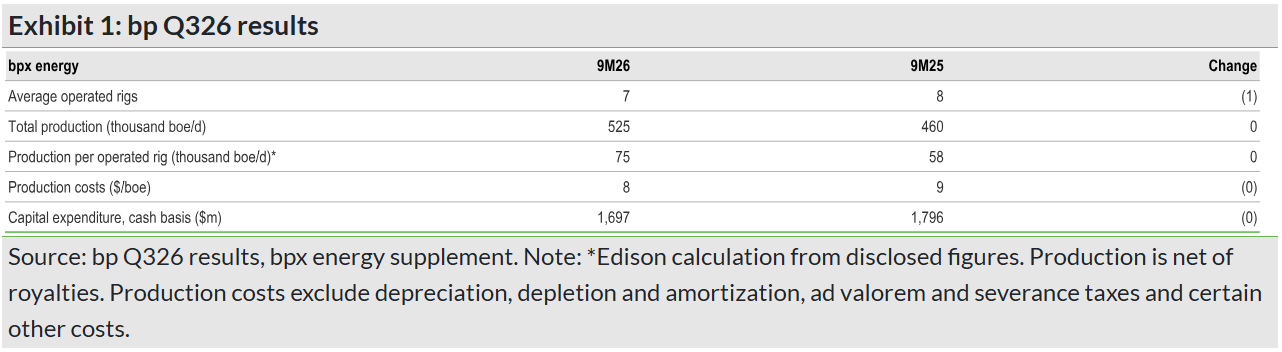
Q3 on its own points the same way when compared with a year earlier. bpx averaged seven operated rigs, down from eight. Production costs were $7.86 per boe against $8.21, and capital expenditure was $530m against $569m. Unit costs did rise from $7.20 in Q2, a reminder that quarterly figures move around.
Dividing production by the number of rigs is a simple measure, and an imperfect one, because output in any period reflects wells drilled earlier as well as the rigs running today. But the direction is consistent across the quarter and the nine months: each rig, and each dollar of capital, is associated with more production than a year ago.
Why efficiency means resilience
For risk-aware investors, the value of these gains lies less in the growth itself and more in what they do to the business’s resilience.
- Lower unit costs protect margins. The less it costs to produce each barrel, the more room a business has when prices fall. That was tested earlier this year, when the average price bpx realized for its gas fell to $1.64 per thousand cubic feet in Q2. It recovered to $2.33 in Q3, but US gas prices remain low, and bp has cut the Henry Hub price it assumes for 2026 in impairment testing to $3.18 per million British thermal units from $3.80 (in real 2024 terms), citing strong expected growth in US supply.
- Short-cycle spending can be adjusted. Because onshore wells produce soon after they are drilled, bpx can change the pace and location of its activity relatively quickly. CEO Meg O’Neill said bp is ‘always making trade-offs around where can we most effectively deploy those dollars within bpx’, across a portfolio where ‘the Haynesville is gas, Eagle Ford has both gas and oil and Permian is quite oily’. In Q3, bpx moved one rig from the gas-weighted Haynesville to the Eagle Ford, showing that flexibility in practice.
- Results show up quickly. Short-cycle investment means the link between spending and production appears in the numbers within a few quarters. Investors can check whether capital is being used well without waiting years for a large project to come on stream.
Exhibit 2 – Doing more with less at bpx energy
Source: Edison Investment Research
Part of a wider discipline at bp
These gains fit the approach bp has set out under CEO Meg O’Neill. Two of her five priorities are directly relevant. One is investing with greater discipline: ‘Every dollar of capital has to compete,’ she said, with the aim of ‘focusing capital on our best opportunities to maximise cash flow and returns’. The other is driving operational excellence, which means running assets ‘safely, reliably and with greater cost efficiency’.
This matters within bp as a whole. At group level, bp now guides to total capital expenditure of $13.5–14.0bn for 2026. Within any fixed budget, businesses that can grow on less capital make that budget go further. bpx grew nine-month production by around 14% while spending around 6% less.
What we can and cannot see
bp does not report bpx’s profit or cash flow separately, so the financial effect of these gains cannot be measured directly from public figures. What investors can see is the operating picture. More production per rig, lower costs per barrel and lower capital spending are the levers an onshore producer controls, and over 9M26 bpx moved all three in the right direction, compared with a year earlier. Higher productivity from the same asset base is what supports cash generation over time.
It would be wrong to treat one period as proof of a permanent change. Well performance varies from year to year, service costs can rise, and commodity prices shift where drilling makes most sense. The test is whether bpx can sustain these gains, and because bp publishes the key figures every quarter, investors can follow that for themselves.
Why this matters for California investors
Many California investors are income-focused and cautious about risk. For them, the quality of growth matters as much as its pace. bpx offers an example of growth that has come alongside lower activity, lower unit costs and lower capital spending, which is the kind of growth that is easier to sustain through the commodity cycle.
In our final report, we look at how bpx fits into bp’s broader investment case, including the progress bp is making on its balance sheet and portfolio. [Link to Consideration landing page]
Forward-looking statements, including bp’s plans, priorities and production expectations, are based on current expectations and planning assumptions. Actual results may differ materially based on various factors including, but not limited to, commodity prices, operational performance, regulatory changes and global economic conditions.
Shareholder distributions, including dividends and share buybacks, are subject to the discretion of the board and may vary based on factors including, but not limited to, commodity prices, cash flow generation, balance sheet considerations and general business conditions. Past distributions are not indicative of future distributions.