“Edison is the go-to for a new investor to get full understanding of the investment case and business. Edison’s distribution reaches investors that we want to connect with directly.”
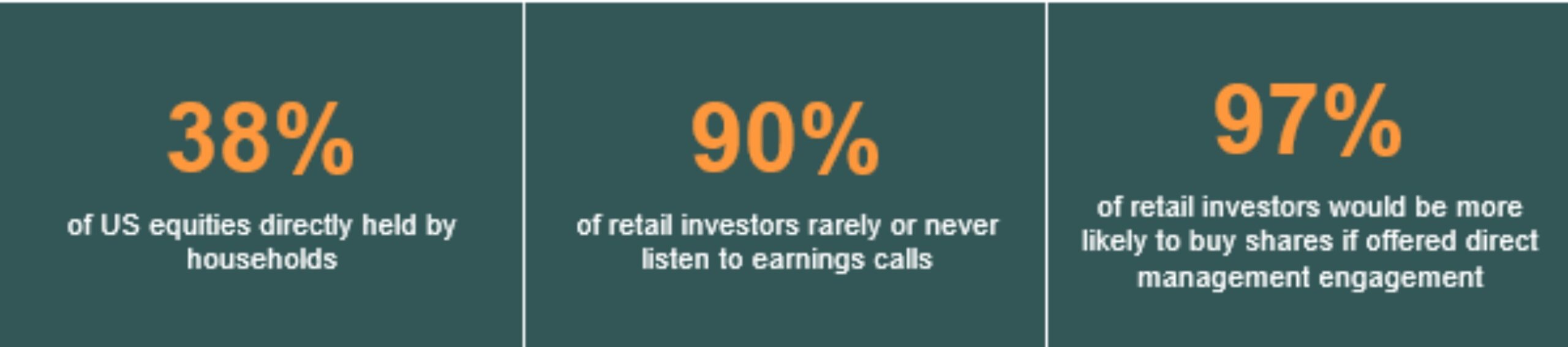
62% of American adults own stock, the highest level since before the 2008 financial crisis, and US households directly hold nearly 38% of US equities, according to the Securities Industry and Financial Markets Association (SIFMA). At peak moments in 2025, retail investors accounted for 35% of total US equity trading volume, an all-time high. Even during more measured periods, retail trading activity has consistently run at 20–25% of daily equity market volume. These are not marginal numbers. The US retail investor is, by some distance, the most participatory in the world.
The contrast with other major markets is striking. Fewer than one in four UK adults hold stocks directly, compared to nearly two in three Americans. The origin of this difference is structural: US retirement savings are built around 401(k) plans that invest directly in equities, giving millions their first experience of stock ownership through an employer. Over time, this has normalised equity investment as a default behaviour for millions of Americans – a familiarity with markets that has no real equivalent in the UK or Europe, and that has produced a retail investor base that is engaged, experienced and, increasingly, influential.
Exhibit 1: US retail investing: Participation and the communication gap
Sources: SIFMA, via BestBrokers 2026, New River Strategies Retail Investor Survey, cited in Governance Intelligence, May 2026
Access drove the revolution
Commission-free trading, fractional shares and mobile-first platforms have dismantled long-standing barriers to entry for the US retail investor. The percentage of 25-year-olds with investment accounts rose from 6% in 2015 to 37% in 2024, while retail flows into US equities in the first half of 2025 exceeded pandemic boom levels, reaching approximately $302bn. This growth is unfolding against a striking backdrop. The universe of US public companies has declined 43% since 1996, while the number of private equity-backed companies has increased fivefold. In fact, fewer than 15% of companies with revenues over $100m are now public. For listed companies, the retail investor’s expanding participation has become an increasingly important strategic asset – but capturing it requires understanding how this audience finds, consumes and acts on information.
The information landscape is changing faster in the US than anywhere else
62% of US retail investors now use AI tools to inform investment decisions and 56% use YouTube for investment research. More than half of US investors aged 22–37 say they have purchased stock based on social media content. Even among high-net-worth investors, social media was cited by 25% and YouTube finance channels by 18% as information sources, with both figures rising year on year. The recent SpaceX IPO is a case in point: a deal that generated nearly $250bn in orders and was reportedly around four times oversubscribed, driven in significant part by a digital investment narrative built over years on social media, amplified by retail platforms competing to offer their users access, and consumed by millions of investors who had quite possibly never read a prospectus but who, nonetheless, felt they knew exactly what the company stood for. The investment case was not discovered in a filing; it was built online.
More communication, not less
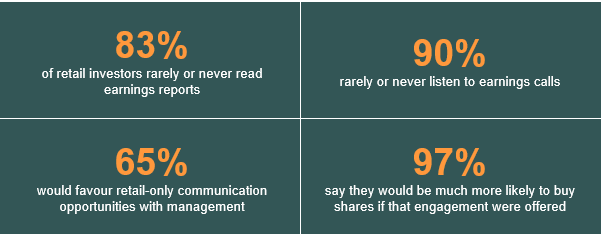
There is an apparent paradox at the heart of retail investor engagement. New River Strategies’ retail investor survey found that 83% of retail investors rarely or never read earnings reports and 90% rarely or never listen to earnings calls. On the surface, this suggests disengagement. But dig beneath these numbers and the same survey actually tells a different story: 65% of retail investors would favour retail-only communication opportunities with management. In fact, 97% of retail investors said they would be much more likely to buy additional shares if management offered such engagement.
The conclusion is not that retail investors are uninterested, it is that the communications format is not working for them.
Exhibit 2: The retail engagement paradox
Source: New River Strategies Retail Investor Survey, cited in Governance Intelligence, May 2026
This distinction matters directly for the ongoing Securities and Exchange Commission debate regarding reducing quarterly reporting frequency to semi-annual. Moving to semi-annual reporting would not reduce the total information circulating in markets, but it would reduce the mandatory information available to everyone equally. What would replace the mandated filings is information that flows through channels that retail investors typically do not have access to: expert networks, direct management meetings and alternative data. That is not a widening of the information gap, but rather a formalisation of it.
The answer to retail disengagement is more communication, not less – but it is communication that meets investors where they already are: short-form video, social platforms, direct management engagement beyond the annual general meeting. Companies that build these channels build something no mandated quarterly filing can: a retail shareholder base that is informed, connected and inclined to hold through volatility.
The world’s most active retail investor market is also the most digitally sophisticated. Engaging it on its own terms is not a communications exercise – it’s a shrewd capital strategy.
To find out how Edison helps companies build meaningful engagement with their retail investor base, visithttps://www.edisongroup.com/.