“Edison is the go-to for a new investor to get full understanding of the investment case and business. Edison’s distribution reaches investors that we want to connect with directly.”
Most market events are noise. The SpaceX listing is not. Having filed in May 2026, SpaceX made its Nasdaq debut (ticker: SPCX) and closed its first day of trading on 12 June 2026 above a $2tn market capitalisation. This makes the listing of SpaceX the largest flotation in history, eclipsing Saudi Aramco’s 2019 $29bn record and instantly one of the six most valuable public companies in the US. The roughly $30bn raise carried an unusually large retail allocation, reported at up to 30% of the offering, roughly three times the norm.
The engine of that valuation is Starlink, which generated $11.4bn of revenue in 2025 (up 48% y-o-y and c 61% of group revenue) and surpassed 10 million active customers across 160 markets by February 2026. But the listing does more than mint a mega-cap; it resets how the entire sector is valued. As Adam Niewiński of OTB Ventures puts it, the IPO is ‘going to reset valuations and establish a benchmark for the space-tech industry’; a recognition that space ‘isn’t sci-fi…but part of globally important strategic infrastructure’. Much as Netscape’s 1995 flotation institutionalised the internet, SpaceX makes space a mainstream investment theme. For the many investors who cannot buy SpaceX directly, the question becomes how to access the same structural growth and which listed incumbents the re-rating threatens versus which it quietly advantages.
What is the ‘Starlink problem’ for listed operators?
Starlink has commoditised satellite connectivity. Traditional operators built their economics on scarce, expensive geostationary earth orbit (GEO) capacity that involved a handful of large satellites in fixed, high-altitude orbits, where capacity is finite and signal latency is high. Starlink works differently; thousands of small, mass-produced satellites in a low earth orbit (LEO) are able to deliver lower latency and near-terrestrial broadband speeds, all while benefiting from SpaceX owned launch vehicles adding capacity at a marginal cost no incumbent can match. Therefore, a mega-constellation priced for volume undercuts the traditional GEO model directly. Management at SES, Europe’s largest listed operator, puts it starkly: ‘Every day we wake up, we think about Starlink. Every day we go to sleep, we think about Starlink.’
The pressure shows up as price erosion across data and connectivity and as structural decline in legacy satellite broadcasting (compounded by streaming). On this reading, the listed operators are simply the companies being ‘killed’, and most coverage of the SpaceX listing stops there. However, it is only half the picture.
So why are the same companies also winners?
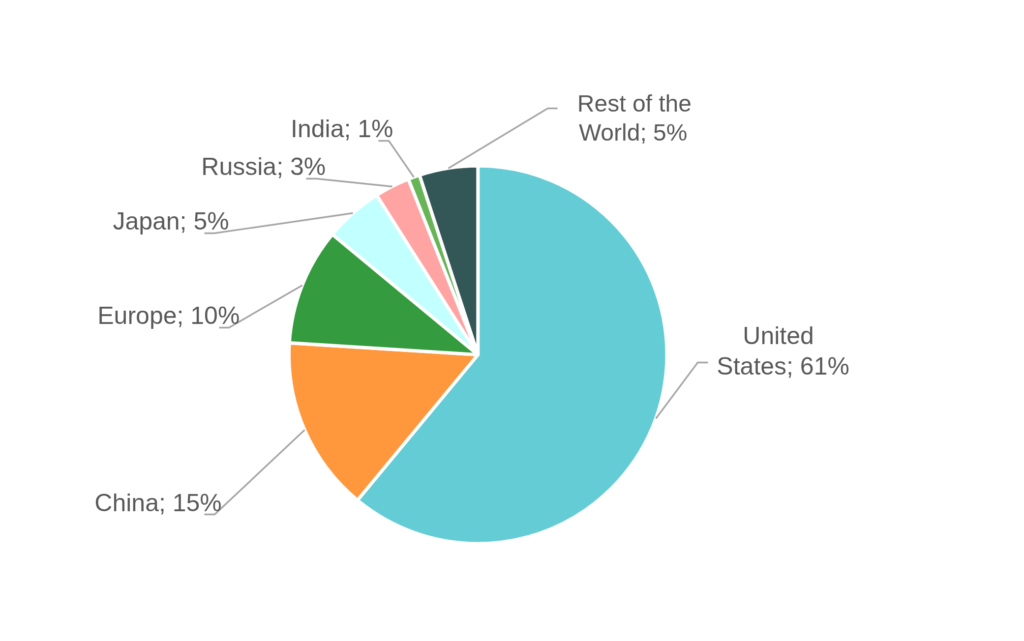
The missing half is sovereignty. For European governments, depending on a single US provider for critical communications has become a strategic risk: when infrastructure sits on a foreign operator’s network, access can be curtailed at short notice. Space assets now underpin almost everything modern economies rely on, from communications and digital payments to navigation and weather forecasting, yet the European Space Agency calculates that Europe accounts for just 10% of global public space funding, against 60% for the US. Closing that gap is now funded policy: institutional space budgets reached a record €122bn in 2024 (up 9%), with defence the main driver (up 12%) and, for the first time, defence space spending exceeding civil.
The EU’s flagship answer is IRIS², a €10.6bn sovereign multi-orbit constellation (60% EU-funded, with services from 2030) awarded to the SpaceRISE consortium led by SES and including Eutelsat. France has gone further: President Macron describes Eutelsat as ‘the only non-American and non-Chinese operator with a LEO constellation…a matter of sovereignty’, and the French State led a €1.35bn capital raise in 2025 to become its largest shareholder (c 30%), alongside a 10-year military OneWeb contract worth up to €1bn. In other words, the very operators Starlink threatens are also the designated, subsidised vehicles of European space sovereignty. The same names are at once the killed, (losing ground to Starlink commercially), the would-be killers (Europe’s challengers to Starlink) and the ‘enabled‘ (beneficiaries of public money).
Exhibit 1: Distribution of institutional space budgets in 2024 (civil and defence)
Source: European Space Agency report on the space economy 2025
The same forces are visible in private markets, where the SpaceX flywheel is already turning. European space-tech start-ups have raised more than €2bn so far this year, almost double the whole of 2025, and the region now commands close to a quarter of global space-tech deal value, up from 12.5%. In the listing’s wake, Finland’s ICEYE and Germany’s Isar Aerospace each closed rounds worth hundreds of millions. Seraphim Space’s Mark Boggett says defence is the primary driver, ‘80% of [portfolio] revenue is coming from defence…the procurement processes that would normally have been blockers have been washed away‘. Compounding it, a generation of newly wealthy (often European) SpaceX employees and cashed-out backers are expected to recycle capital straight back into the theme. The read-across for the quoted operators is a rising, sovereignty-driven tide of capital and contracts.
Which listed players are caught in between?
SES (Euronext Paris/Frankfurt: SESG, c €6bn market cap) completed its acquisition of Intelsat in July 2025, creating a 120-satellite, multi-orbit operator with roughly €3.7bn of pro forma revenue. Its strategy is explicitly not to fight Starlink everywhere, but to win in government, defence, mobility and ‘sovereign‘ managed connectivity by using its combined GEO and medium earth orbit (O3b mPOWER) reach and its lead role in IRIS² (capex of up to €1.8bn ramping from 2027). It is simultaneously threatened by commoditisation and underwritten by sovereign demand.
Eutelsat (Euronext Paris: ETL, c €5bn market cap) owns the OneWeb LEO constellation and is now state-anchored. It is investing up to €2.2bn in 440 next-generation satellites (100 ordered from Airbus Defence and Space) to reach global coverage by the end of 2026, supported by a backlog of c €3.7bn and a roughly €2bn IRIS² commitment. It is the purest sovereignty play in the listed universe and also the most financially stretched.
This is the nuance a research house can hold that a headline cannot: these names are not simply Starlink losers. They are leveraged bets on whether European sovereignty spending can offset Starlink’s commoditisation. And beyond the operators sit the enablers, the picks-and-shovels suppliers of radio-frequency components, optical terminals, ground systems and launch services that benefit from the build-out whoever ultimately wins the orbits.
What are the risks investors should keep in mind?
This is a high-beta, near-binary theme, and three cautions stand out. First, capital intensity: both operators are funding multi-billion-euro constellations well into the 2030s, while IRIS² revenues do not begin until 2030. Therefore, execution and balance-sheet risk are real, and Eutelsat in particular is loss-making and heavily indebted. Second, the competitive gap is not closing: SpaceX’s Starship is scaling and Starlink’s move into direct-to-device keep raising the bar. Third, valuation and euphoria: the SpaceX debut has, in one investor’s words, ‘reset valuations‘ for the whole sector, and a more than $2tn benchmark arriving amid a queue of mega-IPOs can re-rate quoted peers, up or down, faster than fundamentals justify. Subsidy-dependence cuts both ways: political budgets can be cut as well as expanded.
Edison insight
SpaceX’s more than $2tn debut is being read as a verdict on the companies it threatens. The more useful question is which of them sovereignty turns into beneficiaries. Europe funds barely 10% of global public space spending to the US’s 60% and has decided that gap is a risk it will pay to close. A record €122bn of public budgets, a €10.6bn IRIS² programme, state capital behind Eutelsat and a near-doubling of private space-tech funding are the proof. That makes listed operators such as SES and Eutelsat neither simply Starlink victims nor pure challengers but leveraged bets on whether subsidised European sovereignty can outpace commoditisation. For these names, opportunity and risk point in the same direction and that is precisely the nuance worth holding.
Megatrends: disruptive technologies, digital economy, sovereign security and defence, connectivity, the space economy
Market capitalisations are approximate as at mid-June 2026 and should be refreshed at publication. Sources include the ESA Report on the Space Economy (2024 data), SpaceX SEC filings, SES and Eutelsat company disclosures, and PitchBook.