“Edison is the go-to for a new investor to get full understanding of the investment case and business. Edison’s distribution reaches investors that we want to connect with directly.”
Sovereign wealth funds (SWFs) crossed $15tn in assets under management for the first time in December 2025. Add public pension funds and central banks, and state-managed capital now totals $60tn. This is, by some distance, the largest organised pool of investable capital in the world – yet many companies treat SWFs as just another equity holder, with little regard for the very different mandates, priorities and engagement expectations that sit behind the cheque. That is a strategic oversight worth correcting.
Exhibit 1: Sovereign wealth funds manage more than $15tn in assets
The headline figure conceals considerable diversity. Norway’s Government Pension Fund Global (GPFG), the world’s largest sovereign wealth fund at $2.1tn, is a passive universal owner: it holds stakes in 7,200 companies across 60 countries, owning c 1.5% of every publicly listed stock on earth, and its portfolio is constructed to mirror global equity markets rather than to back specific investment theses. The Gulf funds operate differently. The UAE’s Abu Dhabi Investment Authority (ADIA), managing around $1.2tn, pursues a deliberately diversified long-term strategy spanning more than two dozen asset classes – from public equities and fixed income to private equity, real estate and infrastructure – investing across more than 50 countries through a mix of internal management and external fund mandates. Saudi Arabia’s Public Investment Fund (PIF), managing $925bn but targeting $2tn by 2030, is the world’s most active dealmaker, using capital deployment as an instrument of national economic transformation. Singapore’s Temasek ($324bn) and GIC (c $930bn) occupy another category: sophisticated, return-oriented long-term investors with deep sector expertise and a strong preference for companies they can understand in granular detail.
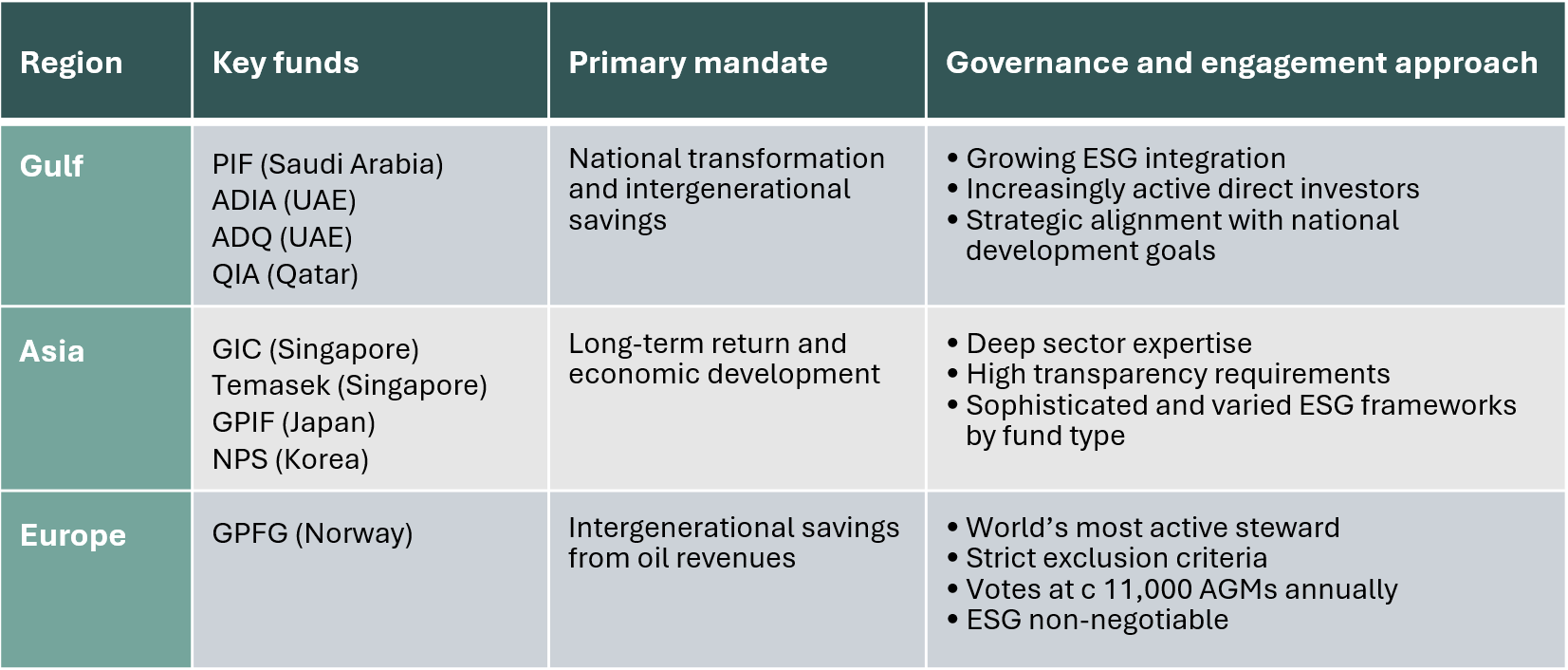
Geography explains the mandate, although the distinction is a spectrum rather than a strict divide. At one end, savings-driven funds, such as Norway’s GPFG and the UAE’s ADIA, recycle commodity revenues into perpetual intergenerational wealth, prioritising governance and risk-adjusted return above all else. At the other, development-oriented funds, Saudi Arabia’s PIF foremost among them, pursue economic transformation alongside financial return, and want to understand a company’s role in global value chains and national strategy. Both ends of the spectrum require the same starting point: quality information.
Exhibit 2: Geography explains the mandate
Source: Edison research, corporate disclosures
Governance is the entry ticket
Despite these differences, many, but not all, major sovereign wealth funds treat governance quality as a non-negotiable requirement. Norges Bank Investment Management (NBIM), which manages the GPFG, voted at c 11,000 shareholder meetings in 2024 and, as of the end of 2024, had excluded 104 companies from its portfolio based on conduct – ranging from human rights violations to severe environmental damage to corruption. The empirical evidence reinforces this: research published in leading finance journals finds that all three pillars of ESG are positively associated with the likelihood of sovereign wealth fund investment and that higher ESG performance consistently attracts greater SWF ownership stakes.
Other funds strike a different balance: Saudi Arabia’s PIF, Qatar’s QIA and the UAE’s sovereign vehicles were already early-stage shareholders in SpaceX (and lined up multibillion-dollar orders for its IPO on 11 June 2026), a company whose corporate governance has drawn considerable scrutiny but which sits squarely within the AI and space infrastructure themes these funds have prioritised strategically.
For Norway’s GPFG and funds like it, poor governance is a disqualifier; for others, it is one factor weighed against the scale of the opportunity.
What separates the companies that get noticed
Scale creates its own practical requirements. Funds managing hundreds of billions need companies liquid enough to enter and exit without moving markets, which sets a floor on market capitalisation. But within that universe, the differentiator is consistently the quality and accessibility of information.
Norway’s GPFG sets perhaps the clearest benchmark. Since 2012, NBIM has published formal expectation documents – publicly available standards covering governance, climate, biodiversity, human rights and tax transparency – against which it assesses every company it holds. These are not soft preferences. In March 2024, the fund voted against the re-election of board chairs at firms that failed to meet its gender diversity expectations. NBIM is also actively pushing for a unified global reporting standard, calling on regulators to align European and international sustainability disclosure frameworks so investors can compare companies across jurisdictions in a single document. Research confirms that these expectation documents measurably reshape corporate governance at scale – and other major funds are following the model. Temasek formed a dedicated Investment Stewardship team in 2024 and introduced a formal voting policy in 2025, setting out its expectations on governance and long-term value creation. GIC actively engages portfolio companies on their climate transition plans and funds the adoption of green technologies as part of its net-zero commitment.
Companies that want to retain access to this pool of capital are taking notice. Those that benefit most are not necessarily the largest or best-known but are the most legible: companies with consistent, substantive communication, a clear long-term equity story and credible third-party research that is openly accessible. Independent research not locked behind institutional distribution is read, cited and used by sovereign fund analysts in ways that paywalled content simply is not.
The world’s most powerful investors are not hard to impress. They require the basics, done well and done consistently, and they notice when those basics are missing.