Viralytics
Written by
Viralytics |
Combination trials gather momentum |
Keytruda combo |
Pharma & biotech |
26 November 2015 |
Share price performance
Business description
Next events
Analysts
Viralytics is a research client of Edison Investment Research Limited |
|||||||||||||||||||||||||||||||||||||||||||||||||||
Viralytics is escalating combination trials of its Cavatak oncolytic virotherapy with immune checkpoint inhibitors (ICI), adding a collaboration with Merck to study IV Cavatak combined with Keytruda in advanced lung and bladder cancers to its portfolio of ongoing trials combining intralesional Cavatak with Keytruda or Yervoy in melanoma patients. Cavatak has the potential to markedly improve the proportion of patients who respond to ICI therapy and we expect it to continue to attract attention from big pharma. We value Viralytics at A$192m or A$1.04 per share.
Year end |
Revenue |
PBT* |
EPS* |
DPS |
P/E |
Yield |
06/14 |
2.5 |
(4.7) |
(3.9) |
0.0 |
N/A |
N/A |
06/15 |
2.5 |
(5.5) |
(3.0) |
0.0 |
N/A |
N/A |
06/16e |
4.4 |
(7.6) |
(4.2) |
0.0 |
N/A |
N/A |
06/17e |
4.4 |
(7.9) |
(4.3) |
0.0 |
N/A |
N/A |
Note: *PBT and EPS are normalised, excluding intangible amortisation, exceptional items and share-based payments.
Viralytics and Merck collaborate on combination trial
Viralytics and Merck will collaborate on a clinical trial combining intravenous (IV) Cavatak with Merck’s marketed anti-PD1 checkpoint inhibitor Keytruda (pembrolizumab) in lung and bladder cancer. The Phase Ib trial, which we expect to begin in H116, will be the second stage of Viralytics’ ongoing STORM trial.
Adds to checkpoint inhibitor combination trials
Viralytics has already initiated separate trials of Cavatak administered by intralesional injection combined with either Keytruda or Yervoy (ipilimumab). Amgen and Merck appear to have wound down their combination trial of Keytruda with intralesional injections of Amgen’s recently-approved oncolytic virotherapy Imlygic (T-vec). This may allow Viralytics to make up some ground on Amgen’s current lead in the development of ICI/oncolytic virus combination therapy.
Cavatak plus checkpoint inhibitors could be a potent combination
Checkpoint inhibitors have markedly improved the treatment prospects for a number of cancers. Results of preclinical studies in melanoma indicate that Cavatak/ICI combination therapy has the potential to significantly improve the percentage of patients who respond to checkpoint inhibitor therapy. We view Merck’s decision to collaborate on a joint trial as significant validation of the potential benefits of Cavatak/ICI combination therapy.
Valuation: Virtually unchanged at A$1.04/share
Our risked DCF valuation is A$192m (vs A$189m) or A$1.04/share (vs A$1.03/share) with higher uptake of Cavatak in NSCLC and metastatic bladder cancer partly offset by higher R&D spend and deferring Cavatak deal timing by 12 months to FY17. Cash at 30 September of A$19.5m is sufficient to fund operations for the next two years at the forecast cash burn rate of ~A$8.3m per year.
Merck collaboration is a feather in the cap
Viralytics has entered into a clinical trial collaboration agreement with Merck, that means that the second stage of the ongoing STORM trial will test IV administration of its Cavatak oncolytic virotherapy in combination with Merck’s anti-PD1 ICI antibody Keytruda (pembrolizumab) in advanced bladder cancer and non-small cell lung cancer (NSCLC).
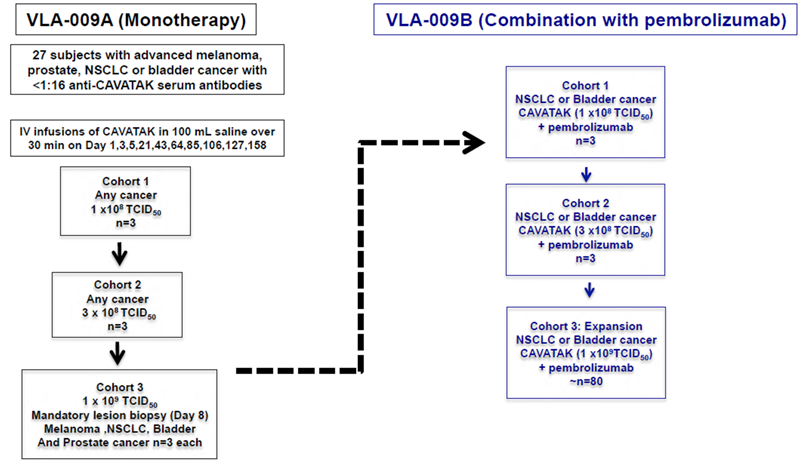
The proposed trial design illustrated in Exhibit 1 shows that three escalating dose cohorts of three patients each will receive, respectively, 1x10⁸, 3x10⁸ and 1x10⁹ TCID50 doses of Cavatak in combination with fixed doses of Keytruda. These are the same three doses of Cavatak that have been tested in the ongoing monotherapy study that comprises stage 1 of the trial. The highest dose cohort will be expanded to include ~80 subjects across both cancer types. The aim of the study is to establish a recommended dose for the Cavatak/Keytruda combination and to assess anti-cancer activity and patient tolerability.
Under the collaboration agreement, Viralytics will provide Cavatak and sponsor the study, Merck will provide Keytruda and conduct biomarker analysis. The agreement allows for the collaboration to be extended to include a potential Phase III trial. No other details of the collaboration have been disclosed.
|
Exhibit 1: Design of Phase I/II STORM study, including Keytruda combination extension |
|
|
Source: Pandha et al STORM poster Society for the Immunotherapy of Cancer (SITC), November 2015 |
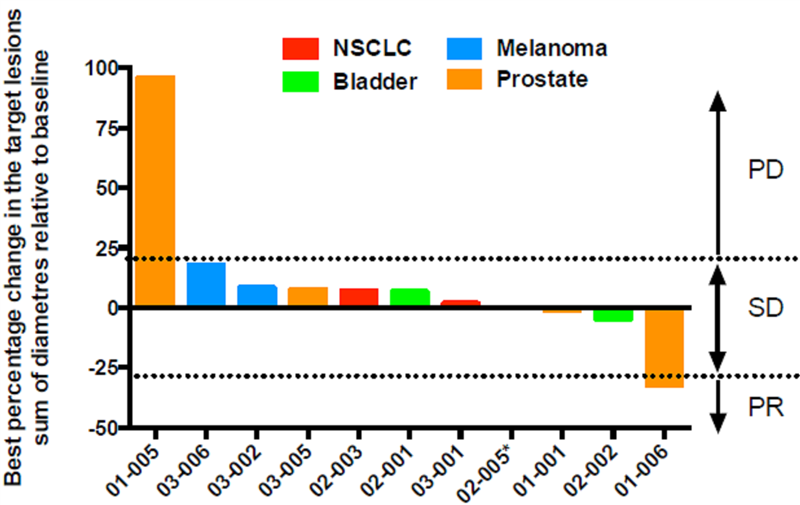
The combination study will build on the encouraging evidence of efficacy for IV Cavatak seen in the monotherapy arm of the STORM trial to date. Initial results from the first 12 out of a target of 18 patients, including six patients who have received the highest dose of Cavatak, showed that the treatment is well tolerated. Several patients achieved a best overall response of stable disease, including one patient from the highest dose cohort with a confirmed partial response (Exhibit 2).
|
Exhibit 2: Best percentage change in target lesions in STORM trial |
|
|
Source: Pandha et al STORM poster Society for the Immunotherapy of Cancer (SITC), November 2015. |
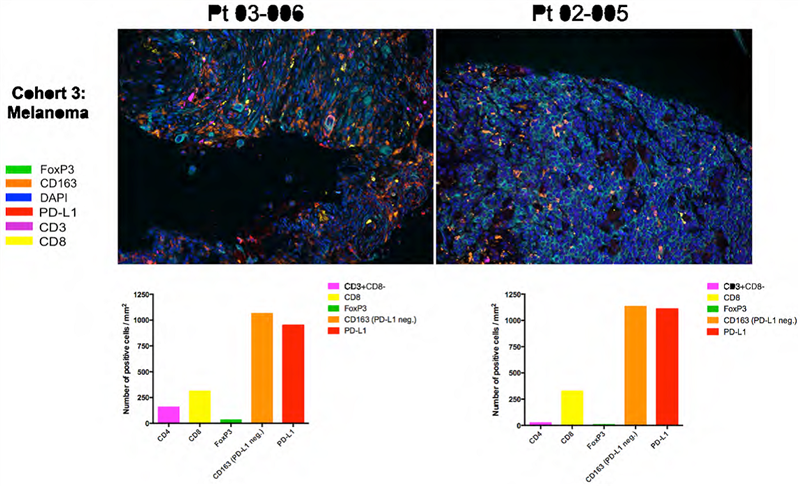
The two melanoma patients in cohort 3 showed evidence of successful tumour targeting following IV administration, with Cavatak RNA detected in tumour biopsies taken eight days after the first dose of Cavatak was administered. These biopsies also showed the presence of immune cell infiltration and high levels of PD-L1 staining, suggesting a potential benefit from combining Cavatak with an ICI such as Keytruda (Exhibit 3).
In addition, measurement of serum viral load suggests that viral replication, possibly within tumours, is occurring within at least some of the patients following IV administration.
|
Exhibit 3: Tumour biopsy from STORM cohort 3 melanoma patient shows immune cell infiltration and enhanced PD-L1 expression |
|
|
Source: Pandha et al STORM poster Society for the Immunotherapy of Cancer (SITC), November 2015 |
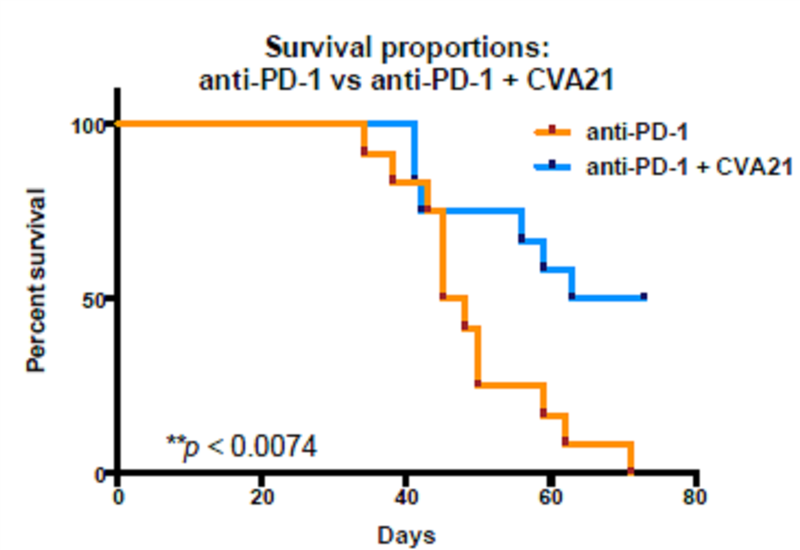
Preclinical studies in melanoma indicate that Cavatak combination therapy has the potential to significantly improve the percentage of patients who respond to checkpoint inhibitor therapy. For example, studies in a mouse model of melanoma showed that combining Cavatak with an anti-PD-1 ICI (similar to Keytruda) produced significantly greater antitumour activity and prolonged survival compared to use of either agent alone, as shown in Exhibit 4.
|
Exhibit 4: Combining Cavatak (CVA21) with ICI improves survival in a mice with melanoma |
|
|
Source: Pandha et al STORM poster Society for the Immunotherapy of Cancer (SITC), November 2015 |
Approval of T-vec (Imlygic) confirms regulators are comfortable with oncolytic virotherapy
On 27 October, the US FDA approved Amgen’s T-vec (talimogene laherparepvec) for the treatment of melanoma lesions in the skin and lymph nodes that cannot be completely removed by surgery. The drug will be marketed under the brand name Imlygic.
Imlygic is the first oncolytic virotherapy drug that has been approved by the FDA. We view the approval as a positive development for Viralytics, as it confirms that regulators are comfortable with this new class of anti-cancer therapy. This is particularly relevant given that the efficacy of intra-lesional Cavatak in melanoma in Viralytics’ Phase II CALM trial was similar to that reported for T-vec where comparable data are available.
Amgen/Merck scale back T-vec/Keytruda combo trial
Amgen is also investigating the potential of combining T-vec with ICIs. Amgen and Merck are collaborating on Phase I trials of T-vec and Keytruda in both melanoma and squamous cell carcinoma of the head and neck (SCCHN). In May 2015, they announced that would extend the ongoing Phase I trial of the combination in melanoma to a Phase III trial (MASTERKEY-265, clinical trials registry NCT02263508). However, in September 2015 the enrolment recorded on clinicaltrials.gov record was changed from a target of 680 to actual enrolment of 21 and the trial is no longer actively recruiting subjects. This could indicate that there is a delay in initiating the
Phase III component of the trial, or alternatively, it may indicate that Amgen is reconsidering its plans to initiate a Phase III trial in melanoma.
Viralytics is not far behind Amgen in the development of oncolytic virus/ICI combination therapy in Melanoma, having already initiated separate Phase I trials of Cavatak in combination with either Keytruda or Yervoy. If Amgen and Merck have indeed scaled down the T-vec/Keytruda combination trial as we suspect, Viralytics may be even closer behind Amgen than we had previously believed. We note that Cavatak has the advantage over T-vec in many other cancer types in that it can be safely administered IV, whereas T-vec cannot.
CANON update – complete clinical tumour response
Researchers presented an update on the CANON Phase I study of Cavatak in patients with early-stage bladder cancer at the Society for the Immunotherapy of Cancer (SITC) conference in November. Recruitment of patients in the monotherapy cohorts is complete. Recruitment of ~19 patients in the mitomycin-C combination cohorts is underway.
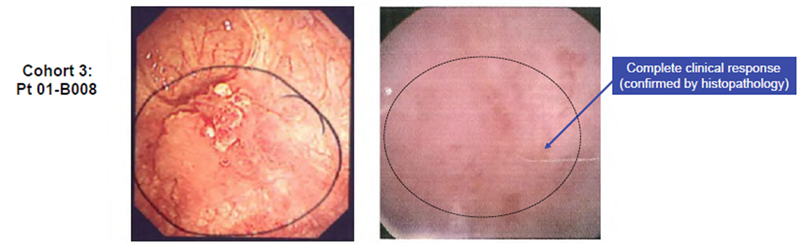
The SITC presentation showed that one of the three patients in monotherapy cohort 3 had a complete clinical tumour response, confirmed by histopathology as shown in Exhibit 5. While the data are still preliminary they support the thesis that neoadjuvant therapy with Cavatak has the potential to reduce the reoccurrence rate in patients with non-muscle invasive bladder cancer.
|
Exhibit 5: Complete tumour response in a cohort 3 patient – pre and post treatment cystoscopy |
|
|
Source: Pandha et al CANON poster Society for the Immunotherapy of Cancer (SITC), November 2015 |
Valuation
We update our valuation of Viralytics, which now stands at A$192m or A$1.04/share (undiluted, previously A$189m or A$1.03/share). This reflects the fact that we have increased forecast uptake of Cavatak in NSCLC and metastatic bladder cancer, partly offset by increased R&D expenditure and pushing back our assumption of likely Cavatak deal timing from FY16 to FY17.
We have increased forecast peak market penetration in NSCLC and metastatic bladder cancer from 2% to 5% due to potential combination therapy with Keytruda or other ICI.
Our valuation assumes a partnering deal or out-licensing of Cavatak driven by data from the Phase Ib ICI combination trials. As we view the Keytruda combination trial to be the most likely deal catalyst, we have delayed our forecast deal timing by 12 months to 2017 (from 2016), when we expect to see initial data from the trial. The decline in the valuation is due to the slightly later receipt of milestone payments and Viralytics being responsible for funding R&D expenses in FY17, which we previously assumed would be borne by the partner.
Our valuation uses a risk-adjusted net present value (rNPV) method to discount future cash flows through to 2033 of the cancer indications shown in Exhibit 6, using a 12.5% discount rate. It assumes a partnering deal or out-licensing of Cavatak in 2017, with the costs of all subsequent clinical development borne by the partner/licensee. Our model includes risk-adjusted upfront payments and clinical/regulatory milestones (but not sales milestones) from a potential licensing deal, based on average Phase II deal metrics from BioCentury (US$25m upfront payment, US$240m total milestones – we assume half of those payments [US$120m] are for clinical and regulatory milestones).
Exhibit 6: Viralytics rNPV valuation
Value driver |
Unrisked NPV (A$m) |
Probability of success |
rNPV |
rNPV per share |
Key assumptions |
|
Cavatak in metastatic melanoma |
396.6 |
35% |
138.8 |
0.75 |
Launch in 2021, with peak market penetration of 20% five years after launch. Peak global sales of US$675m. |
Assumes simultaneous product launches in US, Europe and RoW; average price of drug US$75k in US and US$45k elsewhere. One cycle of treatment per patient. Out-licensing in 2016 with all development costs borne by licensee and a 15% royalty on sales due to Viralytics. |
Cavatak in NSCLC |
239.7 |
15% |
36.0 |
0.19 |
Launch in 2023, with peak market penetration of 5% five years after launch. Peak global sales of US$950m. |
|
Cavatak in CRPC |
106.9 |
15% |
16.0 |
0.09 |
Launch in 2023, with peak market penetration of 2% five years after launch. Peak global sales of US$285m. |
|
Cavatak in metastatic bladder cancer |
32.7 |
15% |
4.9 |
0.03 |
Launch in 2023, with peak market penetration of 5% five years after launch. Peak global sales of US$130m. |
|
Intravesical Cavatak in NMI bladder cancer |
59.3 |
15% |
8.9 |
0.05 |
Launch in 2024, with peak market penetration of 10% five years after launch. Peak global sales of US$185m, assuming average price of drug US$10k in US market, and global sales 2x US sales. 15% royalty on sales due to Viralytics. |
|
Milestones |
90.0 |
50-35% |
37.8 |
0.20 |
US$25m upfront payment (50% risk adjustment); US$20m milestones on Phase III start, US$40m filing, US$60m on approval (35% risk adjusted). |
|
R&D expenses (net of rebate) |
(13.1) |
|
(9.8) |
(0.05) |
|
|
Admin |
(18.8) |
100-10% |
(9.3) |
(0.05) |
|
|
Tax |
(212.6) |
|
(53.1) |
(0.29) |
Australian corporate tax of 30% |
|
Portfolio Total |
680.6 |
|
170.1 |
0.92 |
||
Net cash (end FY15) |
|
|
21.6 |
0.12 |
|
|
Total |
|
|
191.7 |
1.04 |
|
|
Source: Edison Investment Research
Sensitivities: Trial results and partnering key risks
Viralytics is subject to typical biotech company development risks, including the unpredictable outcome of trials, regulatory decisions, success of competitors, financing and commercial risks. In particular, it has a very high single-product risk, with its entire value residing in Cavatak. The investment case hinges on the outcome of clinical trials and the company’s ability to secure a partnership (or further capital) to advance Cavatak into late-stage trials. Ideally, a partner would have the resources to evaluate Cavatak in multiple cancer indications. The greatest commercial opportunity for Cavatak is likely to be in combination with checkpoint inhibitors or other targeted agents – outcomes of ongoing and planned Phase Ib combination trials could be critical to future clinical and commercial success.
Financials
Viralytics' Q116 4C quarterly cash flow report showed cash at 30 September of A$19.5m. Payments for R&D expenses of A$2.0m in Q116 were 150% higher than the previous corresponding period (pcp, A$0.8m), while operating cash burn of A$2.7m was 120% higher than pcp (A$1.2m). Cash burn for FY15 (ended 30 June) was A$4.5m, including the benefit of a rebate of A$2.5m under the Australian R&D tax incentive scheme. R&D expenditure for the year was A$5.0m. With the clinical trial programme continuing to expand, we double our forecast R&D spend in FY16 and FY17 to A$10.0m (previously A$5.0m). After deducting the R&D rebate we forecast net R&D expenditure to be A$5.7m for each of those two years. The company has sufficient cash to fund operations for the next two years, but it is likely to require additional funding in FY18 if a partner or licensee is not secured for Cavatak before by that time (we include A$2m of debt in our FY18 forecasts).
Exhibit 7: Financial summary
A$000s |
2014 |
2015 |
2016e |
2017e |
2018e |
||
Year-end 30 June |
IFRS |
IFRS |
IFRS |
IFRS |
IFRS |
||
PROFIT & LOSS |
|||||||
Revenue |
|
|
2,508 |
2,454 |
4,350 |
4,350 |
3,480 |
R&D expenses |
(4,998) |
(5,925) |
(10,000) |
(10,000) |
(8,000) |
||
SG&A expenses |
(2,438) |
(2,568) |
(2,578) |
(2,578) |
(2,578) |
||
EBITDA |
|
|
(4,928) |
(6,040) |
(8,228) |
(8,228) |
(7,098) |
Operating Profit (before amort. and except.) |
|
|
(4,956) |
(6,074) |
(8,284) |
(8,298) |
(7,181) |
Intangible Amortisation |
(390) |
(390) |
(390) |
(390) |
(390) |
||
Exceptionals |
0 |
0 |
0 |
0 |
0 |
||
Other |
0 |
0 |
0 |
0 |
0 |
||
Operating Profit |
(5,346) |
(6,465) |
(8,674) |
(8,688) |
(7,571) |
||
Net Interest |
296 |
527 |
647 |
430 |
194 |
||
Profit Before Tax (norm) |
|
|
(4,660) |
(5,547) |
(7,637) |
(7,867) |
(6,987) |
Profit Before Tax (FRS 3) |
|
|
(5,050) |
(5,938) |
(8,027) |
(8,257) |
(7,377) |
Tax |
0 |
0 |
0 |
0 |
0 |
||
Profit After Tax (norm) |
(4,660) |
(5,547) |
(7,637) |
(7,867) |
(6,987) |
||
Profit After Tax (FRS 3) |
(5,050) |
(5,938) |
(8,027) |
(8,257) |
(7,377) |
||
Average Number of Shares Outstanding (m) |
119.2 |
184.0 |
184.0 |
184.0 |
184.0 |
||
EPS - normalised (c) |
|
|
(3.9) |
(3.0) |
(4.2) |
(4.3) |
(3.8) |
EPS - normalised fully diluted (c) |
|
|
(3.9) |
(3.0) |
(4.2) |
(4.3) |
(3.8) |
EPS - (IFRS) (c) |
|
|
(4.2) |
(3.2) |
(4.4) |
(4.5) |
(4.0) |
Dividend per share (c) |
0.0 |
0.0 |
0.0 |
0.0 |
0.0 |
||
BALANCE SHEET |
|||||||
Fixed Assets |
|
|
2,523 |
2,116 |
1,740 |
1,349 |
945 |
Intangible Assets |
2,475 |
2,034 |
1,643 |
1,253 |
863 |
||
Tangible Assets |
48 |
82 |
96 |
96 |
82 |
||
Investments |
0 |
0 |
0 |
0 |
0 |
||
Current Assets |
|
|
27,120 |
24,441 |
17,221 |
9,354 |
4,381 |
Stocks |
0 |
0 |
0 |
0 |
0 |
||
Debtors |
2,784 |
2,875 |
2,875 |
2,875 |
2,875 |
||
Cash |
24,336 |
21,566 |
14,345 |
6,478 |
1,506 |
||
Other |
0 |
0 |
0 |
0 |
0 |
||
Current Liabilities |
|
|
(767) |
(1,685) |
(1,685) |
(1,685) |
(1,685) |
Creditors |
(767) |
(1,685) |
(1,685) |
(1,685) |
(1,685) |
||
Short term borrowings |
0 |
0 |
0 |
0 |
0 |
||
Long Term Liabilities |
|
|
0 |
0 |
0 |
0 |
(2,000) |
Long term borrowings |
0 |
0 |
0 |
0 |
(2,000) |
||
Other long term liabilities |
0 |
0 |
0 |
0 |
0 |
||
Net Assets |
|
|
28,877 |
24,872 |
17,275 |
9,018 |
1,640 |
CASH FLOW |
|||||||
Operating Cash Flow |
|
|
(5,486) |
(5,010) |
(8,228) |
(8,228) |
(7,098) |
Net Interest |
0 |
544 |
647 |
430 |
194 |
||
Tax |
0 |
0 |
0 |
0 |
0 |
||
Capex |
(8) |
(69) |
(69) |
(69) |
(69) |
||
Acquisitions/disposals |
0 |
0 |
0 |
0 |
0 |
||
Financing |
25,180 |
40 |
0 |
0 |
(0) |
||
Dividends |
0 |
0 |
0 |
0 |
0 |
||
Net Cash Flow |
19,686 |
(4,495) |
(7,650) |
(7,867) |
(6,973) |
||
Opening net debt/(cash) |
|
|
(5,079) |
(24,336) |
(21,566) |
(14,345) |
(6,478) |
HP finance leases initiated |
0 |
0 |
0 |
0 |
0 |
||
Other |
(429) |
1,725 |
429 |
0 |
0 |
||
Closing net debt/(cash) |
|
|
(24,336) |
(21,566) |
(14,345) |
(6,478) |
494 |
Source: Viralytics accounts, Edison Investment Research. Note: *Risk-adjusted revenue from anticipated licencing deals that have not yet been signed is included in our DCF valuation model but is not included in our financial forecasts.
|
Research: Investment Companies
Invesco Asia Trust