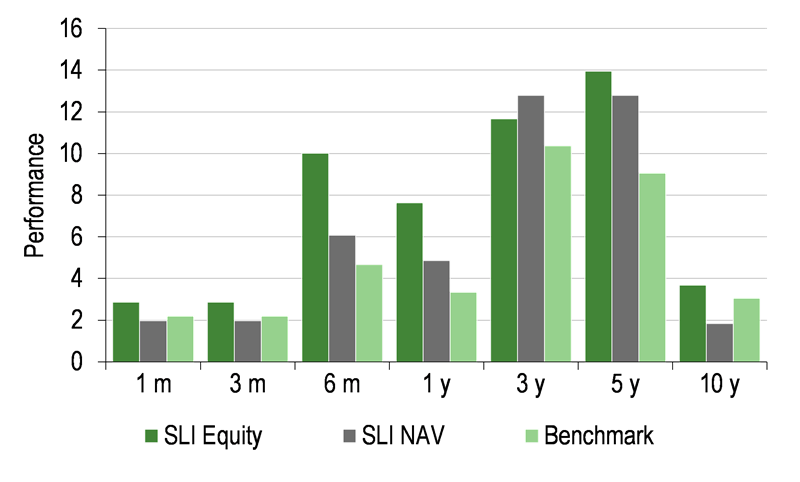
Standard Life Investments Property Income Trust (SLI) aims to generate both income and capital growth from investing directly in UK commercial property. Its emphasis continues to be on generating above-average income for shareholders and it currently yields 5.4%. In FY16, the dividend was 117% covered by earnings and the manager, Jason Baggaley, is reasonably sanguine about future dividend prospects. Relative performance is measured against the quarterly version of the IPD Monthly Index Funds, which is representative of UK direct property funds. SLI has outperformed this benchmark, in NAV total return terms, over one, three and five years.
Standard Life Inv. Property Income Trust |
UK REIT generates net income surplus in FY16 |
Investment trusts |
23 May 2017 |
Share price/discount performance
Three-year performance vs index
Gearing
Analysts
|
||||||||||||||||||||||||||||||||||||||||||||||||||||||||||||||||||||||||||||||||||||||||
Standard Life Investments Property Income Trust (SLI) aims to generate both income and capital growth from investing directly in UK commercial property. Its emphasis continues to be on generating above-average income for shareholders and it currently yields 5.4%. In FY16, the dividend was 117% covered by earnings and the manager, Jason Baggaley, is reasonably sanguine about future dividend prospects. Relative performance is measured against the quarterly version of the IPD Monthly Index Funds, which is representative of UK direct property funds. SLI has outperformed this benchmark, in NAV total return terms, over one, three and five years.
12 months ending |
Share price |
NAV |
Benchmark |
FTSE All-Share (%) |
UK real estate |
31/03/13 |
3.8 |
(4.8) |
1.8 |
16.8 |
21.3 |
31/03/14 |
32.9 |
33.7 |
12.8 |
8.8 |
28.0 |
31/03/15 |
25.8 |
20.6 |
17.1 |
6.6 |
25.3 |
31/03/16 |
2.9 |
13.4 |
11.1 |
(3.9) |
(5.3) |
31/03/17 |
7.6 |
4.9 |
3.4 |
22.0 |
(0.0) |
Source: Thomson Datastream. Note: All % on a total return basis in pounds sterling, up to last reported NAV.
Investment strategy: Minimise risk, optimise income
The portfolio is invested in direct holdings within the three main commercial property sectors of retail, office and industrial. Yield compression in certain hotspots and stagnant demand for poor secondary and tertiary locations mean that the manager seeks to avoid yield traps and low-yielding ‘fashionable’ assets with high downside risk. For example, yields have compressed so severely in City of London office space that SLI no longer has any exposure there. Instead, the focus is on finding undiscovered early cyclical plays in good locations, where there is reversionary yield and asset management upside potential.
Market outlook: Demand for real income supportive
The yield on the UK commercial property market remains attractive relative to 10-year gilts, with a spread of over 350 basis points. For an overseas investor, that yield looks significantly more attractive than in June 2016, when sterling was much higher. Thus, while Brexit has encouraged overseas corporates to delay UK investment due to uncertainty, its largely unforeseen impact on the pound is proving hard for some property investors to resist – witness the recent sale of London’s ‘Cheesegrater’ to China’s CC Land. Meanwhile, UK investors facing higher inflation and wanting some protection may consider increasing exposure to UK property assets.
Valuation: Back on a premium
SLI’s current share price premium to NAV of 8.7% is higher than the averages of the last one, three and five years (range of 4.6% to 7.1%), perhaps reflecting SLI’s high real income generation and growth potential in a low-income, low-growth world. The ongoing programme to issue shares at a premium should help improve supply while also serving to enhance the NAV per share for existing shareholders.
Exhibit 1: Trust at a glance
Investment objective and fund background |
Recent developments |
||||||||||||||||||||||||||||||||||||||||||||||||||||||||||||||
Standard Life Investments Property Income Trust’s objective is to provide shareholders with an attractive level of income together with the prospect of income and capital growth through investing in a diversified portfolio of UK commercial properties. The majority of the portfolio will be invested in direct holdings within the three main commercial property sectors of retail, office and industrial. |
■ 27 April 2017: Q1 NAV total return of 2.0%. ■ 9 May 2017: Announcement of first interim dividend of 1.19p. ■ 31 March 2017: Purchase of multi-let industrial property in Bristol with asset management potential for £5.27m. ■ 23 March 2017: Final results to 31 December 2016 – NAV total return +4.4%. ■ 23 March 2017: Sale of White Bear Yard, Farringdon, London for £19m. |
||||||||||||||||||||||||||||||||||||||||||||||||||||||||||||||
Forthcoming |
Capital structure |
Fund details |
|||||||||||||||||||||||||||||||||||||||||||||||||||||||||||||
AGM |
June 2017 |
Ongoing charges |
1.7% |
Group |
Standard Life Investments |
||||||||||||||||||||||||||||||||||||||||||||||||||||||||||
Interim results |
August 2017 |
Loan to value |
21.2% |
Manager |
Jason Baggaley |
||||||||||||||||||||||||||||||||||||||||||||||||||||||||||
Year end |
31 December |
Annual mgmt fee |
Tiered – 0.75% to 0.65% total assets |
Address |
1 George Street, |
||||||||||||||||||||||||||||||||||||||||||||||||||||||||||
Dividend paid |
Mar, May, Aug, Nov |
Performance fee |
None |
||||||||||||||||||||||||||||||||||||||||||||||||||||||||||||
Launch date |
19 December 2003 |
Trust life |
Indefinite |
Phone |
0845 60 60 062 |
||||||||||||||||||||||||||||||||||||||||||||||||||||||||||
Continuation vote |
No |
Loan facilities |
See page 7 |
Website |
|||||||||||||||||||||||||||||||||||||||||||||||||||||||||||
Dividend policy and history (financial years) |
Share buyback policy and history (financial years) |
||||||||||||||||||||||||||||||||||||||||||||||||||||||||||||||
SLI pays dividends quarterly. A key objective is to provide an attractive sustainable level of income to shareholders. |
Renewed annually, SLI has authority to purchase up to 14.99% and allot up to 10% of its issued share capital. |
||||||||||||||||||||||||||||||||||||||||||||||||||||||||||||||
|
|
||||||||||||||||||||||||||||||||||||||||||||||||||||||||||||||
Shareholder base (as at 31 March 2017) |
Portfolio allocation by IPD sub-sector (as at 31 March 2017) |
||||||||||||||||||||||||||||||||||||||||||||||||||||||||||||||
|
|
||||||||||||||||||||||||||||||||||||||||||||||||||||||||||||||
Top 10 holdings (as at 31 March 2017) |
|||||||||||||||||||||||||||||||||||||||||||||||||||||||||||||||
|
|||||||||||||||||||||||||||||||||||||||||||||||||||||||||||||||
Source: Standard Life Investments Property Income Trust, Edison Investment Research, Morningstar. Note: *N/A where not in March 2016 top 10.
Market outlook: Continuing uncertainty ahead of Brexit
Exhibit 2 (right-hand side) suggests that the yield on the UK commercial property market remains attractive relative to gilts, even as gilt yields have risen from their lows. For a non-sterling based international investor, the yield on UK property appears more attractive than it did in June 2016, when sterling was significantly stronger relative to the major currencies than today. Thus, on the one hand, Brexit has encouraged overseas corporates to delay UK investment due to uncertainty, while, on the other hand, the compensating effect of the weaker pound is proving too hard for some property investors to resist – witness the recent sale of the City of London’s tallest tower, known as the Cheesegrater, to China’s CC Land.
While global economic and political uncertainty reign, however, tenants are unlikely to want to move premises since this would incur additional risk, distraction and expense. This can be viewed as positive for actively managed direct property funds, enabling them to keep a lid on transaction costs and maximise asset management potential to enhance and improve the sustainability of rental income for shareholders.
In the UK, rising inflation is potentially negative for UK consumer confidence but it seems unlikely to result in higher UK interest rates in the short term, given wages have stayed flat (save for the legislated rise in the minimum wage). This means that UK deposit rates are likely to stay low, encouraging UK savers to look elsewhere for income. A well selected portfolio of UK commercial property assets might be of interest to investors seeking a stable income return with some protection against rising inflation.
|
Exhibit 2: UK real estate returns vs equities and bonds over 10 years |
|
UK real estate total returns vs equities and bonds to 31 March 2017 |
UK real estate yield vs 10-year government bond yield to 30 April 2017 |
|
|
|
Source: Thomson Datastream, Edison Investment Research |
|
Fund profile: Focus on small lot sizes in middle ground
Launched in December 2003, SLI is a Guernsey-registered, closed-end UK REIT listed on the London Stock Exchange. SLI aims to provide shareholders with an attractive level of income, together with the prospect of income and capital growth through investing in a diversified portfolio of UK commercial properties. The portfolio principally invests directly within the three main commercial property sectors of retail, office and industrial. Although it does have the flexibility to invest in other commercial property such as hotels, nursing homes and student housing, but to date, has chosen not to. The board reviews SLI’s property income and total return performance against the quarterly version of the IPD Monthly Index Funds. Jason Baggaley, the investment manager, respects the broad collective experience and expertise of the board, seeing them as an additional layer of due diligence, and consults them before making new investments. A typical initial purchase lot size is £5-10m, an area of the market seen as under-researched with greater potential to find hidden gems. Standard Life Investments has been SLI’s investment manager since its launch in 2003, with Jason Baggaley acting as lead fund manager since September 2006. Baggaley, a qualified chartered surveyor, joined Standard Life Investments in 1996 and has over 26 years of real estate fund management experience. Baggaley is supported by portfolio managers Alex Thompson and Cameron MacKay, while an additional portfolio manager, Andrew Roberts, has recently joined the team on a full-time basis, providing further dedicated resource. Baggaley can also draw on the investment manager’s wider real estate team.
The fund manager: Jason Baggaley
The manager’s view: Mind the hotspots and the yield traps
While the amount of annual rental income the manager seeks to generate to finance SLI’s attractive dividend payout remains relatively stable over the course of the cycle, the factors that affect the stability of that income tend to vary. Yields have compressed significantly in certain locations and sectors in recent years, affected by supply, tenant demand, tenant quality, availability of domestic and international capital, and the relative attractiveness of other asset classes. Baggaley notes that there are times in the cycle when he has the flexibility to invest across all sectors and locations without jeopardising SLI’s income requirement, since yields are high across the board. However, this is not the case in the current environment – yield compression in certain hotspots and falling demand for poor secondary and tertiary locations mean that Baggaley needs to be a little more canny, avoid the yield traps as well as the fashionable assets, and look to invest in undiscovered early cyclical plays where there is reversionary yield and asset management upside potential.
To generate SLI’s annual income requirement, Baggaley must be highly selective about where he invests: a tertiary retail property, offering a yield of 9% with two years of unexpired lease, may look attractive on the surface, he argues, but once that lease comes to an end or if the tenant defaults, and a void emerges, retail properties in poor locations can be hard to fill, meaning that “the 9% yield, rather than compressing to 8%, could as likely be zero within a short space of time”. The portfolio is then potentially stuck with a long-term void, something that Baggaley strives to avoid, since voids generate zero income and the capital value of that asset may fall. At the other end of the yield spectrum are the prime retail and office hotspots in central London, where yields have compressed so severely that there would need to be a precipitous fall in London property values before Baggaley would consider buying there again.
Currently, the manager is seeing the most attractive opportunities in the industrials sector, but even here value has become harder to find. As regards the outlook, Baggaley expects economic fundamentals to weaken as Brexit evolves. He shares Standard Life’s house view that UK inflation will continue to pick up in 2017/18, but sees that as an advantage for his asset class, since unlike conventional bonds, a property portfolio can provide a measure of inflation protection. The uncertain times through which businesses are currently navigating encourages tenants to remain where they are rather than look for alternative accommodation. This is positive from the manager’s perspective since it enables portfolio management costs to be kept down (fewer transactions and fewer voids).
Asset allocation
Investment process: Get in early and avoid the crowds
The manager is focused on investing in good-quality, albeit not necessarily prime, UK commercial real estate assets situated in sound locations, where there is perceived to be sustainable tenant demand. Properties are selected that the manager believes will appeal to occupiers, where there is seen to be high reversionary yield potential, especially as a result of asset management activity. SLI’s income objective can influence both sector and geographic weightings, on the basis of relative yields. While being contra-cyclical is perceived as a potentially risky strategy, the manager’s purchase philosophy is to be ‘early’ cyclical: to acquire attractively priced assets whose future income return prospects are not yet appreciated. Once a trade becomes popular, it generally ceases to be attractive. Baggaley tends to focus on smaller lot sizes of c £5m. SLI collects its own rent and has a 99% record of collecting rent within 21 days. At end-March 2017, voids were at 3.2%, c 50% lower than the market average, although there is potential for this to tick up somewhat.
Current portfolio positioning
The portfolio reflects Standard Life’s current property strategy, while taking into account SLI’s income objective. In terms of portfolio activity, after the acquisition of 22 properties from Pearl in December 2015, a period of consolidation followed in 2016, during which no further purchases were made. Recent sales include the Quadrangle in Cheltenham and Interplex in Bristol in January 2017 – both required capital investment, while the latter was partially void. The most recent sale was White Bear Yard, an office in Farringdon (previously SLI’s largest holding). Profits were finally taken on this long-held property ahead of a lease expiry in 2019. This reduced SLI’s City of London office exposure to zero, having been gradually reduced in recent years as yields contracted and expectations of potential oversupply rose. The proceeds of the aforementioned sales were used to pay down debt and to make two new investments – an industrial unit in Sunderland adjacent to the Nissan plant and occupied by one of its suppliers, and a multi-let industrial scheme in Bristol fully let to seven tenants, providing the opportunity for asset management over the next three years.
Exhibit 3: Top 10 tenants
Passing rent (£m) |
% of total rent |
||
31 March 2017 |
31 March 2017 |
31 March 2016* |
|
Sungard Availability Services |
1.320 |
4.8 |
4.5 |
BAE Systems |
1.258 |
4.5 |
4.3 |
Techno Cargo Logistics |
1.242 |
4.5 |
4.2 |
DSG |
1.178 |
4.2 |
4.0 |
The Symphony Group |
1.080 |
3.9 |
3.7 |
Bong UK |
0.742 |
2.7 |
2.5 |
Euro Car Parts |
0.703 |
2.5 |
N/A |
Ricoh UK |
0.697 |
2.5 |
2.4 |
Matalan |
0.697 |
2.5 |
2.4 |
Grant Thornton UK |
0.680 |
2.5 |
2.3 |
Top 10 |
9.597 |
34.6 |
32.6 |
Source: Standard Life Investments Property Income Trust, Edison Investment Research. Note: *N/A where not in March 2016 top 10.
|
Exhibit 4: Sector allocation at 31 March 2017 |
Exhibit 5: Portfolio split by region at 31 March 2017 |
|
|
|
Source: SLI, Edison Investment Research |
|
Exhibit 4: Sector allocation at 31 March 2017 |
|
|
Source: SLI, Edison Investment Research |
|
Exhibit 5: Portfolio split by region at 31 March 2017 |
|
|
Source: SLI, Edison Investment Research |
SLI has an average unexpired lease term to the earliest of lease end or tenant break of 5.5 years. The benchmark has a slightly longer average of 7.4 years (excluding leases over 35 years). While some may be wary of shorter lease terms, Baggaley argues that so long as the building is in a good location, has an attractive initial yield, has reliable tenants and is of sound quality, then a short unexpired lease term is not an issue and is possibly an advantage. While the location of a property cannot be altered or easily improved, the lease has the potential to be regeared.
Performance: Rental income boosts NAV total return
While the share prices of direct property funds fluctuated in 2016, SLI’s net rental income proved stable and contributed to both income and capital return. Offsetting this positive, capital values fell as the yield curve steepened following the Brexit vote. The marking to market of SLI’s swap liability (£3.6m) and its gearing also detracted. However, over one, three and five years, SLI’s NAV total return has outperformed the benchmark, as well as being strongly positive in absolute terms.
Exhibit 6: Share price and NAV total return performance, relative to indices (%)
|
One month |
Three months |
Six months |
One year |
Three years |
Five years |
10 years |
Price relative to benchmark* |
0.6 |
0.6 |
5.1 |
4.1 |
3.6 |
24.5 |
6.1 |
NAV relative to benchmark* |
(0.2) |
(0.2) |
1.3 |
1.5 |
6.7 |
18.3 |
(11.2) |
Price relative to FTSE All-Share |
1.6 |
(1.1) |
1.8 |
(11.7) |
11.5 |
21.1 |
(17.3) |
NAV relative to FTSE All-Share |
0.7 |
(2.0) |
(1.8) |
(14.0) |
14.9 |
15.1 |
(30.9) |
Price relative to UK Real Estate Index |
3.0 |
1.1 |
7.6 |
7.6 |
17.4 |
4.4 |
78.0 |
NAV relative to UK Real Estate Index |
2.1 |
0.3 |
3.7 |
4.9 |
21.0 |
(0.8) |
48.9 |
Source: Thomson Datastream, Edison Investment Research. Note: *Benchmark is the quarterly version of the IPD Monthly Index Funds. Data to end-March 2017. Geometric calculation.
|
Exhibit 7: Investment trust performance to 31 March 2017 (last published NAV date) |
||
Price, NAV and benchmark total return performance, one-year rebased |
Price, NAV and benchmark total return performance (%) |
|
|
|
|
|
Source: Thomson Datastream, Edison Investment Research. Note: Three, five and 10-year performance figures annualised. |
||
|
Exhibit 8: NAV total return performance relative to benchmark over 10 years |
||
|
||
|
Source: Thomson Datastream, Edison Investment Research |
||
Capital structure and fees
SLI is a conventional investment trust with one class of share; following regular issuance in 2017, the ordinary share capital has increased and there are now 388.8m ordinary shares outstanding. SLI refinanced its debt facilities in April 2016: a new £110m seven-year facility and a £35m revolving credit facility were taken out, and a swap agreement was entered into. At the year end, having used sales proceeds to pay down debt, SLI had a net LTV of 26.0% (as compared with 28.1% at the prior year end) and an all-in rate of financing of 2.6% (2.7%). The annual management fee is tiered: the fees are 0.75% of total assets up to £200m; 0.70% of total assets between £200m and £300m; and 0.65% of total assets in excess of £300m. The ongoing charge was 1.7% for FY16, compared with 1.5% the previous year, reflecting the fall in capital value.
Dividend policy and record
For FY16, the dividend was 4.76p, an increase of 2.5% on the prior year. In addition to retained earnings, there are substantial distributable reserves, and in conjunction with the outlook for future portfolio rental income, this makes the manager reasonably optimistic about future dividend prospects. At the December year-end, the dividend yield equated to 5.5%, comparing favourably to the end-December dividend yields of 3.7% for the FTSE All-Share REIT and 3.5% for the FTSE All-Share indices. Based on its current share price, SLI has a dividend yield of 5.4%.
Peer group comparison
Exhibit 10 shows the AIC Property Direct – UK sector excluding funds with a market cap of less than £100m or that have been trading for less than one year. In spite of its portfolio acquisition in 2015, SLI remains one of the smaller trusts in the peer group, enabling it to maintain its focus on smaller lot sizes without encountering liquidity issues. In terms of NAV total return, SLI has lagged the peer group over one and 10 years, but has outperformed the sector average over three and five years.
Exhibit 10: UK direct property closed-ended sector selected peer group as at 22 May 2017
% unless stated |
Market cap £m |
NAV TR |
NAV TR |
NAV TR |
NAV TR |
Discount (ex-par) |
Ongoing charge |
Perf. |
Net gearing |
Dividend yield (%) |
Standard Life Inv. Property Income |
344.1 |
4.9 |
43.5 |
82.6 |
20.1 |
11.3 |
1.7 |
No |
137 |
5.4 |
AEW UK REIT |
126.3 |
7.4 |
|
|
|
7.3 |
1.5 |
No |
112 |
7.8 |
Custodian REIT |
387.9 |
7.4 |
20.6 |
|
|
12.4 |
2.0 |
No |
119 |
5.6 |
Ediston Property Investment Co |
141.6 |
7.7 |
|
|
|
0.7 |
1.6 |
No |
129 |
5.0 |
F&C Commercial Property |
1,161.5 |
6.6 |
45.8 |
77.6 |
68.9 |
5.7 |
1.0 |
No |
128 |
4.1 |
F&C UK Real Estate Investments |
249.1 |
4.4 |
33.2 |
52.0 |
25.1 |
5.3 |
1.7 |
Yes |
146 |
4.8 |
Picton Property Income |
461.7 |
10.6 |
68.3 |
84.0 |
14.3 |
5.6 |
1.1 |
No |
139 |
3.9 |
Primary Health Properties |
674.0 |
9.3 |
45.1 |
54.4 |
62.4 |
26.5 |
1.3 |
Yes |
234 |
4.7 |
Regional REIT |
320.8 |
4.9 |
|
|
|
2.0 |
|
Yes |
169 |
7.2 |
Schroder Real Estate Investment |
328.0 |
1.4 |
42.2 |
34.9 |
(25.2) |
4.2 |
2.5 |
No |
147 |
3.9 |
Secure Income REIT |
801.1 |
16.7 |
|
|
|
8.4 |
1.6 |
Yes |
219 |
3.6 |
UK Commercial Property Trust |
1,136.3 |
7.3 |
35.0 |
59.5 |
59.5 |
0.1 |
1.4 |
No |
107 |
4.2 |
Simple average |
511.0 |
7.4 |
41.7 |
63.6 |
32.2 |
7.5 |
1.6 |
149 |
5.0 |
|
SLI rank in sector |
7 |
10 |
4 |
2 |
5 |
3 |
3 |
7 |
4 |
Source: Morningstar, Edison Investment Research. Note: Performance data to end-March 2017. TR = total return. Net gearing is total assets less cash and equivalents as a percentage of net assets.
The board
SLI has five independent non-executive directors following the appointment on 17 August 2016 of James Clifton-Brown, who has served as UK CIO of CBRE Global Investors since 1996. Chairman Robert Peto succeeded Richard Barfield at the June 2016 AGM, having joined the board in May 2014. Mike Balfour was appointed in March 2016; he has over 30 years’ investment management experience. Sally Ann Farnon was appointed in July 2010 and Huw Evans in April 2013.
|
|
Research: TMT
Vectron’s core point of sale (POS) business generated strong growth in revenues and earnings in FY16, and should continue to benefit from several growth drivers in the short to medium term. With adoption by 2-3% of its customer base, Vectron’s existing online marketing solution, bonVito, is close to breaking even. The recently announced partnership with Coca-Cola to support its GetHappy loyalty app has the potential to add high-margin recurring revenues from the end of FY17.