Proxama (to be renamed Location Sciences on 21 March) is a mobile location data intelligence business that analyses consumer behaviour using its proprietary location technology. Over the past few months a new management team effected a complete restructuring of the business positioning the company at the forefront of this rapidly evolving part of the wider £5.4bn UK digital media sector. The company has built a large and growing footprint in terms of consumer reach and monetises its data products in sectors including retail, city and transport planning and financial services as well as media. As at year end 2017, the Location Sciences’ UK consumer base exceeded 7.3m and its data lake had amassed 14bn data points. These market leading figures, combined with the company suite of data products, in our view positions Location Sciences as a leading UK player in this high growth sector.
Written by
Proxama |
The power of data |
Initiation of coverage |
Media & technology |
19 March 2018 |
Share price performance
Business description
Next events
Analysts
Proxama is a research client of Edison Investment Research Limited |
|||||||||||||||||||||||||||||||||||||||||||
Proxama (to be renamed Location Sciences on 21 March) is a mobile location data intelligence business that analyses consumer behaviour using its proprietary location technology. Over the past few months a new management team effected a complete restructuring of the business positioning the company at the forefront of this rapidly evolving part of the wider £5.4bn UK digital media sector. The company has built a large and growing footprint in terms of consumer reach and monetises its data products in sectors including retail, city and transport planning and financial services as well as media. As at year end 2017, the Location Sciences’ UK consumer base exceeded 7.3m and its data lake had amassed 14bn data points. These market leading figures, combined with the company suite of data products, in our view positions Location Sciences as a leading UK player in this high growth sector.
Year end |
Revenue (£m) |
PBT** |
EPS** |
DPS |
P/E |
Yield |
12/17 |
0.1*** |
(4.4) |
(0.06) |
0.0 |
N/A |
N/A |
12/18e |
0.6 |
(1.4) |
(0.01) |
0.0 |
N/A |
N/A |
12/19e |
2.3 |
(0.1) |
(0.00) |
0.0 |
N/A |
N/A |
Note: **PBT and EPS are normalised, excluding amortisation of acquired intangibles, exceptional items and share-based payments. ***Excluding discontinued operations
A business transformed
The business underwent a wholesale restructuring in 2017. The Payments division was divested in October, enabling the group to focus on the more scalable location data and intelligence division – Location Sciences. A new board of directors was established to drive the group’s new strategy, the cost base has been aggressively streamlined and the £3.1m equity raise in July means the group ended the year with net cash of £1.1m, providing a solid foundation for Location Sciences. The company plans to change its name to Location Sciences Group at the AGM on 21 March thus we refer to the company as such throughout the note.
Location Sciences: Precise mobile location data
Management considers the data being collected to be of unrivalled accuracy, enabling a precise but anonymous picture of consumer habits to be built. While online ads to online store conversion is established, Location Sciences can verify or predict a user’s behaviour in the physical world making it valuable to a range of sectors; in particular for media or advertising attribution – a potentially vast market.
Early progress swift: Building strategic value
The company already has a footprint of c 7.3m consumers and 14bn data points providing the base data for its recently launched products. The platform capabilities are in place and the sales pipeline has been built. Our forecasts assume steady conversion of this sales pipeline on a much-reduced cost base, but at this early stage in development forecasts are subject to significant uncertainty.
Valuation potential: Early mover in evolving sector
There have been a number of deals in this segment over the last year, which should underpin the value of the group until more traditional financial metrics can be used; eg Snap’s $135m acquisition of Placed. As well as building a pipeline of customers, delivery of key milestones such as consumer base growth, sales growth and data growth are the main metrics we will use to gauge the group’s progress and value.
Investment summary
Context: A business transformed to deliver precise data
Location Sciences’ core business is to help brands better understand their business performance by analysing consumer behaviour using accurate and precise location data. The data is gathered with permission via its proprietary mobile software embedded in partner apps. The location data gathered can be used, for example, to connect offline to online journeys and inform decision making for ad agencies and brands. Understanding the customer journey online has become increasingly possible with the use of cookies and customer IDs, but mapping a consumer’s real-world behaviour offline remains elusive. Precise mobile location data allow brands and ad agencies to build a picture of a consumer’s behaviour in the real world, ie where did they go? The data is valuable to a wide range of market segments; in particular brands and their ad agencies when planning campaigns, but also in verifying the returns on their ad spend, a potentially vast addressable market. In this regard, Location Sciences is the referee and not the player, helping to regulate the mobile ad sector, ensuring fairness and transparency for which agencies and brands are prepared to pay a premium. In a short period of time it has built a large footprint of 7.3m cumulative consumers at the end of December 2017, enabling it to collect and analyse location data in the UK. Four products were launched and during 2018 Location Sciences has begun monetising them.
Financials: Growing revenues and strong balance sheet
The new management team has effected a complete restructuring. The balance sheet was strengthened following a £3.1m fund-raising in July 2017 and sale of the Digital Payments business for an initial net consideration of £0.7m in November. These two transactions have left the business broadly debt free, with net cash on the balance sheet of £1.14m at December 2017. The cost base has been halved and additional efficiencies are being sought; 2018 will be the first year to reflect the company’s new focus. At this early stage, forecasts are subject to a high degree of uncertainty. From a low base we forecast accelerating growth based on increased revenues in Q417 and a solid pipeline of new customers. On this basis, the company looks set to remain loss making over the next two years at the operating level but we forecast positive EBITDA in 2019 of £0.32m reflecting our estimates of growing revenues and continued strong cost control. The 2017 year-end net cash of £1.1m should enable the company to fund the initial scaling of its product sets through 2018 but in our view additional funding will be required to accelerate growth both organically and acquisitively.
Investment case: A valuable strategic asset
Major businesses, organisations and brands are prepared to pay a premium for precise location based data. The market for mobile location data and intelligence services is a rapidly emerging part of a £5.4bn market. Location Sciences has already built a valuable footprint across which to collect its data and has developed the platform capabilities to start to scale the business during 2018. While still early in the execution of its strategy, Location Sciences has already a credible position vs other companies in this segment in terms of consumer footprint and technology. Recent deals in the sector (Telefonica’s acquisition of Statiq; Snap’s purchase of Placed) suggest there is appetite for M&A. Companies in the peer group average 2.4x EV/sales including the price paid by GB Group for Loqate in 2015. Against this the company’s valuation of 1.1x 2019 sales seems unassuming.
Catalysts
■
Evidence that the company’s objectives are being met vs KPIs of revenue, costs and EBITDA.
■
Delivery of secondary measures: audience size (cumulative number of consumers who have the Location Sciences technology embedded in their app), data points and revenue generation from all four core products.
■
M&A activity in the sector.
Company background
A business transformed
In the past year Location Sciences has been transformed. A new management team including new Chairman, CEO, CFO and Chief Strategy Officer has effected a complete restructuring. On 31 October 2017, the company disposed of its Digital Payments division for a consideration of £0.7m cash and up to a total £1.7m over the next 18 months and the company is now focused exclusively on its Location Sciences business. Reflecting the new strategy the group will propose to change its name to Location Sciences Group at the AGM on 21 March 2018. The cost base has been halved and net cash of £1.1m leaves the company better placed to drive scale and revenue in the Location Sciences business. The company is now in a stronger position, strategically, financially, operationally and in terms of its market position. In a short space of time, it has built a large footprint in terms of audience consumer reach and during 2018 it will be working towards further monetisation via its suite of mobile location data and artificial intelligence- (AI) powered audience attribution products.
Executive management
Mark Slade, CEO, was previously Managing Director of the Location Sciences division having joined the company in June 2017. He replaced John Kennedy as CEO in November 2017, when the company sold the Digital Payments division and focused exclusively on Location Sciences. He has considerable industry experience from managing the EMEA business at Opera Mediaworks, a mobile technology business. Mark previously founded 4th Screen Advertising, which was subsequently sold to Opera Mediaworks.
David Rae, CFO, was appointed in February 2018. He has a range of public company, growth and international business experience within the technology and energy sectors. He joined the Location Sciences board on a part-time basis and will assist in delivering the Location Sciences business plan, providing strategic input and leading the finance and IR functions. David is the CFO of SmartXpo Solutions, the AI and machine learning company to the global events industry. Prior to this, he was CFO of STC Energy Management, a leading energy software technology provider, where he led the sale of the company to Inspired Energy. He is a Fellow of the Institute of Chartered Accountants and began his career in 1992 with EY.
Dan Francis, CSO, previously held senior management positions at Barclays, American Express and Aimia primarily focused on the launching and commercial scaling of new technology businesses based around data, mobile and AI.
Shareholder structure
As at 31 December 2017 the principal shareholders are Peel Hunt, with 21.3%, Gavin Breeze with 9.1% and Hargreaves Lansdowne also with 9.1%. Location Sciences directors and related holdings account for 4.5%.
Location Sciences: Location data and intelligence
Location Sciences, formally launched on 11 September 2017, is a mobile location data and intelligence business. As at year end 2017, the Location Sciences’ business had 7.3m cumulative consumers, which had provided the company with 14bn cumulative data points by the same date.
Location intelligence products can be used to help companies, governments or brands understand precisely how their customers move throughout the day, providing truly insightful consumer data. This data is valuable to a range of industries, in particular for advertising by attributing specific real-world behaviour to advertising campaigns with particular value coming from independent verification.
The company’s analysis of the location data provides, among other information, home location, work, shopping and leisure habits, and how long they spend there. Each consumer remains anonymous but Location Sciences can track that user via the mobile operating system’s unique ID and build up a picture of the consumer’s habits; for example, which supermarket they use most regularly or what car they drive (the software can recognise, say, an Audi or Mercedes Bluetooth connection).
Platform overview
From its current user base, Location Sciences processes and stores up to 100m data points a day, processing them based on three fundamental stages (Exhibit 1).
|
Exhibit 1: What Location Sciences does |
|
|
Source: Company data |
Proprietary technologies enable precise location data collection
The company’s proprietary software development kit (SDK) technology is embedded into partner apps. Where the users of these apps give permission to tracking (usually to unlock greater functionality), Location Sciences can collect first-party data directly from the mobile operating system 24 hours a day.
Data providers generally run apps that include a mobile tracking element to which the user is invited to enable on signing up for the app. The location tracking then works in the background whenever the user has mobile data enabled on their device.
Location Science pays partner apps for the right to collect this data and the partner also get access to the location data and insight as part of the deal.
The company currently has a beneficial relationship with National Rail Enquiries and an exclusive multi-year deal, while similar deals are in place with the other two main providers. In addition, it has a pipeline of c 200 apps at various stages from proposal to prospect.
From location data to location intelligence
Precise location data drives the company’s place attachment methodology.
■
Point of interest mapping – retail locations including supermarkets, convenience stores, pubs and bars, car dealerships and cinemas mapped to Location Sciences’ point of interest database.
■
Visit confirmation – consumers matched to retail locations over required time period with a time stamp to confirm visit occurred during store opening hours.
■
Duration of visit – the consumer’s dwell time is confirmed to ensure there was a long enough opportunity to purchase and to exclude passers-by and employees.
Accurate data is key and, when combined with the company’s machine learning techniques and data science teams, the end result delivers actionable insights and analysis into consumer behaviour. Location Sciences is thus able to answer questions such as:
■
Where should I put my next store/restaurant?
■
How loyal are my customers and which competitor stores do they go to?
■
Is my out of home (OOH) advertising or digital advertising leading customers into store?
■
What is the make-up of customers going near to my OOH advertising?
■
Is my location advertising effective and accurate?
■
What is the catchment area of my customers?
USPs: Ultra-precise mobile location data at scale
Management believes that its 7.3m consumer base at the end of 2017 gives it one of the largest consumer footprints in the UK, and that its technology enables it to map mobile location data to a degree of accuracy that is not found elsewhere in the market; at best it is able to track a user’s location down to 1m. Multiple data points allow calculation of the dwell time, allowing the company to say that a particular user spent, say, 20 minutes in a coffee shop or two hours in a cinema. The company started to collect data in scale in March 2017 and has rapidly scaled data collection since then:
■
The company now has one of the largest location data footprints in the UK.
■
Data is collected first-party, with permission, directly from the mobile operating system allowing a 24/7 view of consumer movement for accurate attribution.
■
Location Sciences is media agnostic, which means an unbiased view on the data and insights generated from advertising campaigns.
■
Location Sciences is the first and only non-US Google-certified location services provider. This is a new partnership and management is hopeful of strong revenue and gross margin contribution from this new product line.
■
As the data increases, the better the platform’s machine learning algorithms become at determining behaviour. This provides a barrier to entry and increases the company’s differentiation.
Strategy
The group has made considerable strides over the last six months in securing app partnerships and advancing the data-science capabilities. It is now in a position to start to commercialise its new products while continuing to expand its consumer footprint and invest in platform functionality. Four products have been launched and the group is focusing its limited resources on building a pipeline of business from the agency and town planning sectors.
Expand consumer base
Via its 7.3m consumer base (cumulative since inception) the group is especially well positioned in London and Manchester with strong coverage across key cities and full national coverage. There are 45 million smartphone users in the UK. Location Sciences is working towards adding strategic app partnerships to build its market share in other cities and has a pipeline of c 200 apps at various stages from proposal to prospect. As well as building its presence in other cities around the UK, this will reduce its dependency on its current partners.
Management believes there are many more businesses that would benefit from partnership with Location Sciences, to monetise their own data and to gain a greater understanding of their customers’ behaviour.
Four core products and services
The group started to monetise location data in Q317 and has since launched three additional higher-value audience attribution products, which are largely project based.
■
Location data – this is a data-as-a-service product provided to sophisticated technology businesses that can integrate location data into their products and services.
■
Audience data and verification – enriched location data, attached to points of interest, which can be used for insights and analytics, for example the analysis of retail customer preferences (which shops people go to, catchment area, competitive behaviour etc.).
■
OOH – the measurement and analysis of OOH advertising on store visits.
■
Online to offline – the impact of digital advertising on driving store visits.
Target markets
Advertising agencies and brands want to know the efficacy of their campaigns. With mobile campaigns and OOH advertising, the company is well placed to provide that. Location Sciences can, for example, track the make-up of audiences exposed to a brand advert on a particular billboard that subsequently visited the associated store, or restaurant, or viewed that film being advertised. Similar data can be gleaned about an online ad.
Location data intelligence has value to a wide variety of industries. Initially management is focusing on the following areas:
■
Location data companies, which buy data to combine with their products.
■
Online and OOH advertising agencies. The company’s location data can predict the key times when a particular demographic is passing a billboard to help both media targeting or demonstrate the effectiveness of an ad campaign.
■
Town planners, for example, where best to put another Pret a Manger or Costa Coffee based on commuter routes and where consumers linger at the relevant times of day.
■
Brands and retailers, for competitive intelligence to show where else their customers shop and when. For example, Location Sciences’ data can show which supermarkets a particular consumer visits in a town with several different supermarket choices.
|
Exhibit 2: Location Sciences works with all key players in the value chain |
|
|
Source: Company data |
By 2017 year end the company was using its 14bn+ data points to generate promising recurring monthly revenues. Management is also finding that it can build a relationship through project work, which then leads to the client taking further products and services.
Early experience: Case studies
The company has recently concluded an analysis of an online advertising campaign for a major telco retailer in conjunction with Havas that included online banner ads and Facebook ads. Location Sciences was able to measure how many people exposed to the ad campaign subsequently went into the retail store.
The following results give an idea of the type of output – this shows how Location Sciences measured the effectiveness of a particular campaign against a control group to give a clear picture of the uplift attributable to the campaign.
|
Exhibit 3: OOH advertising campaign – increase in visitors over entire campaign |
|
|
Source: Company data |
The market for location data
The power of data
In May 2017 the Economist suggested that data was now the world’s most valuable resource. Precise and verifiable data on consumers and in particular on their purchasing behaviour would be a hugely valuable resource for any consumer-focused business. The following comments reflect prominent views on the potential value of this genre of data.
■
“The world’s most valuable resource is no longer oil, but data.” The Economist, 6 May 2017
■
“Snap Wants to Help Brands Track When Ads Drive People to Locations” Wall Street Journal,12 April 2017
■
WPP’s Sir Martin Sorrell calling for more third-party measurement. “Clearly it's an example where the player and referee cannot be the same person or where you cannot mark your own homework.” The Drum, 16 November 2016
Analysing consumer behaviour
At its core, Location Sciences provides a better understanding of a consumer’s behaviour, making its services useful to a wide variety of consumer-facing industries and to media companies targeting those customers.
For example, if a particular consumer goes to the same location five days a week then Location Sciences can ‘learn’ that this is their workplace. If they go to a gym three times a week after work, they may be keen on fitness, and so the picture builds, allowing the brand to build a precise image of millions of consumers.
Measuring the effectiveness of ad spend (attribution)
John Wanamaker (1838-1922, US merchant and politician) said, “Half the money I spend on advertising is wasted; the trouble is I don't know which half.” With intelligent audience targeting, performance-based pricing and data analysis, today advertisers should have a better understanding of which advertising spend yields the best results.
A customer’s online journey can now be tracked from ad click to online store. However, offline Wanamaker’s advertising truism still stands. Location intelligence can join the dots between online and offline behaviour, tracking and analysing the effectiveness of driving a customer to the shop. This makes it valuable to advertising agencies seeking to demonstrate the effectiveness of their marketing strategies or to the OOH advertising industry to demonstrate footfall passing their real estate.
The industry is coming under increasing pressure to improve the transparency of the media buying process. Some of the most dominant companies such as Google, Facebook and WPP saw the services they offer come under scrutiny as the demand for transparency and accountability across the marketing industry rose.
In this regard, Location Sciences is the referee and not the player, helping to regulate the digital ad sector, ensuring fairness and transparency for which agencies and brands are prepared to pay a premium.
Large and growing addressable market
With such an expanse of potential user cases, pinpointing a precise addressable market is not possible. However, to add context, annual advertising spend on mobile and OOH in the UK was estimated by IAB to be a combined £6.6bn in 2017, while total advertising spend was £22bn according to the Advertising Association.
In most markets, mobile advertising has already surpassed desktop, and it continues to grow. In April 2017 IAB forecast UK mobile advertising to increase from £3.8bn in 2016 to £5.4bn in 2017.
Furthermore, location data is becoming a key component of all aspects of the campaign lifecycle. BIA Kelsey estimated that in 2016 38% of mobile media was based on location, although the majority of this was the lower quality bid stream data provided by ad exchanges. IAB/Kelsey also projects location-targeted mobile ad spending in the US to almost double over the next five years.
Main competitors
With 7.3m consumers and 14bn data points, Location Sciences is positioned competitively among its peers in the UK. While reliable data is scarce in a very young industry, this looks to put Location Sciences in a strong position competitively.
Further, location data is being used across an increasing range of industries: city and transport planning, financial services and mobile advertising, and is increasingly used in advertising attribution. We believe this market is set to see substantial growth over the next few years. Location Sciences’ precise geo-location technology gives it early-mover advantage in the UK. With regards to changes in regulation, the Location Sciences risk management team monitors closely the likely direction of policy change and indeed sees the new GDPR regulations as an opportunity for Locations Sciences to grow, through fully compliant, audited and permissioned first-party mobile data. This is not necessarily the position of other data providers using third party data.
We profile potential competitors below. Location Sciences’ nearest UK competitors are Rippll and Tamoco. These companies both have a smaller consumer base with limited working capital to enable them to increase scale.
Foursquare is a US-based local search and discovery service mobile app that provides its users with personalised local search experiences. It gathers location data from its users to improve its customers’ experiences and inform business decisions for its corporate customers. The company’s website notes that the company has 50 million ‘people’ worldwide of which the majority are in the US, although its 12bn data points imply less depth to the data than that Location Sciences can achieve.
Cuebiq‘s website states that it accesses 61m smart phones in the US with an average of 100+ data points per user per day, which is suggests that the clarity and completeness of its view of consumer behaviour rivals that of Location Sciences. The company also states that it accesses MAUs via 180+ apps. At this stage we understand that Cuebiq has only just begun to look outside the US.
Factual, another US-based company, claims to be the leader in location data but rather than providing any major insights into consumer behaviour it creates lists to sell to businesses and advertisers of, for example, people who visit McDonald’s. Although that remains the main focus of the business, Factual has recently launched Geopulse Measurement, which helps brands understand whether their ads are actually convincing people to visit their stores. This can include testing different ads to see which are driving more visits. The data is delivered to clients in real time, so campaigns can be consistently tweaked to improve performance.
Significant players not in direct competition
Google, along with Facebook and Twitter, has extensive ‘closed book’ data. Google can tell you how a campaign has performed to the extent that it can say how many people were targeted but its job is to sell media and audiences to advertisers and brands. The drawback to Google’s data is that there is no independent verification of the data as it is both poacher and gamekeeper.
Facebook also sells media rather than location data, so is not in direct competition with Location Sciences, and similar to Google, it is not independent. The complication that this poses to brands was clearly demonstrated by its admissions in October 2016 regarding miscalculation in its metrics. This led to an audit by the Media Rating Council and a change in policy by Facebook to ensure that its verification partners receive more detailed information about its ad impressions on Facebook and Instagram to help provide better insights to advertisers.
Risks: Bull and bear
While Location Sciences was founded in 2005 and listed on AIM in 2013, the radical restructuring that the company has undergone in the past few months means the business is essentially a start-up and is in the early stages of proving its business. We see the following key risks on the downside:
■
The company is loss making and additional funding may be required if revenues do not build as expected.
■
While Location Sciences has achieved a wide footprint of data, the rapid growth of the location intelligence market is attracting new entrants. Increased competition is likely to the extent that management’s current plans may not be realised and the company may have to re-evaluate its business plan.
■
Location Sciences competes against larger and potentially better-funded groups, such as Foursquare and Cuebiq.
■
Changes in regulation especially around the new GDPR regulation may negatively impact the group’s market to the extent that the company may find the demand for its products reduced, or the cost of compliance significantly increased.
■
Locations Sciences’ main data providers, including National Rail Enquiries, currently deliver c 80% of all MAUs. It is clearly a risk that data providers and consumers could move to another provider.
Valuation: Early-stage company could be strategic asset
Location Sciences offers investors the opportunity to invest in an early-stage company in the large and dynamic addressable market for location data in the UK. The group is in an investment phase and although we forecast that it will be EBITDA positive by 2019, it will still be loss making at the operating profit level. In addition, we caution that visibility is low given that the market for the company’s products is evolving rapidly.
We plan to measure progress against both our own forecasts and a variety of other data including consumer audience KPIs, new partner announcements, customer wins and data growth. The company is set to announce new KPIs at its AGM on 21 March. We expect that, beyond financial measures, the company will address consumer audience KPIs and total cumulative data points, which were 7.3m and 14bn respectively at the end of 2017.
Benchmarking the valuation
Given the evolving nature of the sector, there is not a natural peer set against which to benchmark Location Sciences beyond recent deals in the sector. However, we cite a number of deals that demonstrate that there is appetite within the sector for M&A. Provided the group can achieve key milestones, these could support the group’s valuation.
■
In March 2017 Telefonica’s subsidiary Axonix acquired British mobile geo-location data start-up Statiq for £3.5m, according to multiple industry sources.
■
In August 2017 Snap acquired Placed for US$135m according to Business Insider. Placed helps advertisers track real-world purchases and store visits.
■
Oracle announced in April 2017 that it acquired Moat, a digital measurement cloud company. Industry sources put the consideration at US$850m.
Financials
In FY17, Location Sciences reported revenues of £0.47m and an operating loss of £3.66m, of which the loss attributable to discontinued operations was £1.85m. However, given the major changes in the structure on the business in the past year, analysis of 2017 results is only of limited use in forecasting future revenues (see our note published in February 2018).
2017 revenues reflect the divested Digital Payments division (£1.06m, disaggregated), the discontinued Proximity Marketing division (£0.33m) and initial revenues from the continuing Location Sciences division (£0.14m), providing the starting point for forecasting. The company has also received grant income in the past and an earn-out from the sale of its Payments division; similarly these sources of income will come to an end this year. We do not include these in revenues but instead include them as cost benefits in the operating cost line to show a cleaner trading revenue line. In addition, following the sale of the Digital Payments division in October 2017, the company could gain a potential deferred consideration of up to £1.0m over the next 18 months, subject to certain performance conditions.
During 2017 management radically reduced the cost base of the group. Staff costs, the single biggest contributor to operating costs, fell 29% in the year to December 2017 and are forecast to fall by another 62% in 2018 as head count reduced from 60 at the end of 2016 to 23 by December 2017. By the end of February 2018 headcount had been reduced to 16.
Forecasts: EBITDA positive by 2019
Given the nascent stage of Location Sciences, and the limited trading history, forecasting is subject to an unusually high degree of uncertainty. We present the basis of our forecasting below and a summary of forecasts in Exhibit 5. Delivery of these forecasts is dependent on the company leveraging its already encouraging UK data and consumer footprint. We note that the company can incur cost of sales through paying for access to apps without necessarily driving any sales.
Revenues: with management’s focus now entirely on the rapidly growing location intelligence market, we expect a sharp ramp-up in sales from the company’s suite of products, based on encouraging customer take-up in Q417 and a growing pipeline of potential new customers. We forecast £0.64m of trading revenue in 2018 rising to £2.27m in 2019. With limited visibility on forecasts, we will evaluate these against quarterly revenue updates and other KPIs.
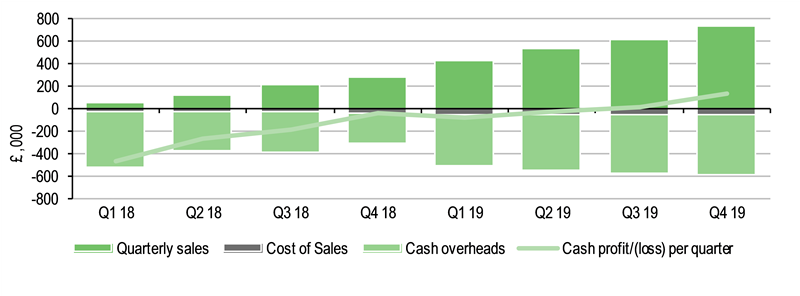
Exhibit 4 shows our forecast quarterly sales progression, costs of sales and cash costs. We forecast that the company will begin to show a cash profit from Q319.
|
Exhibit 4: Quarterly sales, cost of sales and cash costs |
|
|
Source: Edison Investment Research |
Gross margins: cost of sales captures app publisher payments (ie the cost of acquiring the raw data). This is likely to be a relatively volatile figure quarter-on-quarter as the timing and amount payable will vary according to both the consumer base and the seasonality of revenues. We forecast full year gross margin of 75% increasing to 89% over the next two years as the company builds scale and critical mass.
Operating costs: we estimate that the quarterly operating cash cost base of the company is running at approximately £570k in Q118. Management believes there is scope for further efficiency savings over the course of 2018 and we forecast the quarterly operational cost base to reduce to £420k by Q418. Cash costs are likely to grow from that point as revenues increase. We forecast an average of £470k over the next eight quarters.
EBITDA: these strong operational gearing characteristics would enable a rapid reduction of current EBITDA losses during 2018, with a positive EBITDA forecast in 2019 of £0.32m reflecting the growing revenues and continued strong cost control.
■
Operating cash flow: we forecast an operating cash outflow of £0.42m 2018 as revenues will remain relatively low this year but as revenues pick up in 2019 we expect this to turn more positive, to £0.14m. We expect the company to be funding £0.3m of working capital from 2019.
■
Net cash flow: the company has stated that it intends to continue to invest in the Location Sciences business so we forecast £0.5m capex per year resulting in net cash outflows of £0.9m and £0.36m over the next two years.
Balance sheet
The company completed a £3.1m fund-raising on 21 July and sold the Digital Payment business for an initial net consideration of £0.7m on 1 October 2017. These two transactions have left the business broadly debt free, with net cash on the balance sheet of £1.14m at December 2017 year end. This will be used to fund working capital for the Location Sciences business as well as investing in engineering resources to improve platform and data science capabilities and continuing to widen the group’s audience reach.
Assuming the company performs in line with our forecasts, additional sources of funding would be required by Q219. In Exhibit 5, for illustrative purposes we model this as debt. However, in order to provide for additional flexibility or to accelerate growth management may seek financing earlier.
Exhibit 5: Financial summary
£000s |
2017 |
2018e |
2019e |
||
31-December |
IFRS |
IFRS |
IFRS |
||
INCOME STATEMENT |
|||||
Revenue |
|
|
472 |
642 |
2,270 |
Cost of Sales |
(166) |
(159) |
(246) |
||
Gross Profit |
306 |
483 |
2,025 |
||
EBITDA |
|
|
(2,746) |
(1,004) |
316 |
Normalised operating profit |
|
|
(4,209) |
(1,449) |
(114) |
Exceptionals |
637 |
331 |
18 |
||
Share-based payments |
(88) |
(84) |
(84) |
||
Reported operating profit |
(3,660) |
(1,202) |
(181) |
||
Net Interest |
(142) |
4 |
8 |
||
Profit Before Tax (norm) |
|
|
(4,351) |
(1,446) |
(107) |
Profit Before Tax (reported) |
|
|
(3,802) |
(1,199) |
(173) |
Reported tax |
280 |
0 |
0 |
||
Profit After Tax (norm) |
(4,071) |
(1,446) |
(107) |
||
Profit After Tax (reported) |
(3,522) |
(1,199) |
(173) |
||
Discontinued operations |
(1,853) |
0 |
0 |
||
Net income (normalised) |
(4,071) |
(1,446) |
(107) |
||
Net income (reported) |
(5,374) |
(1,199) |
(173) |
||
Basic average number of shares outstanding (m) |
7,158 |
13,746 |
13,746 |
||
EPS - basic normalised (p) |
|
|
(0.06) |
(0.01) |
(0.00) |
EPS - diluted normalised (p) |
|
|
(0.06) |
(0.01) |
(0.00) |
EPS - basic reported (p) |
|
|
(0.08) |
(0.01) |
(0.00) |
Dividend (p) |
0.00 |
0.00 |
0.00 |
||
Revenue growth (%) |
75.4 |
36.0 |
253.8 |
||
Gross Margin (%) |
64.9 |
75.3 |
89.2 |
||
EBITDA Margin (%) |
N/A |
N/A |
13.9 |
||
Normalised Operating Margin |
N/A |
N/A |
N/A |
||
BALANCE SHEET |
|||||
Fixed Assets |
|
|
1,666 |
1,731 |
1,811 |
Intangible Assets |
1,380 |
1,460 |
1,540 |
||
Tangible Assets |
16 |
1 |
1 |
||
Investments & other |
269 |
269 |
269 |
||
Current Assets |
|
|
1,374 |
517 |
624 |
Stocks |
0 |
0 |
0 |
||
Debtors |
233 |
105 |
373 |
||
Cash & cash equivalents |
1,140 |
411 |
250 |
||
Current Liabilities |
|
|
(487) |
(410) |
(486) |
Creditors |
(483) |
(406) |
(482) |
||
Tax and social security |
0 |
0 |
0 |
||
Short term borrowings |
(4) |
(4) |
(4) |
||
Other |
0 |
0 |
0 |
||
Long Term Liabilities |
|
|
(1) |
(201) |
(401) |
Long term borrowings |
(1) |
(201) |
(401) |
||
Other long term liabilities |
0 |
0 |
0 |
||
Net Assets |
|
|
2,552 |
1,637 |
1,548 |
Shareholders' equity |
|
|
2,552 |
1,637 |
1,548 |
CASH FLOW |
|||||
Op Cash Flow before WC and tax |
(4,191) |
(1,004) |
316 |
||
Working capital |
(984) |
51 |
(192) |
||
Exceptional & other |
1,626 |
331 |
18 |
||
Tax |
456 |
200 |
0 |
||
Net operating cash flow |
|
|
(3,093) |
(423) |
141 |
Capex |
(694) |
(510) |
(510) |
||
Acquisitions/disposals |
773 |
0 |
0 |
||
Net interest |
(142) |
4 |
8 |
||
Equity financing |
5,401 |
0 |
0 |
||
Dividends |
0 |
0 |
0 |
||
Other |
(4) |
0 |
0 |
||
Net cash flow |
|
|
2,241 |
(929) |
(361) |
Opening cash |
|
|
3,201 |
(1,135) |
(207) |
FX |
111 |
0 |
0 |
||
Other non-cash movements |
1,984 |
0 |
0 |
||
Closing net debt/(cash) |
|
|
(1,136) |
(207) |
154 |
Source: Company accounts, Edison Investment Research
|
|||||||||||||||||||||||||||||||||||||||||||||||||
|
|
The overall valuation of Is Private Equity’s (ISGSY) private equity investments remained resilient in 2017, with gross asset exposure to these investments increasing (and liquid assets reduced) as ISGSY invested further, for larger stakes in existing assets. With economic recovery taking hold, investee companies saw total revenue growth of c 35% in 2017, and the increased investment may prove to be well timed, especially if inflation and interest rates decline as the Central Bank expects. A pick-up in M&A activity may also provide additional opportunity for capital recycling from mature assets into new opportunities. The significant 52% discount to NAV provides scope for a re-rating.