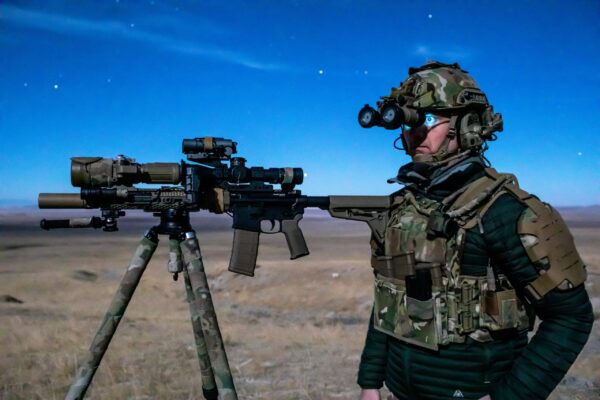
Theon International — The optics look good

Theon International (AMS: THEON)

Last close As at 05/08/2026

EUR34.24

−0.56 (−1.61%)

Market capitalisation

EUR2,693m

More on this equity

Research: Industrials

Theon International — The optics look good

Theon International is a leading European developer and manufacturer of customisable night vision and thermal imaging systems for military and security applications with a global footprint spanning 72 countries. Having built a leading position in man-portable night vision, the company is now broadening into platform-based optronics and digital man-portable products, supported by an active M&A programme and structurally rising defence demand. Theon’s Q126 trading update included a reiteration of mid-term and FY26 guidance with revenues this year of €570–600m along with mid-20s adjusted EBIT margins. Our unchanged valuation approach now suggests €35.3 per share, broadly unchanged from €36.4 previously.

Written by

Jonathan Day

Director of Content, Industrials

Aerospace and defence

Review with updated forecasts

17 July 2026

Price €31.80
Market cap €2,500m

Net cash/(debt) at Q126

€(228.2)m

Shares in issue

78.6m
Free float 29.9%
Code THEON
Primary exchange AEX
Secondary exchange N/A
Price Performance
% 1m 3m 12m
Abs 2.3 0.0 (1.2)
52-week high/low €36.4 €21.7

Business description

Theon International develops and manufactures customisable night vision and thermal imaging systems, primarily for military and security applications. These optoelectronic devices are developed for both man-portable and platform applications.

Next events

Q226 trading update

27 July 2026

Analysts

Jonathan Day
+44 (0)20 3077 5700
Yana Mihaylova
+44 (0)20 3077 5700

Theon International is a research client of Edison Investment Research Limited

Note: PBT and EPS are normalised, excluding exceptional items and share-based payments.

Year end Revenue (€m) PBT (€m) EPS (EUc) DPS (EUc) P/E (x) Yield (%)
12/24 352.4 86.7 98.00 34.00 32.4 1.1
12/25 443.4 105.5 115.00 31.00 27.7 1.0
12/26e 598.7 149.2 150.00 37.00 21.2 1.2
12/27e 748.5 175.1 174.00 42.00 18.3 1.3

Q126 results and orders confirm momentum

Q126 revenue rose 32% y-o-y to €120.1m with adjusted EBIT of €30.0m (+26%), c 4% ahead of consensus, and a 25.0% margin. EPS of €0.69 (Q125: €0.25) was lifted by strong operations and the appreciation of the 9.8% Exosens stake. Net debt of €228m (a net debt/EBITDA ratio of 1.8x) reflects the completion of the Kappa and Exosens transactions. On 22 June Theon announced that year-to-date order intake had reached €223m plus €68m of options. FY26 guidance of c 30% revenue growth (more than 20% organic) and a book-to-bill ratio above 1x was reiterated, with order growth expected to be H2/Q4 weighted.

A shift in strategy to a broader optronics platform

The investment case is increasingly defined by diversification. Theon is moving from a business where night vision generated c 93% of FY25 revenue towards a medium-term mix of c 50% night vision, c 20% platform-based and c 30% digital man-portable products (thermal imaging, advanced soldier systems), targeting more than €1bn of revenue by 2029. The platforms market is around three times the size of man-portable night vision, and management is prepared to accept slightly lower initial margins to establish itself, supported by strategic M&A. Platform margins are expected to recover to group level as operations scale. With the major acquisitions complete, Theon states that its focus is now on integration, with no further acquisitions foreseen in the near future.

Valuation suggests c 11% upside

We continue to value Theon using our peer group and discounted cash flow (DCF) based methodology. Our peer-based approach (Exhibit 14) suggests a valuation of €30.8 per share, while our DCF valuation (Exhibit 15) suggests €39.8. Our updated suggested valuation of €35.3 per share is 3% below our previous €36.4 and is based on the average of these two approaches, indicating c 11% upside. Risks include execution risk, uneven order intake and M&A integration.

Investment summary

A night vision leader broadening into a larger optronics market

Theon International is a leading developer and manufacturer of customisable night vision and thermal imaging systems for military and security applications in Europe with a global footprint spanning 72 countries. The company designs and manufactures cutting-edge optoelectronic devices for both man-portable and platform-based systems, enabling the visualisation of images in low-light or obscured conditions using state-of-the-art technologies. Product design is handled by Theon’s experienced in-house engineering team.

Mid-term growth targets were set at the 6 November 2025 capital markets day (CMD), including organic revenue growth of more than 15% per year, with bolt-on M&A on top and a mid-20s adjusted EBIT margin. The company aims to deliver more than €1bn of revenue (FY25: €443m) in the medium term, clarifying with its FY25 results that it expects to achieve this target by 2029. The company expects the mid-term revenue to be more diverse with c 50% from night vision (FY25: 93%), c 20% platform based and c 30% digital man portable. In FY25 the remaining 7% of revenue came from the ‘other’ category.

Growth is supported by structurally elevated defence markets and geographic expansion, with management characterising the opportunity as the reshaping of the European defence industry rather than simply the rearmament. Europe remains the stronghold, where management expects the shift towards joint procurement to reach c 40% of the total by 2030, from c 20% today, while Asia-Pacific (APAC) night vision goggle (NVG) procurements are expected to accelerate from 2026. The Middle East and North Africa (MENA) offers a platform optronics opportunity centred on Saudi Arabia and the UAE, and the US presents an opening through the replacement of PVS-14 monoculars with binoculars. Global opportunities should facilitate medium-term geographic expansion and diversification of revenue. The most significant strategic lever is platforms. According to management, the platforms market is around three times the size of man-portable night vision, and Theon has historically had almost no presence in this space. Management has been clear that it is prepared to sacrifice some margins to enter the platforms market with the expectation that platform margins converge towards man-portable levels as volumes mature. Importantly, FY26 and medium-term adjusted EBIT margin guidance remains as ‘mid-twenties’ implying that margins at group level should remain at what Theon believe are best-in-class levels. The company also has a track record of M&A (see Exhibit 9) and an active deal pipeline, although it expects no new acquisitions in the near future as the focus is on integration. In June 2026 Theon announced the c €300m agreed acquisition of HGH Systèmes Infrarouges, the latest in a series of platform-focused deals, accelerating its push into platform electro-optics and counter drone solutions without requiring an equity capital increase.

Financials: Rapid growth guided, margin trade-off visible

FY25 was a record year, with revenue up 26% to €443.4m at a 26.2% adjusted EBIT margin, order intake of c €1.3bn and a soft backlog of €1.42bn providing visibility beyond the normal 18-month horizon. Q126 revenue growth maintained the momentum with guidance unchanged. Management expects FY26 revenue of €570–600m with a mid-20s adjusted EBIT margin and reiterated at the Q126 stage that it expects revenue growth of c 30%, with more than 20% organic and a book-to-bill ratio above 1x. Order momentum and guidance supports this: on 22 June 2026 Theon announced c €70m of additional order intake, taking Q2 order intake to c €153m (plus €27m of options) and total year-to-date intake to c €223m (plus €68m of options).

Order intake seasonality is expected to follow the normal H2 weighting including a strong Q4 concentration.

We forecast FY26 revenue of €599m with adjusted EBIT of €155m, implying a 25.9% adjusted EBIT margin, a slight decline of 30bp from 26.2% in FY25. Our FY26 forecasts are within Theon’s guided range. Night vision remains the main driver of revenue growth in FY26.

For FY27 we forecast revenue of €748m and adjusted EBIT of €192m, implying an adjusted EBIT margin of 25.7%, which reflects some mild dilution from scaling initially lower-margin platform deliveries. Adjusted EBIT still roughly doubles between FY24 (€90.8m) and FY27 (€192.1m) driven by strong revenue growth including announced M&A.

We expect recent acquisitions to push net debt to €464m, taking net debt/EBITDA to 3.0x in FY26. Thereafter, the balance sheet de-levers on our estimates, with net debt falling to €396m (c 2.1x EBITDA) at end FY27, back below the company's stated 2.5x net debt/EBITDA ratio ceiling.

Valuation: Suggested fair value €35.3 per share

We continue to value Theon using our peer group and DCF-based methodology. Our peer-based approach, as shown in Exhibit 14 in the valuation section, suggests a valuation of €30.8 per share, while our DCF valuation (Exhibit 15) with an unchanged 8% cost of capital and a 3% terminal growth rate suggests a valuation of €39.8. The average of these two approaches provides an updated valuation of €35.3 per share, a 3% decrease compared to our previous valuation of €36.4, and c 11% upside.

Sensitivities

The main execution risk sits in platforms: the medium-term revenue bridge requires further platform-focused bolt-on M&A to be sourced, completed and integrated on schedule, and platform margins must converge towards group levels as volumes mature. Order intake remains lumpy, and while Q126 orders were down 40% y-o-y on seasonality and contract phasing and an H2-weighted FY26 year is expected, order intake of €223m (22 June ytd) is running ahead of the €168m achieved in H1 25. Night vision growth is constrained by image intensifier tube capacity, a risk Theon has mitigated through its long-term commercial agreement further reinforced by the stake acquisition in Exosens (9.8%) and Harder Digital (60%). M&A including integration remains a risk, although the company expects no new acquisitions in the near future as the focus shifts to integration. The main upside sensitivities are faster platform adoption, including the transition of the Rheinmetall PHYLAX programme to serial production, and the higher-margin digital product roll-out under THEON NEXT, with an ARMED NEXT component prototype expected before end-2026, ahead of the original timeline.

2026: The story so far

Theon released FY25 preliminary results in February (see our note), which included FY26 guidance for revenue of €570–600m (FY25: €443.4m) and a mid-20s adjusted EBIT margin (FY25: 26.2%). Mid-term guidance was reiterated. Highlights from the full FY25 results call in April included the 8 April 2026 strategic agreement with Rheinmetall (RHM GY), which establishes a long-term industrial and technological cooperation between the two companies. The agreement covers the development and supply of a stabilised multi-sensor (camera, thermal, laser rangefinder) electro-optic system based on Theon’s latest PHYLAX technology, which enhances situational awareness, reconnaissance and target acquisition capabilities for combat vehicles, with Theon’s optronics integrated into Rheinmetall’s products’ turrets. It marks an important milestone in Theon’s expansion into advanced electro-optical solutions for modern combat vehicles, and the company expects to become a more established player in the space. Theon also expects synergies from Kappa Optronics, the acquisition of which it announced in August 2025 (see our note), to contribute meaningfully to growth in 2026 and sees a positive growth path for platform optronics, with a significant increase in deliveries expected by the company in 2027. Theon indicated that its margins in the platform business could initially be lower than the group level and reiterated its comment from the November 2025 CMD that if necessary it is prepared to sacrifice some margins to enter the platforms business.

Recent updates: Q126 trading (5 May 2026), June order wins

Q126 order intake of €70m was down 40% y-o-y primarily due to seasonality and contract phasing, with accelerated order intake expected in the coming quarters supported by customers exercising options. The soft backlog of €1.42bn was stable despite high growth in Q1, helped by the consolidation of Kappa Optronics.

Revenues of €120.1m (+32% y-o-y) were a c 1% miss versus €121.7m consensus, but adjusted EBIT of €30m (+26% y-o-y) was c 4% better than the €28.9m consensus expected, with the adjusted EBIT margin of 25.0% little changed versus 25.3% in Q125. EPS of €0.69 was a significant improvement versus the €0.25 achieved in Q125 driven by the healthy operational performance and the appreciation of its 9.8% strategic stake in Exosens. As expected Theon moved into a net debt position in Q1 following the completion of the acquisitions of a 9.8% equity interest in Exosens at €268.7m and 100% of Kappa Optronics at €75m, taking net debt to €228m at the end of the quarter. Net debt/EBITDA rose to 1.8x, leaving the company with sufficient financial flexibility to support its investment plans. The company expects to focus on bolt-on M&A going forward.

On 22 June 2026 Theon announced c €70m of additional order intake, taking Q2 order intake to c €153m (plus €27m of options) and total year-to-date intake to c €223m (plus €68m of options). These figures reflect the full consolidation of the Kappa Optronics and Harder Digital order intake. The largest single component came from the Rheinmetall order intake for the Bundeswehr’s Future Soldier programme (Infanterist der Zukunft – IdZ). Theon reiterated guidance for an organic book-to-bill above 1.0x in FY26, and order seasonality is expected to follow the normal pattern of an H2 weighting with a particularly strong concentration in Q4.

FY26 and medium-term guidance unchanged

For FY26 Theon is confident that it can maintain a book-to-bill ratio above 1.0x, with order growth stronger in H2 and Q4, following the usual seasonal pattern. The strong order backlog with longer-term framework agreements provides more visibility than it has had historically. Theon guides to FY26 revenue in the €570–600m range (FY25: €443.4m) translating to growth of c32% with more than 20% expected to be organic. Adjusted EBIT margins are expected by management to land in the mid-20s.

Medium-term guidance for organic revenue growth of 15% or more, plus bolt-on M&A, mid-20s (c 24–26%) adjusted EBIT margins, capex/sales of c 4% and a 20–30% dividend payout ratio is unchanged.

Strategy overview

Theon’s strategy involves evolving from a leader in night vision optronics into a leader in the broader defence optoelectronics sector, diversifying revenue across three pillars while preserving its industry-leading profitability. As part of its mid-term revenue diversification target, the company aims for a more balanced split of sales across its three pillars from c 93% for night vision in FY25, to c 50% night vision, c 20% platform based and c 30% digital man portable. The model rests on vertical integration, spanning in-house design, production and business development, combined with an international supply chain producing components to Theon's own designs.

Night vision: The foundation with a long growth runway

Management frames night vision growth, the first pillar, as structural and durable rather than cyclical. Night vision is considered to no longer be a luxury for special forces but standard equipment, a mindset shift accelerated by the current global geopolitical landscape. The same backdrop is also drawing in countries with no direct exposure to conflict, where governments are increasingly choosing to secure defensive capabilities as a precaution, broadening demand well beyond the nations most immediately affected. At Theon’s November 2025 CMD, the company estimated that the 2025 dismounted (man-portable) addressable market is worth €1.7bn, growing at a c 11% CAGR over 2025–30 (see exhibits 4 and 5 below). Growth drivers include:

  • increased penetration rates,
  • larger personnel numbers, and
  • increased target acquisition and the shift of countries moving towards longer-term agreements to secure supply of equipment for the coming three to five years.

Regional penetration of NVGs remains low outside the US (Europe c 30%, MENA c 20%, APAC c 10%, versus c 100% in the US), with management expecting modernisation to move towards a 1:1 NVG-to-soldier ratio. The runway is therefore substantial relative to Theon’s current scale. Against FY25 revenue of c €443m, of which 93% was night vision, a growing €1.7bn market leaves significant room for share gains before penetration matures.

Image intensifier tube capacity is key

According to Theon image intensifier tubes account for c 50–60% of the cost of NVGs. The binding constraint on growth is image intensifier tube manufacturing capacity, rather than demand. The number of Western tube manufacturers is limited, and securing supply is therefore central to Theon's ability to grow. This is the strategic rationale behind both the October 2024 acquisition of a 60% controlling stake in Harder Digital, a vertically integrated tube manufacturer, and Theon’s investment in Exosens, a French optical sensor manufacturer and one of the largest Western producers (in terms of production output) of image intensifier tubes, with a growing capacity of c 120k tubes per year. Theon took a 9.8% stake in Exosens in October 2025, making it the second-largest stakeholder on its register and the only strategic investor, a deliberate move to help secure long-term tube capacity rather than a purely financial holding. Theon is Exosens’ largest customer, accounting for c 60–70% of its night vision tube output, and has a long-term supply agreement with pre-agreed pricing rather than spot prices. The scale of capacity constraint is such that covering even 10% of European troop night vision procurement would absorb roughly two years of Exosens’ output, equivalent to c 250k tubes. The long-term agreement, in place until 2030, guarantees minimum supply to cover Theon’s anticipated growth and also foresees capturing a proportional part of the suppliers capacity increase.

Theon’s products are also tube-agnostic, such that there is no need to change product lines as tube sourcing shifts. Beyond securing supply, Theon’s differentiation in the segment rests on a low-cost Greek engineering and production base, a willingness to work closely with customers to incorporate their feedback regarding system configuration and subsequent customisation of products to specific customer/operational requirements (for example making a product where the AAA batteries required for operation can be put in any way round in response to customer feedback), and high strategic inventories that enable it to serve ad-hoc end-of-year budget demand. The company believes that its low-cost production enables it to offset the high levels of discounts that competitors might offer and operational leverage can counter any volume discount large procurement tenders may require.

In addition to night vision, Theon also offers thermal imaging. Thermal imaging is digital technology while night vision is analogue. The two technologies are complementary. Combining night vision and thermal imaging gives the advantage of having both capabilities in one set of goggles. While Theon does not expect thermal imaging to reach 100% of soldier penetration, it thinks it may be possible to reach a level of around 30%.

Platforms: The key diversification lever

Increasing exposure to the platforms market, the second pillar, is at the centre of Theon’s strategic shift. The platform (vehicle-mounted optronics) market is around 1.5x the size of the man-portable night vision market (Exhibit 4), and the company aims to replicate in platforms the share gains it achieved in goggles by leveraging its strong customer relationships. At Theon’s November 2025 CMD the company showed that the 2025 platforms addressable market is sized at c €2.5bn growing at a c 12% CAGR, with growth mainly driven by large European armoured vehicle programmes and MENA from 2026. The main focus is on armoured fighting vehicles using remote weapon stations and turrets with advanced optronics. Theon’s target is for platforms to make up c 20% of group mid-term revenue, with revenue beginning to contribute in FY26 and a significant step-up in deliveries expected in 2027.

Platform ramp up included in margin guidance

Theon expects platform margins to be a few percentage points lower than the mid-20s group margins initially. Management has been clear that it is prepared to sacrifice some margin to enter the market, with the expectation that platform margins will converge towards group levels over time. The company expects the third manufacturing site coming on-line in H127 to be a key milestone, as the scaling of platform operations should help divisional margins converge towards group levels.

The margin sacrifice is a deliberate choice already embedded in guidance and projections rather than a later downside risk. The trade-off is helped by the margin profile of the rest of the range, with night vision gross margins in the mid-thirties while other products can reach gross margins above 40%. The first c €40m platform order, a key milestone, was secured on terms consistent with the company's profitability standards. Management aims to keep the groupwide adjusted EBIT margin in the mid-20s as it rolls out new higher-margin products alongside platforms. This should help offset the dilution from the initially lower-margin platform sales, with several of these higher-margin products being built out through M&A. Demand-side interest is strong, with Theon reporting approaches from numerous OEMs wanting to use it as a subcontractor on platforms.

Growth supported by Kappa, ShockEOS and the April 2026 agreement with Rheinmetall

Theon’s entry into platforms has been built out through acquisition as well as internal development. The August 2025 acquisition of Kappa Optronics, a German specialist vision systems business and first-tier supplier to most European defence OEMs, is central to this. Kappa brings stabilised platform optronic capabilities and OEM relationships that would have taken years to build organically, and its German base positions Theon in Europe’s largest defence-spending market at a time of rising procurement. Management expects Kappa to contribute c €40m to revenue in FY26, and it is already delivering commercial synergies. New products for the segment include two gimbals co-developed with ShockEOS, combining internal and external design expertise.

Further validation of the platform implementation is the strategic agreement signed with Rheinmetall in April 2026. Rheinmetall, one of Europe’s largest defence groups and a full system integrator with significant experience in vehicle optronics, has selected Theon’s PHYLAX system for integration into its SEOSS 210 P stabilised electro-optical sight for medium-calibre turret solutions. PHYLAX is a compact stabilised electro-optic system designed to improve situational awareness, reconnaissance and target acquisition for combat vehicles. The agreement establishes a long-term industrial and technological cooperation between the two companies.

The programme is expected to transition to serial production in connection with the fire-control system of the Luchs 2 reconnaissance vehicle, with an initial committed contract value exceeding €40m for several hundred systems and the potential for further quantities as the system is integrated onto additional platforms and turret programmes. To support production of PHYLAX and other platform-based products, Theon has begun construction of a third facility in Athens, expected to be ready by Q227 at a cost of around €10m, already included within the 2026–27 capex guidance.

On 17 June 2026, Theon announced an exclusive agreement to acquire HGH Systèmes Infrarouges, a French electro-optical and infrared specialist, for an enterprise value of c €300m. HGH broadens Theon’s Multi-Domain intelligence, surveillance and reconnaissance (ISR) portfolio and adds counter-drone capability built on proprietary, ITAR-free AI detection and classification technology. The transaction also deepens Theon’s strategic commitment to France, intended to become an export hub and AI R&D centre for the group. Closing is expected by Q426, subject to the statutory works council process and regulatory approvals.

Digital man-portable and THEON NEXT: Higher-margin, capacity-unconstrained growth

The third pillar targets c 30% of revenue in the medium term through digital and fused products. This includes thermal imaging, which is complementary to analogue night vision, and a potential soldier penetration of up to c 30% rather than the higher rates seen in goggles. Theon is also expanding into fire-control systems, the fastest-accelerating man-portable category, which improves hit accuracy, mitigates ammunition scarcity and reduces exposure to counter-fire. These digital products carry higher margins than the core night vision range and, importantly, are not constrained by tube capacity such that production scales more easily. Sitting above this is THEON NEXT, an initiative to advance soldier systems towards augmented reality and networked situational awareness. The company expects to present an ARMED NEXT component prototype before the end of 2026, ahead of the original CMD timeline, with the Dark-I image-fusion prototype (jointly developed with Kopin) already being shown to customers. This ambition is already converting into orders. On 22 June 2026 Theon announced c €70m of new order intake, a significant part of which came from Rheinmetall for the Bundeswehr’s Future Soldier programme (Infanterist der Zukunft – IdZ), comprising a new firm order and an exercised option across the ARMED ecosystem portfolio. This new order expands Theon’s role in the soldier digital vision system within the IdZ programme and supports its stated ambition to take a leading position in augmented reality applications for the soldier, with further IdZ option exercises possible later in the year.

Geographic expansion supports all three pillars

Growth is underpinned by elevated and accelerating defence spending, with Theon’s CEO characterising the opportunity as ‘a tectonic shift in the European defence industry’ rather than simply rearmament. The strategy targets four regions: Europe, the Americas, APAC and MENA. Europe remains the stronghold, where Theon expects the shift towards joint procurement through bodies such as the Organisation for Joint Armament Cooperation (OCCAR), NATO Support and Procurement Agency (NSPA) and Nordic Defence Cooperation (NORDEFCO) to rise to c40% of procurement by the end of 2027 from c 20% today. The growth is not evenly distributed. In dismounted optronics, Theon expects the Americas to be the largest market in both 2025 and 2030 but Europe and APAC to see the fastest proportional growth to 2030, while in platforms the absolute opportunity is larger still and growth is broad-based, with MENA and APAC roughly doubling and Europe remaining the single biggest region. In APAC, large NVG procurements are expected to start in 2026, and Theon is building an industrial presence from South Korea with a focus on US allies. In MENA, the focus is on Saudi Arabia and the UAE, expanding platform optronics capability and targeting the Saudi vehicle market. The US is the largest defence market at c $900bn per year, where the ongoing replacement of PVS-14 monoculars with binoculars represents an opening. However, management notes that roughly two-thirds of US NVG demand is inaccessible due to tube export restrictions and US producers not being able to export their highest-quality product outside the US.

M&A and strategic initiatives

Theon’s stated approach is to support organic growth with targeted deals that can add complementary products, technologies, capabilities and geographic reach, with target markets being fire-control systems, platforms, unmanned aerial vehicles (UAVs), vehicles and digital/augmented reality soldier systems under THEON NEXT, while target geographies include the US and APAC. Fire-control systems can be mounted on missile launchers to help the user hit the target with one shot, which is also important for managing ammunition scarcity in the battlefield. Fire-control systems do not have capacity restrictions, making it easier to scale production, and they come with attractive margins.

Two major transactions for Theon included Kappa Optronics and Exosens (discussed in the strategy overview section). Following these significant acquisitions, the company has continued to execute a pipeline of deals that build out platform, digital and geographic capability, with no capital increase required. Some recent transactions in the table below reflect that shift in emphasis towards smaller deals that build out platform, digital and geographic capability. One of the most recent announced transactions is Merio, a French manufacturer of gyrostabilised gimbal and turret systems, which further extends platform and drone exposure.

However, the largest recent transaction is the c €300m agreed acquisition of HGH Systèmes Infrarouges, announced on 17 June 2026, which materially increases the contribution of platform electro-optics and adds counter-unmanned aerial systems (CUAS) capability. Notably, despite its scale, the deal requires no equity capital increase but consequently pushed net debt/EBITDA to c 3.0x, albeit we estimate this will fall back to 2.1x by the end of FY27. Alongside the Safran joint venture mentioned below, it reinforces a clear tilt in the pipeline towards France, platforms, drones and AI-enabled ISR.

On 15 June 2026 Theon signed a memorandum of understanding with Safran Electronics and Defense to establish a joint venture (JV) for airborne electro-optical and infrared systems for UAVs, focused on small gimbals for ISR and targeting applications. The JV would be 51% controlled by Theon with equal 50/50 governance rights and the JV’s CEO role rotating every three years, with Theon holding the first appointment. Part of the JV’s activities would be based in Greece, preserving the group’s operational base and low-cost competitive advantage.

The balance sheet supports continued bolt-on activity from FY27. The Exosens and Kappa outflows, partly funded by the €147.7m net proceeds of the December 2025 rights issue and supported by a €300m revolving credit facility (RCF), took pro forma net debt to around €211.7m at end-FY25, equivalent to roughly 1.8x last 12 months EBITDA. The HGH acquisition, announced on 17 June 2026, at a cost of c €300m, raises debt further to c €464m by the end of FY26, assuming HGH closes, taking net debt/EBITDA to 3.0x at end FY26. From there we expect the balance sheet to de-lever. We forecast net debt to fall to €396m at end-FY27, taking leverage down to 2.1x, back inside the company's stated ceiling of 2.5x. These forecasts do not assume major new acquisitions, although the de-leveraging continuously rebuilds the capacity to fund deals.

We believe continued bolt-on M&A is possible given Theon’s active track record and the scale of the medium-term ambition. Theon targets platforms at c 20% of a €1bn revenue business, implying platform revenue of around €200m. The current base is the c €40m Kappa contribution, plus the c €15m from Merio and the c €40m impact of the HGH acquisition in FY26, assuming it closes as planned. This makes the pipeline of platform-focused transactions that management has flagged as forthcoming an ongoing strategic preference. We believe that M&A is a quantitative requirement of the medium-term plan, and it is also the most visible execution risk, since the targets must be sourced, completed and integrated on schedule for the revenue bridge to hold.

Order backlog

Theon’s order book is best understood in three layers. The hard backlog, c €1.20bn, represents firm orders already moved into production. The soft backlog, c €1.42bn at the end of Q126, comprises the hard backlog and the secured orders awaiting only final approval (typically parliamentary ratification of a final Ministry of Defence signature) rather than speculative volumes. Sitting on top of both of these are options that are the rights attached to existing contracts that allow customers, at their discretion, to acquire further quantities of the same products at the agreed price levels (subject to limited inflationary adjustment). Options are not yet firm revenue and are not included in the €1.42bn soft backlog figure. Historically Theon notes that customers have often added to existing contracts, even after options have been exhausted. This is more straightforward than launching a new tender and reflects customer satisfaction with Theon’s quality as well as efficiency benefits if customers have already developed related training and logistics programmes.

Theon has historically guided to forwards revenue visibility of c 18 months, yet a differing feature of its current soft backlog position is that it extends well beyond that horizon, spanning out to 2029.

The soft backlog stood at €1,420m at the end of Q126, up sharply from €669m for Q125. This represents more than three years at the FY25 level and provides a strong base of forward visibility, which management contrasts favourably with the shorter visibility it has had historically as customers move towards longer-term agreements.

The soft backlog is spread between several years of delivery, where the 26% earmarked for 2026 covers a little under two-thirds of the €570–600m revenue guided for the year, with the balance expected to come from new orders and the conversion of existing options. This is consistent with the normal seasonal pattern in which order intake is skewed towards H2, particularly Q4. As mentioned above, Theon notes a clear historical precedent for customers continuing to draw on existing contracts even after options are exhausted. Therefore, a key dynamic to monitor is the pace at which the options convert into firm orders, since that conversion is a key factor underpinning the company's ability to meet its near-term revenue targets.

Financial forecasts

Management guides to FY26 revenue of €570–600m, with a mid-20s adjusted EBIT margin, and reiterated at the Q126 stage that it expects revenue growth of c 30%, with more than 20% organic and a book-to-bill above 1x. Order momentum and guidance supports this: on 22 June 2026 Theon announced c €70m of additional order intake, taking Q2 order intake to c €153m (plus €27m of options) and total year-to-date intake to c €223m (plus €68m of options), with order seasonality expected to follow the normal pattern of an H2 weighting with a particularly strong concentration in Q4.

We forecast FY26 revenue of €599m with adjusted EBIT of €155m, implying a 25.9% adjusted EBIT margin, a slight decline of 30bp from 26.2% in FY25. Night vision remains the main driver of revenue growth in FY26.

For FY27 we forecast revenue of €748m with growth of c 25% still primarily driven by night vision but also supported by growth of the platform business, driven by previous acquisitions and contract wins. Our adjusted EBIT margin estimate falls by 26bp to 25.7% due to higher costs and some mild dilution from scaling initially lower-margin platform deliveries. We assume zero non-recurring charges, giving reported and adjusted EBIT of €192m (+16.1% y-o-y). Adjusted EBIT still roughly doubles between FY24 (€90.8m) and FY27 (€192.1m) driven by strong revenue growth including announced M&A. We assume zero non-recurring charges.

Recent acquisitions push net debt to €464m taking net debt/EBITDA to 3.0x in FY26. Thereafter, the balance sheet de-levers on our estimates, with net debt falling to €396m (c 2.1x EBITDA) at end FY27, back below the company's stated 2.5x ceiling.

Medium-term targets appear achievable

Following the HGH acquisition, organic revenue growth of 15% (the company guides to at least 15%) from FY27 with no further M&A would take FY29 revenue to c €1bn, whereas 20% would take it to c €1.1bn. The €1bn target therefore appears broadly achievable in the context of guidance for at least 15% organic growth, complemented by bolt-on M&A. Guidance for mid-20s margins, which we think of as around 24–26%, gives the company some headroom for margin dilution, although with stronger gross margins on platform products we would expect that margin dilution from the ramp up of platforms should have dissipated by 2029 or 2030, post the third 2,500sqm plant coming online by H127.

Changes to estimates

We make minor changes to our FY26 estimates. Our PBT estimate falls by 2% due to our assumption that operating costs, and in particular administration costs, scale with the business, and we also assume a slightly higher finance charge. However, our EPS estimate is unchanged due to a lower minority interest deduction. We continue to assume a dividend payout ratio of c 25%, in the middle of Theon’s guided range of 20–30%.

The change in our 2026 net debt estimate reflects the timing of transactions. Net cash at end FY25 was €129m, which shifted to a net debt position following the completion of the Kappa Optronics and Exosens transactions, which closed post period end and which we had previously partially included in FY25. FY26 cash flow now includes the impact of the HGH acquisition announced on 17 June 2026, which is expected to close towards the end of 2026 hence the impact on revenue and profits is not expected to be material.

Valuation suggests c 11% upside

Our combined approach suggests a value per share of €35.3

We continue to value Theon using our peer group and DCF-based methodology:

  • Our peer-based approach (Exhibit 14) suggests a valuation of €30.8 per share.
  • Our DCF valuation (Exhibit 15), with an unchanged 8% cost of capital and a 3% terminal growth rate, suggests a valuation of €39.8.
  • The average of these two approaches provides an updated valuation of €35.3 per share, 3% lower than our previous valuation of €36.4, and c 11% upside.

Peer-based valuation

We use two peer groups: one for specialist electronics companies with vision systems exposure and another for defence-related peers. The higher-rated specialist electronics peers suggest an average valuation of €36.2 per share, while the defence peers suggest an average valuation of €25.3 per share, with the average of the two at €30.8.

Theon is growing revenue at c 30% in FY26, well ahead of the growth rates of most peers. Faster-growing businesses command higher multiples on current-year earnings.

Theon's c 26% adjusted EBIT margin is at or above the level of most names in both peer groups and it has a structurally low-cost Greek manufacturing base. A higher-margin, higher-growth business should trade above the median on EV/EBIT and EV/EBITDA multiples.

DCF valuation

Our DCF valuation, using a cost of capital of 8% and a long-term growth rate of 3%, suggests a valuation of €39.8 per share, an increase compared to our previous €36.9 as we have rolled our model forwards one year.

Defence stocks re-rating explained

Defence stocks in Europe have not always traded at current levels. Prior to early 2025, these stocks traded at much lower multiples. However, the changing geopolitical backdrop and the understanding that European defence spending needed to increase relative to GDP, to put Europe in a stronger position to defend itself and become less reliant on support from global allies, provided a significant boost to defence spending in the region. According to the European Defence Agency (EDA), in 2024 total defence spending by the EU27 was €343bn, up 19% compared to 2023 (2023 was +10%) and equivalent to 1.9% of GDP (2023: 1.6%), closer to NATO’s old guideline of 2.0% of GDP. Defence investment in the EU exceeded €100bn for the first time in 2024, accounting for 31% of total defence expenditure. In March 2025 the European Commission launched its Readiness 2030 initiative, which is likely to boost spending further by up to €800bn. NATO’s defence spending targets were updated at its April 2025 summit to 5% of GDP by 2035 and at least 3.5% of GDP annually, with the allies agreeing to submit plans showing a path to reach this goal.

The current and anticipated increase in defence spending, with the associated boost to sector revenue growth now guided for by Theon and peers such as Rheinmetall, caused the market to re-rate key companies in the sector from P/E multiples around the mid-teens to multiples in the low-to-mid 20s (Exhibit 17). With defence spending likely to remain elevated as Europe catches up after years of underinvestment, supported by company guidance for robust growth until 2030, we assume sector multiples can continue to trade around current levels over the next few years at least.

Sensitivities

Demand concentration

Theon's revenue derives, directly or indirectly, almost entirely from government defence and security budgets, so its growth is ultimately a function of public spending and the geopolitical backdrop. The current investment case rests heavily on elevated European defence spending continuing, which means a de-escalation of current conflicts, a settling of geopolitical tensions, or a reprioritisation of government budgets towards personnel rather than equipment would weigh directly on demand. Defence procurement is also lengthy and politically driven, so contract awards can be delayed or amended, and given Theon's focus on larger tenders, the timing of a small number of orders can materially affect results in any given year.

Execution

The shift into platforms, the build-out of digital products and the reliance on continued M&A all have to be delivered to schedule for Theon’s medium-term targets to hold. Integrating acquired businesses carries the usual risks of cost, delay and unrealised synergies, and as noted the revenue bridge to the €1bn target depends on acquisitions being sourced and integrated successfully. The platform ramp also carries margin risk, since platform profitability is initially expected to be below the group level and has not been quantified, so the pace of margin convergence remains uncertain.

Supply chain concentration

Image intensifier tubes are available from only a small number of Western manufacturers, and although Theon has secured capacity through Harder Digital and Exosens, any disruption to tube supply would directly constrain its ability to convert orders into revenue. The business is also exposed to export controls and licensing regimes that can restrict access to certain markets, foreign exchange movements, given its international footprint, and to the customer-concentration and competitive-pricing pressures common to the defence sector.


M&A/leverage

Theon is likely to remain acquisitive, which comes with associated risks including integration risks and delivering on planned synergies. We expect net debt/EBITDA to briefly rise to 3.0x at end-FY26 before falling back below Theon’s 2.5x target. The higher levels of debt in the short term ideally require Theon to successfully deleverage and raise the sensitivity of the company to higher interest rates.

Shareholder structure

Theon retains a concentrated ownership structure centred on founder and CEO Christian Hadjiminas. Data from the 2025 annual report shows that the largest shareholder is Venetus, an entity majority owned by Hadjiminas, which holds c 59.6% of the share capital. The second-largest holder is CHRE Investments at c 10.5%, which is also a party closely associated with Hadjiminas. The remainder of the register is made up of smaller institutional and retail holders.

The free float has been deliberately widened since IPO where it stood at 20%. In a March 2025 placing, Venetus sold c 3.2m shares (c 4.5% of the company) at €17.7 per share via an accelerated bookbuild, with the stated aim of improving liquidity and easing access to the stock. This was followed by Venetus’ sale of c 3.73m shares on 4 June 2025, equal to c 5.3% of the share capital, as a way of further increasing the free float and liquidity. Management has indicated no near-term intention to reduce below c 70% of share capital, so further increases in free float are likely to be measured. A subsequent transfer in February 2026 saw Venetus move c 0.79m shares to CHRE at €28.98 per share.


For investors, the structure has two implications. The high insider ownership aligns management firmly with shareholders’ interests and signals confidence in the strategy, but the corresponding low free float constrains liquidity and means minority holders have limited influence. The trajectory of further placings will be the key variable to watch, both for liquidity and as a potential source of share supply.

For more information on Theon’s investment case, see our previous research notes.


 Contact details

A57, Ioannou Metaxa str
Koropi, GR-19441
Greece
+30 2106641420
www.theon.com

  Revenue by geography

Enlarge

Source: Theon FY25 results presentation, 21 April 2026


Management team

Chair: Kolinda Grabar-Kitarović

Kolinda Grabar-Kitarović is chair of the board and independent non-executive director of Theon International. She has an MA in arts from the University of Zagreb. Kolinda acted as VP of the UN General Assembly on behalf of Croatia (2006), was ambassador of the Republic of Croatia to the US, NATO, assistant secretary general for public diplomacy (2011–14) and president of the Republic of Croatia (2015–20). She is a member of the International Olympic Committee. From October 2025, she became
member of the public affair’s advisory board of Palo
Alto Networks.

Vice chair and CEO: Christian Hadjiminas

Christian Hadjiminas has a BA in economics from Columbia University and an MBA from Wharton Business School. He is the owner of EFA GROUP, a set of companies with a leading-edge position in the international market with more than 30 years’ experience in the fields of aerospace, security, defence and industrial cooperation. Christian is the founder and majority shareholder of Theon. He is also president of the Hellenic Entrepreneurs Association (EENE) and head of EENE International.

Business development director: Philippe Mennicken

Philippe Mennicken joined Theon in 2010 and has been Business Development Director since January 2013. He has a BA in mechanical engineering from Université de Liège, an MSc in aerospace dynamics from Cranfield University and an MSc in strategic management from the University of Bristol. He has worked in technical sales roles at Goodrich Aero, SKF Aerospace and Epicos.

CFO: Dimitris Parthenis

Dimitris Parthenis joined Theon in August 2017. He has a degree in business administration from Athens University of Economics & Business. Between 2004 and 2017 he served as CFO and later as CEO of Alpha Grissin Group, an Athens stock exchange-listed company, specialising in data centre infrastructure design and support.

Principal shareholders
%

Venetus

CHRE Investments

59.6%

10.5%

General disclaimer and copyright

This report has been commissioned by Theon International and prepared and issued by Edison, in consideration of a fee payable by Theon International. Edison Investment Research standard fees are £60,000 pa for the production and broad dissemination of a detailed note (Outlook) following by regular (typically quarterly) update notes. Fees are paid upfront in cash without recourse. Edison may seek additional fees for the provision of roadshows and related IR services for the client but does not get remunerated for any investment banking services. We never take payment in stock, options or warrants for any of our services.

Accuracy of content: All information used in the publication of this report has been compiled from publicly available sources that are believed to be reliable, however we do not guarantee the accuracy or completeness of this report and have not sought for this information to be independently verified. Opinions contained in this report represent those of the research department of Edison at the time of publication. Forward-looking information or statements in this report contain information that is based on assumptions, forecasts of future results, estimates of amounts not yet determinable, and therefore involve known and unknown risks, uncertainties and other factors which may cause the actual results, performance or achievements of their subject matter to be materially different from current expectations.

Exclusion of Liability: To the fullest extent allowed by law, Edison shall not be liable for any direct, indirect or consequential losses, loss of profits, damages, costs or expenses incurred or suffered by you arising out or in connection with the access to, use of or reliance on any information contained on this note.

No personalised advice: The information that we provide should not be construed in any manner whatsoever as, personalised advice. Also, the information provided by us should not be construed by any subscriber or prospective subscriber as Edison’s solicitation to effect, or attempt to effect, any transaction in a security. The securities described in the report may not be eligible for sale in all jurisdictions or to certain categories of investors.

Investment in securities mentioned: Edison has a restrictive policy relating to personal dealing and conflicts of interest. Edison Group does not conduct any investment business and, accordingly, does not itself hold any positions in the securities mentioned in this report. However, the respective directors, officers, employees and contractors of Edison may have a position in any or related securities mentioned in this report, subject to Edison's policies on personal dealing and conflicts of interest.

Copyright 2026 Edison Investment Research Limited (Edison).

Australia

Edison Investment Research Pty Ltd (Edison AU) is the Australian subsidiary of Edison. Edison AU is a Corporate Authorised Representative (1252501) of Crown Wealth Group Pty Ltd who holds an Australian Financial Services Licence (Number: 494274). This research is issued in Australia by Edison AU and any access to it, is intended only for "wholesale clients" within the meaning of the Corporations Act 2001 of Australia. Any advice given by Edison AU is general advice only and does not take into account your personal circumstances, needs or objectives. You should, before acting on this advice, consider the appropriateness of the advice, having regard to your objectives, financial situation and needs. If our advice relates to the acquisition, or possible acquisition, of a particular financial product you should read any relevant Product Disclosure Statement or like instrument.

New Zealand

The research in this document is intended for New Zealand resident professional financial advisers or brokers (for use in their roles as financial advisers or brokers) and habitual investors who are “wholesale clients” for the purpose of the Financial Advisers Act 2008 (FAA) (as described in sections 5(c) (1)(a), (b) and (c) of the FAA). This is not a solicitation or inducement to buy, sell, subscribe, or underwrite any securities mentioned or in the topic of this document. For the purpose of the FAA, the content of this report is of a general nature, is intended as a source of general information only and is not intended to constitute a recommendation or opinion in relation to acquiring or disposing (including refraining from acquiring or disposing) of securities. The distribution of this document is not a “personalised service” and, to the extent that it contains any financial advice, is intended only as a “class service” provided by Edison within the meaning of the FAA (i.e. without taking into account the particular financial situation or goals of any person). As such, it should not be relied upon in making an investment decision.

United Kingdom

This document is prepared and provided by Edison for information purposes only and should not be construed as an offer or sol icitation for investment in any securities mentioned or in the topic of this document. A marketing communication under FCA Rules, this document has not been prepared in accordance with the legal requirements designed to promote the independence of investment research and is not subject to any prohibition on dealing ahead of the dissemination of investment research.

This Communication is being distributed in the United Kingdom and is directed only at (i) persons having professional experience in matters relating to investments, i.e. investment professionals within the meaning of Article 19(5) of the Financial Services and Markets Act 2000 (Financial Promotion) Order 2005, as amended (the "FPO") (ii) high net-worth companies, unincorporated associations or other bodies within the meaning of Article 49 of the FPO and (iii) persons to whom it is otherwise lawful to distribute it. The investment or investment activity to which this document relates is available only to such persons. It is not intended that this document be distributed or passed on, directly or indirectly, to any other class of persons and in any event and under no circumstances should persons of any other description rely on or act upon the contents of this document.

This Communication is being supplied to you solely for your information and may not be reproduced by, further distributed to or published in whole or in part by, any other person.

United States

Edison relies upon the "publishers' exclusion" from the definition of investment adviser under Section 202(a)(11) of the Investment Advisers Act of 1940 and corresponding state securities laws. This report is a bona fide publication of general and regular circulation offering impersonal investment-related advice, not tailored to a specific investment portfolio or the needs of current and/or prospective subscribers. As such, Edison does not offer or provide personal advice and the research provided is for informational purposes only. No mention of a particular security in this report constitutes a recommendation to buy, sell or hold that or any security, or that any particular security, portfolio of securities, transaction or investment strategy is suitable for any specific person.

London │ New York │ Frankfurt

20 Red Lion Street

London, WC1R 4PS

United Kingdom

More on Theon International

View All

Latest from the Industrials sector

View All Industrials content

Research: TMT

Knowit — First half 2026 results show a beat in Q2

In recent years, management has clearly been focused on addressing those parts of the business model within its control. At the same time it has been nurturing new segments such as security and defence, now 6% of sales. This process has been gradual and not helped by significant market headwinds, but recent quarterly results continue to show promising signs, including a Q226 ahead of expectations. With a new management team at the helm, we suspect the question now for investors should not be if this recovery will pick up pace, but when.

Continue Reading
Cookie Policy Overview
Edison Group

This website uses cookies so that we can provide you with the best user experience possible. Cookie information is stored in your browser and performs functions such as recognising you when you return to our website and helping us understand which section of the website you find more interesting and useful. See our Cookie Policy for more information.

Strictly necessary and functional

These cookies are used to deliver our website and content. Strictly necessary cookies relate to our hosting environment, and functional cookies are used to facilitate social logins, social sharing and rich-media content embeds.

Advertising

Advertising Cookies collect information about your browsing habits such as the pages you visit and links you follow. These audience insights are used to make our website more relevant.

Performance

Performance Cookies collect anonymous information designed to help us improve the site and respond to the needs of our audiences. We use this information to make our site faster, more relevant and improve the navigation for all users.