Williams Grand Prix Holdings is a unique investment proposition. It allows ownership of a Formula One team alongside a high tech consultancy business. Management’s priorities are to challenge for race wins and grow a profitable advanced engineering business, but the potential for shareholder return is currently limited. The new owners of Formula One Group, Liberty Media, seem intent on changing the structure of the industry which could open up opportunities for longer-term value creation.
Written by
Williams Grand Prix Holdings |
The need for speed
Industrials |
Scale research report - Initiation
26 June 2017 |
Share price graph
Share details
Business description
Bull
Bear
Analyst
|
|||||||||||||||||||||||||||
Williams Grand Prix Holdings is a unique investment proposition. It allows ownership of a Formula One team alongside a high tech consultancy business. Management’s priorities are to challenge for race wins and grow a profitable advanced engineering business, but the potential for shareholder return is currently limited. The new owners of Formula One Group, Liberty Media, seem intent on changing the structure of the industry which could open up opportunities for longer-term value creation.
Track performance is vital
Williams’ financial performance is inextricably linked to its position on the track. Its two main sources of income; commercial rights (participation and prize money received from Formula One Group) and partnership income (sponsorship), are both higher when the team is doing well. Success breeds success. Thus, the group’s focus is on developing racing cars that compete at the front of the grid. There are no caps on the amount Formula One teams can spend and Williams’ main competitors, Ferrari, Red Bull and Mercedes are thought to spend up to three times as much. While Williams Advanced Engineering (WAE) is a profitable and growing business in its own right, it currently helps to finance the Formula One team.
The start of a new era in Formula One
Liberty Media recently bought Formula One Group, the company responsible for the promotion of the Formula One World Championships and the sport’s commercial rights. The deal represented the end of Bernie Ecclestone’s stranglehold on Formula One and heralds the start of a new era. Liberty Media has stated its desire to grow Formula’s One’s core revenue streams as well as access untapped potential in digital media. Whereas the previous owners saw social media as a threat, Liberty Media sees it as an opportunity. Higher revenues at Liberty Media mean a higher prize fund for the teams. Liberty is also considering ways to make the sport more competitive, which are thought to include introducing spending caps. This would benefit Williams and other smaller teams.
A unique value proposition
As the only publicly listed Formula One team in the world, it has no peers. The Formula One operation is cash consumptive and therefore its value is in the brand, which is highly subjective. WAE could be valued as an engineering consultancy business but this would require a change in the group’s capital allocation policy.
|
Historic financials
Source: Williams Grand Prix Holdings. Note: *Revenue & PBT for continuing operations. |
Edison Investment Research provides qualitative research coverage on companies in the Deutsche Börse Scale segment in accordance with section 36 subsection 3 of the General Terms and Conditions of Deutsche Börse AG for the Regulated Unofficial Market (Freiverkehr) on Frankfurter Wertpapierbörse (as of 1 March 2017). Two to three research reports will be produced per year. Research reports do not contain Edison analyst financial forecasts.
The first and only publicly listed Formula One team
Sir Frank Williams first entered a car in the Formula One Championship in 1969. In 1977 he co-founded Williams with Sir Patrick Head. Since then, the team has won nine Constructors’ Championships and seven Drivers’ Championships, making it the third most successful team in history after Ferrari and McLaren. It listed on the German Stock Exchange in March 2011, raising approximately €60m for selling shareholders and becoming the first publicly owned Formula One team. It opted to list in Germany to avoid regulations in London that would have required the disclosure of key sources of income, in particular amounts from its principal sponsors. Sir Patrick stepped down from the board in December 2011 and remained a part-time employee until his retirement in 2015. Sir Frank Williams has retains a controlling 51.3% stake in the company. The company’s strategic objective is to build a championship winning Formula One team alongside a robust and profitable advanced engineering business.
|
Exhibit 1: Revenue by division |
|
|
Source: Williams Grand Prix Holdings 2016 annual report |
|
Exhibit 2: Revenue by division (LHS) and group PBT margin (RHS) |
|
|
Source: Williams Grand Prix Holdings 2016 annual report |
Williams Grand Prix Holdings consists of two separate legal entities: Williams Grand Prix Engineering, which operates the Williams Formula One team (currently branded Williams Martini Racing), and Williams Advanced Engineering (WAE). The group exists because of the Formula One team, and the Formula One team’s raison d’être is to win motor races. This leads to a business strategy where the primary capital allocation for the group is reinvestment in the business in pursuit of performance improvements. However, as the only publicly listed Formula One team, Williams is frequently faced with the difficult choice of balancing continued technical development with financial prudence; whereas several competitors benefit from higher budgets. The £14m of other income in 2016 mostly relates to a one off project delivered across the Formula One and WAE business units for an undisclosed customer. It is not expected to recur.
Williams Formula One
Williams Martini Racing competes in the Formula One World Championship, an annual nine-month long motor race based competition in which teams compete for the Constructors’ Championship and drivers compete for the Drivers’ Championship. It has two main sources of revenue: commercial rights income and partnership income.
Commercial rights income
This is the money received from Formula One (now part of Liberty Media Corporation) under the ‘Current Concorde Arrangements’. The prize fund paid to teams is a percentage of Formula One Group’s EBITDA (65% in FY15, equating to $876m), plus an additional amount that is c $120-175m. The majority of the prize fund is paid to teams based on their position in the Constructors’ Championships the previous year so in 2017, Williams is receiving commercial rights income based on its fifth place finish in the Constructors’ Championship in 2016.The correlation between Williams Formula One’s revenue and its performance on the track is evidenced by Exhibit 3. Generally, an improved performance on the track is followed by higher revenues the following year and vice versa.
|
Exhibit 3: Williams Formula One revenues compared to performance in the Constructors’ Championship, 2012-16 |
|
|
Source: Williams Grand Prix Holdings 2016 Annual Report and Formula One website |
The distribution of the remainder is based on the following principles and measures of performance:
■
Success – meaning the long standing of a team within the World Championship and its reputation within the sport
■
Heritage – reflecting the extent of a team’s brand presence and perceived value to the World Championship over time
■
Longevity – measuring the contribution of a team by reference to the length of time a team has been participating in the World Championship
■
Commitment – recognising anticipated ongoing participation and investment of a team, including preparedness to provide a meaningful parent company guarantee, in order to secure medium- to long-term participation of teams and therefore the ongoing financial viability of the Formula One Group.
While there are some fixed fees, most of the prize fund elements are variable and are dependent on Formula One’s financial performance. Recent press speculation has suggested that in 2017 Ferrari will receive c $180m in commercials rights income, over twice as much as Williams who is estimated to receive $79m. Ferrari, Mercedes, Red Bull and McLaren are known to have agreed separate deals for Constructors’ Championship payments. Ferrari receives an additional payment for being the longest standing team.
Partnership income
This is the revenue from sponsorship and other branding activities. The primary form of corporate exposure is through the display of logos on cars, equipment and uniforms which are then on display during the live television broadcasts and other media coverage with a cumulative global audience of hundreds of millions of unique viewers. Williams is constantly seeking innovative ways to maximise the use of what is a finite space in order to attract more sponsors. However, branding is not important to all sponsors. Some are attracted by the hospitality available and offer it as a ‘money can’t buy’ prize to incentivise staff or entertain their clients. Others offer services in-kind, becoming partners rather than conventional sponsors and benefitting from the brand association with a Formula One team.
Williams has capacity for more sponsors and there is no regulatory limit on the amount of partnership income teams can receive, so there is potential for this revenue stream to grow. However it is constrained by the need to maintain a level of exclusivity for sponsors and there is downward pressure on pricing. Sponsorship deals are generally multi-year contracts and they are all set to expire or roll over at different points. Thus the company is unlikely to find itself with a sudden and unexpected drop in partnership income, unless there was a problem with the team which caused the sponsors to break their contracts.
Williams generates limited revenue through merchandise. This is because it chooses to protect its quality brand by only producing high-end goods, which means the volume of sales is low, albeit with reasonable margins.
Costs of participation in Formula One continue to rise, and there is no regulatory cap on the amount the teams are allowed to spend. Williams is competing with teams who have greater financial resources and therefore it has to make focused investments to try and deliver the maximum performance. This means that the division’s margin will always be under pressure (Exhibit 4). Personnel costs are the single biggest line item as high quality drivers, engineers and mechanics are crucial to the team’s on-track success. Other costs are research and development, materials and operation of the team activity at races.
|
Exhibit 4: Williams Formula One revenue, profit (LHS) and margin (RHS), 2012-16 |
|
|
Source: Williams Grand Prix Holdings 2016 annual report. Note: Margin for FY14 -48.1%. |
Williams Advanced Engineering
Williams Advanced Engineering (WAE) is the technology and engineering services business of the Williams Grand Prix Holdings Group. It provides world class technical innovation, engineering, testing and manufacturing services to deliver energy efficient performance to the automotive, motorsport, civil aerospace, defence, sports science and energy sectors. It specialises in lightweight materials, battery systems, electronics, advanced aerodynamics, vehicle dynamics and holistic integration capabilities.
The origins of WAE were the acquisition by Williams of a stake in Williams Hybrid Power (WHP) in 2008. WHP’s business was the development of electromechanical flywheels for mobile applications such as buses, trams and high performance endurance racing cars, following the introduction of the Kinetic Energy Recover System (KERS) into Formula One for the 2009 season. While the flywheel technology was never used in Formula One, WHP has since seen its technology adapted for a range of applications, including on a series of buses for Go-Ahead. In April 2014 WHP was sold to GKN.
Since then the group has focused on the development of innovative technologies and it operates on a consultancy business model. WAE’s revenue and profit development is shown in Exhibit 5 below, and we note that 2012 sales were still benefiting from work on a concept car programme for Jaguar, the C-X75. Revenue grew 74% year-on-year in 2016 and there are currently 40-50 individual projects on the go, including the first major defence contract with General Dynamics. WAE does not intend to enter the world of mass manufacturing; rather it is focusing on niche areas where it can innovate for a wide range of clients. The main focus market is automotive OEMs where current penetration is estimated to be 30-40% so the potential for growth is clear. Its profitability has been volatile historically, and its margin rose from 6.0% in 2015 to 10.3% in 2016. It is apparently challenging for WAE to estimate project costs at the outset and some consume more engineering resource than expected. However, management is developing processes and systems to support delivery as the business grows, with the aim of improving profitability.
|
Exhibit 5: Williams Advanced Engineering revenue, profit (LHS) and margin (RHS), 2012-16 |
|
|
Source: Williams Grand Prix Holdings 2016 annual report |
Strategy
Management’s stated strategy is to build a championship winning Formula One team, alongside a robust and profitable advanced engineering business. Williams Grand Prix Holdings therefore has an unusual equity story because the focus is not about maximising returns for shareholders. At this current point in time, because WAE is in its relative infancy and only generating a small amount of profit (£4.2m of EBITDA in FY16 which was 27% of group EBITDA), all of its profits are reinvested into the Formula One team. However, as WAE grows there are a number of future scenarios of how we think management could choose to run the business:
■
Management continues to prioritise Formula One performance and as profits grow at WAE, investment in Williams Formula One rises commensurately. This currently feels the most likely. While there is a focus on cost efficiency and financial prudence within the group, Williams is owned and run by individuals who are passionate about Formula One. The focus of all Williams Formula One employees is to make its cars go faster, therefore if the group was able to invest more in the pursuit of speed, it seems logical to assume that it would.
■
WAE generates enough profit to fund the requirements of the Formula One team with some left over to return the shareholders: For management to pursue this strategy either spending caps would have to be introduced to Formula One teams across the board, or management would have to decide that it has a self-imposed spending limit, even if it had the means to spend more. Currently there are no caps on the amount a Formula One team can spend. Ferrari and Mercedes are thought to spend about three times the amount of Williams. There has been press speculation that Liberty Media is considering spending caps as a way to make the sport more competitive. While many support the idea in theory, enforcing such a rule would be challenging because all the teams categorise their spending in different ways, and there is a risk that the biggest teams would say they couldn’t comply with a lower limit and simply walk away from the sport. Sir Frank Williams’ continued influence on the company as the majority shareholder makes it seem unlikely that the board would actively decide to disadvantage its racing team against its competitors if it had the means to spend more.
■
Management chooses to prioritise shareholder return and invests enough in Williams Formula One to continue participation in the sport, but with an uncompetitive team which is out of contention for the podium. This feels the most unlikely scenario as it goes against the company’s DNA. However, this strategy could emerge if no spending caps are imposed and other teams continue to increase their spending making it harder for Williams to be competitive. At that point, Williams might then decide to focus on shareholder return.
Opportunity presented by Liberty Media
The main catalyst for Williams Grand Prix Holdings’ profitability and therefore share price is performance on the track. Success brings with it higher commercial rights income and more partnership income. This leads to higher profitability and success breeds success because profits can be reinvested to improve performance in the next season. The inverse is of course also true. The Grand Prix season runs from March to November every year.
However, the acquisition of Formula One Group by Liberty Media Corporation presents an extremely interesting opportunity for the sport. Up until last year, Formula One had been controlled by Bernie Ecclestone for nearly 40 years, even after CVC became the largest shareholder. In late 2016 Liberty Media bought the controlling interest in the Formula One Group for £3.3bn. Bernie Ecclestone has retained a figurehead role as Chairman Emeritus but his stranglehold over the sport has been relinquished. In its 2016 Annual Report, Liberty Media wrote that it is “laser focused on improving the sport for the long-term; we feel the stability of ownership and longer investment horizon will stand to greatly benefit the teams and dedicated fan base”
“We tip our hats to Bernie Ecclestone for building this asset into a remarkable global franchise. That said, we believe there are significant opportunities to grow each of F1’s core revenue streams (race promotion, broadcasting and advertising & sponsorship), each with its own time horizon. Beyond the core revenue streams, the untapped potential in digital is enormous.
F1 generates an incredible amount of video content with each race, much of which goes unused, and we have a die-hard global fan base clamouring for access. Gamification, virtual reality and augmented reality are all on the table. There will be some level of investment as we build these growth initiatives, both in talent and capital, which will likely put modest pressure on near-term margin expansion. And we have heard loud and clear from drivers, teams and fans — F1 needs a revival in excitement. Boosting the energy, drama and competition of the sport is a key priority. This will ultimately make F1 more valuable to all of our partners and more enjoyable to our fans.”
The previous owners saw social media as a threat to their business model which was based on the exclusive rights to coverage of Formula One. However, Liberty Media sees the value of social media through its other business interests. Higher revenues at Liberty Media from the untapped digital space for Formula One would obviously benefit Williams by way of higher commercial rights income. However what is more interesting is how Liberty Media will look to create a ‘revival in excitement’. The competitive landscape is very uneven in Formula One with teams having widely different budgets, access to different technologies and different ownership structures.
It is extremely early days in Liberty Media’s tenure and no formal discussions have yet taken place with the teams about how the landscape could evolve. We expect that any major changes would take place over the next three to five years. Spending caps are probably the most obvious way for Liberty Media to engender more competitive racing and there has been significant press speculation on the topic. Williams and many of the other smaller teams would welcome such regulation, but as discussed earlier, implementing it could prove challenging.
Market overview of Formula One
Williams Martini Racing is one of ten Formula One teams competing in the 2017 Formula One World Championship. In 2016, 21 events took place in 21 countries across Europe, Asia-Pacific, the Middle East and North and South America. The Championship is followed by television viewers in over 200 territories and the largest events such as the British Grand Prix host live audiences of over 300,000. However, Liberty Media believes Formula One is a growth industry. The sport is not yet followed widely in the United States of America and its viewers remain predominantly male from above average incomes. There is much that can be done to broaden its popularity, particularly by exploiting opportunities created by the evolution of media.
Viewing levels in specific countries are significantly influenced by the performance of local drivers. For example, the previously very high viewership in Germany dropped after Michael Schumacher’s original retirement in 2006, but increased in 2010 and 2011 because of Sebastian Vettel winning the Drivers’ Championship. Recently audience figures in the Netherlands have increased due to Max Verstappen’s strong performances.
To be eligible to compete in Formula One, a team must be responsible for the design and manufacture of certain key parts of its cars, including the chassis. This distinguishes Formula One from many other genres of motorsport because it places special emphasis on the technological capabilities and innovative prowess of each team. Currently the teams are supplied race engines by one of Ferrari, Mercedes, Renault or Honda.
The teams are all structured in very different ways. Williams is the only publicly listed Formula One team. Ferrari, Mercedes and Renault are part of much larger organisations which are publicly listed. These organisations use their racing team to promote their premium end car sales. Car manufacturers may also invest in a team in order to develop technology that will be used in their road car for the retail market. Ferrari is the only team to have participated in every World Championship since 1950. There are then a number of smaller independently-owned teams, whose presence is viewed by many as important to the character of the sport. Many of these compete in order to promote their own brand, for example Red Bull Racing.
Team owners looking to exit Formula One can sell their team to new owners who would then be able to start out with a fully resourced team, pre-developed technology and facilities, and in some cases an established brand name with existing prize fund performance qualifications under the Current Concorde Arrangement.
Management, organisation and corporate governance
Supervisory board and management board
The board of directors is responsible for managing the business and has both supervisory and executive functions, including formulating, reviewing and approving the group’s strategy, budgets and corporate actions. There are two independent non-executives on a board of seven. The key executives are:
■
CEO Mike O’Driscoll: Mr O’Driscoll has spent his entire career in the automotive industry. He became CEO of Williams Grand Prix Holdings in 2013 and before that he was the managing director of Jaguar Cars’ global operations.
■
Chief technical officer, Paddy Lowe: Mr Lowe is a stalwart of the Formula One industry. He joined Williams in 1987, working as an engineer during the heydays of Nigel Mansell and Alain Prost. He then worked for McLaren and Mercedes before rejoining Williams in 2017.
■
Deputy team principal, Claire Williams: Miss Williams has been working at Williams since 2002 and is the daughter of Sir Frank Williams. She was appointed to the role of deputy team principal in 2003 in a move that created a clear succession path for Williams.
Shareholders and free float
Sir Frank Williams remained the majority shareholder and team principal after the IPO in 2011. He currently holds 51.3% of the shares and it is his intention that the shares will remain in the Williams family. As discussed above, his daughter Claire is the deputy team principal and one of his sons also works for the company. 24.6% of the company is owned by other individual shareholders, leaving 24.1% in free float. Liquidity levels are currently relatively low. None of the other individual shareholders has announced an intention to sell, but theoretically that 24.6% of the company could be put to the market in the future if any of the individuals chose to sell their stake.
|
Exhibit 6: Ownership structure of Williams Grand Prix Holdings |
|
|
Source: Williams Grand Prix Holdings |
Financials
The group’s 2016 results were a marked improvement on the prior year, due mainly to the higher commercial rights income as a result of the third place finish in the 2015 F1 Constructors’ Championship (same as 2014) and strong revenue growth at WAE (albeit with lower profitability). However, Williams was unable to repeat its performances on the track in 2016 and the level of growth at WAE is not sustainable so 2017’s results are likely to be affected by these factors.
Exhibit 7: Financial summary
£000 |
2012 |
2013 |
2014 |
2015 |
2016 |
|
Year end 31 December |
||||||
Income statement |
||||||
Revenue |
126,969 |
130,427 |
90,174 |
125,620 |
167,415 |
|
Profit before tax (as reported) |
(4,984) |
11,742 |
(34,481) |
(11,209) |
5,903 |
|
Net income (as reported) |
(4,573) |
11,957 |
(37,749) |
(11,209) |
5,903 |
|
EPS (as reported) (p) |
(47) |
124 |
(391) |
(116) |
59 |
|
Dividend per share (p) |
0 |
0 |
0 |
0 |
0 |
|
Balance sheet |
||||||
Fixed assets |
40,335 |
66,066 |
66,594 |
64,112 |
67,085 |
|
Current assets |
57,467 |
31,768 |
30,539 |
40,546 |
61,677 |
|
Total assets |
97,802 |
97,834 |
97,133 |
104,658 |
128,762 |
|
Total non-current liabilities |
(3,149) |
0 |
(19,978) |
(13,135) |
(10,648) |
|
Total current liabilities |
(57,444) |
(25,711) |
(41,578) |
(66,516) |
(86,647) |
|
Total liabilities |
(60,593) |
(25,711) |
(61,556) |
(79,651) |
(97,295) |
|
Net assets |
37,209 |
72,123 |
35,577 |
25,007 |
31,467 |
|
Shareholder equity |
||||||
Cash flow |
||||||
Net cash from operating activities |
5,310 |
15,026 |
(33,142) |
4,788 |
(2,937) |
|
Net cash from investing activities |
(5991) |
(6,764) |
1,536 |
(2,136) |
(6,959) |
|
Net cash from financing activities |
53 |
3,417 |
17,290 |
(2,447) |
6,899 |
|
Net cash flow |
(628) |
11,678 |
(14,316) |
205 |
(2,997) |
|
Net cash (debt) at end of year |
(1,131) |
(7,024) |
(26,406) |
(25,260) |
(36,096) |
Source: Company accounts
Income statement
The performance in the last five years has been erratic. As discussed earlier, annual performance is heavily dependent on where the team places in the Constuctors’ Championship the year before. A high places leads to higher revenues and higher margin and vice versa.The -44.5% group margin in 2014 was as a result of increased investment made to try and reverse the decline in performance after the disppoointing ninth place finish in 2013. It succeeded and in 2014 the team placed third. This is indicative of the pace of the sport and the consequent requirement for constant investment.
|
Exhibit 8: Cash flow and net debt, 2012-16 |
|
|
Source: Edison Investment Research, company accounts |
Balance sheet and cash flow
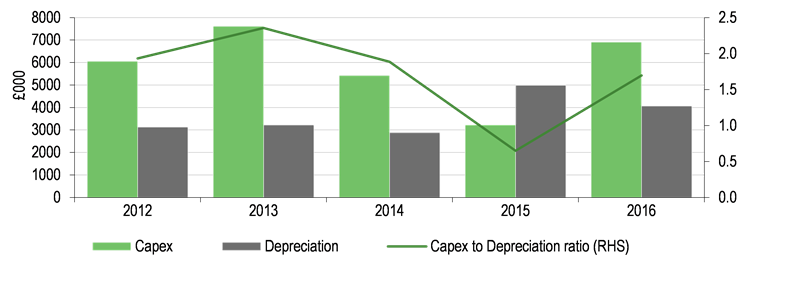
The company’s cash flow is weighted towards the beginning of the year, due to the timing of receipt of partnership income. Significant expenses are incurred in Formula One at the beginning of the year when the team is building the new season’s car and creating an adequate stock of spare parts for the new design. In 2016 it deferred the submission of its R&D expenditure credit into the following financial year to lower the costs of the claim process. This means that £6m of cash from 2016 will be received in 2017. As a result, year-end net debt is abnormally high at the end of 2016. Free cash flow is erratic year-on-year and is highly dependent on how much investment is required in the Formula One business (see Exhibit 8).
The company has a revolving credit facility of c £10m in order to manage its working capital cycle.
The company is limited in its ability to raise capital from the markets due to its small free float. However, management does not see this as an issue because it would only need to raise capital to finance a new facility, and their current one at Grove in Oxfordshire is more than adequate. The company is self-sustaining financially and has no ambition for that to change.
The group’s stated capital management objectives are:
■
Invest in long-term growth opportunities available to the group
■
Ensure the group’s ability to continue as a going concern
|
Exhibit 9: Capex and depreciation, 2012-16 |
|
|
Source: Company accounts |
Valuation
Williams is the only directly quoted Formula One motor racing team in the world, although some teams are part of much larger quoted parent companies. There are also very limited more general motorsport teams. Therefore, creating a valuation peer group for Williams requires some imagination.
As the Formula One operations appear to be the focus of the capital allocation, sporting brands is one alternative although the range of activities here is highly varied. Football clubs such as Borussia Dortmund or Manchester United display some of the same traits as Williams in terms of volatile profitability, dependence on results and global marketing. However, since the Formula One operation is essentially cash consumptive this has to be an exercise in valuing the brand directly, and that is not easy. There is an argument that you could relate it to the valuation placed on Formula One by Liberty Media (£3.3bn), or indeed the standing in terms of concession rights, but this would be highly subjective. It is possible to look at the premium sports brands in automotive car manufacturing including Ferrari or Porsche, but again these are dominated by production models.
Intrinsically WAE could be compared to other engineering consultancy and specialised production companies such as Ricardo, but this would require a view that a self-sustaining capital allocation could be attributed to the operations. At present it is not clear that this is the case, although a change in the commercial rights structure of Formula One to provide a more consistent financial return, possibly along the lines of financial fair play in soccer, could make this a more viable proposition.
Sensitivities
Williams Grand Prix Holdings is highly sensitive to two company specific issues:
■
Sponsorship income: Williams Formula One is heavily reliant on a small number of quite large sponsorship contracts. They are all due to roll off at different times which mitigates the risk somewhat, but if Williams were to lose all its major sponsors within a short period of time a significant portion of its revenue stream would be lost. The propensity of companies to sponsor Formula One is dependent on the macroeconomic environment, the status of Formula One and the team’s on track performance.
■
Track performance: The Constructors’ Championship provides a very quantitative method of measuring team performance. Where Williams comes in the Championship affects not only its commercial rights income, but also its ability to attract sponsors, talented drivers and engineers. As discussed earlier, success tends to breed success and the opposite also holds true. The significant loss the company made in 2014 was in order to break out of a downward period of track performance.
Sponsorship income and track performance have a knock effect on another crucial area of the
business:
■
Recruitment and retention: Williams Formula One is a people business. How fast the racing cars go on the track is dependent on the quality of engineers that have designed them and the calibre of drivers at the wheel. However, Williams has significant competition in the south of England when trying to attract and retain high quality people. Given that Formula One is a global sport, it is astonishing that seven of the 10 current teams are located within what is known in the industry as ’Motorsport valley’. Red Bull, Force India, Williams, Mercedes, Renault, Haas and McLaren are all within about fifty miles of each other. The key pinch point is engineers. Williams tries to mitigate against individuals being headhunted by employing them on multi-year contracts. However, the risk of losing people to a competitor is very real, as evidenced by the chief technical officer, Paddy Lowe who has recently returned to Williams after spells at McLaren and Mercedes. Recruitment and retention are easier when the team is performing well.
Looking more widely, Williams Formula One operates under the jurisdiction of the Formula One Group and the Federation Internationale de l’Automobile (FIA) and it is therefore subject to:
■
Regulatory change: As discussed earlier, the new owners of Formula One, Liberty Media are likely to want to make some changes to the sport, in order to make it accessible to a wider audience and to make it more competitive. While the teams are consulted on these changes, Williams is ultimately at the mercy of the organisations running Formula One. Regulatory changes can have positive and negative impacts on Williams.
■
Health and safety issues: Formula One is a highly dangerous sport, and one that is unfortunately often remembered for its rare yet high profile accidents, for example the tragic death of Jules Bianchi following an accident in the 2014 Japanese Grand Prix. Such incidents can lead to regulatory change and safety improvements which can cost the teams money in needing to adapt the cars, but they also have an impact on the public perception of the sport which can affect sponsorship income.
As an expensive sport reliant on sponsorship, Formula One is also exposed to fluctuations in the macro environment, and is particularly sensitive to prolonged periods of financial crisis.
Frankfurt +49 (0)69 78 8076 960 Schumannstrasse 34b 60325 Frankfurt Germany |
London +44 (0)20 3077 5700 280 High Holborn London, WC1V 7EE United Kingdom |
New York +1 646 653 7026 295 Madison Avenue, 18th Floor 10017, New York US |
Sydney +61 (0)2 8249 8342 Level 12, Office 1205 95 Pitt Street, Sydney NSW 2000, Australia |
|
Research: Real Estate
Picton Property Income is an internally managed property company, which has assembled a £624m portfolio diversified by sector, geography and also income concentration. Long-term performance has been strong; its portfolio has outperformed the MSCI quarterly benchmark in the last one, three, five and 10 years. It has also often exceeded its targeted geared IRRs of 10-15%. Last year’s property return of 9.9% was more than double the benchmark. Improving occupancy, rental increases and falling interest costs from debt reduction in FY17 should underpin earnings growth in FY18-19, thereby supporting the dividend yield of over 4%. Despite this track record and yield, Picton trades at a discount to the sector average P/NAV, even after the share price recovery we have seen in the last year.