Last close As at 05/08/2026
GBP2.58
▲ −3.00 (−1.15%)
Market capitalisation
GBP597m
Research: Investment Companies
Henderson Far East Income (HFEL) is managed by Mike Kerley and Sat Duhra, who are genuine income investors. This is evidenced by the trust’s very attractive double-digit dividend yield, which is well above its peer group, and is a ‘natural’ distribution as it is fully paid out of income. HFEL’s managers have been increasing the trust’s allocation to Chinese-listed companies in anticipation of a post-COVID economic recovery in the country; China now makes up around a quarter of the fund. Meanwhile, they have retained an underweight position in Taiwanese and technology stocks, given the limited yields and more demanding valuations.
Henderson Far East Income |
A fully covered 10% dividend yield |
Investment trusts |
17 July 2023 |
Analyst
|
||||||||||||||||||||||||||||||||||||||||||||||||||||||||||||||||||||||||||||||||||||||||||||||||||||||||||||||||||||||||||||||
Henderson Far East Income (HFEL) is managed by Mike Kerley and Sat Duhra, who are genuine income investors. This is evidenced by the trust’s very attractive double-digit dividend yield, which is well above its peer group, and is a ‘natural’ distribution as it is fully paid out of income. HFEL’s managers have been increasing the trust’s allocation to Chinese-listed companies in anticipation of a post-COVID economic recovery in the country; China now makes up around a quarter of the fund. Meanwhile, they have retained an underweight position in Taiwanese and technology stocks, given the limited yields and more demanding valuations.
|
Dividends are an important contributor to HFEL’s total returns |
|
|
Source: HFEL, Edison Investment Research |
Why consider HFEL?
Global investors seeking exposure to a relatively high-growth, attractively valued region, along with a regular income, should consider HFEL. The trust offers a very attractive 10.0% dividend yield (fully covered by income) plus the potential for capital growth. This is a different proposition compared with its four peers in the AIC Asia Pacific Equity Income sector (average yield of 5.8%), with two funds paying dividends out of capital. HFEL’s dividend growth potential is underpinned by: a balanced 50:50 portfolio split between high-yield and dividend growth stocks; the reinstatement of dividends following the reopening of the Chinese economy; potential for increased payout ratios by portfolio companies; and superior earnings growth prospects in Asia compared with other regions.
HFEL’s portfolio is more exposed to a potential rebound in the Chinese economy than its two closest peers, with the trust’s emphasis on Chinese stocks with exposure to domestic consumer demand, such as home appliances, sportswear and equipment, online retail and luxury brands, and financials including insurance and wealth management businesses.
The managers’ focus on companies that can generate sustainable growth in cash flow and dividends, along with the fund’s below-market technology exposure, means that HFEL should be relatively defensively positioned during periods of market weakness, although performance could lag during a strong growth-led bull market. Investors appreciate HFEL’s high dividend yield, which is evidenced by its shares having regularly traded at a premium to NAV since 2007, and it is the highest-rated fund in its peer group (the only one trading at a premium).
Henderson Far East Income is a research client of Edison Investment Research Limited
HFEL: Positioned for Chinese economic recovery
China/Hong Kong weight above the market and higher than close peers’
HFEL’s managers have increased the trust’s Chinese exposure by 8.0pp in anticipation of an improvement in the country’s economy following the lifting of COVID-induced lockdowns, while they reduced HFEL’s Australian exposure by 7.0pp, to just below the market weighting (by taking profits in some of the fund’s former largest positions such as BHP Group and Woodside Energy), see Exhibit 2.
The trust’s combined China/Hong Kong exposure is now slightly above the market weight (32.9% versus 32.6% for the Asia Pacific ex-Japan index), it is meaningfully above its closest Asian equity income peers: abrdn Asian Income Fund (AAIF, 16.3% at end-May 2023) and Schroder Oriental Income (SOI, 26.3% at end-May 2023). HFEL’s managers also expect to benefit from a Chinese economic rebound through overweight exposures in materials and energy stocks (due to a pick-up in demand for commodities); and an overweight exposure to South Korea versus the index (as roughly 50% of the country’s exports are to China).
HFEL remains underweight Taiwan and technology
Compared with AAIF and SOI, HFEL has a lower allocation to Taiwan, and is also underweight technology versus the market. The trust has a lower combined weighting of Taiwan Semiconductor Manufacturing Company (TSMC) and Samsung Electronics versus its peers, as while these companies have positive fundamentals, their dividend yields are only around 2%. HFEL’s overall underweight position in Taiwan is due to the relatively rich valuations in the technology segment of the market (which is where the trust normally focuses). This positioning has recently been detrimental to HFEL’s performance as Taiwanese technology stocks have performed very well due to the hype around artificial intelligence (AI).
However, the trust is better shielded from a potential reversion of the recent very positive sentiment towards technology stocks. Companies with exposure to AI have performed particularly well, even if their earnings are declining, which the managers find frustrating. They expect weak hardware demand, and hence semiconductor demand, over the next one to two years; while AI is driving demand for semiconductors, the managers are not convinced that there is money to be made out of this technology over the next three years.
|
Exhibit 1: HFEL geographic exposure versus Asia Pacific ex-Japan index |
|
|
Source: HFEL, Edison Investment Research |
Exhibit 2: Portfolio geographic changes and active weights (% unless stated)
Portfolio end- |
Portfolio end- |
Change |
Active weight vs Asia Pac ex-Jap index (pp) |
|
China |
23.4 |
15.4 |
8.0 |
(3.3) |
Australia |
16.3 |
23.3 |
(7.0) |
(0.4) |
South Korea |
14.2 |
20.4 |
(6.2) |
2.6 |
Hong Kong |
9.5 |
6.5 |
3.0 |
3.6 |
Singapore |
9.0 |
12.1 |
(3.1) |
6.1 |
Taiwan |
8.0 |
6.3 |
1.7 |
(6.7) |
Indonesia |
6.5 |
4.5 |
2.0 |
4.5 |
India |
4.1 |
N/S |
N/A |
(10.4) |
Vietnam |
3.0 |
2.8 |
0.2 |
3.0 |
Thailand |
2.3 |
3.0 |
(0.7) |
0.2 |
Other |
3.7 |
5.7 |
(2.0) |
0.9 |
Total |
100.0 |
100.0 |
Source: HFEL, Edison Investment Research. Note: N/S is not stated separately. Numbers subject to rounding.
|
Exhibit 3: HFEL sector exposure versus Asia Pacific ex-Japan index |
|
|
Source: HFEL, Edison Investment Research |
Exhibit 4: Portfolio sector changes and active weights (% unless stated)
Portfolio end- |
Portfolio end- |
Change |
Active weight vs Asia Pac ex-Jap index (pp) |
|
Financials |
31.4 |
30.4 |
1.0 |
9.5 |
Real estate |
13.5 |
12.8 |
0.7 |
9.4 |
Telecoms |
10.3 |
16.3 |
(6.0) |
7.7 |
Consumer discretionary |
10.3 |
7.4 |
2.9 |
(1.9) |
Technology |
10.1 |
7.3 |
2.8 |
(15.0) |
Basic materials |
9.0 |
9.6 |
(0.6) |
1.5 |
Energy |
8.0 |
11.6 |
(3.6) |
3.2 |
Utilities |
4.5 |
1.2 |
3.3 |
1.9 |
Industrials |
3.0 |
3.5 |
(0.5) |
(5.8) |
Consumer staples |
0.0 |
0.0 |
0.0 |
(5.3) |
Healthcare |
0.0 |
0.0 |
0.0 |
(5.2) |
Total |
100.0 |
100.0 |
Source: HFEL, Edison Investment Research. Note: Numbers subject to rounding.
High, sustainable and growing dividend
HFEL has a progressive dividend policy and continues to deliver a high dividend yield (now at 10.0%), which is higher than the level of Asian inflation and those available on high-yield corporate bonds in developed economies (for example, the current effective yield of the ICE BofA US High Yield Index is c 8.5%), plus equities are likely to deliver a higher capital return than bonds in an economic recovery. The managers explain that earnings growth in Asia is forecast to exceed that in other regions, with consensus earnings growth (excluding the technology-heavy South Korea and Taiwan) for 2023 at +18%. If this is reflected in valuations, which are relatively attractive in Asia ex-Japan versus the world market (with a one-year forward P/E ratio of 12.6x versus 15.7x, respectively), HFEL could be viewed as a very interesting investment opportunity.
HFEL’s portfolio is a combination of high-yield and dividend growth stocks (currently split around 50:50), which allows for dividend growth over time. Over the last five financial years, HFEL’s dividend compounded at an annual rate of c 2.7% and FY22 marked the 15th consecutive year of increased distributions. Based on the interim dividends already declared in respect of FY24, HFEL’s progressive dividend policy is continuing; the recently announced third interim dividend of 6.10p per share is 1.7% higher year-on-year. While the very high dividends from resource stocks in 2022, due to robust commodity prices, are unlikely to be repeated this year, the managers are confident that any shortfall can be made up elsewhere in the portfolio. This includes the reinstatement of Chinese dividends that were halted during the global pandemic. Also, there is potential for companies to increase their payout ratios given the low level of dividends compared with corporate earnings.
Current portfolio positioning
HFEL’s exposure to Chinese consumer demand
HFEL has considerable exposure to Chinese domestic consumer activity. Luxury goods stocks have performed very well and Kerley expects increased demand for other consumer-facing businesses. The trust has a position in CITIC Securities based on higher stock market activity and growth in its wealth management operations; the manager expects consumers’ savings to be put to work. Other Chinese companies in the portfolio include sportswear businesses Anta Sports, Li-Ning and JD.com, to benefit from the growth in e-commerce, and Midea, which is a white goods manufacturer. Kerley expects a recovery in the Chinese property market but prefers to benefit from this by investing in appliances, as property shares have performed well despite the sector being under the microscope.
So far, the pace of Chinese recovery has been slower than generally expected, although the managers do not want to see a short-lived boom that then tails off over subsequent years. China did not provide the level of financial support during the pandemic that was available in western regions. There has been a savings boost in China but three years of COVID lockdowns, geopolitical concerns and high youth unemployment have sapped confidence. This will take longer to recover than originally thought.
Other changes to geographical exposures
HFEL’s managers recently shifted the portfolio weight from Southern Asia (where they consider valuations to be somewhat demanding) in favour of North Asia. However, the managers have increased HFEL’s Indonesian exposure on a valuation basis. Indonesia is a beneficiary of higher-priced resources and international manufacturers are relocating to the country. It has a large population and low labour costs, while its political environment is relatively stable. There is a new position in Astra International, which is a conglomerate operating in a wide range of industries, including automobiles and financial services. Kerley favours the company’s exposure to the Indonesian consumer and its c 9.5% dividend yield.
At end-May 2023, the main differences in HFEL’s geographical exposures versus the broad Asia Pacific ex-Japan index were overweight exposures in Singapore (+6.1pp) and Indonesia (+4.5pp), with below-index weightings in India (-10.4pp, due to unattractive valuations and low yields) and Taiwan (-6.7pp).
HFEL retains an overweight position in materials and energy
The anticipated Chinese economic recovery in 2023 should benefit energy and mining stocks as China is the largest consumer of commodities and higher demand there should offset weakness elsewhere. Although the managers have reduced HFEL’s exposure over the last six months, it retains overweight positions in the energy and materials sectors, which have been weak due to fears about a recession in the US and Europe.
Some commodities are capacity constrained, including lithium. The trust has positions in Australia-listed IGO and Pilbara Minerals. Australia is a stable lithium producer, but the mineral is difficult to extract. The process requires a lot of water and other resources, and lithium naturally occurs in areas where water is scarce. There is accelerating demand for the metal for battery manufacturing (including for electric vehicles) and other industrial applications. Unsurprisingly, there is high demand for lithium assets; for example, oil producer Exxon Mobil, miner Rio Tinto and auto manufacturers are looking to acquire lithium producers.
Limiting the exposure to a turn in the interest rate cycle
Financials is by far HFEL’s largest sector exposure and the largest overweight exposure versus the index (+9.5pp). The managers have low exposure to commercial banks due to their interest rate sensitivity. Peak interest rates are likely in Asia before other regions, so the benefits to net interest margins from higher rates is likely coming to an end. Recently, the People’s Bank of China trimmed its one-year loan prime rate and five-year rate by 10bp. The trust has a new holding in Ping An Insurance, which is a life insurer that employs a traditional business model where agents knock on doors. Unsurprisingly, Ping An’s business declined during COVID-19, but it has improved following the reopening of China’s economy and is being helped by increased demand for insurance after the pandemic. In China, penetration of insurance products is low, offering Ping An a potentially long growth runway. The managers also favour companies with wealth management operations due to positive industry fundamentals, including brokers and investment banks.
Real estate investments with no exposure to mainland China residential developers
HFEL’s second-largest sector exposure is real estate, which represents a 9.4pp overweight versus the index. The managers favour logistics assets due to the continued growth in e-commerce and the trust’s holdings include Australia-listed Goodman Group and Singapore-listed Mapletree Logistics Trust. Given ongoing problems in the Chinese property sector, it should be noted that HFEL does not own any China-listed property companies, although it has positions in Hong Kong-based property developers (Sun Hung Kai Properties and Swire Properties).
Looking at changes in HFEL’s sector breakdown in the six months to end-May 2023 (Exhibit 4), there was less exposure to telecoms (-6.0pp) and energy stocks (-3.6pp). The sector with the largest weighting increase over the period was utilities (+3.3pp). We also note that HFEL has no allocations to consumer staples and healthcare, which make up 5.3pp and 5.2pp of the index respectively.
HFEL’s top 10 holdings
At end-May 2023, HFEL’s top 10 holdings made up 31.4% of the fund (Exhibit 5), which was a notably lower concentration compared with 37.3% six months earlier; just two positions were common to both periods. Unsurprisingly, given it is the largest sector in the trust’s portfolio by far, four of the top 10 holdings were financial stocks.
Exhibit 5: Top 10 holdings (at 31 May 2023)
Company |
Country |
Sector |
Portfolio weight % |
|
31 May 2023 |
30 Nov 2022* |
|||
Taiwan Semiconductor Manufacturing |
Taiwan |
Technology |
3.9 |
N/A |
Samsung Electronics |
South Korea |
Technology |
3.7 |
N/A |
Macquarie Korea Infrastructure Fund |
South Korea |
Financials |
3.6 |
N/A |
HKT Trust and HKT |
Hong Kong |
Telecommunications |
3.4 |
N/A |
VinaCapital Vietnam Opportunity Fund |
Vietnam |
Financials |
3.0 |
N/A |
Ping An Insurance Group Co of China |
China |
Financials |
3.0 |
N/A |
Bank of Communications |
China |
Financials |
3.0 |
N/A |
Midea Group |
China |
Consumer discretionary |
2.7 |
N/A |
Rio Tinto |
Australia |
Basic materials |
2.6 |
3.0 |
BHP Group |
Australia |
Basic materials |
2.5 |
4.2 |
Top 10 (% of holdings) |
31.4 |
37.3 |
||
Source: HFEL, Edison Investment Research. Note: *N/A where not in end-November 2022 top 10.
Performance: Total returns led by income not capital
There are just five funds in the AIC Asia Pacific Equity Income sector (Exhibit 6). The peers fall into two distinct groups: those investing specifically for income as well as capital growth (HFEL, AAIF and SOI) and those that focus primarily on growth but have high distributions, which may be paid out of capital (JPMorgan Asia Growth & Income and Invesco Asia Trust). HFEL’s focus on higher-yielding companies has negatively affected the rankings of its total returns as lower-yielding Asian stocks have performed relatively better.
As shown in the front-page chart, the majority of HFEL’s shareholder returns over time have come from dividends, which are generally fully covered by income. The trust’s dividend yield is by far the highest in the peer group and is a ‘natural’ yield as none of its distribution is paid out of capital. HFEL’s yield is currently 4.7pp higher than the second-highest yielding fund. This feature is obviously appealing to investors as the trust is the only fund that is trading at a premium and its valuation is meaningfully higher than those of all of its peers.
Exhibit 6: AIC Asia Pacific Equity Income sector at 12 July 2023*
% unless stated |
Market |
NAV TR |
NAV TR |
NAV TR |
NAV TR |
Discount |
Ongoing |
Perf. |
Net |
Dividend |
Henderson Far East Income |
386.6 |
(8.3) |
(8.3) |
(6.5) |
33.3 |
4.0 |
1.01 |
No |
106 |
10.0 |
abrdn Asian Income Fund |
337.5 |
(4.7) |
18.6 |
23.8 |
53.9 |
(11.8) |
0.99 |
No |
110 |
5.3 |
Invesco Asia |
219.9 |
(0.5) |
25.0 |
40.4 |
168.3 |
(10.1) |
0.97 |
No |
102 |
4.5 |
JPMorgan Asia Growth & Income |
326.2 |
(2.4) |
1.1 |
19.7 |
119.8 |
(8.5) |
0.69 |
No |
100 |
4.7 |
Schroder Oriental Income |
633.8 |
(0.5) |
21.6 |
27.8 |
97.7 |
(4.1) |
0.86 |
Yes |
104 |
4.6 |
Simple average (5 funds) |
380.8 |
(3.3) |
11.6 |
21.0 |
94.6 |
(6.1) |
0.90 |
105 |
5.8 |
|
HFEL rank in peer group |
2 |
5 |
5 |
5 |
5 |
1 |
5 |
2 |
1 |
|
MSCI AC Asia Pacific ex Japan |
(5.4) |
(0.8) |
12.1 |
78.7 |
||||||
MSCI AC Asia Pacific ex Japan HDY |
(0.6) |
13.4 |
16.0 |
54.4 |
Source: Morningstar, Edison Investment Research. Note: *Performance data to 11 July 2023 based on ex-par NAV. TR = total return. Net gearing is total assets less cash and equivalents as a percentage of net assets.
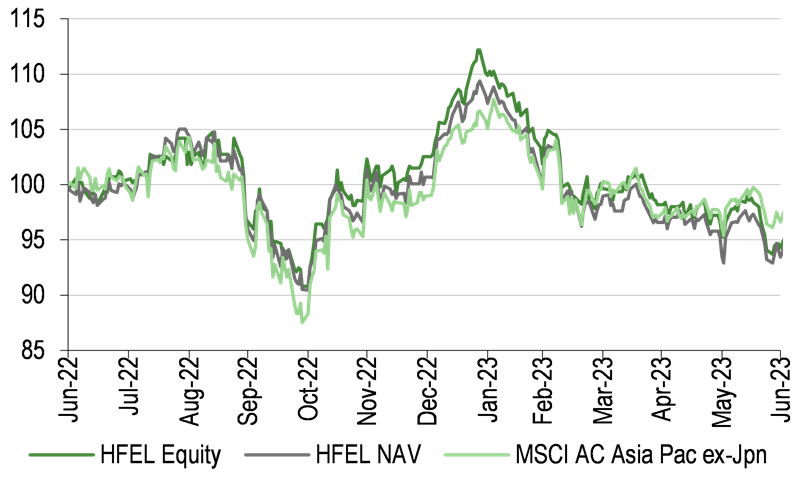
Kerley explains that HFEL’s relative performance had experienced a positive trend from summer 2022 until the third week of January 2023. However, as investors adopted a more bearish outlook for global growth, including in China, the trust’s relative performance deteriorated. This is mainly due to HEFL’s underweight Taiwanese exposure and a large below-market technology weighting. The trust’s overweight exposure to resource stocks has also been detrimental this year, having been beneficial in 2022.
The manager has found the trust’s performance frustrating as the market has been driven by themes rather than company fundamentals, which are the long-term drivers of stock market returns. Kerley comments that investors have leapt from one theme to another: inflation, interest rates, recession and, more recently, AI.
While the Chinese Q123 results season was poor, forward guidance was positive and earnings estimates are being upgraded. Despite this, the Chinese market has de-rated as investors have concerns about domestic consumer confidence and the relationship between China and the US.
Kerley explains that as interest rates rise, high-growth stocks should de-rate as the value of their long-term cash flows is reduced; this occurred in 2022, but is not happening now. Over the last two months the reverse has been true as the stock prices of high-growth companies are rising even as interest rates are still increasing. The manager comments that even if interest rates are peaking, they are not going back to 1% anytime soon, so these share price moves do not make sense. Kerley notes that the bellwether US S&P 500 Index has risen by around 18% so far this year, but excluding the top seven-performing stocks the US market is flat, making it very difficult for active managers to outperform such a narrow market.
|
Exhibit 7: HFEL’s performance to 30 June 2023 |
|
Price, NAV and index total return performance, one-year rebased |
Price, NAV and index total return performance (%) |
|
|
|
Source: Refinitiv, Edison Investment Research. Note: Three-, five- and 10-year performance figures annualised. |
|
Exhibit 8: Share price and NAV total return performance, relative to indices (%)
|
One month |
Three months |
Six months |
One year |
Three years |
Five years |
10 years |
Price relative to MSCI AC Asia Pac ex-Jpn |
(1.6) |
(1.8) |
(5.8) |
(2.4) |
(9.2) |
(14.2) |
(25.1) |
NAV relative to MSCI AC Asia Pac ex-Jpn |
(0.6) |
(2.0) |
(4.9) |
(3.3) |
(8.8) |
(15.5) |
(26.5) |
Price relative to MSCI AC Asia Pac ex-Jpn HDY |
(0.3) |
(3.0) |
(8.4) |
(5.5) |
(17.4) |
(15.6) |
(17.9) |
NAV relative to MSCI AC Asia Pac ex-Jpn HDY |
0.7 |
(3.2) |
(7.5) |
(6.3) |
(17.1) |
(17.0) |
(19.4) |
Price relative to CBOE UK All Cos |
(2.1) |
(4.7) |
(10.2) |
(12.9) |
(28.5) |
(15.7) |
(20.4) |
NAV relative to CBOE UK All Cos |
(1.1) |
(4.9) |
(9.4) |
(13.7) |
(28.1) |
(17.1) |
(21.9) |
Source: Refinitiv, Edison Investment Research. Note: Data to end-June 2023. Geometric calculation.
Exhibit 9: Five-year discrete performance data
12 months ending |
Share price |
NAV |
MSCI AC Asia Pac ex-Jpn (%) |
MSCI AC Asia Pac ex-Jpn HDY (%) |
CBOE UK All Cos (%) |
MSCI AC World (%) |
30/06/19 |
11.2 |
9.3 |
4.9 |
9.4 |
0.3 |
10.3 |
30/06/20 |
(8.2) |
(8.5) |
2.9 |
(8.7) |
(13.6) |
5.7 |
30/06/21 |
9.2 |
10.3 |
24.9 |
14.5 |
21.1 |
25.1 |
30/06/22 |
(6.9) |
(6.7) |
(12.5) |
1.6 |
2.2 |
(3.7) |
30/06/23 |
(5.7) |
(6.5) |
(3.4) |
(0.2) |
8.3 |
11.9 |
Source: Refinitiv. Note: All % on a total return basis in pounds sterling.
Dividends: Progressive distribution policy
The board employs a progressive dividend policy, and HFEL’s annual distributions are generally fully covered by income. An exception was FY21, where the dividend was uncovered for the first time in 10 years; this was due to a higher number of shares in issue, sterling strength and a lower level of Asian dividend growth in 2020. Quarterly dividends are paid in February, May, August and November. So far in FY23, the board has declared three interim payments of 6.0p, 6.0p and 6.1p per share, which are 0.1p per share higher year-on-year. If HFEL’s payments follow the pattern of the prior three financial years, the fourth distribution in respect of FY23 will also be 6.1p per share. This would equate to an annual dividend of 24.2p per share and a 10.1% prospective yield.
The trust’s dividend receipts are heavily weighted to the second half of its financial year. In H123 (ending 28 February), income from investments (c 90% of the total) decreased by 6.9% year-on-year, while income from writing options increased by 24.2%; total income declined by 3.9% compared with H122. This was due to a 4% appreciation in sterling and some Australian companies going ex-dividend in March in 2023 versus February in 2022. Higher option income was a function of increased market volatility, and an additional option was written (at end-H123, HFEL had four open option positions). At the end of the half year the trust had c £26.7m of revenue reserves, which is equivalent to c 0.7x the last annual dividend payment.
Kerley reports that there have not been many income surprises or disappointments so far this year. Last year there were very large regular dividend payments from energy and mining companies due to high commodity prices, which translated into double-digit dividend yields. The manager suggests that with oil prices at current levels energy company dividend yields could still be in a mid to high single-digit range, due to excess profits that will be distributed to shareholders. Kerley believes that any income shortfall this year from HFEL’s resource companies compared with 2022 should be made up from increased income from its Chinese holdings due to higher GDP growth and other parts of the portfolio. Around 30% of the trust’s income comes from its Chinese companies; however, these firms only pay a dividend once a year, making it difficult to forecast HFEL’s income.
|
Exhibit 10: Dividend history since FY17 |
|
|
Source: Bloomberg, Edison Investment Research |
|
|
Research: Industrials
Renewi has announced that trading in Q1 was in line with expectations. As a recycling business, the group is well placed to benefit from the European Green Deal and shift towards a circular economy, while the shares are trading on a rating more reflective of the legacy issues than the future opportunities.