Orexo
Written by
Orexo |
Short-term pain; on the cusp of longer-term gains |
FY15 results and corporate outlook |
Pharma & biotech |
17 February 2016 |
Share price performance
Business description
Next events
Analysts
|
||||||||||||||||||||||||||||||||||||||||||||||||||||||
Zubsolv sales of SEK417m were up 83% on FY14, against overall 7.8% market growth. As expected, its 6.4% market share at end FY15 was eroded in January due to the loss of favourable reimbursement status at CVS Caremark. Nevertheless, a 5% price rise, effective February, coupled with a targeted sales effort and stronger marketing message, should help drive sales, particularly as Zubsolv’s reimbursement position improves. With changes in federal legislation on the cusp of significantly increasing the available market, expanding use of medical-assisted treatment and increasing the number of prescribers, Zubsolv remains well positioned. Global expansion with a potential new partner represents further upside.
Year end |
Revenue (SEKm) |
PBT* |
EPS* |
DPS |
P/E |
Yield |
12/14 |
570 |
(53) |
(1.6) |
0.0 |
N/A |
N/A |
12/15 |
643 |
(191) |
(5.7) |
0.0 |
N/A |
N/A |
12/16e |
690 |
(115) |
(3.2) |
0.0 |
N/A |
N/A |
12/17e |
957 |
28 |
0.6 |
0.0 |
73.3 |
N/A |
Note: *PBT and EPS are normalised, excluding intangible amortisation, exceptional items.
Rising to a new challenge in 2016
Focus is on mitigating the impact of the loss of exclusive status at CVS Caremark restricted plans (c 10-15% of Rx). Longer term this should be more than offset by marketing and education initiatives and US legislative change. Positively, market share is growing in new patients and in the large/profitable commercial segment.
US government action: A significant inflection point
US Department of Health and Human Services (HHS) plans to expand access to therapy by doubling the number of prescribers, narrowing the gap between need and availability and significantly expanding the current >$2bn US opioid dependence market. This reinforces our long-term Zubsolv sales forecasts. Further details are anticipated during H116.
Prospect of an ex-US partnership
Deal discussions for Zubsolv ex-US could conclude in H116. Various European authorities have agreed the regulatory pathway; PK studies are underway. Filing in 2016 could mean approval from 2017, subject to reimbursement. International opioid dependence markets lag the US in terms of development, but represent a c5x larger patient pool; this is attracting the attention of larger players.
Valuation: SEK4.2bn or SEK123/share on a DCF basis
Our updated valuation of SEK4.24bn or SEK123/share (previously SEK5.8bn and SEK169/share) reflects decreased Zubsolv sales expectations for 2016-18 offset by lower future R&D spend and rolling forward our valuation. New near-term forecasts better reflect the effect and likely timing of key factors affecting Zubsolv sales in the near- to mid-term. We continue to have confidence in Orexo’s initiatives to secure market share gains via improved market access which, coupled with federal changes, are sources of potential upside, as is an ex-US deal on Zubsolv or OX51.
Investment summary
Company description: Specialist focus on addiction
Orexo AB, an emerging Swedish speciality pharmaceutical company founded in 1995, is a product-based drug delivery company with a focus on addiction and pain and expertise in reformulation technologies (in particular sublingual formulations). It has 90 employees (excluding the c 75-strong inVentiv sales force), US commercial operations in New Jersey and a Swedish R&D facility. Orexo has three marketed proprietary drugs. Core drug Zubsolv (opioid dependence) was launched in the US in September 2013, where it is sold by Orexo through a dedicated contract field force. Abstral (cancer breakthrough pain) and Edluar (insomnia) are sold by partners. Orexo is actively seeking partners for Zubsolv ex-US and Phase III-ready acute pain programme OX51; it also has a pipeline of reformulations of approved compounds and a collaboration project with Astra Zeneca. It adopted the name Orexo in 2003 and listed on NASDAQ-OMX Stockholm in November 2005; raising SEK333m gross (3.7m shares at SEK90). Subsequent equity raises include SEK250m in June 2011 (6.6m shares at SEK38) and SEK346.3m in September 2014 (2.5m shares at SEK139).
Valuation: SEK4.24bn represents significant upside potential
We value Orexo at SEK4.24bn or SEK123/share ($505m or $14.7/share) based on a DCF out to 2030, assuming a standard 10% WACC, a long-term tax rate of 30% after 2016 and no terminal value. Key Zubsolv assumptions are a 25% peak market share (equivalent to peak gross sales of around $650m) of a growing c $2bn market and an average 35% rebate. We also include a modest revenue contribution from global Abstral and Edluar royalties until 2020. We estimate a long-term gross margin of 85% on Zubsolv, with the operating margin trending to 50% in the long term. We do not explicitly value the ex-US Zubsolv opportunity, Orexo’s technology platform and R&D pipeline (eg OX51); however, we highlight that Orexo is evaluating partners for the wider commercialisation of Zubsolv and further development of OX51.
Financials: Funded to sustainability
At end-FY15, cash and equivalents were SEK198m (net cash of SEK296m), which is ample to fund working capital requirements for Zubsolv commercialisation and expansion until sustainability is reached (in 2018 as per our model). Zubsolv is the main component of revenues: sales grew 83% to SEK416.7m (FY14: SEK228.0m). Our revised near-term Zubsolv forecasts (FY16: SEK578m, FY17: SEK957m) better reflect the effect of the CVS Caremark loss and Rx trends over January, a 5% price rise and a competitive background of aggressive rebating to win market share. In the mid-term, we continue to have confidence in Orexo’s initiatives to drive market share gains through improved market access, but this will be from a lower base and more modest trajectory until new large contracts are secured. We still anticipate growth over 2015, continuing into 2017 and 2018. Federal changes could expand the market and provide a significant boost to sales longer term.
Sensitivities: Zubsolv execution risk remains
Orexo is subject to various sensitivities common to speciality pharmaceutical companies, including commercialisation, manufacturing and financing risks. Execution risk is a key sensitivity in relation to Zubsolv: the outcome of reimbursement discussions, impact of physician education initiatives and the evolving competitive landscape could have a significant bearing on Zubsolv’s sales trajectory, peak sales potential and ultimate market share gains. Various factors could impact on our valuation, either through their influence on Zubsolv’s market penetration (eg reimbursement, pricing and competition) or on operating margins (cost of promotion, revenue split between commercial and public plans, level of rebates). An ex-US partnership on Zubsolv or OX51 could represent upside.
Short-term pain ahead of long-term legislative gains
Zubsolv sales of SEK417m were an 83% increase on the prior year against 7.8% growth in the overall buprenorphine/naloxone market. Disappointing sales in the first half of the year missed management and market expectations; although H2 saw a renewed impetus. Mitigating the impact of the loss of exclusive status at CVS Caremark restricted plans (previously 10-15% of prescriptions) from January presents a new challenge for the start of 2016, although longer term this should be more than offset by Orexo marketing initiatives and a potentially seismic shift in market dynamics. With this in mind we have revised our near-term forecasts downwards, now forecasting SEK578m of Zubsolv sales in 2016, rising to SEK957m in 2017.
US government action and changes to legislation represent a significant inflection point; expanding access to medical-assisted treatment by increasing the number of prescribers, over time narrowing the gap between the need for treatment and its availability. More clarity on timelines is expected in the coming months. In the meantime, competitive dynamics continue to evolve. Performance of the incumbent, Indivior’s Suboxone film, remains strong, BDSI’s Bunavail was a new market entrant in Q415, and six generic tablets are now on the market. Nevertheless, Zubsolv is maintaining its overall position and increasing market share particularly with new patients and in the largest and more profitable commercial segment. A 5% price rise effective from February coupled with a targeted sales effort and stronger marketing message should help drive sales particularly as Zubsolv’s reimbursement position improves at a number of commercial plans.
Longer-term Zubsolv sales will benefit from the US legislative change, and also further afield as the conclusion of partnering negotiations for ex-US rights, potentially by H216, paves the way for global expansion with international regulatory filings and launches.
Zubsolv performance to date
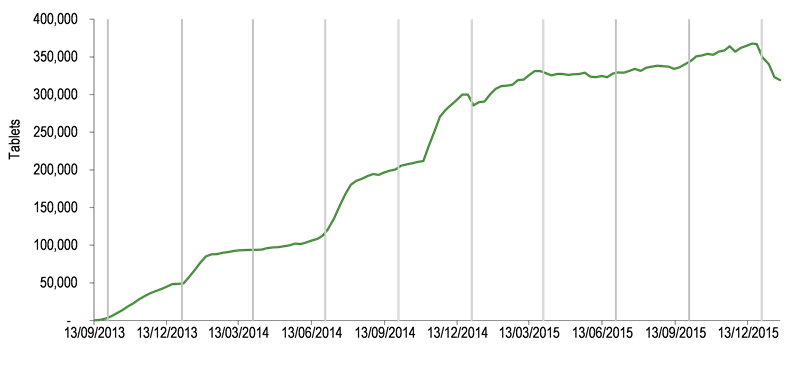
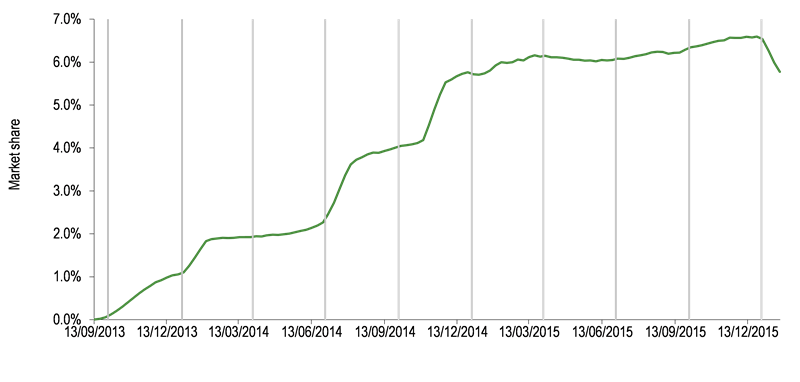
Zubsolv’s market share continues to increase, although the trajectory has slowed. It exited 2015 with a 6.4% market share by volume, flat on a Q315, which benefitted from stocking effects, but higher than the 5.6% volume share at end 2014 (Exhibits 1 and 2). Sales over the year were aided by currency and an improved gross:net sales ratio over the latter half, due to lower rebating and a changing payer mix. Short-term, the CVS Caremark loss is likely to impact the gross:net negatively.
|
Exhibit 1: Zubsolv tablet volumes (four-week average) |
Exhibit 2: Zubsolv market share (four-week average) |
|
|
|
Source: Wolters Kluwer, Bloomberg. Note: Gridlines separate quarters |
|
Exhibit 1: Zubsolv tablet volumes (four-week average) |
|
|
Source: Wolters Kluwer, Bloomberg. Note: Gridlines separate quarters |
|
Exhibit 2: Zubsolv market share (four-week average) |
|
|
Source: Wolters Kluwer, Bloomberg. Note: Gridlines separate quarters |
Zubsolv continues to make gains in the commercial segment (market share now 9.7%); this is the largest and one of the more profitable segments, hence traction here is key. A summary of the dynamics in each of the three market sectors is shown in Exhibit 3. Share has remained stable in the public segment (with the highest rebates), and has been maintained in the highly profitable cash segment, helping to improve the gross:net sale ratio. Orexo remains most focused on the commercial segment, the largest of the market. Gains continued to be made in the absence of any new agreements, suggesting physician and patient acceptance in this key segment.
Exhibit 3: Overview of the main market segments
Commercial |
Public |
Cash & vouchers |
|
Four-week average market share |
|||
At end December 2014 |
7.3% |
4.3% |
5.3% |
At end June 2015 |
8.6% |
3.4% |
4.9% |
At end September 2015 |
9.3% |
3.5% |
5.3% |
At end December 2015 |
9.7% |
3.7% |
5.2% |
% of total market volume |
42% |
40% |
18% |
% of Zubsolv sales |
62% |
23% |
14% |
Rebating |
Low-medium |
High |
Low |
Source: Orexo estimates
Swings and roundabouts for Zubsolv 2016 market share
Zubsolv sales and market share in 2016 and beyond will be affected by a number of important, albeit in the longer-term offsetting, factors. The negatives (loss of exclusive status at CVS Caremark1) will outweigh the positives in H116, although longer-term Orexo should be in a better position as internal initiatives (including a 5% price rise and field force targeting) as well as prospective US legislative changes strengthen both Zubsolv’s competitive position and more broadly increase the demand and therefore the potential market for medical-assisted opioid dependence therapy.
From January 1 2016, Zubsolv lost exclusive status at CVS Caremark restricted plans (a plan that is more highly controlled with less product choice for patients; typically this would be a cheaper insurance programme) and preferred branded status in other plans. Consequently, Zubsolv remains available to many, but not all, CVS members.
The CVS Caremark loss, a financial decision based on more aggressive rebating by competitors, is not the sole factor that we expect to depress sales in Q116. A trend has been apparent over the past four years whereby consistently lower volumes and value of bup/nal products have been prescribed in Q1 vs the preceding Q4. This is an artefact of stocking effects due to the insurance dynamic, whereby patients tend to have to pay more out of pocket early in the year while reimbursement admin is being processed whereas later in the year prescriptions are fully reimbursed. This is another reason behind our expectation of a stronger H2 in 2016 for Zubsolv.
By H216 the scale of the impact of CVS Caremark will be apparent, Orexo initiatives should begin to bear fruit and there may be more clarity on the scope of US government plans to increase access to treatment for opioid dependence and the timing for implementation.
Reimbursement update: CVS loss, other PBMs come on line
As previously flagged, the immediate impact of the CVS Caremark loss will depress Q116 numbers, although the precise impact longer term will depend on the individual formulary decisions of the 200+ insurers covered under this umbrella agreement and their speed of implementation. At the time of announcement in August 2015, Orexo estimated that these changes could affect 10-15% of Zubsolv gross sales, and data to end January suggest the loss was c11% vs Q4. However, to date, two large CVS Caremark accounts have confirmed their intention to keep Zubsolv reimbursed (FEHP in parity with Suboxone, and CDPHP as exclusive from March 2015).
Orexo’s various initiatives to mitigate this loss will take longer to play out. In particular, new PBM agreements (including framework agreements with Managed Medicaid) have the potential to offset losses resulting from the CVS change in the mid-to longer term. These umbrella agreements will offer Orexo access to a number of insurance plans, including with large insurance companies. Negotiation with these individual companies will take time and so these agreements will not result in an immediate Zubsolv uptick, but more likely a gradual increase in share. We would expect Orexo to announce the conclusion of negotiations/new wins with large players in future.
Seeking a competitive edge: Induction label, broadest doses
Since initial launch in September 2013, Orexo has continued to invest in label extensions (for induction therapy and maintenance) and new doses of Zubsolv to meet the spectrum of medical need and to seek a competitive edge. This strengthens the marketing message, but also enables Orexo to strengthen its IP around Zubsolv (a new patent was granted in 2015). The Zubsolv field force is now able to talk about whole treatment phase, from the start or induction of therapy through maintenance, to potential tapering off with lower doses. We believe that in the longer term this should have a positive impact on Zubsolv’s positioning and uptake in the market.
Approval of the induction label in August last year helps the sales force facilitate dialogue with physicians, providing a much simpler message; that Zubsolv can be used to initiate and maintain treatment. This is important as rather than trying to switch patients to Zubsolv after induction, de novo patients can now be initiated immediately on Zubsolv, removing some of the perceived complexity surrounding treatment by new physicians.
With five dose strengths available and an additional low dose filed with the FDA (approval expected Q416), Zubsolv has the broadest range of doses on the market (Exhibit 4). This could be a key differentiator over the competition. The variety of dose levels has compliance benefits as it enables intended once daily use as per the FDA label and also minimises diversion, while low doses help meet patient need for dose tapering to achieve abstinence or stabilisation on a lower dose.
Exhibit 4: Available dose levels across the bup/nal market
Zubsolv |
Suboxone film |
Bunavail |
Generics |
11.4mg |
- |
- |
- |
8.6mg |
12mg |
6.3mg |
- |
5.7mg |
8mg |
4.2mg |
8mg |
2.9mg |
4mg |
2.1mg |
- |
1.4mg |
2mg |
- |
2mg |
Undisclosed dose filed Q415 |
- |
- |
- |
Source: Orexo. Note: Ordered by buprenophine dose bioequivalence with Zubsolv
We note that stocking in of the more recently approved doses by wholesalers (as well as current rebate levels) will delay the full impact of a 5% price increase for Zubsolv, implemented in mid-January and coming into effect in February, that brings pricing back in line with Suboxone film. The benefit to Orexo of this price rise should begin to flow through later in 2016 once prescription demand catches up with stocking.
RESOLV data expected soon: Formalising the treatment paradigm?
Data from the RESOLV (Retrospective Evaluation of Zubsolv Outcomes – A Longitudinal View) study should also provide additional impetus to the marketing effort. This >1,000-pt registry study is now fully recruited and is expected to render first data towards the end of Q116. Study design is not typical as it does not have a defined primary or second endpoint; rather it has been designed to collect real world data on what the important factors are in determining clinical outcomes (ie treatment and psychosocial factors such as patient and prescriber characteristics, care settings, behavioural therapies). This data will be invaluable in providing additional insight to benefit both the sales process and physician education. It could also inform the characterisation of a clinical approach and creation of more formal guidelines to guide treatment practice with Zubsolv products.
Spreading the message: A targeted marketing effort
New states and regional players have begun reimbursing Zubsolv, leading to geographic shifts in coverage. Zubsolv is now also doing well in the north-eastern US as well as continuing to capture market share in central and southern states where it has historically had a strong position. The field force continues to be preferentially deployed in regions where the reimbursement position is favourable, with a focus is on the higher profit segments (commercial and cash). Zubsov has shown several months of week-on-week growth in the cash and commercial market segments, where physician choice is the main driver of prescriptions and there is less rebating.
Nevertheless, Orexo also needs to improve its position in the public segment by securing larger agreements. It currently has access to c 40% of patients in this segment. While rebating levels will be higher (depressing the gross:net) this segment is associated, albeit not exclusively, with key opinion leaders/high prescribing physicians and significant volume. Prescription volume can have a significant financial impact on a number of fronts: higher volumes would flow through into lower COGS and better wholesaler terms, and also provide an advantage in reimbursement negotiations, particularly for exclusive agreements where price and volume are both parts of the equation.
A key priority for Orexo in 2016 is to grow market share. Active promotion has been successful in driving Zubsolv sales, and there has been a trend towards taking greater market share when the market is growing (ie a disproportionate percentage of new patients are being prescribed Zubsolv). Consequently, Orexo is preparing to invest more heavily into promotion once there is movement on a federal level.
US government seeks to increase access to treatment
Plans announced by the US Department of Health and Human Services (HHS) to increase access to treatment for opioid dependence2 remains the most significant industry wide development. This has the potential to expand the whole US opioid dependence market and thus the opportunity for Zubsolv. After many years of discussion and increased awareness, it seems that concrete measures are now going to be put in place, with more details anticipated during H116.
The need for opioid dependence therapy continues to exceed the proportion of dependent patients actually treated. Improving access to medication-assisted therapy by increasing the number of physicians authorised to prescribe buprenorphine and the number of patients they can individually take under their care should help narrow this gap. Presdient Obama has also outlined goals to double the number of physicians from 30,000 to 60,000 who are authorised to prescribe buprenorphine (currently around 6,000 physicians are active in treating opioid dependence, each with a 100-patient cap, severely limiting access to treatment). The first step is for the submission of action plans within 90 days from each of healthcare related agencies to identify current barriers to medical treatment.
If these goals are realised, it could significantly expand the current >$2bn US opioid dependence market. Access to treatment has increased linearly over the past decade; however, these federal initiatives would be an important inflection point, and while the impact will not be immediate, they serve to reinforce our long-term Zubsolv sales forecasts.
Partnership potential for Zubsolv and OX51
Significant progress in partnering discussions for ex-US rights to Zubsolv and for pain programme OX51 during 2015, mean that the first deal is in sight. Orexo’s negotiations are at a late-stage and it expects to secure a contract in H116 for an international ex-US commercialisation partner.
Zubsolv ex-US market size and dynamics attractive to larger players
Opioid addiction is a developed country problem, with growth driven by liberal prescription of opioids for pain relief and increased illegal opioid abuse. Like the US, only a small proportion of dependent individuals are diagnosed internationally, with even a smaller proportion treated; however, the potential patient pool is c 5x larger3 and international markets lag the US in terms of development. Hence there is opportunity to develop and grow the market for medical-assisted treatment for opioid dependence, and this is attracting the attention of larger players. The fragmented nature of the European market means that Orexo’s ideal partner would have a broad reach and resources to take a leadership role with Zubsolv in this.
The number of opioid dependent individuals is estimated at 20 million ex-US vs five million in the US. In the US only two million of these are currently diagnosed, and of these, 750,000 are treated.
Zubsolv regulatory pathway clearer: Potential to file in Europe this year
Orexo has completed its assessments of regulatory requirements and IP landscapes of various territories in Europe and the rest of the world, and has agreed the final development programme agreed with regulatory authorities in Sweden, the UK and Germany. In Europe, additional PK bioequivalence studies are needed since Suboxone tablets in this region differ from those that had been marketed in the US; these studies are underway and due to complete in H2. Furthermore, given Suboxone tablet data exclusivity until 2016 this would be the earliest timing for Zubsolv submission in Europe, with approval possible one year later. Launch would be contingent on completion of reimbursement decisions, which have varied timelines in different EU member states.
OX51: Narrowing the focus given broad potential
Partnership discussions for OX51, a sublingual tablet formulation of short-acting IV analgesic alfentanil, are at an earlier stage, although there is an open dialogue with several interested parties. Further due diligence is required to assess the right indication for Phase III development as potential applications are wide ranging, and this will inform the profile of the optimal partner. In tandem, Orexo has completed manufacturing scale up for Phase III so is well prepared.
Alfentanil has a broad spectrum of potential use and is suited to providing rapid short-term pain relief for short procedures (eg prostate biopsies, relocation of fractures, minor surgery, obstetrics/gynaecology), minimising the need for general or local anaesthesia. Prostate biopsies would be the least risk regulatory pathway to pursue given existing positive Phase II data in this indication; however, this would limit the market potential. To maximise commercial potential, the focus is now on defining what the optimal Phase III programme would look like (in terms of design, geographic reach and indication), and what data will need to be collected to facilitate favourable reimbursement.
Wider early-stage pipeline opportunities remain under wraps
Orexo has also made modest investment into establishing technical proof of principle in a number of early-stage drug delivery projects in addiction medicine. These are presently undisclosed and little is known about their nature as Orexo is working to secure the necessary IP with patent filings. However, we expect that more information will be forthcoming from late summer onwards.
Sensitivities
Orexo is subject to various sensitivities common to speciality pharmaceutical companies, including commercialisation (pricing, reimbursement, uptake and competition), manufacturing and financing risks. Key sensitivities relate to execution risk in relation to Orexo’s main value driver, Zubsolv, where uncertainty and operational risk surrounding the sales trajectory and ultimate market share gains remains. Exhibit 5 outlines our SWOT analysis for Zubsolv.
Our valuation is based on our estimates for Zubsolv’s net price (ie after co-pay or other discounts) and penetration in the US, which we believe are reasonable. The outcome of ongoing reimbursement discussions with payers is a key sensitivity, with significant bearing on Zubsolv’s sales trajectory and peak sales potential in the US. Various factors could have an impact on our valuation, either through their influence on Zubsolv’s market penetration (eg reimbursement, pricing, competition) or on operating margins (cost of promotion, revenue split between commercial and public plans, rebating). Fluctuations in the US$/SEK FX rate may also impact profitability and valuation as the majority of revenues are US$ denominated while costs include a SEK component. We also highlight that, pending a partnership, we do not yet explicitly value the ex-US opportunity.
Non-Zubsolv related sensitivities include the performance of Abstral in Europe and the US, and potential approvals and launches in other regions. Also, we do not value the technology platforms and early-stage R&D pipeline/collaborations, including OX51, which could represent upside.
Exhibit 5: Zubsolv SWOT analysis
Strengths |
Weaknesses |
|
■ Bioequivalent to Suboxone, but at a 29% lower buprenorphine dose. ■ Broadest dose range in market: approved for both induction and maintenance therapy, enables intended once daily use, potential to minimise diversion. ■ Lower abuse potential than alternatives: contains less buprenorphine (8.6mg, 5.7mg, 2.9mg or 1.4mg) than Suboxone Film (12mg, 8mg, 4mg or 2mg) and has a higher class of child-resistant packaging (F1 vs F2). Generic tablets have highest abuse potential (supplied in a bulk tablet bottle). Diversion with Suboxone could be payer driver for reimbursement. ■ Preference data: comparator data vs Suboxone (tablet and film) presented at ASAM 2013; further supportive data from the ISTART and 007 studies. ■ New clinical data: confirms no clinical or pharmacological disadvantage to using Zubsolv instead of the incumbent buprenorphine-based therapies. ■ Solid reimbursement position in commercial and cash segments. ■ Exclusive reimbursement position maintained at key plans: Zubsolv has exclusive status at UHG (commercial) and Wellcare (public). ■ Formulation expertise: accelerated disintegration time, reduced tablet size, improved taste (menthol) and mouth feel. Generics have similar composition to Suboxone tablet and the same actively disliked citrus taste. |
■ Current co-pay assistance levels: reimbursement parity with Suboxone Film but while co-pay levels are dropping, use of co-pay assistance programmes remains high. Level of patient co-pay (ie the out-of-pocket expense paid by a patient) is important. ■ Patient and physician loyalty to Suboxone (and Indivior): Reckitt Benckiser (Indivior’s forerunner) was instrumental in building awareness, developing and initially funding the opioid dependence treatment market. ■ Need for continued infrastructure investment: still building the Zubsolv brand and providing infrastructure support for prescribers and payers (make it easier to treat opioid dependence). Further investment needed into sales reps in new regions following market access wins. ■ Prescriber caution: patient experience is key. Physicians want to get own experience and prescribe initially to a small number of patients. ■ Resistance to switching by doctors: there is little switching, particularly in the case of well-treated patients. Clinical data on switching collected by Orexo may increase physician confidence in switching to Zubsolv. ■ Different dosing to Suboxone: despite identical bioavailability, the perception barrier needs to be overcome for patients to accept switching and be confident in efficacy. (May be overcome by dose range.) ■ Pricing: currently at a c 20% lower price to generics and on par with Suboxone Film. 5% price rise implemented mid-January 2016. |
Opportunities |
Threats |
|
■ Underserved and dynamic market: only two million of the estimated five million opioid-dependent individuals are currently diagnosed and, of these, 750,000 are treated. 25% patient turnover by quarter; average six months on therapy. ■ Government policy: addiction medicine is a focus area; Obama and the HHS have committed to reviewing current legislation to improve access to treatment and increase the patient cap to shorten treatment waiting lists. ■ Potential to develop treatment paradigm: research into treatment guidelines/documentation; tapering off (lowering dose); early identification of pain patients likely to become opioid dependent. ■ RESOLV study: >1,000pt retrospective registry study fully enrolled; will provide insight into factors (treatment and psychosocial) impacting clinical outcomes, thus informing guidelines for treatment practice. ■ Addressing the cause: dependence predominantly results from high-dose pain relief; buprenorphine is an effective analgesic, thus has the potential to assist in decreasing the dose of other opioids, helping dependence issues to be bypassed; potential to improve documentation for Zubsolv to address the continuing pain part of the market. ■ Other territories (in particular Europe and China): opioid addiction is a developed-country problem. Growth is driven by increased/liberal prescription of opioids for pain relief and illegal opioid abuse. |
■ Strength of Suboxone brand: high brand recognition with Suboxone and the brand name is used interchangeably with generics. ■ Competitor rebating strategies: loss of CVS Caremark was based purely on a financial decision with competitors offering more aggressive rebating. Volume is an important part of the equation. ■ Broader focus on addiction medicine by Indivior: spun-off from RB Pharmaceuticals (Indivior) Dec 2014, with renewed focus on investment in promotion of Suboxone and the development of complementary products. ■ Increased direct competition: BDIS’s Bunavail (bup/nal film) launched November 2014. In addition, Actavis filed an ANDA for generic Zubsolv in August 2014; and six ANDAs for generic bup/nal film have been filed by IntelGenex/Par Pharmaceuticals (July 2013), Actavis (Nov 2013), Teva (Oct 2014), Mylan (Sept 2015), Sandoz (Oct 2015). The originators are suing for patent infringement; hence the above ANDAs are subject to a 30-month stay. This stay expired in February 2016 for IntelGenex/Par and Actavis. ■ Depot injections: Braeburn/Titan’s Probuphine buprenorphine implant received positive FDA panel vote (Jan 2016); PDUFA date pending. Indivior and BDSI are both developing once-monthly depot formulations of buprenorphine that could reach the market in 2018+. These have potential patient adherence and diversion benefits. |
Strengths |
|
■ Bioequivalent to Suboxone, but at a 29% lower buprenorphine dose. ■ Broadest dose range in market: approved for both induction and maintenance therapy, enables intended once daily use, potential to minimise diversion. ■ Lower abuse potential than alternatives: contains less buprenorphine (8.6mg, 5.7mg, 2.9mg or 1.4mg) than Suboxone Film (12mg, 8mg, 4mg or 2mg) and has a higher class of child-resistant packaging (F1 vs F2). Generic tablets have highest abuse potential (supplied in a bulk tablet bottle). Diversion with Suboxone could be payer driver for reimbursement. ■ Preference data: comparator data vs Suboxone (tablet and film) presented at ASAM 2013; further supportive data from the ISTART and 007 studies. ■ New clinical data: confirms no clinical or pharmacological disadvantage to using Zubsolv instead of the incumbent buprenorphine-based therapies. ■ Solid reimbursement position in commercial and cash segments. ■ Exclusive reimbursement position maintained at key plans: Zubsolv has exclusive status at UHG (commercial) and Wellcare (public). ■ Formulation expertise: accelerated disintegration time, reduced tablet size, improved taste (menthol) and mouth feel. Generics have similar composition to Suboxone tablet and the same actively disliked citrus taste. |
Weaknesses |
|
■ Current co-pay assistance levels: reimbursement parity with Suboxone Film but while co-pay levels are dropping, use of co-pay assistance programmes remains high. Level of patient co-pay (ie the out-of-pocket expense paid by a patient) is important. ■ Patient and physician loyalty to Suboxone (and Indivior): Reckitt Benckiser (Indivior’s forerunner) was instrumental in building awareness, developing and initially funding the opioid dependence treatment market. ■ Need for continued infrastructure investment: still building the Zubsolv brand and providing infrastructure support for prescribers and payers (make it easier to treat opioid dependence). Further investment needed into sales reps in new regions following market access wins. ■ Prescriber caution: patient experience is key. Physicians want to get own experience and prescribe initially to a small number of patients. ■ Resistance to switching by doctors: there is little switching, particularly in the case of well-treated patients. Clinical data on switching collected by Orexo may increase physician confidence in switching to Zubsolv. ■ Different dosing to Suboxone: despite identical bioavailability, the perception barrier needs to be overcome for patients to accept switching and be confident in efficacy. (May be overcome by dose range.) ■ Pricing: currently at a c 20% lower price to generics and on par with Suboxone Film. 5% price rise implemented mid-January 2016. |
Opportunities |
|
■ Underserved and dynamic market: only two million of the estimated five million opioid-dependent individuals are currently diagnosed and, of these, 750,000 are treated. 25% patient turnover by quarter; average six months on therapy. ■ Government policy: addiction medicine is a focus area; Obama and the HHS have committed to reviewing current legislation to improve access to treatment and increase the patient cap to shorten treatment waiting lists. ■ Potential to develop treatment paradigm: research into treatment guidelines/documentation; tapering off (lowering dose); early identification of pain patients likely to become opioid dependent. ■ RESOLV study: >1,000pt retrospective registry study fully enrolled; will provide insight into factors (treatment and psychosocial) impacting clinical outcomes, thus informing guidelines for treatment practice. ■ Addressing the cause: dependence predominantly results from high-dose pain relief; buprenorphine is an effective analgesic, thus has the potential to assist in decreasing the dose of other opioids, helping dependence issues to be bypassed; potential to improve documentation for Zubsolv to address the continuing pain part of the market. ■ Other territories (in particular Europe and China): opioid addiction is a developed-country problem. Growth is driven by increased/liberal prescription of opioids for pain relief and illegal opioid abuse. |
Threats |
|
■ Strength of Suboxone brand: high brand recognition with Suboxone and the brand name is used interchangeably with generics. ■ Competitor rebating strategies: loss of CVS Caremark was based purely on a financial decision with competitors offering more aggressive rebating. Volume is an important part of the equation. ■ Broader focus on addiction medicine by Indivior: spun-off from RB Pharmaceuticals (Indivior) Dec 2014, with renewed focus on investment in promotion of Suboxone and the development of complementary products. ■ Increased direct competition: BDIS’s Bunavail (bup/nal film) launched November 2014. In addition, Actavis filed an ANDA for generic Zubsolv in August 2014; and six ANDAs for generic bup/nal film have been filed by IntelGenex/Par Pharmaceuticals (July 2013), Actavis (Nov 2013), Teva (Oct 2014), Mylan (Sept 2015), Sandoz (Oct 2015). The originators are suing for patent infringement; hence the above ANDAs are subject to a 30-month stay. This stay expired in February 2016 for IntelGenex/Par and Actavis. ■ Depot injections: Braeburn/Titan’s Probuphine buprenorphine implant received positive FDA panel vote (Jan 2016); PDUFA date pending. Indivior and BDSI are both developing once-monthly depot formulations of buprenorphine that could reach the market in 2018+. These have potential patient adherence and diversion benefits. |
Source: Edison Investment Research
Valuation
Our Orexo valuation has been updated to SEK4.24bn or SEK123/share (from SEK5.8n and SEK169/share). While we have decreased our Zubsolv sales expectations for 2016-18 and updated FX to reflect the strengthening of the US$, this has been somewhat offset by lower assumed R&D spending in 2016 and beyond (the Zubsolv R&D programme is now complete), and adjustments to our SG&A expenses, coupled with rolling forward our valuation in time. Our forecasts are now based on the current rate of SEK8.39/US$ (from SEK8.55/US$ when we last published our forecasts). The net debt component of the valuation has changed only modestly (now SEK296m vs SEK293m in our last publication).
We have taken this opportunity to revise our near-term Zubsolv forecasts to better reflect the effect and likely timing of the key factors influencing Zubsolv over the near- to mid-term. Prescribing trends seen over January show the impact of the CVS Caremark loss and this will weigh on Q1 sales. Benefit from the 5% price increase should start to take effect in Q2, albeit against a competitive background of aggressive rebating to win market share through gaining preferential status with payers. Consequently, we have also have tweaked our gross:net assumptions and expect market share by volume to outpace value/sales in the short term. We continue to have confidence in Orexo’s initiatives to drive market-share gains through improvements in market access, but expect this now to be from a lower base and, until new large contract wins are announced, also on a less steep trajectory. We still expect anticipate growth over 2015 which will continue into 2017 and 2018; however, in those later years we have also trimmed forecasts to reflect the fact that expected that federal changes will also take time to be implemented. Formalisation of these federal changes would provide a market opportunity for Orexo to increase Zubsolv revenues, at which point, we would expect further investment in sales infrastructure.
This has a modest impact on our underlying long-term Zubsolv assumptions: adjusting the market size for the wholesaler margin (typically c15%) but maintaining our peak market share of 25%, implies peak Zubsolv gross sales of around $650m). We continue to expect rebating will improve from current levels (not disclosed), as growth accelerates in the non-exclusive segments to a long-term average of around 35% (implying peak net sales of c $420m). Our Zubsolv forecasts are shown in Exhibit 6. Evidence of a growth step-up, or implementation of government plans to increase access to treatment could lead us to positively revise these forecasts.
Exhibit 6: Zubsolv revenue assumptions to 2021
Assumption |
2015 |
2016e |
2017e |
2018e |
2019e |
2020e |
2021e |
Zubsolv sales – pre-rebates ($m) |
107.0 |
143 |
190 |
259 |
351 |
471 |
647 |
Zubsolv sales – post-rebates ($m) |
51.9 |
69 |
95 |
142 |
210 |
306 |
421 |
Total Zubsolv sales – post-rebates (SEKm) |
416.7 |
577.6 |
797.2 |
1,195.1 |
1,764.4 |
2,570.6 |
3,530.2 |
Total product sales (SEKm) |
643.2 |
699.7 |
961.6 |
1,268.8 |
1,811.4 |
2,595.0 |
3,530.2 |
Source: Edison Investment Research, Orexo. Note: Assumes SEK8.39/$ FX rate, peak market share of 25% and average 35% rebate.
Our explicit DCF-based valuation out to 2030 assumes a WACC of 10%, a long-term tax rate of 30% after 2016 and no terminal value. We estimate a long-term gross margin of 85% on Zubsolv by 2025, with the operating margin gradually trending to 50% in the long term. We include a modest revenue contribution from global Abstral4 and Edluar royalties until 2020, at which point we assume for simplicity that all revenues relate to Zubsolv. Before securing partnerships that should clarify timelines, we do not explicitly value the ex-US Zubsolv opportunity, nor OX51, which could both provide upside to our forecasts.
We model declining Abstral sales from mid-2018 when generics will become available.
Financials
Orexo’s FY15 net revenues of SEK643.3m grew 12.8% on FY14 (SEK570.3m). The majority of revenues, and revenue growth, was attributable to Zubsolv sales, which grew 83% over the period (SEK416.7m in FY15 vs SEK228.0m in FY14). Zubsolv Q415 net revenues were SEK120.3m, +8.6% compared to Q315 and +51.3% y-o-y. The past two financial years have both included one-off Abstral milestones (SEK66m in FY15 and SEK58.5m in FY14) and a fixed royalty (FY15: SEK57m, FY14: SEK173.6m) from partner Prostrakan. In future, Abstral revenues will solely be comprised of royalty payments. Orexo has now received the last of the milestones due from Prostrakan and the P&L recognition of the fixed royalty in FY15 represents the completion of amortisation of the payment received from Prostrakan under a 2012 deal. Excluding these milestones and fixed royalty, FY15 net revenues grew 54% to SEK520.3m.
Orexo’s FY15 revenue and Edison’s per product estimates for FY16 are shown in Exhibit 7.
Exhibit 7: Orexo revenue breakdown by product
Revenue SEKm |
FY15 |
Change on FY14 |
Old FY16e |
New FY16e |
Notes |
Abstral royalties |
134.1 |
-39.1% |
111.2 |
98.4 |
Patent dispute settled with Actavis: US generic entry from June 2018 (or earlier under certain undisclosed conditions), ahead of the Sept 2019 patent expiry. Partnered with ProStrakan (Europe): 15% royalty on net sales >€42.5m; Sentynl (US rights acquired from Galena in Nov 2015): low double-digit royalty; Kyowa Hakko Kirin (Japan) single-digit royalty. |
Abstral milestones |
66.0 |
+12.8% |
- |
- |
|
Edluar royalties |
13.6 |
+27.1% |
13.1 |
13.9 |
Sold by Meda in the US, Canada and EU. |
Zubsolv |
416.7 |
+82.8% |
849.1 |
577.6 |
CVS Caremark loss will depress Q116; 5% price rise to take effect in Q2. Forecasts reduced due to competitive background of aggressive rebating to win market share. Expectation that market share by volume will outpace value/sales in the short-term. |
Kibion |
12.8 |
-75.0% |
- |
- |
Four months of sales; divestment completed 30 April 2015. |
Total product revenue |
643.2 |
+12.8% |
973.3 |
689.9 |
Source: Edison Investment Research; Orexo
FY15 core operating costs were SEK676.2m were 38.6% higher than in FY14. This reflects a 54% increase in sales expenditure (SEK297.5m vs SEK193.6m) due to sales force expansion, increased investment in Zubsolv commercialisation and the strengthening of the US$ vs SEK, and 25% higher admin expenses (SEK141.5m vs SEK113m) on account of legal costs incurred by the patent infringement litigation against Actavis (in relation to Abstral and Zubsolv – the former has been settled) and the maintenance and protection of IP in general. R&D costs fell 12.7% to SEK172.6m reflecting the conclusion of the US Zubsolv clinical programme in H114; however, these increased 17.6% in Q415 due to the RESOLV study and the cost of regulatory submissions for the new Zubsolv low dose. Core operating expenses do not include ‘other revenue/expense’, which ordinarily relates to FX gains/losses, but in Q415 included a SEK62m non-cash impairment charge for OX-MPI.
In the absence of specific guidance for FY16 from management, we expect R&D expenses to decrease modestly to SEK170.8m as the Zubsolv R&D programme is now complete and investment in RESOLV and the early-stage pipeline is at a comparatively lower level. We forecast G&A to increase to SEK164m due to ongoing litigation with Actavis, and patent filings across the portfolio. Projected sales expenses of SEK308m are a modest increase on FY15 due to Orexo’s commitment to investing to win market share; however, we believe that there could be more meaningful movement in this line item depending on market dynamics and the timeline for legislative change.
Our financial forecasts are summarised in Exhibit 8 and the main changes to our estimates post FY15 are shown in Exhibit 9.
Exhibit 8: Changes to estimates
Revenue (SEKm) |
PBT (SEKm) |
EPS (SEK) |
|||||||
Old |
New |
Change |
Old |
New |
Change |
Old |
New |
Change |
|
2016e |
973 |
690 |
(29.1%) |
(180) |
(115) |
36.1% |
(4.9) |
(3.2) |
34.7% |
2017e |
1,975 |
957 |
(51.5%) |
401 |
28 |
(93.0%) |
8.1 |
0.6 |
(92.6%) |
Source: Edison Investment Research. Note: SEK/US$ FX rate updated to 8.39 from 8.55.
SEK398.9m of Zubsolv inventory (both raw material and finished product) was held on balance sheet at end-December 2015. This is lower than the peak inventory position at end-FY14 (SEK478m) and as a result cash flow generation from operations has improved. Longer term, approximately two years of inventory will be held to circumvent any potential procurement issues.
Net debt at end December 2015 stood at SEK296m, with SEK198m of cash and equivalents. Orexo’s debt primarily consists of its SEK500m four-year senior unsecured bond loan (maturing on 9 May 2018, with a coupon of three-month STIBOR +4%), which was issued to fund working capital requirements for Zubsolv commercialisation and expansion to consolidate Orexo’s positon in addiction medicine before sustainable profitability is reached in 2017 (according to our model).
Exhibit 9: Financial summary
SEKm |
2013 |
2014 |
2015 |
2016e |
2017e |
||
Year end 31 December |
IFRS |
IFRS |
IFRS |
IFRS |
IFRS |
||
PROFIT & LOSS |
|||||||
Revenue |
|
|
429 |
570 |
643 |
690 |
957 |
Cost of Sales |
(29) |
(107) |
(136) |
(146) |
(178) |
||
Gross Profit |
400 |
463 |
507 |
544 |
778 |
||
EBITDA |
|
|
(45) |
(13) |
(88) |
(91) |
51 |
Operating Profit (before GW and except.) |
|
(96) |
(25) |
(169) |
(99) |
46 |
|
Intangible Amortisation |
0 |
0 |
0 |
0 |
0 |
||
Other |
(6) |
17 |
(65) |
0 |
0 |
||
Exceptionals |
(44) |
0 |
0 |
0 |
0 |
||
Operating Profit |
(140) |
(25) |
(169) |
(99) |
46 |
||
Net Interest |
(14) |
(28) |
(22) |
(16) |
(17) |
||
Other |
0 |
0 |
0 |
0 |
0 |
||
Profit Before Tax (norm) |
|
|
(110) |
(53) |
(191) |
(115) |
28 |
Profit Before Tax (IFRS) |
|
|
(153) |
(53) |
(191) |
(115) |
28 |
Tax |
(2) |
(4) |
(7) |
6 |
(8) |
||
Deferred tax |
0 |
0 |
0 |
0 |
0 |
||
Profit After Tax (norm) |
(111) |
(57) |
(198) |
(109) |
20 |
||
Profit After Tax (IFRS) |
(155) |
(57) |
(198) |
(109) |
20 |
||
Average Number of Shares Outstanding (m) |
30.8 |
34.3 |
34.6 |
34.6 |
34.6 |
||
EPS - normalised (ore) |
|
|
(360.0) |
(164.8) |
(572.9) |
(316.0) |
57.8 |
EPS - IFRS (ore) |
|
|
(5.0) |
(1.6) |
(5.7) |
(3.2) |
0.6 |
Dividend per share (ore) |
0.0 |
0.0 |
0.0 |
0.0 |
0.0 |
||
Gross Margin (%) |
93.2 |
81.2 |
78.8 |
78.8 |
81.4 |
||
EBITDA Margin (%) |
(10.5) |
(2.2) |
(13.7) |
(13.2) |
5.4 |
||
Operating Margin (before GW and except.) (%) |
(22.3) |
(4.4) |
(26.3) |
(14.3) |
4.8 |
||
BALANCE SHEET |
|||||||
Fixed Assets |
|
|
228 |
290 |
186 |
179 |
174 |
Intangible Assets |
195 |
259 |
159 |
159 |
159 |
||
Tangible Assets |
33 |
29 |
25 |
18 |
13 |
||
Other |
0 |
1 |
2 |
2 |
2 |
||
Current Assets |
|
|
544 |
936 |
830 |
718 |
746 |
Stocks |
383 |
478 |
399 |
241 |
195 |
||
Debtors |
55 |
174 |
233 |
170 |
236 |
||
Cash |
106 |
285 |
198 |
307 |
314 |
||
Other |
0 |
0 |
0 |
0 |
0 |
||
Current Liabilities |
|
|
(497) |
(268) |
(252) |
(253) |
(255) |
Creditors |
(360) |
(266) |
(252) |
(253) |
(255) |
||
Short term borrowings |
(137) |
(3) |
0 |
0 |
0 |
||
Long Term Liabilities |
|
|
(114) |
(503) |
(498) |
(498) |
(498) |
Long term borrowings |
(104) |
(494) |
(494) |
(494) |
(494) |
||
Other long term liabilities |
(10) |
(9) |
(4) |
(4) |
(4) |
||
Net Assets |
|
|
161 |
455 |
266 |
146 |
167 |
CASH FLOW |
|||||||
Operating Cash Flow |
|
|
(256) |
(456) |
(73) |
131 |
31 |
Net Interest |
(6) |
(32) |
(29) |
(16) |
(17) |
||
Tax |
(2) |
0 |
0 |
(5) |
(6) |
||
Capex |
(108) |
(72) |
(4) |
(1) |
(1) |
||
Acquisitions/disposals |
0 |
0 |
22 |
0 |
0 |
||
Financing |
19 |
342 |
4 |
0 |
0 |
||
Dividends |
0 |
0 |
0 |
0 |
0 |
||
Other |
(3) |
0 |
0 |
0 |
0 |
||
Net Cash Flow |
(354) |
(217) |
(81) |
109 |
7 |
||
Opening net debt/(cash) |
|
|
(115) |
135 |
212 |
296 |
187 |
HP finance leases initiated |
0 |
0 |
0 |
0 |
0 |
||
Exchange rate movements |
3 |
2 |
5 |
0 |
0 |
||
Other |
102 |
139 |
(8) |
0 |
0 |
||
Closing net debt/(cash) |
|
|
135 |
212 |
296 |
187 |
180 |
Source: Edison Investment Research, Orexo accounts
|
|||||||||||||||||||||||||||||||||||||||||||||
|