Corero Network Security — 6 videos in collection
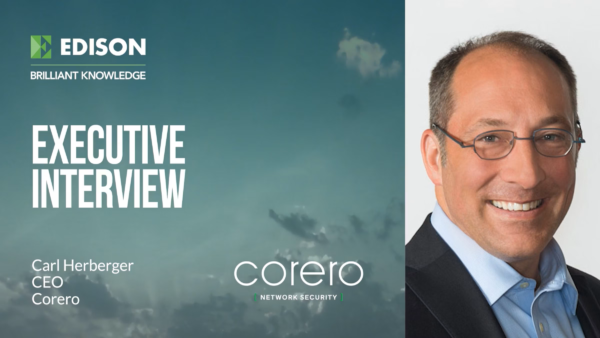
In this interview, Carl Herberger, CEO of Corero Network Security, discusses the strong operating leverage evident in the company’s H1 results. Revenue grew 42% y-o-y, adjusted EBITDA reached $2.7m and gross margin was 93%, despite a higher proportion of capex-related sales. Annual recurring revenue grew 12%, while operating costs increased by only 5%. This produced a c $4m y-o-y increase in net revenue contribution. Management expects further operating leverage as the business continues to grow.
The discussion then turns to Corero’s strategy to broaden its offering from distributed-denial-of-service (DDoS) protection to a wider cyber-resilience platform, addressing network availability, performance and service-level requirements. Recent tier-one telecom wins in the UK and US, together with growing exposure to NeoCloud and AI data-centre infrastructure, support this development. Herberger also outlines the four pillars of the company’s go-to-market strategy: expanding reseller coverage, further developing OEM relationships, increasing managed-service sales and growing enterprise and cross-sell revenues through newer products, which in combination support the company’s ambition of delivering sustained, operationally leveraged growth.
Corero Network Security is a leading provider of real-time, adaptive distributed denial-of-service attack detection and mitigation solutions, protecting organisations against external and internal threats and ensuring an ability to continually operate web-based services.
What has driven Corero’s growth and improving operational leverage?
Carl Herberger: We are pleased with the first-half results and see no reason why momentum should not accelerate in the second half. Three years ago, I saw the potential in the business and its role in supporting technology and communications infrastructure. Corero provides network resilience: it helps ensure that networks can support the applications and technologies built on them. As AI data centres, autonomous vehicles and drones proliferate, networks are becoming ever more important. The need for reliable, resilient networks and effective control mechanisms is growing with them. We recently announced a customer among the top five NeoCloud providers. Corero is continuing to develop its solutions as technology changes.
How is Corero evolving beyond DDoS protection?
Carl Herberger: DDoS – distributed denial of service – is unwanted traffic intended to clog an environment so that it cannot communicate. Historically, customers knew they had a DDoS issue when they went down. Today, applications can underperform before there is an outage. That expands the issue from DDoS to denial of service (DoS) and wider network resilience. Corero’s solutions now address DDoS, DoS and network service-level requirements, helping customers distinguish offending from legitimate traffic in sub-seconds. Availability depends on speed. As computing technology evolves, new ways emerge to disrupt networks. We are investing in the next set of solutions, even as R&D becomes a lower proportion of sales.
What do the recent tier-one telecom wins demonstrate?
Carl Herberger: Our strategy has been to become more relevant to the world’s tier-one operators. Once a technology is selected by a major operator, it can provide an important reference point for other customers. We announced wins with major tier-one operators in the US and UK. These selection processes typically take nine to 18 months and involve much more than technology and pricing. Compliance is increasingly important. In the UK, the Telecoms Security Act was a significant consideration. Regulation is increasing the focus on resilience and uptime across critical infrastructure, including telecoms, financial services, utilities and government. Data sovereignty is becoming more significant in customer decision-making around the world.
How does the ROMEE strategy support growth?
Carl Herberger: ROMEE is our go-to-market framework.
The ‘R’ is for resellers: we are investing in regional reseller relationships, an area where Corero had not historically invested as heavily.
The ‘O’ is for OEM relationships. Around 20–25% of the business currently comes through three large OEMs: HPE Juniper, Akamai and GTT. We see scope to add one or two further OEM relationships.
The ‘M’ is for managed sell-through. Managed service providers resell our products to their customers. In Brazil, where we had no revenue two years ago, two managed service providers, and increasingly a third, now account for more than 10% of group business. We are seeing similar opportunities develop elsewhere.
The two ‘E’s are enterprise and existing customers. We are expanding geographically and into government and industries such as banking and healthcare. We are also selling more to existing customers. Since I joined, an AI-enabled software development programme has produced six new products, supporting add-on and upgrade sales. We are also winning new logos, including major banks in continental Europe and Chile.
What is the opportunity in AI infrastructure and NeoClouds?
Carl Herberger: The opportunity is substantial. There is significant investment in data-centre construction, and DDoS protection and resilient networks are fundamental requirements. Corero now supplies three of the world’s major NeoCloud providers. These newer data centres are often designed for specific workloads rather than traditional multi-tenancy. They may also incorporate their own power generation. Security and network resilience need to be considered 18 to 24 months before a facility is built. DDoS is not a problem that will simply disappear. Where there is commerce, there will be attempts to disrupt or steal from it. The growing use of data centres in areas such as gaming, cryptocurrency and military applications increases the need for high-performance, resilient networks.
How should investors think about operating leverage as Corero scales?
Carl Herberger: The first-half P&L demonstrated powerful operational leverage. Net revenue increased by about $4m y-o-y, while operating costs grew by only 5%. The first half is also when we typically make much of our annual investment in marketing and people, giving those investments time to contribute during the year. We see no reason for the operating leverage to change markedly and believe it could improve. Gross margin was 93%, even though the first-half sales mix included more capex-related deals. ARR grew 12% y-o-y, reflecting that mix. The business is software-led, has high gross margins and is receiving a strong market response. Corero has also been recognised as a leader in its market for a second consecutive year, while remaining the only acknowledged innovator in the relevant independent evaluation. We recognise that competitors are taking notice as our sales execution improves.