Last close As at 05/08/2026
—
— 0.00 (0.00%)
Market capitalisation
—
Research: Investment Companies
The Merchants Trust (MRCH) is managed by Simon Gergel at Allianz Global Investors (AllianzGI). Aiming to continue to provide a high and growing level of income, he is adjusting the trust’s portfolio in the wake of dividend cuts sparked by the negative economic effects of COVID-19. If there is an income shortfall in this financial year, MRCH is well positioned to maintain its dividend, with revenue reserves of more than 1x the last annual payment. It has not been an easy period for value managers over the last decade as growth stocks have led the charge; however, Gergel has outperformed the UK market over this period in both NAV and share price terms. The board reduced MRCH’s gearing in late January 2020, which was opportune timing ahead of the recent significant stock market weakness.
The Merchants Trust |
Opportune reduction in gearing in early 2020 |
Investment trusts |
26 May 2020 |
Share price/discount performance
Three-year performance vs index
Gearing
Analysts
|
|||||||||||||||||||||||||||||||||||||||||||||||||||||||||||||||||||||||||||||||||||||||||
The Merchants Trust (MRCH) is managed by Simon Gergel at Allianz Global Investors (AllianzGI). Aiming to continue to provide a high and growing level of income, he is adjusting the trust’s portfolio in the wake of dividend cuts sparked by the negative economic effects of COVID-19. If there is an income shortfall in this financial year, MRCH is well positioned to maintain its dividend, with revenue reserves of more than 1x the last annual payment. It has not been an easy period for value managers over the last decade as growth stocks have led the charge; however, Gergel has outperformed the UK market over this period in both NAV and share price terms. The board reduced MRCH’s gearing in late January 2020, which was opportune timing ahead of the recent significant stock market weakness.
|
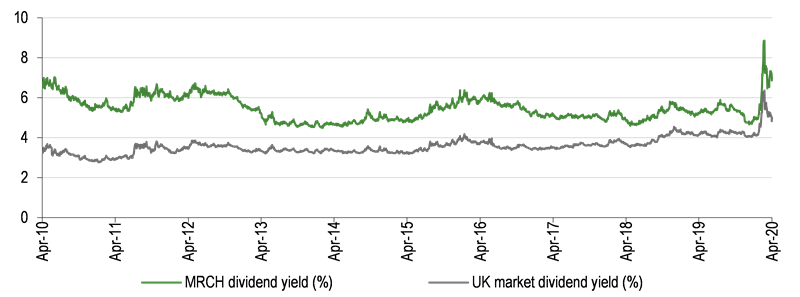
MRCH has consistently offered a dividend yield in excess of the UK market |
|
|
Source: Refinitiv, The Merchants Trust, Edison Investment Research |
The market opportunity
The UK market has experienced a significant correction in response to the coronavirus pandemic. While earnings estimate revisions are in a state of flux and many companies are cutting or suspending their dividends, there are still some high-quality businesses trading on reasonable valuations available for investors with a longer-term perspective.
Why consider investing in The Merchants Trust?
■
Attractive 7.6% dividend yield is higher than the UK market’s and the majority of its peers’. The annual distribution has increased for 38 consecutive years.
■
Diversified portfolio of attractively valued UK equities positioned to benefit from an economic recovery.
■
Long-term record of outperformance versus the UK stock market.
■
Lower interest costs due to refinancing of and reduction in debt.
Actively issuing shares at a premium to NAV
MRCH’s current 1.6% discount to cum-income NAV compares to a range of a 1.0% average premium to a 3.4% average discount over the last one, three, five and 10 years. The board actively issues shares when they are trading at a premium. MRCH has a progressive dividend policy and the annual distribution has increased for the last 38 consecutive years. The trust currently offers a 7.6% dividend yield.
Exhibit 1: Trust at a glance
Investment objective and fund background |
Recent developments |
|||||||||||||||||||||||||||||||||||||||||||||||||||||||
The Merchants Trust’s investment objective is to provide an above-average level of income and income growth, together with long-term growth of capital, through investing mainly in higher-yielding large-cap UK companies. With effect from 1 February 2017, the benchmark is a broad UK stock market index (previously an index of the 100 largest UK companies). |
■ 1 May 2020: Appointment of Karen McKellar as a non-executive director. ■ 24 April 2020: Final report to 31January 2020. NAV TR +18.7% versus benchmark TR +10.7%. Share price TR +18.6%. ■ 16 April 2020: Fourth interim dividend of 6.8p declared (+3.0% year-on-year). ■ 29 January 2020: Repayment of £16m debt under revolving credit facility. ■ 21 January 2020: Third interim dividend of 6.8p declared (+4.6% year-on-year). |
|||||||||||||||||||||||||||||||||||||||||||||||||||||||
Forthcoming |
Capital structure |
Fund details |
||||||||||||||||||||||||||||||||||||||||||||||||||||||
AGM |
TBA |
Ongoing charges |
0.59% |
Group |
Allianz Global Investors |
|||||||||||||||||||||||||||||||||||||||||||||||||||
Interim results |
September 2020 |
Net gearing |
17.2% |
Manager |
Simon Gergel |
|||||||||||||||||||||||||||||||||||||||||||||||||||
Year end |
31 January |
Annual mgmt fee |
0.35% |
Address |
199 Bishopsgate, London, EC2M 3TY, UK |
|||||||||||||||||||||||||||||||||||||||||||||||||||
Dividend paid |
Quarterly |
Performance fee |
None |
|||||||||||||||||||||||||||||||||||||||||||||||||||||
Launch date |
February 1889 |
Trust life |
Indefinite |
Phone |
+ 44 (0)800 389 4696 |
|||||||||||||||||||||||||||||||||||||||||||||||||||
Continuation vote |
None |
Loan facilities |
See page 9 |
Website |
||||||||||||||||||||||||||||||||||||||||||||||||||||
Dividend policy and history (financial years) |
Share buyback policy and history (financial years) |
|||||||||||||||||||||||||||||||||||||||||||||||||||||||
Dividends are paid quarterly in August, November, February/March and May. The annual dividend has increased for 38 consecutive years. |
Renewed annually, the trust has authority to purchase up to 14.99% and allot up to 5% of issued share capital. |
|||||||||||||||||||||||||||||||||||||||||||||||||||||||
|
|
|||||||||||||||||||||||||||||||||||||||||||||||||||||||
Shareholder base (as at 30 April 2020) |
Portfolio exposure by sector (ex-cash as at 30 April 2020) |
|||||||||||||||||||||||||||||||||||||||||||||||||||||||
|
|
|||||||||||||||||||||||||||||||||||||||||||||||||||||||
Top 10 holdings (as at 30 April 2020) |
||||||||||||||||||||||||||||||||||||||||||||||||||||||||
|
||||||||||||||||||||||||||||||||||||||||||||||||||||||||
Source: MRCH, Edison Investment Research, Bloomberg, Morningstar. Note: *N/A where not in end-April 2019 top 10.
Market outlook: Focus on quality and value
Investors have had a torrid time so far in 2020. The year started well with expectations of reasonable economic growth. However, stock markets were then turned on their heads as the coronavirus spread from China across the world, leading to lockdowns and a sharper and faster reduction in economic activity than experienced ever before. There has been a slew of dividend cuts across a range of industries, but these could prove to be temporary as government support has been unprecedented in an attempt to mitigate the negative effects of the pandemic. These measures have led to a significant rebound in global stock markets from the mid-March 2020 lows. However, we remain in a period of high uncertainty. In the table below, we show the valuation of both UK and global equities, but caution these figures should be taken with a pinch of salt given that company earnings estimates are in a state of flux. In the UK, the stock market is polarised between lowly valued cyclicals and those businesses perceived to be safe havens; there are very few companies trading on market-average valuations. With this investment backdrop, a focus on quality companies that are trading on reasonable valuations could prove a sensible approach.
|
Exhibit 2: Valuation of UK equities |
|||||||||||||||||||||||||||||||||||||||||||||||||||||||||||||||||||
Valuation versus global market |
Valuation metrics (at 22 May 2020) |
||||||||||||||||||||||||||||||||||||||||||||||||||||||||||||||||||
|
|
||||||||||||||||||||||||||||||||||||||||||||||||||||||||||||||||||
|
Source: Refinitiv, Edison Investment Research |
|||||||||||||||||||||||||||||||||||||||||||||||||||||||||||||||||||
Fund profile: Attractive yield from UK equities
Launched in 1889, MRCH is one of the oldest investment trusts listed on the London Stock Exchange. The trust has been managed by Simon Gergel since 2006. He has 32 years’ investment experience and is chief investment officer for UK equities at AllianzGI. The manager works closely with two other members of the UK investment team, Matthew Tillett (portfolio manager – 13 years’ investment experience) and Richard Knight (portfolio manager – six years’ investment experience). Gergel aims to generate an above-average level of income and income growth, as well as long-term capital appreciation, from a relatively concentrated portfolio of c 40–60 UK stocks. He has a contrarian approach, seeking undervalued equities that can be held for the long term. MRCH’s performance is measured against the broad UK market (the largest 100 companies prior to end-January 2017).
In order to mitigate risk, there are investment guidelines in place. MRCH must be invested in at least five of the 10 market sectors, with a maximum 35% of the portfolio in a single sector. Each individual investment may not exceed 15% of assets. Gearing in a range of 10–25% of NAV, at the time of drawdown, is permitted; at end-April 2020, net gearing was 17.2%. MRCH currently offers an above-market dividend yield of 7.6% and its annual distribution has increased for the last 38 financial years, with reserves being used to supplement income when required.
The fund manager: Simon Gergel
The manager’s view: Focusing on MRCH’s income generation
Having outperformed the benchmark and increased the dividend by 4.2% in FY20 (31 January year-end), Gergel says that MRCH was in a good position going into FY21. The coronavirus outbreak has brought a different perspective given the importance of income security to fulfil the trust’s objective of a high and growing dividend, although MRCH has the benefit of revenue reserves equivalent to more than 1x the last annual dividend payment. Gergel has made changes to the portfolio, aiming to generate additional income given the broad range of dividend cuts announced by UK companies, and notes that the trust also has the capacity to pay dividends out of capital reserves if there is a temporary shortfall in MRCH’s income. The manager is focusing on companies’ mid- to longer-term income generation potential, including firms that will be able to reinstate or increase their dividends in the future. He is finding opportunities throughout the market and the trust has a well-diversified income stream across a range of industries, including those that are more likely to have secure income – such as pharma and utility companies – as well as firms in areas that are likely to be under more pressure to pay dividends in the short term.
Gergel continues to focus on companies with strong fundamentals and attractive valuations, that have a supportive thematic background (for further details see the following ‘Investment process’ section). He is also looking for businesses where the fundamental case has changed. As an example, the manager sold MRCH’s holding in Informa (exhibitions and events), whose operations have been hit hard by the COVID-19 outbreak and which also has longer-term issues as people are getting used to travelling less and are finding other ways of doing business. Gergel believes that it will be many years before Informa returns to its prior levels of profitability, commenting that ‘its valuation is not attractive enough to compensate for the risk’.
Considering the macro backdrop, the manager argues that no-one knows how long the effects of the coronavirus will last, or what the ultimate economic impacts will be. He says that the current downturn has been quicker and sharper than any other, surpassing that of the global financial crisis. However, the manager adds that measures the government has taken to support the UK economy have been extreme and unprecedented, including loan guarantees, furloughing workers and lower interest rates. As governments around the world are starting to lift restrictions, Gergel suggests there could be a relatively quick global economic recovery. He believes that some businesses, such as airlines and leisure, will suffer long-term damage as ‘the demand shock is so great and there are social distancing measures to contend with’. The manager comments that UK housebuilders are ramping up their operations and suggests that their production rates could soon be back to 70–90% of their prior levels. Interestingly, he notes that pricing for new-build properties has remained firm. Gergel says that while pubs, restaurants and travel businesses will take time to come back to full operation, he believes that there is no reason to expect a prolonged UK recession; he is hopeful that economic activity will rebound.
The manager comments that in the second half of 2019, value stocks ‘performed pretty well, as there was pent-up demand for UK stocks following the Brexit uncertainty’. He suggests that this change was interrupted by the pandemic and that valuation dispersions in the UK market are even more extreme as investors have continued to favour defensive businesses. This is not just between subsectors, such as the disparity between pharma and bank stocks, but also on an intra-subsector basis such as in the engineering sector, where some companies are trading on P/E multiples around 30x despite being cyclical businesses, as investors are paying up for high returns.
Gergel says that it is also interesting to note that UK company valuations are not in a normal bell-shape distribution; there is a bulge at either end. In the mid-March trough, around a quarter of the broad market index constituents were trading on P/E multiples of 16x plus, while around 40% were trading on multiples of less than 10x. MRCH’s portfolio is skewed towards more reasonably priced companies and the manager says he is finding ‘great opportunities due to the market polarisation’.
Asset allocation
Investment process: Bottom-up stock selection
Gergel believes that markets are inefficient, and that by focusing on undervalued companies with strong fundamentals it is possible to deliver a high and rising income stream and long-term capital growth for investors. He says there is compelling historical evidence that, on average, companies paying high dividend yields have delivered above-average total returns, not just a higher income stream. Dividend yield in itself is not a sufficient reason to buy or sell a share; instead the manager focuses on a company’s total return potential. Gergel is able to draw on the significant resources of AllianzGI’s investment team, which includes equity and credit research analysts, environmental, social and governance (ESG) specialists, and a proprietary Grassroots market research operation.
Company research focuses in particular on analysing the sustainability of a firm’s cash flows, while stock selection is centred around three pillars – fundamentals, valuation and themes – seeking to answer three questions: how good is the business, are the company’s share undervalued, and how supportive is the environment? Fundamental research includes industry analysis as well as an assessment of the strength of individual companies, along with a consideration of a firm’s corporate governance framework, management track record and incentive structure. Valuation analysis is based on a wide range of metrics in both absolute and relative terms, while the third discipline, themes, looks at the environment in which a business operates either on a macro or on a sectoral basis. This is particularly important for a value manager in helping to identify and avoid value traps – shares that appear undervalued but are unlikely to appreciate due to industry disruption or structural challenges.
MRCH’s portfolio typically holds 40–60 stocks, with position sizes based on the manager’s level of conviction, the potential valuation upside and the specific risk profile of each holding. Positions may be sold if they reach the estimated target price, if there is a change in the environment meaning the original investment thesis no longer holds true, or if a better investment opportunity is identified.
The portfolio can be broken down into four broad ‘buckets’ (% as at 30 April 2020, excluding-cash):
■
High yield (c 33%) – undervalued companies with a high dividend yield. Expected return is from dividends and revaluation. Examples include Royal Dutch Shell and British American Tobacco.
■
Cyclical growth (c 33%) – companies that can grow over a cycle but may have economic or market sensitivity. Expected return is from revaluation, compounding growth and dividends. Examples include Legal & General and St James’s Place.
■
Defensive growth (c 27%) – firms that can grow with limited economic sensitivity. Expected return is from dividends, compounding growth and potentially revaluation. Examples include GlaxoSmithKline and BAE Systems.
■
Special situations (c 7%) – companies undergoing a turnaround or restructuring. Expected return is primarily via capital appreciation as their shares are revalued. Examples include Barclays and Balfour Beatty.
Gergel stresses that his focus on value stocks does not mean investing in low-quality businesses; he says that he is ‘buying decent companies at attractive valuations’, some of which are world leaders in their fields, such as IG Group (derivatives trading), Inchcape (car distribution), Keller (geotechnical engineering) and SThree (STEM recruitment). However, given these companies’ UK listings, their shares tend to be attractively valued.
Current portfolio positioning
At end-April 2020, MRCH’s top 10 holdings made up 37.7% of the fund, which was broadly in line with 37.3% a year earlier; six positions were common to both periods. More than 60% of the portfolio was in large-cap stocks (Exhibit 3), which was broadly similar compared with a year earlier, although the mid-cap exposure was lower (-4.1pp).
Exhibit 3: Market capitalisation breakdown (% unless stated)
Index |
Portfolio end-April 2020 |
Portfolio end-April 2019 |
Change (pp) |
|||
Large cap |
62.7 |
61.6 |
1.1 |
|||
Mid cap |
23.8 |
27.9 |
(4.1) |
|||
Small cap |
9.4 |
7.4 |
2.0 |
|||
Cash |
4.2 |
3.1 |
1.1 |
|||
100.0 |
100.0 |
|||||
Source: The Merchants Trust, Edison Investment Research. Note: Numbers subject to rounding.
MRCH’s sector exposure is shown below in Exhibit 4. The largest changes in the 12 months to end-April are a higher weighting to consumer goods (+8.9pp) and a lower financials weighting (-7.4pp). In terms of active weights versus the broad UK market, the manager particularly favours industrials (+5.2pp), consumer goods (+4.7pp) and utilities (+4.0pp), with underweight exposures to healthcare (-5.9pp) and financials (-4.0pp).
Exhibit 4: Portfolio sector exposure vs benchmark (% unless stated)
Portfolio end- |
Portfolio end- |
Change |
Index |
Active weight |
Trust weight/ |
|
Financials |
21.2 |
28.6 |
(7.4) |
25.2 |
(4.0) |
0.8 |
Consumer goods |
20.8 |
11.9 |
8.9 |
16.2 |
4.7 |
1.3 |
Industrials |
16.7 |
19.4 |
(2.7) |
11.5 |
5.2 |
1.5 |
Consumer services |
11.1 |
10.2 |
0.9 |
11.7 |
(0.6) |
1.0 |
Utilities |
7.5 |
6.9 |
0.6 |
3.5 |
4.0 |
2.1 |
Healthcare |
6.1 |
5.4 |
0.7 |
12.0 |
(5.9) |
0.5 |
Oil & gas |
5.8 |
8.6 |
(2.8) |
9.2 |
(3.4) |
0.6 |
Basic materials |
4.3 |
4.5 |
(0.2) |
7.4 |
(3.1) |
0.6 |
Telecommunications |
2.3 |
1.4 |
0.9 |
2.3 |
0.0 |
1.0 |
Technology |
0.0 |
0.0 |
0.0 |
1.1 |
(1.1) |
0.0 |
Cash |
4.2 |
3.1 |
1.1 |
0.0 |
4.2 |
N/A |
100.0 |
100.0 |
100.0 |
Source: The Merchants Trust, Edison Investment Research. Note: Numbers subject to rounding.
In recent months, Gergel has sold positions that performed relatively well during the initial stock market sell-off such as Prudential and Sirius Real Estate, which has industrial property in Germany. The stock had appreciated due to a rising rental stream and higher profits, and moved to a premium to NAV. Given the outlook for the German industrial economy, the manager considered it prudent to sell the company, locking in significant gains.
There is a new position in BT, which apart from a brief time around three years ago, has not been in MRCH’s portfolio for several years. The manager says that the company was challenged due to increased investment in fibre networks and higher competition in mobile phones. BT’s shares had been extremely weak, halving between mid-February and mid-March 2020, and were trading on a very low valuation. Gergel considers that the company’s business is relatively resilient. However, in the medium term returns from this stock are more likely to come from capital appreciation, as BT has suspended its final dividend for FY20 (ending 31 March) and its interim and final dividends for FY21, with payouts expected to resume in FY22 at 7.7p per share versus 15.4p per share in FY19.
The manager highlights MRCH’s position in spread betting company IG Group, which is now a top 10 position. He says the firm is benefiting from new business opportunities; trading has been strong, and the company has increased earnings guidance twice in recent months. While IG’s shares have performed relatively well, they continue to offer an attractive c 6% dividend yield. Gaming company GVC is another of MRCH’s holdings that has suspended its dividend; however, Gergel is confident that its business will rebound, and, while betting shops have closed, its online business remains robust. While there is currently a lack of sports to bet on, the manager says that Premier League football and horse racing will resume. He adds that once betting shops reopen, it should be relatively easy to follow social-distancing rules. Gergel was able to add to the GVC position in March at levels more than 50% lower than its current share price. He has also added to the holding in furniture retailer DFS and participated in its recent rights issue. The manager says the company is a market leader and he expects it to emerge from the lockdown relatively stronger in both its online and its physical operations. Gergel believes that there is pent-up demand for new furniture, and notes that DFS’s competition tends to struggle with low profitability.
MRCH’s largest subsector exposure is to tobacco, which the manager says is attractively valued. British American Tobacco has recently announced a very robust trading statement. Its new product areas have been slower to take off than originally thought, but this has not affected the company’s profitability as cigarette sales are holding up well. Tobacco companies are very cash generative; however, not unexpectedly, Imperial Brands has recently cut its dividend by a third to pay down debt. Despite this, its shares still offer an attractive above-market c 9% dividend yield.
Performance: Strong relative performance in FY20
Exhibit 5: Five-year discrete performance data
12 months ending |
Share price |
NAV* |
Blended benchmark **(%) |
CBOE UK All companies (%) |
CBOE UK 100 Companies (%) |
30/04/16 |
(10.8) |
(9.7) |
(6.8) |
(5.7) |
(6.8) |
30/04/17 |
20.2 |
19.4 |
21.4 |
20.1 |
20.0 |
30/04/18 |
14.5 |
13.2 |
8.2 |
8.2 |
8.5 |
30/04/19 |
2.4 |
(1.1) |
2.6 |
2.6 |
3.1 |
30/04/20 |
(16.8) |
(21.0) |
(16.7) |
(16.7) |
(16.6) |
Source: Refinitiv. Note: All % on a total return basis in pounds sterling. *NAV with debt at market value. **Blended benchmark is UK 100 Index until 31 January 2017 and UK All-Share Index thereafter.
|
Exhibit 6: Investment trust performance to 30 April 2020 |
|
Price, NAV and benchmark total return performance, one-year rebased |
Price, NAV and benchmark total return performance (%) |
|
|
|
Source: Refinitiv, Edison Investment Research. Note: Three, five and 10-year performance figures annualised. |
|
In FY20 (ending 31 January), MRCH’s NAV and share price total returns of +18.7% and +18.6% respectively were considerably ahead of the benchmark’s +10.7% total return. The top contributors to relative returns were Pennon (+0.9pp), Keller, and Greene King (both +0.8pp), while the largest detractors were portfolio holdings Senior (-0.7pp) and Imperial Brands (-0.6pp), and not owning AstraZeneca (-0.9pp). The year was essentially a game of two halves: in H120, MRCH’s value style was out of favour and the trust lagged its benchmark, but its relative performance was very strong in H220, not just due to a recovery in reasonably valued shares. Small- and mid-cap stocks performed relatively better in the second half of the financial year, while a reduction in political risk helped the fund’s utility and defence positions, and the trust benefited from three takeover bids: Greene King, Hansteen and Inmarsat.
Exhibit 7: Share price and NAV total return performance, relative to indices (%)
|
One month |
Three months |
Six months |
One year |
Three years |
Five years |
10 years |
Price relative to blended benchmark |
1.7 |
(8.6) |
(1.9) |
(0.2) |
5.5 |
(0.1) |
23.3 |
NAV relative to blended benchmark |
3.8 |
(11.1) |
(5.3) |
(5.1) |
(4.2) |
(8.8) |
8.0 |
Price relative to CBOE UK All Companies |
1.7 |
(8.6) |
(1.9) |
(0.2) |
5.5 |
(0.2) |
18.3 |
NAV relative to CBOE UK All Companies |
3.8 |
(11.1) |
(5.3) |
(5.1) |
(4.2) |
(8.9) |
3.7 |
Price relative to CBOE UK 100 |
2.4 |
(10.0) |
(2.3) |
(0.2) |
4.5 |
0.2 |
23.6 |
NAV relative to CBOE UK 100 |
4.5 |
(12.4) |
(5.7) |
(5.2) |
(5.1) |
(8.5) |
8.3 |
Source: Refinitiv, Edison Investment Research. Note: Data to end-April 2020. Geometric calculation.
MRCH’s relative returns are shown in Exhibit 7. The trust has outperformed its blended benchmark over the last decade in both NAV and share price terms, and in share price terms over the last three years. Relative performance over most periods shown has been negatively affected by the recent coronavirus-induced market volatility.
During March 2020, MRCH’s NAV underperformed the benchmark by around 10pp due to the portfolio being positioned for economic recovery following an end to political gridlock in the UK at the end of 2019; its exposure to mid-cap stocks, which generally underperformed the broader market; and investors focusing on perceived safe businesses rather than value stocks. Shares in the trust’s bank holdings Barclays and RBS fell by around 35%, whereas peer HSBC – which is not owned – fell by around 15%. Other negative contributors to relative performance included National Express, Hammerson, and not holding AstraZeneca, while positive contributors included IG Group, PZ Cussons and Imperial Brands. April 2020 witnessed better relative performance for MRCH; there was a strong recovery in housebuilders and National Express, while its positioning within the banking sector was also a positive contributor.
|
Exhibit 8: NAV total return performance relative to benchmark over three years |
|
|
Source: Refinitiv, Edison Investment Research |
Capital structure and fees
MRCH is a conventional investment trust with one class of share; there are currently 118.8m ordinary shares in issue. At the end of 2020, the board and the manager decided to reduce the trust’s gearing to 15% by paying down £16m of its revolving credit facility (RCF). This transaction occurred on 29 January 2020, just before the financial year end, and before the stock market began to sell off in February 2020. The move was deemed prudent given the strong stock market rebound in Q419. MRCH’s total debt now stands at c £93m, and debt restructuring in recent years has meaningfully reduced the trust’s effective interest rate from 8.5% at end-FY17 to 3.8% at end-FY20.
AllianzGI is paid 0.35% pa of the value of MRCH’s gross assets (minus current liabilities, short-term loans and any funds within the portfolio managed by AllianzGI). The management fee is allocated 65:35 between the capital and revenue accounts respectively, reflecting the board’s expected split of long-term returns between capital and income. MRCH’s ongoing charge in FY20 was 0.59%, just 1bp higher than 0.58% in FY19.
Dividend policy and record
|
Exhibit 10: Growth of MRCH’s dividend vs UK inflation |
|
|
Source: Refinitiv, The Merchants Trust, Edison Investment Research |
MRCH’s dividend growth and attractive yield are differentiating features of the trust. The annual dividend has increased for the last 38 consecutive years, and over this period has compounded at a significantly higher rate than that of UK CPI inflation (7.0% pa versus 2.9% pa – Exhibit 10). MRCH has also offered a consistently higher dividend yield than the broad UK market, as shown in the front-page chart.
The trust pays regular quarterly dividends, generally in August, November, February/March and May. In FY20, the total annual dividend of 27.1p per share was 4.2% higher year-on-year and 1.1x covered by revenue earnings. At the end of the last financial year, MRCH had revenue reserves equivalent to just over 1x the FY20 dividend. These are available to smooth dividend payments in years when income is lower; revenue reserves were last drawn upon in FY17. Based on its current share price, MRCH offers an attractive 7.6% dividend yield.
Peer group comparison
MRCH is a member of the AIC UK Equity Income sector, of which the 17 largest funds with market caps above £100m are shown in Exhibit 11. The trust’s NAV total returns are below the selected peer group averages over the periods shown, ranking ninth over one year, 12th over three and five years, and 13th over the last decade. In general, peers that share a more value-orientated approach have also posted below-average returns over most periods shown, given the extreme disparity between the performance of value and growth styles in recent years. Following a re-rating in late 2018 that has been sustained, MRCH had one of the narrowest discounts on the date shown. It has a competitive ongoing charge, the second highest level of gearing, and an attractive 7.6% dividend yield – the second highest in the selected peer group, and 2.0pp above the mean.
Exhibit 11: Selected peer group as at 22 May 2020*
% unless stated |
Market |
NAV TR |
NAV TR |
NAV TR |
NAV TR |
Discount |
Ongoing charge |
Perf. |
Net gearing |
Dividend yield |
Merchants Trust |
424.3 |
(18.2) |
(16.2) |
(8.3) |
82.3 |
(1.5) |
0.6 |
No |
117 |
7.6 |
Aberdeen Standard Equity Inc Trust |
128.1 |
(27.8) |
(27.6) |
(21.2) |
66.8 |
(12.3) |
0.9 |
No |
112 |
7.9 |
BMO Capital & Income |
261.5 |
(21.2) |
(14.3) |
7.6 |
87.5 |
0.7 |
0.6 |
No |
106 |
4.7 |
City of London |
1,355.4 |
(16.0) |
(12.5) |
0.2 |
109.4 |
(0.1) |
0.4 |
No |
109 |
5.8 |
Diverse Income Trust |
316.2 |
(4.3) |
(3.4) |
20.4 |
|
(3.9) |
1.2 |
No |
100 |
4.4 |
Dunedin Income Growth |
374.9 |
(5.6) |
1.3 |
15.7 |
116.4 |
(5.1) |
0.6 |
No |
109 |
5.0 |
Edinburgh Investment |
770.4 |
(21.0) |
(28.5) |
(14.6) |
100.2 |
(14.3) |
0.6 |
No |
105 |
6.5 |
Finsbury Growth & Income |
1,747.4 |
(7.0) |
19.5 |
51.2 |
281.5 |
(0.6) |
0.7 |
No |
101 |
2.0 |
Invesco Income Growth |
130.0 |
(14.6) |
(15.1) |
(3.7) |
105.0 |
(15.2) |
0.7 |
No |
103 |
5.3 |
JPMorgan Claverhouse |
316.9 |
(18.8) |
(13.4) |
0.7 |
94.8 |
(1.6) |
0.7 |
No |
109 |
5.3 |
Law Debenture Corporation |
570.8 |
(14.0) |
(7.6) |
11.5 |
128.1 |
(7.6) |
0.3 |
No |
120 |
5.4 |
Lowland |
244.8 |
(26.1) |
(29.8) |
(17.8) |
113.5 |
(8.3) |
0.6 |
Yes |
116 |
6.6 |
Murray Income Trust |
487.9 |
(5.6) |
1.1 |
18.9 |
121.1 |
(4.8) |
0.7 |
No |
107 |
4.7 |
Perpetual Income & Growth |
448.9 |
(29.1) |
(36.6) |
(30.2) |
65.6 |
(15.2) |
0.7 |
No |
113 |
7.2 |
Schroder Income Growth |
154.5 |
(18.2) |
(15.7) |
(4.5) |
98.3 |
(5.1) |
0.9 |
No |
112 |
5.6 |
Temple Bar |
464.8 |
(35.3) |
(33.3) |
(23.7) |
48.8 |
(12.4) |
0.5 |
No |
105 |
7.4 |
Troy Income & Growth |
242.4 |
(7.0) |
(1.3) |
17.0 |
130.6 |
(0.6) |
0.9 |
No |
100 |
3.9 |
Selected group average (17 funds) |
496.4 |
(17.1) |
(13.7) |
1.1 |
109.4 |
(6.3) |
0.7 |
109 |
5.6 |
|
MRCH rank |
8 |
9 |
12 |
12 |
13 |
5 |
11 |
2 |
2 |
Source: Morningstar, Edison Investment Research. Note: *Performance to 21 May 2020. NAV with debt at par. TR = total return. Net gearing is total assets less cash and equivalents as a percentage of net assets.
The board
There are five directors on MRCH’s board, all of whom are non-executive and independent of the manager. Chairman Colin Clark joined the board in June 2019 and assumed his current role in September 2019 following the retirement of Simon Fraser. The four other directors and their dates of appointment are: Sybella Stanley (senior independent director, November 2014); Mary Ann Sieghart (November 2014); Timon Drakesmith (November 2016); and Karen McKellar (formerly Karen Robertson, May 2020).
McKellar replaced Paul Yates, who stepped down from the board on 1 May 2020 following nine years’ service. For many years, she was an investment manager at Standard Life, managing the Standard Life Equity Income Investment Trust and several large UK equity open-ended funds.
|
|
Research: Healthcare
Clyra Medical, BioLargo’s partially owned (36%) subsidiary, recently announced that it registered with the FDA and launched Clyraguard, a disinfectant marketed for the treatment of non-critical surfaces such as personal protective equipment (PPE) that is non-irritating to skin. Concurrent with this BioLargo announced the results of two studies that showed Clyraguard and the company’s environmental product CupriDyne could both fully inactivate COVID-19.