Last close As at 06/08/2026
—
— 0.00 (0.00%)
Market capitalisation
—
Research: Metals & Mining
Europe needs a long-term, secure source of rare earths and, increasingly, Greenland does not look like the answer. Rare earths are now clearly geopolitical, and, like the US, Europe will need ‘in the ground’ sources in safe jurisdictions where investors are willing to commit capital. Rare earth elements (REEs) are needed for decarbonising power grids, electric vehicle (EV) production, defence applications and robotics. Our analysis indicates that Leading Edge Materials’ (LEM’s) Norra Kärr deposit in Sweden has the potential to supply all of Europe’s heavy rare earth element (HREE) needs, and this is likely to become more obvious as its development progresses and processing and offtake routes mature. In this note we look broadly at Europe’s strategy to meet its HREE needs in what is, even for mining, a volatile sector.
REEs are essential components of permanent magnets, which are used in EV drivetrains, wind turbines and industrial motors. They also have defence applications (eg drones) and, importantly for the future, uses in robotics. The REE supply chain is geopolitical because it is concentrated. China represents 60–70% of global mining, c 90% of separation and refining, and more than 90% of permanent magnet manufacturing. This dominance is the result of economics and industrial choices over recent decades, not scarcity or geology. The US is now responding to China’s dominance with an integrated mine-to-magnet approach domestically and is eyeing international opportunities, while Europe has set up the Critical Raw Materials Act (CRMA), with 2030 strategic raw materials targets of 10% extraction, 40% processing and 25% recycling. The CRMA also sets a concentration risk test of no more than 65% at any relevant processing stage from a single third country. Its first wave of strategic projects included some rare earths, but mostly mid- and downstream operations and non-European mining, which does not fully solve long-term security where mining is key. Deposits inside Europe that can credibly supply magnet materials are limited and although Greenland is near Europe, it is now geopolitically complex.
LEM’s Norra Kärr deposit in Sweden is critical for European HREE supply. We estimate current European dysprosium (Dy) demand to be 180–200tpa of Dy2O3 and global demand is 1,800–2,000tpa. Norra Kärr’s disclosed preliminary economic assessment (PEA, August 2021) outputs are similar to European consumption, with average annual Dy2O3 of 248t and Tb2O3 of 36t within recovered total rare earth oxides (TREO) of 5,341t and magnetic REO (MREO) of 1,005t. Norra Kärr is unique in that it is European (excluding Greenland) and weighted towards HREEs. We have yet to provide a valuation or estimates for LEM. We intend to follow up with more detail on its corporate structure and strategy, but in this note we focus on how the Norra Kärr deposit fits into the broader REE landscape.
There are 17 REEs (see Appendix), but only a handful are critical for high-performance permanent magnets. For NdFeB magnets, the volume drivers are the light rare earths neodymium and praseodymium (NdPr), while the HREEs dysprosium (Dy) and terbium (Tb) are added in smaller amounts to improve coercivity and maintain performance at higher operating temperatures, which is especially important for EV traction motors. Power generation is based on electromagnetic induction: when a conductor moves through a magnetic field, a voltage is induced, and while generators and motors can be built without rare earth permanent magnets, high-strength permanent magnets can improve efficiency and reduce size and weight. This is why they feature in key parts of the energy transition, including wind turbines, electric mobility and robotics. Rare earths have niche defence applications (eg NdFeB magnets are used in systems such as radar, guidance and aircraft actuation and small powerful magnets enable lightweight military drones) and magnet materials are strategically important for robotics. As part of an integrated value chain strategy, Europe will need supply chains that remain resilient under geopolitical stress.
The rare earths supply chain is heavily concentrated in China. It is estimated China
accounts for c 60–70% of global rare earth mining, c 90–91% of separation and refining,
and more than 90% of permanent magnet manufacturing. This dominance is driven less
by geology and more by historical and economic factors. Through the 1980s and 1990s,
rare earth demand was dominated by relatively low-growth applications, with magnet
demand becoming the strategic driver later. In this earlier period, China displaced
much of the Western industry on cost. Cheap capital and labour, along with looser
environmental enforcement, made it uneconomic for Western producers to sustain capacity
or build new mines. The main REE producer, Molycorp, which operated the Mountain Pass
Rare Earth Mine in California, filed for Chapter 11 bankruptcy in June 2015. It relisted
as MP Materials (NYSE: MP) in 2020, has a market capitalisation of c
Supply is no longer governed by economics alone; policy is becoming as important, with governments and end-users actively trying to build value chains that exclude China. The geopolitical supply risk is not theoretical as rare earths have clear precedents as a policy tool, most notably the widely reported 2010 export interruption to Japan following a marine incident. This was followed by a World Trade Organization (WTO) dispute, in which China’s export restrictions on REEs were ruled inconsistent with WTO rules in 2014 after complaints by the US, EU and Japan. In April 2025, China announced new export controls covering categories that included Dy and Tb, and prices for Dy2O3 and Tb4O7 spiked in the immediate aftermath. More recently, China has expanded export controls on rare earth-related products, equipment and technologies, including measures announced on 9 October 2025, which reinforces the strategic risk around licensing and access.
REEs are a small industry by revenue compared with bulk commodities such as copper or iron ore (a few billion dollars per year versus hundreds of billions of dollars for iron ore and copper), but they sit at critical choke points in modern industrial systems.
Dy and Tb are generally classified as HREEs. As described above, they raise coercivity,
with the trade-off being cost and scarcity (NdPr oxide prices are
Data limitations make rare earth market estimation, particularly for individual elements, challenging. On our estimates, global Dy demand is c 1,800–2,000t Dy2O3 per year. We estimate Europe accounts for 8–10% of global demand (c 180–200tpa Dy2O3), broadly consistent with Europe’s share of end-use manufacturing. This also broadly reconciles with a bottom-up sense-check using Dy intensity assumptions for European EV traction motors and permanent magnet wind turbines.
Europe needs a secure source of REEs, and, in particular, the four magnet metals mentioned above (Nd, Pr, Dy and Tb). While this is recognised, and processing and downstream projects are now being considered, ultimate security means ‘metal in the ground’ (ie a secure, mined supply). Processing, separation, metals, recycling and magnet plants in Europe matter, but, in our view, do not form complete security of supply unless they are anchored to a European mine feed. We examine EU policy initiatives below to highlight the fundamental strategic need for REE projects in Europe, rather than an evaluation of the merit of the projects included to date.
The CRMA is the EU’s core policy initiative. The Act came into force in May 2024 (Regulation (EU) 2024/1252) and sets out 2030 strategic raw materials targets. These are:
Rare earths for permanent magnets are explicitly within its scope, but the Act does not set separate quotas for NdPr or DyTb. The CRMA’s delivery mechanism is biased towards the parts of the chain that Europe can move fastest. Europe can, and is, accelerating separation, refining, recycling and magnet manufacturing faster than it can permit and finance new mines (which face the traditional gating, licensing and development challenges). This is clear in the first wave of implementation. The first strategic projects call closed on 22 August 2024 and attracted 170 applications. The commission adopted the first EU list (47 projects) in March 2025, followed by a non-EU list in June 2025. Selection is criteria-based, with emphasis on supply-security contribution, feasibility and credible deliverability.
Europe does not have any existing material REE mine production and, with the exception of Greenland, no country is represented in the United States Geological Survey (USGS) (see Exhibit 1 below). Current global production is dominated by China, the US, Australia and South-East Asia. Most of the South-East Asian mine supply is processed and separated in China.
Europe has some incumbent processing plants, but the most visible progress to date is in the mid- and downstream segments of the supply chain: separation and refining capacity, recycled feedstock processing, specialist alloys and magnet manufacturing operations.
The operations above are the historical processing plants based in Europe. The constraint will likely be feedstock and ultimately a European separator can only be as secure as its concentrate supply. A European heavy oxide project built around recycled magnets can only be as secure as scrap availability and as scalable as the recycling loop in the relevant time window. A European magnet plant can only be as strategic as the stability of upstream oxide, metal and alloy supply.
Two non-European mines (Songwe Hill in Malawi and Zandkopsdrift in South Africa) were included in the first CRMA strategic projects list (47 projects) in March 2025. Both appear further advanced on paper, with Songwe Hill having a definitive feasibility study (DFS) and Zandkopsdrift a pre-feasibility study (PFS). That said, Norra Kärr has a longer technical lineage than the PEA label implies and the current focus is driven as much by permitting as by engineering.
Although Songwe Hill and Zandkopsdrift are included in the CRMA list, we note that they are relatively light in HREEs and, critically, not located in Europe. LEM could seek CRMA reconsideration, but the more direct route may be to progress through Sweden’s domestic licensing pathway rather than via the EU, as Sweden is trying to shorten mine permitting timelines. In an interview with SVT (26 September 2025), Deputy Prime Minister Ebba Busch argued for a single-threaded process: ‘På det sättet kan vi få en sammanhållen tillståndsprocess med en myndighet’ (‘That way we can have a coherent permitting process with one authority’). The government states it intends to establish a new environmental permitting authority during 2027 to make permitting more coordinated and predictable, including consolidating responsibilities that are currently spread across multiple bodies. In January 2026 the government received proposals to shorten environmental permitting and appeals processes.
A full comparison of REE distribution across these projects (and including Greenland) is included in Exhibit 4. Norra Kärr is unique in that is it European (excluding Greenland) and weighted towards HREEs.
Greenland can provide optionality for rare earth supply chains near Europe, but arguably can no longer be considered secure for geopolitical reasons. At the time of writing, the US Trump administration had stated that it wishes to control Greenland, either by purchasing it from Denmark or via other means. From a strictly mining perspective, this is likely to create supply bottlenecks. Mines typically take many years to develop (licensing, financing, design etc) and the recovery of the capital employed can extend to decades. Any risk to title will immediately raise the cost of capital, and this has arguably now occurred for Greenland, and is unlikely to reverse quickly. In all likelihood, the only rapid development path now feasible for any mining project in Greenland is via US control of Greenland. This, of course, would mean that the deposits are of no strategic value to Europe.
We list the currently known key projects versus Norra Kärr along with key metrics in Exhibit 4 below. Mineral resource estimate (MRE) refers to the reported tonnage and grade of a defined resource (inferred/indicated/measured), distinct from proved and probable ore reserves. Key points for the relevant Greenland projects are:
The analysis above indicates that LEM’s Norra Kärr deposit is the leading source of secure HREEs in Europe. It is arguably the only significant source of HREEs, as we are not aware of any similar scale projects in development, although rare earth projects can emerge.
Norra Kärr is currently progressing through Swedish licensing and permitting, with the PEA as the latest published economic study. It is a very well-understood deposit, with over 16 years of development work and a previous 2015 PFS study. This earlier PFS has now been superseded following a redesign of the footprint of the proposed mine, off-site processing and the addition of co-products (notably nepheline syenite plus Zr and Nb). Separately, the Swedish mining lease pathway was reset after the 2016 Supreme Administrative Court decision and subsequent permitting sequencing questions. In December 2025, the County Administrative Boards for Jönköping and Östergötland endorsed the new mining lease application, and LEM is now waiting for the decision. With both County Administrative Boards supportive, the decision should be handled through the Mining Inspectorate rather than being escalated to government due to conflicting regional views.
Norra Kärr has long been identified as an important rare earth source. The Geological Survey of Sweden (SGU) designated Norra Kärr as a site of national interest in 2011 and has publicly highlighted its importance for Swedish and European rare earth supply, given its high heavy rare earth content. A 2014 European Commission study on rare earths (the ERECON network report) described Norra Kärr as an advanced-stage European rare earth project and highlighted its unusually low uranium and thorium levels, while citing indicative critical-REE outputs of c 2,300tpa of yttrium (Y), 280tpa of Dy and 40tpa of Tb, which supports the strategic relevance of the deposit.
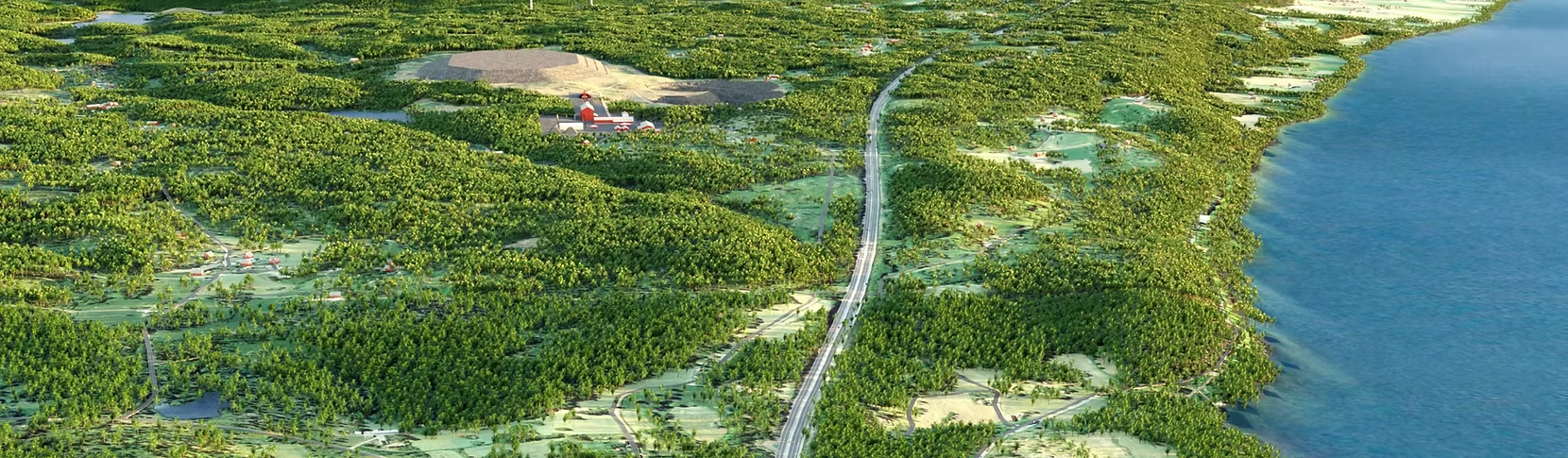
Norra Kärr is a rare earth and industrial minerals project in southern Sweden, close to the small town of Gränna on the eastern side of Lake Vättern, about 240km from Stockholm. The main north-south motorway runs close to the project area. Lake Vättern is roughly 1.5km away, which is why water management and footprint have been central to the project’s design and the permitting debate (see below).
The Norra Kärr intrusive complex has been known for more than a century. The PEA cites initial identification during Swedish geological mapping in 1906, with later industrial interest including work by Boliden in the mid-20th century. The deposit is an alkaline nepheline syenite complex. Rare earths are hosted mainly in eudialyte-group minerals, with associated Zr and Nb and a large nepheline syenite component. This not a typical bastnäsite or monazite system and metallurgy and downstream processing routes need to be established.
According to the PEA, Norra Kärr is not a single-product rare earth project. On an average annual basis, the PEA attributes around 74% of gross revenue to rare earth oxide products, with the balance coming from co-products: nepheline syenite (11.6%), ZrO2 (10.6%) and Nb2O5 (4.8%), before any toll treatment charge assumptions. Within the rare earth revenue stream, value is concentrated in the HREEs: Dy2O3 (43% of REO gross revenue), Nd2O3 (21%) and Tb2O3 (16%).
A 25-year mining lease was granted in 2013 and later revoked by Sweden’s Supreme Administrative Court in 2016 on procedural grounds tied to the supporting environmental assessment, which reset the permitting pathway. The PEA describes the project as still in a permitting-led phase.
What changed in the 2021 PEA design
The PEA’s central redesign is to keep the mine site to physical processing only (crush, grind and magnetic separation) and move chemical processing off-site. It presents this as a way to reduce the local footprint and simplify water and tailings handling versus earlier designs. In other words, it is a deposit that is being engineered to fit a sensitive setting, rather than assuming the setting will adapt to the mine.
Norra Kärr’s next priorities are licensing, permitting and downstream processing options. We see it likely that these can be advanced directly by management in conjunction with the Swedish government and potential commercial partners. The CRMA could help, but management can progress licensing and processing/offtake directly.
The term rare earths has become a generic catch-all for any mined element that is fashionably rare (in the same sense that many critical minerals are critical in the eye of the beholder, usually a specific producer lobby group). Rare earths are actually a defined set of elements (the lanthanides, atomic number 57 through 71 (see below), plus often scandium and yttrium). They are typically found together in nature and mined as a group. They are famously not rare, but not often found in economic concentrations. They are found in a broad range of mixes, and mining operations typically convert relatively small quantities of ore into a concentrate at the mine site, which then requires painstaking separation into individual rare earth compounds, typically oxides. China has come to dominate both mining and processing over the past 20 years.
General disclaimer and copyright
This report has been commissioned by Leading Edge Materials and prepared and issued by Edison, in consideration of a fee payable by Leading Edge Materials. Edison Investment Research standard fees are £60,000 pa for the production and broad dissemination of a detailed note (Outlook) following by regular (typically quarterly) update notes. Fees are paid upfront in cash without recourse. Edison may seek additional fees for the provision of roadshows and related IR services for the client but does not get remunerated for any investment banking services. We never take payment in stock, options or warrants for any of our services.
Accuracy of content: All information used in the publication of this report has been compiled from publicly available sources that are believed to be reliable, however we do not guarantee the accuracy or completeness of this report and have not sought for this information to be independently verified. Opinions contained in this report represent those of the research department of Edison at the time of publication. Forward-looking information or statements in this report contain information that is based on assumptions, forecasts of future results, estimates of amounts not yet determinable, and therefore involve known and unknown risks, uncertainties and other factors which may cause the actual results, performance or achievements of their subject matter to be materially different from current expectations.
Exclusion of Liability: To the fullest extent allowed by law, Edison shall not be liable for any direct, indirect or consequential losses, loss of profits, damages, costs or expenses incurred or suffered by you arising out or in connection with the access to, use of or reliance on any information contained on this note.
No personalised advice: The information that we provide should not be construed in any manner whatsoever as, personalised advice. Also, the information provided by us should not be construed by any subscriber or prospective subscriber as Edison’s solicitation to effect, or attempt to effect, any transaction in a security. The securities described in the report may not be eligible for sale in all jurisdictions or to certain categories of investors.
Investment in securities mentioned: Edison has a restrictive policy relating to personal dealing and conflicts of interest. Edison Group does not conduct any investment business and, accordingly, does not itself hold any positions in the securities mentioned in this report. However, the respective directors, officers, employees and contractors of Edison may have a position in any or related securities mentioned in this report, subject to Edison's policies on personal dealing and conflicts of interest.
Copyright 2026 Edison Investment Research Limited (Edison).
Australia
Edison Investment Research Pty Ltd (Edison AU) is the Australian subsidiary of Edison. Edison AU is a Corporate Authorised Representative (1252501) of Crown Wealth Group Pty Ltd who holds an Australian Financial Services Licence (Number: 494274). This research is issued in Australia by Edison AU and any access to it, is intended only for "wholesale clients" within the meaning of the Corporations Act 2001 of Australia. Any advice given by Edison AU is general advice only and does not take into account your personal circumstances, needs or objectives. You should, before acting on this advice, consider the appropriateness of the advice, having regard to your objectives, financial situation and needs. If our advice relates to the acquisition, or possible acquisition, of a particular financial product you should read any relevant Product Disclosure Statement or like instrument.
New Zealand
The research in this document is intended for New Zealand resident professional financial advisers or brokers (for use in their roles as financial advisers or brokers) and habitual investors who are “wholesale clients” for the purpose of the Financial Advisers Act 2008 (FAA) (as described in sections 5(c) (1)(a), (b) and (c) of the FAA). This is not a solicitation or inducement to buy, sell, subscribe, or underwrite any securities mentioned or in the topic of this document. For the purpose of the FAA, the content of this report is of a general nature, is intended as a source of general information only and is not intended to constitute a recommendation or opinion in relation to acquiring or disposing (including refraining from acquiring or disposing) of securities. The distribution of this document is not a “personalised service” and, to the extent that it contains any financial advice, is intended only as a “class service” provided by Edison within the meaning of the FAA (i.e. without taking into account the particular financial situation or goals of any person). As such, it should not be relied upon in making an investment decision.
United Kingdom
This document is prepared and provided by Edison for information purposes only and should not be construed as an offer or sol icitation for investment in any securities mentioned or in the topic of this document. A marketing communication under FCA Rules, this document has not been prepared in accordance with the legal requirements designed to promote the independence of investment research and is not subject to any prohibition on dealing ahead of the dissemination of investment research.
This Communication is being distributed in the United Kingdom and is directed only at (i) persons having professional experience in matters relating to investments, i.e. investment professionals within the meaning of Article 19(5) of the Financial Services and Markets Act 2000 (Financial Promotion) Order 2005, as amended (the "FPO") (ii) high net-worth companies, unincorporated associations or other bodies within the meaning of Article 49 of the FPO and (iii) persons to whom it is otherwise lawful to distribute it. The investment or investment activity to which this document relates is available only to such persons. It is not intended that this document be distributed or passed on, directly or indirectly, to any other class of persons and in any event and under no circumstances should persons of any other description rely on or act upon the contents of this document.
This Communication is being supplied to you solely for your information and may not be reproduced by, further distributed to or published in whole or in part by, any other person.
United States
Edison relies upon the "publishers' exclusion" from the definition of investment adviser under Section 202(a)(11) of the Investment Advisers Act of 1940 and corresponding state securities laws. This report is a bona fide publication of general and regular circulation offering impersonal investment-related advice, not tailored to a specific investment portfolio or the needs of current and/or prospective subscribers. As such, Edison does not offer or provide personal advice and the research provided is for informational purposes only. No mention of a particular security in this report constitutes a recommendation to buy, sell or hold that or any security, or that any particular security, portfolio of securities, transaction or investment strategy is suitable for any specific person.
London │ New York │ Frankfurt
20 Red Lion Street
London, WC1R 4PS
United Kingdom
Research: Real Estate
Target Healthcare REIT has reported another strong quarter, underpinned by organic rental growth, strong rent collection and arrears recovery. Around half of recent sales proceeds have been deployed, but significant available capital remains, more than matched by a strong pipeline of similarly attractive opportunities. Our unchanged forecasts point to acquisitions, in combination with indexed rent reviews, driving continuing earnings and DPS growth.