Last close As at 05/08/2026
—
— 0.00 (0.00%)
Market capitalisation
—
Research: Energy & Resources
In June 2019, Hurricane Energy successfully delivered first oil from the Lancaster early production system (EPS) on time and on budget. Initial production performance has been ahead of management expectations providing support for increasing the EPS production plateau from a current base case of 17kbd to c 30kbd from Q420/Q121. Key to achieving this would be access to gas export, together with success at the ongoing Lincoln Crestal well, 205/26b-14, in the Greater Warwick Area (GWA). In this note, we update our short-term oil price deck (continuing to use last published EIA short-term forecasts) and adjust operational metrics to reflect the latest company guidance. In addition, we increase our risking of GWA to reflect the results of the Warwick Deep exploration well and remove the risked value we had included for Halifax. Overall, these leave our valuation broadly unchanged at 102.8p/share (+0.5%).
Written by
Hurricane Energy |
Lancaster EPS performing above expectations |
Capital markets day |
Oil & gas |
30 July 2019 |
Share price performance
Business description
Next events
Analysts
Hurricane Energy is a research client of Edison Investment Research Limited |
|||||||||||||||||||||||||||||||||||||||||||||||||||||
In June 2019, Hurricane Energy successfully delivered first oil from the Lancaster early production system (EPS) on time and on budget. Initial production performance has been ahead of management expectations providing support for increasing the EPS production plateau from a current base case of 17kbd to c 30kbd from Q420/Q121. Key to achieving this would be access to gas export, together with success at the ongoing Lincoln Crestal well, 205/26b-14, in the Greater Warwick Area (GWA). In this note, we update our short-term oil price deck (continuing to use last published EIA short-term forecasts) and adjust operational metrics to reflect the latest company guidance. In addition, we increase our risking of GWA to reflect the results of the Warwick Deep exploration well and remove the risked value we had included for Halifax. Overall, these leave our valuation broadly unchanged at 102.8p/share (+0.5%).
Year-end |
Revenue |
EBITDA |
Operating |
Capex* |
Net debt/ |
12/17 |
0.0 |
(14.6) |
(8.1) |
(265.7) |
(133.5) |
12/18 |
0.0 |
(12.6) |
(4.4) |
(209.9) |
103.4 |
12/19e |
113.2 |
68.1 |
23.4 |
(35.6) |
115.6 |
12/20e |
365.0 |
256.8 |
235.6 |
(59.5) |
(60.6) |
Note: *Capex is net of carried investment by Spirit Energy.
Supportive Lancaster EPS start-up performance
The two producing Lancaster wells, 205/21a-6 and 205/21a-7Z, have benefited from longer clean-up periods and are producing at higher rates than seen during drill stem testing (DST), with improved reservoir characteristics. This performance uplift has resulted in Hurricane increasing its target production guidance envelope to an upper target of 20kbd from 2020, with the base case remaining at 17kbd (net of operational downtime). A minimum period of production of six to 12 months is now required to prove long-term production performance.
Lincoln Crestal: Expected tieback to Aoka Mizu
Drilling is underway at the Lincoln Crestal well, 205/26b-14, and is expected to be tied back to the Aoka Mizu in 2020 with first oil in Q420/Q121 for long-term production in the event of success. Meanwhile, work is progressing on a gas export solution, which would allow the realisation of the full potential of debottlenecked capacity and allow gross, post-uptime targeted production of c 34kbd.
Valuation: Updated GWA risking
Key changes include updated EPS operational cost assumptions, a higher Lancaster crude discount, and an increase in our risking assumption for GWA to reflect the non-commercial flow seen at Warwick Deep. We also removed our risked value for a standalone Halifax development. Our short-term Brent forecasts are re-based to the EIA’s latest published forecasts (Brent moves from $62.8/bbl to $66.5/bbl in FY19, and from $62.0/bbl to $67.0/bbl in FY20). Our long-term (2022 onwards) Brent assumption remains $70/bbl. The share count also has been updated. Our risked valuation stands at 102.8p/share, or 38.5p/share excluding any value beyond Lancaster EPS.
Investment summary
Confirming initial fractured basement productivity
Hurricane specialises in the discovery, appraisal and development of fractured basement reservoirs and has discovered 523mmbbl 2P reserves and 2C resources (RPS 2017 CPR) of recoverable oil at the Lancaster field, West of Shetland. Lancaster came on-stream in June 2019 and is a play-opening development, being the first field to produce from fractured basement on the UK Continental Shelf (UKCS). The company is now gathering reservoir data from the field to clarify the ultimate potential of its Rona Ridge assets, which includes discoveries at Whirlwind, Lincoln and Halifax, and gross prospective resources in excess of 2.5bnboe, but initial results are extremely positive, with better production rates and reservoir characteristics than anticipated. In addition, Hurricane is progressing the exploration and appraisal of the GWA, with a three-well drilling programme ongoing, having been accelerated into 2019 by a farm-in agreement with Spirit Energy in 2018.
Valuation: 0.5% increase in RENAV to 102.8p/share
In our base case, we use RPS reserve and resource estimates, management operational cost guidance and internal capital cost estimates for future full-field developments. Our valuation is based on our long-term oil price of $70/bbl (from 2022) and Edison uses a base case 12.5% discount rate. In addition to the development of Lancaster, we include a risked value for resources under appraisal at GWA in our RENAV of 102.8p/share. Key areas of uncertainty other than commodity prices include uptime assumptions and reservoir performance for full field development.
Financials: Funds available for further exploration & GWA FFD
In this note, we highlight Hurricane’s potential to fund capital commitments including net GWA full-field development capex from a combination of existing cash resources, cash flow from EPS, and existing cost-carry arrangements. Our base case assumes farm-down of Lancaster full field development (FFD) for a full cost carry; based on a farminee IRR of 20%, we estimate Hurricane would retain a 46% working interest.
Sensitivities: Possible Lancaster EPS upside
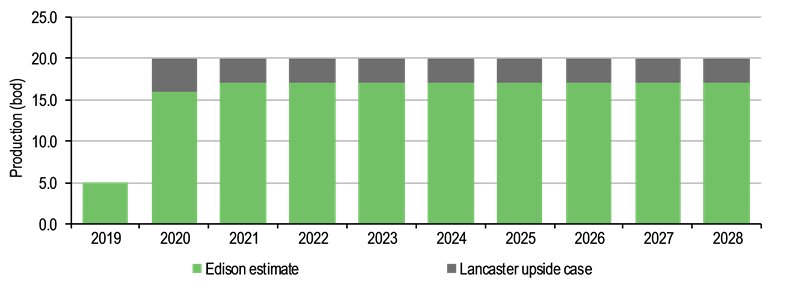
Hurricane has observed better than expected well performance in 205/21a-6 and 205/21a-7Z, and as a result, the company now includes a possible upside case of 20kbd in its production guidance from 2020. Hurricane’s base case remains at 17kbd net of operating efficiency.
|
Exhibit 1: Edison Lancaster EPS base case vs management’s upside scenario* |
|
|
Source: Edison Investment Research. Note: *Excludes net GWA tieback volumes, and does not assume full use of the Aoka Mizu or the debottlenecked capacity. |
Lancaster EPS: Gathering data for full field development
The EPS will provide dynamic reservoir data to enhance Hurricane’s understanding of the Lancaster reservoir characteristics and validate its resource estimate for the Greater Lancaster Area (GLA). Hurricane's guidance includes a period of increasing production over the first six months, as production efficiency of the redeployed FPSO improves towards its long-term target of 85%. Preliminary flow and build-up tests carried out during the start-up have been highly encouraging and Hurricane has increased its target production guidance range to an upper target of 20kbd from 2020, with the base case remaining at 17kbd. The company expects it will now need six to 12 months of stable production to assess whether the reservoir performance is corresponding to the current reservoir model.
Potential reserves uplift to more than 100mmboe in 2020
In the near term, the company has the potential to significantly increase 2P reserves from the current 37mmboe to over 100mmboe in 2020. This can be achieved by extending the vessel lease, and through a combination of de-bottlenecking and tieback of an additional producer increasing net output to Hurricane through the Aoka Mizu FPSO to c 30kbd. A key consideration will be a gas export solution, in order to minimise the need for gas flaring. Work has commenced on reinstating the gas compression system on the Aoka Mizu together with a tie-in to the West of Shetland Pipeline System (WOSPS) to evacuate the GLA and GWA associated gas.
Lancaster EPS start-up: Positive initial results
Having successfully brought the EPS on-stream on time and budget in June 2019, attention is now focused on Lancaster production performance, data gathering and flow assurance. Results to date have exceeded Hurricane’s forecasts across all aspects of the project, including production, reservoir data and facilities performance. Initial production data supports the company’s reservoir model, and reservoir performance to date is at the higher end of management expectations. Based on these positive results, Hurricane has increased its production guidance envelope to an upside of 20kbd, which it believes it can achieve from 2020. At the company’s capital markets day on 11 July 2019, management addressed the topic of water production from the Lancaster 7Z well. Management believes that this is consistent with the production of perched water production rather than aquifer, as indicated by the early appearance and water cut not being production rate dependent.
Positive well performance drives production guidance upside
The two producing Lancaster wells, 205/21a-6 and 205/21a-7Z, had been shut in since DSTs was carried out in 2014 and 2016, respectively. The wells have been cleaning up since they were drilled. Hurricane was able to carry out longer flow and shut-in periods during start-up than during DST and the wells are now performing better than when initially tested.
|
Exhibit 2: Summary of EPS start-up phase expectations/results |
|
|
Source: Hurricane Energy |
Post-start-up, wells 6 and 7Z produced at higher rates under natural flow than was achieved using electric submersible pumps (ESPs) during the DSTs, and so, at this stage, artificial lift has not been necessary. The production rate of c 16.50kbd in each well is also far more than that seen under natural flow pre-start-up, when well 6 produced 5.30kbd and well 7Z produced 6.52kbd. This difference is attributed mainly to the ability to flow for longer periods than during the DSTs, ensuring better clean-up of the wells, and gives a more accurate picture of well performance. Also notable is the increased productivity index (PI) seen during start-up. The PI is defined as the flow rate per unit of pressure drop and is an indicator of the production potential of a well. Already at world-class levels pre-start-up, the PIs have increased due to the lower drawdown required to produce the wells compared to pre-start-up. This ability to minimise drawdown mitigates the risk of water coning and facilitates the piston displacement of reservoir fluids, maximising recovery.
Pressure build-up data indicates that well 6 is contacting major joints in the reservoir, and well 7Z is accessing several well-connected fractures away from the wellbore and no pressure barriers have been identified in the area surrounding the wells. The proximity of the wells to each other (c 350m apart at basement entry, c 850m at the toe of the horizontal section) is also allowing interference data to be evaluated (a pressure pulse created in one well can be picked up by downhole gauges in the other well). This indicates that the wells are very well connected, and that interference is occurring rapidly, but further work will be required for the data to be fully integrated and analysed. However, although preliminary data indicates a well-connected reservoir, it is also possible that the two wells could act as a single wellbore, and we believe Hurricane will look to manage increases in flow rates carefully, particularly in reference to the combined rate.
The high-resolution gauges in the wells are also providing pressure measurements that can be used to refine the oil gradient and the estimate of the deepest oil-water contact (OWC). Pressure data acquired by high-resolution gauges during the EPS start-up point to an OWC of 1,686m true vertical depth SS (TVDSS), 8m deeper than the 1,678m TVDSS assumed in the 2017 competent person’s report (CPR) high case. This is consistent with log data and gas chromatography ranges, though it is too early to adjust reserves figures at this stage.
As a result of the improved performance characteristics, Hurricane now includes an upside of 20kbd to its production guidance range from 2020, with the base case remaining at 17kbd net of operating efficiency.
It is expected that at least six to 12 months of production will be required before an assessment can be made as to how the bottom hole pressure is evolving and so determine which of the company’s three simulated cases (of base, high and low case) is most relevant. Our modelling currently assumes Hurricane’s base case.
Water production: Low levels of trapped water
Shortly after start-up, 205/21a-7Z began producing water at c 8% water cut, while producing oil at 16.5kbd. Current evidence points to this being trapped formation water, which is known to occur in basement reservoirs and is typically maintained at low rates. For example, the Bach Ho basement field in Vietnam produced trapped water at water cuts of up to 4% over a period of 10 years as shown in Exhibit 3. Lancaster was originally filled with water, which was displaced as oil filled in from the top down, but this process left isolated water pockets trapped within the oil column – Exhibit 4. It is difficult to assess the amount and distribution of this water, but the 2017 RPS CPR estimated that the water saturation in Lancaster was in the order of 5–10% in the best-case scenario.
|
Exhibit 3: Bach Ho field performance |
|
|
Source: Hurricane Energy (based on C&C Reservoirs data) |
As the water cut occurred very shortly after Lancaster came on-stream and does not vary with changes in drawdown, the evidence supports it being from trapped water and not early breakthrough of aquifer water. The wells are designed to mitigate against early aquifer water breakthrough by being positioned at a significant distance from the OWC and by producing at low drawdowns.
|
Exhibit 4: 205/21a-7Z trapped water schematic |
|
|
Source: Hurricane Energy |
Flow assurance: No evidence of significant wax deposition
A key element of ensuring optimum flow performance through the subsea infrastructure and surface facilities is the ability to manage wax deposition through the implementation of a wax management philosophy. Lancaster crude has a wax appearance temperature between 33°C and 37°C, some 20°C lower than the reservoir temperature. Hurricane is employing a range of strategies to minimise wax deposition and has been fine-tuning these alongside production parameters in order to achieve this.
Preliminary results indicate that these strategies are working successfully, with no evidence at this stage of significant wax deposition. The injection of wax inhibition/dissolver chemicals at the wellhead is having a demonstrable effect on the pour point of the crude and the subsea insulation is delivering high fluid arrival temperatures at the FPSO. Finally, regular pigging of the system during start-up indicates very low levels of wax deposition.
GWA: On track for first oil in Q420/Q121
The accelerated three-well drilling programme on the GWA has been underway since April 2019, with work on the Warwick Deep well completed and the Lincoln Crestal well spudding on 12 July. The programme was designed to assess the GWA by drilling a well in each of three potential separate fault compartments across the area and to gather data to support a 500mmboe FFD sanction in 2021.
|
Exhibit 5: GWA well locations map |
|
|
Source: Hurricane Energy |
Warwick Deep, 205/26b-13Z, encountered oil in a 712m horizontal section drilled below structural closure at 1,964m TVDSS. The well did not experience major fluid losses during drilling, suggesting that the wellbore did not intersect any major fractures. A DST was carried out on the well, but it flowed at low rates of 600bpd and 400bpd over two main flow periods and produced a mixture of brine, water and trace oil. This flow required the use of an ESP and a significant drawdown of 1,000psi. Pressure build-up analysis indicates that the flow is likely to have been coming from a single fracture, or group of fractures acting as a single fracture. The well is believed to have intersected a poorly connected section of the fracture network within the oil column and the well has been plugged and abandoned.
Further work is ongoing to understand the outcome of the well, but it is too early to fully understand the implications of the result and its impact on volumetrics. It is possible that similar unconnected zones could exist in Lancaster and Lincoln, but to date, the reservoir sections penetrated in those fields have seen extensive fracturing.
|
Exhibit 6: Warwick reservoir characteristics |
|
|
Source: Hurricane Energy |
The Transocean Leader is now drilling the Lincoln Crestal well, 205/26b-14, which, if successful, will be tied back to the Aoka Mizu and is targeting first oil in Q420/Q121.
Near-term ramp-up to c 30kbd net to Hurricane
Having demonstrated that the existing wells can deliver above the base case forecast, Hurricane is looking to further increase net production through the Aoka Mizu to c 30kbd. This is expected to be delivered with the tieback of a GWA well to the FPSO and a gas export solution, which are both targeting a start date of Q420/Q121, subject to joint venture final investment decision (FID) and regulatory consents. Contracting and engineering activity is progressing on schedule to allow tieback activity in the summer of 2020 pending FID in Q419. The GWA tieback is expected to deliver a gross rate of 10kbd, with 5kbd net to Hurricane.
|
Exhibit 7: GWA forward timetable |
|
|
Source: Hurricane Energy |
A gas export solution will lift current production restrictions due to flaring limits. The company appears to be progressing a tie-in to the BP-operated West of Shetlands pipeline system (WOSPS). This will require the addition of gas export compression at the Aoka Mizu, a c 11km flow line to WOSPS and subsea equipment to enable the tie into the WOSPS pipeline end manifold (PLEM).
Beyond the GWA tieback, Hurricane is targeting full field FID for GWA Phase 1 in 2021 and for GLA Phase 1 in 2022.
|
Exhibit 8: Outlook for growth in reserves and production |
|
|
Source: Hurricane Energy |
Management
Steven McTiernan (chairman) has over 45-years of oil and gas industry and investment banking experience. He was a non-executive director of Tullow Oil for 11 years until December 2012 and served as its senior independent director. His oil and gas industry experience includes roles at Iraq Petroleum, Amoco, BP and Mesa, and his banking experience includes senior roles leading energy teams at the Chase Manhattan Bank, NatWest Markets and CIBC. He has served as an independent director at First Quantum Minerals and Songa Offshore SE and is chairman of Kenmare Resources. He holds an MA in natural sciences from the University of Cambridge.
Dr Robert Trice (CEO), Hurricane’s founder, has over 25-years’ experience in the oil industry. He has combined specialist technical expertise in the characterisation and evaluation of fractured reservoirs. He has a PhD in geology from Birkbeck College, University of London and gained the bulk of his geoscience experience with Enterprise Oil and Shell. He has worked in field development, exploration, well site operations and geological consultancy. Robert has held the position of visiting professor at Trondheim University (Norway) and has published and presented on subjects related to fractured reservoirs and exploration for stratigraphic traps. It is Robert’s vision that lies behind Hurricane, providing clear strategic direction as the company develops, and he takes the lead in all aspects of the scientific and technical heart of the company.
Alistair Stobie (CFO) has significant capital markets and oil and gas industry experience. He was previously director of finance at AIM-listed Zoltav Resources and CFO at Oando Exploration & Production. Prior to this, Alistair founded Volga Gas, where he was CFO and led its IPO to raise $135m, and Pan-Petroleum, which acquired an interest in the multi-billion-barrel oil in place Mengo-Kundji-Bindi licence in Congo-Brazzaville. During his career, Alistair has been actively involved in numerous corporate transactions including fund-raisings, M&A and the acquisition and disposal of licence interests.
Neil Platt (COO) has more than 20-years’ experience in the oil industry and has worked for Amoco, BG and Petrofac. He has completed assignments both in the UK and internationally, working in a variety of engineering, commercial and management roles including production asset manager for BG and vice president for project delivery in Petrofac Production Solutions. Neil joined Hurricane in 2011 and was appointed to the board in 2013. As chief operations officer, he is responsible for daily operations and asset delivery (drilling and projects).
Valuation
Our risked valuation is broadly unchanged at 102.8p/share, or 38.5p/share excluding any value beyond Lancaster EPS. We highlight key changes to our valuation below and include an indication of the value uplift if we were to increase the Lancaster EPS production plateau to 20kbd from 17kbd.
The main changes in our modelling assumptions are:
■
We update the share count to reflect the current number of shares in issue.
■
We update our opex assumptions based on guidance provided by management at the company’s CMD. Opex is assumed at $30/bbl (based on an oil price of $66.5/bbl) in 2019, decreasing to c $20/bbl in 2020 for the Lancaster EPS.
■
We update our short-term capex projections to reflect Hurricane guidance, but continue to use Edison internal assumptions for the timing of GWA (first oil 2025) and GLA FFD (first oil 2027).
■
Edison’s short-term Brent assumptions move from $62.8/bbl to $66.5/bbl in FY19, and from $62.0/bbl to $67.0/bbl in FY20, based on EIA forecasts as published in July 2019. Our long-term Brent forecast of $70/bbl from 2022 remains unchanged. The average price differential for Lancaster crude is yet to be established; only two cargoes have been sold to date. We had previously assumed a 5% discount to Brent, which we have modified to a $4.50/bbl discount to Brent. This is a wider discount based on our Brent price deck and may turn out to be conservative. We expect to update this assumption once there is incremental data on actual cargo sales and price realisations.
■
We increase the risking we apply for GWA to reflect the non-commercial flow seen at Warwick Deep. We have decreased the commercial chance of success from 72% to 64%. We do not believe the result of Warwick Deep should have a material impact on the GWA tieback risking, since a discovery in Lincoln has been confirmed and the tieback is only targeting c 20mmbl of the previously estimated 500mmbbl for the GWA.
■
In this update, we have removed the risked value for the standalone development of Halifax. A standalone development is not currently part of Hurricane’s forward plans and development would be possibly tied to the wider development of GLA resource.
Exhibit 9: Hurricane valuation breakdown
Country |
Diluted WI |
CCoS |
Recoverable reserves |
NPV/boe |
Net risked |
Value per share |
||
Asset |
Gross |
Net |
||||||
Net cash FY18* |
124 |
3.8 |
||||||
SG&A (three years) |
(24) |
(0.7) |
||||||
Lancaster EPS – 10 years |
UK |
100% |
100% |
57 |
57 |
20.0 |
1,147 |
35.4 |
Core NAV |
|
|
|
57 |
57 |
1,247 |
38.5 |
|
Lancaster FFD (post-EPS)** |
UK |
46% |
81% |
451 |
207 |
7.6 |
1,272 |
39.2 |
Contingent RENAV |
|
|
|
451 |
207 |
1,272 |
39.2 |
|
GWA tieback (carried) |
UK |
50% |
64.0% |
23 |
11 |
15.7 |
115 |
3.5 |
GWA FFD (part carried) |
UK |
50% |
42.0% |
478 |
239 |
7.0 |
700 |
21.6 |
Total inc exploration RENAV |
|
|
|
1,009 |
515 |
3,333 |
102.8 |
|
Source: Edison Investment Research. Note: *NOSH: 2,432.5, assumes conversion of convertible debt. **Assumes farm-down and carry, 20% IRR.
Our valuation of Hurricane is highly sensitive to oil price assumptions. In our base case, we use the EIA’s short-term forecasts ($66.5/bbl Brent in 2019 and $67.0/bbl in 2020) and a long-term oil price of $70/bbl (from 2022).
We note that in our oil price sensitivity, our assumptions of farm-out terms for Lancaster full field development remain unchanged. In reality, we would expect farm-down terms to improve as oil prices rise. We continue to assume a development farm-down assuming a farminee 20% IRR.
We also note that even in the event of a 20% decrease in our oil price expectations, our total RENAV would stand at 80p/share, 78% higher than the current share price. We expect a positive result from the Lincoln Crestal well to help the price disconnect from valuation to close.
|
Exhibit 10: Hurricane risked valuation sensitivities |
Exhibit 11: Hurricane RENAV waterfall |
|
|
|
Source: Edison Investment Research |
|
Exhibit 10: Hurricane risked valuation sensitivities |
|
|
Source: Edison Investment Research |
|
Exhibit 11: Hurricane RENAV waterfall |
|
|
Source: Edison Investment Research |
Lancaster wells overperformance scenario
As a result of the preliminary flow and build-up tests carried out during the start-up results at Lancaster EPS, we thought it would be sensible to test the impact of an increased upper target of 20kbd from 2020. We note that even though Lancaster wells are performing above expectations, Hurricane’s base case remains at 17kbd. The company expects it will now need six to 12 months of production to assess if the reservoir performance is corresponding to the current reservoir model. We have not changed our EPS uptime estimates, which are marginally below company guidance (guidance 85%) in FY20, and will update once further EPS production history becomes available.
As shown in Exhibits 12 and 13 below, an increase in the production target from 17kbd to 20kbd would lead to an increase of our total RENAV of 6.0p/share from 102.8p/share to 108.8p/share.
|
Exhibit 12: Upside scenario vs Edison estimate |
Exhibit 13: Impact of the upside case on waterfall |
|
|
|
Source: Edison Investment Research |
|
Exhibit 12: Upside scenario vs Edison estimate |
|
|
Source: Edison Investment Research |
|
Exhibit 13: Impact of the upside case on waterfall |
|
|
Source: Edison Investment Research |
Risks
Hurricane is subject to several sector-specific and company-specific risks. We highlight the key risks below.
Sector risks
Generic sector risks include:
■
commodity price volatility;
■
geological risk and uncertainty and reservoir performance uncertainty;
■
recent studies on project execution in the upstream oil and gas sector suggest that up to 60% of projects incur delays and capex overruns versus FID expectations;
■
small-/mid-cap availability of funding: while we include the potential dilutive impact of equity funding and farm-downs in our valuation, if the cost of capital implied by equity financing or farm-downs is higher than our estimates, this would lead to additional equity NAV/share dilution; and
■
volatility in service sector availability and pricing.
Company-specific risks
Company-specific risks include:
■
Asset concentration: the bulk of Hurricane’s value is based on one large asset. If this asset was impaired for any reason, it would have a material impact on Hurricane’s share price.
■
Geographical concentration: Hurricane is 100% exposed to the UKCS and petroleum fiscal terms, which have been volatile over the last decade. While tax terms and capital allowances are currently favourable versus other mature basins, there is no certainty they will not change if oil prices rise significantly from current levels, potentially reducing equity holder leverage to a rising oil price.
■
Funding risks: Hurricane is reliant on being able to attract additional capital to progress the Lancaster FFD and, as such, valuation will be sensitive to the financing availability and terms.
Financials
Short-term financial forecasts will be driven by timing, initial performance of the Lancaster EPS and the Brent price. Consequently, there is significant uncertainty in precise forecasts of revenues and cash flows for FY19. We expect FY20 to be more reflective of the stabilised cash generation potential of the EPS development phase.
The GWA farm-down provides Hurricane with a large portion of the upfront capital expenditure funded, while Lancaster EPS cash flows will provide for appraisal and development of the rest of the portfolio.
Hurricane remains relatively unlevered, with the company’s only debt being a $230m convertible bond due in 2022 bearing interest of 7.5% and convertible at $0.52/share. We assume the bond converts in our RENAV, treating this debt instrument as equity. Below we look at a cash flow bridge, which highlights Hurricane’s potential to fund capital commitments through to end 2021 from a combination of existing cash resources, cash flow from EPS operations and existing cost-carry arrangements.
|
Exhibit 14: end FY18 to end FY21 cash flow bridge* |
|
|
Source: Edison Investment Research. Note: *Outstanding convertible bond of $230m due in 2022 if not redeemed prior to maturity. |
Exhibit 15: Financial summary
|
$m |
|
2017 |
2018 |
2019e |
2020e |
2021e |
Year-end 31 December |
|
|
IFRS |
IFRS |
IFRS |
IFRS |
IFRS |
PROFIT & LOSS |
|||||||
Revenue |
|
|
0.0 |
0.0 |
113.2 |
365.0 |
496.3 |
Operating Expenses |
(14.6) |
(12.7) |
(79.6) |
(196.8) |
(227.6) |
||
EBITDA |
|
|
(14.6) |
(12.6) |
68.1 |
256.8 |
372.3 |
Operating Profit (before amort. and except.) |
|
(14.6) |
(12.7) |
43.5 |
178.2 |
278.6 |
|
Exploration expenses |
(10.4) |
0.0 |
0.0 |
0.0 |
0.0 |
||
Exceptionals |
10.4 |
(42.4) |
0.0 |
0.0 |
0.0 |
||
Other |
0.0 |
0.0 |
0.0 |
0.0 |
0.0 |
||
Operating Profit |
(14.6) |
(55.0) |
43.5 |
178.2 |
278.6 |
||
Net Interest |
7.6 |
(5.9) |
(21.1) |
(21.2) |
(21.1) |
||
Profit Before Tax (norm) |
|
|
(7.0) |
(18.5) |
22.4 |
157.1 |
257.5 |
Profit Before Tax (FRS 3) |
|
|
(7.0) |
(60.9) |
22.4 |
157.1 |
257.5 |
Tax |
0.0 |
0.0 |
10.0 |
0.0 |
(15.2) |
||
Profit After Tax (norm) |
(7.0) |
(18.5) |
32.4 |
157.1 |
242.3 |
||
Profit After Tax (FRS 3) |
(7.0) |
(60.9) |
32.4 |
157.1 |
242.3 |
||
Average Number of Shares Outstanding (m) |
1,583.8 |
1,959.6 |
1,990.2 |
1,990.2 |
1,990.2 |
||
EPS - normalised (c) |
|
|
(0.4) |
(2.2) |
(2.5) |
12.9 |
13.9 |
EPS - normalised and fully diluted (c) |
|
(0.4) |
(2.2) |
3.7 |
17.9 |
27.6 |
|
EPS - (IFRS) (c) |
|
|
(0.4) |
(3.1) |
1.6 |
7.9 |
12.2 |
Dividend per share (p) |
0.0 |
0.0 |
0.0 |
0.0 |
0.0 |
||
Gross Margin (%) |
NA |
NA |
29.6 |
46.1 |
54.1 |
||
EBITDA Margin (%) |
NA |
NA |
60.2 |
70.4 |
75.0 |
||
Operating Margin (before GW and except.) (%) |
NA |
NA |
38.5 |
48.8 |
56.1 |
||
BALANCE SHEET |
|||||||
Fixed Assets |
|
|
587.9 |
884.2 |
870.9 |
851.9 |
1,109.6 |
Intangible Assets |
126.4 |
131.5 |
131.5 |
131.5 |
131.5 |
||
Tangible Assets |
445.3 |
728.2 |
739.2 |
720.2 |
977.9 |
||
Investments |
16.3 |
24.5 |
0.2 |
0.2 |
0.2 |
||
Current Assets |
|
|
350.1 |
106.0 |
124.6 |
300.7 |
285.3 |
Stocks |
1.4 |
4.6 |
11.1 |
11.1 |
11.1 |
||
Debtors |
4.7 |
2.6 |
2.6 |
2.6 |
2.6 |
||
Cash |
343.9 |
98.9 |
111.0 |
287.1 |
271.7 |
||
Other |
0.0 |
0.0 |
0.0 |
0.0 |
0.0 |
||
Current Liabilities |
|
|
(28.8) |
(55.1) |
(28.0) |
(28.0) |
(28.0) |
Creditors |
(28.8) |
(55.1) |
(28.0) |
(28.0) |
(28.0) |
||
Short term borrowings |
0.0 |
0.0 |
0.0 |
0.0 |
0.0 |
||
Long Term Liabilities |
|
|
(226.7) |
(307.0) |
(307.0) |
(307.0) |
(307.0) |
Long term borrowings |
(191.1) |
(198.4) |
(198.4) |
(198.4) |
(198.4) |
||
Other long term liabilities |
(35.6) |
(108.7) |
(108.7) |
(108.7) |
(108.7) |
||
Net Assets |
|
|
682.5 |
628.1 |
660.5 |
817.6 |
1,059.9 |
CASH FLOW |
|||||||
Operating Cash Flow |
|
|
(8.1) |
(4.4) |
23.4 |
235.6 |
336.0 |
Cash tax paid |
0.0 |
0.0 |
0.0 |
0.0 |
0.0 |
||
Capex |
(265.7) |
(209.9) |
(35.6) |
(59.5) |
(351.5) |
||
Acquisitions/disposals |
0.0 |
0.0 |
0.0 |
0.0 |
0.0 |
||
Financing |
301.2 |
(17.2) |
0.0 |
0.0 |
0.0 |
||
Dividends |
0.0 |
0.0 |
0.0 |
0.0 |
0.0 |
||
Net Cash Flow |
27.4 |
(231.5) |
(12.2) |
176.1 |
(15.4) |
||
Opening net debt/(cash) |
|
|
(98.1) |
(133.5) |
103.4 |
115.6 |
(60.6) |
HP finance leases initiated |
0.0 |
0.0 |
0.0 |
0.0 |
0.0 |
||
Other |
8.0 |
(5.3) |
(0.0) |
0.0 |
0.0 |
||
Closing net debt/(cash) |
|
|
(133.5) |
103.4 |
115.6 |
(60.6) |
(45.1) |
Source: Hurricane Energy, Edison Investment Research
|
|||||||||||||||||||||||||||||||||||||||||||||||
|
|
Research: Industrials
Carbios’s enzyme-based technology for the decomposition of plastic polymers is well placed to exploit the trend for the minimisation of plastic waste. With a strengthened financial position post the recent rights issue and an explicit timetable for the deployment of its technology, Carbios continues its transformation from a research body into a commercial enterprise. Our DCF model indicates a valuation of €13/share.