Last close As at 05/08/2026
EUR21.35
▲ 0.05 (0.23%)
Market capitalisation
EUR376m
Research: Investment Companies
Deutsche Beteiligungs (DBAG) reported a 5.9% NAV (defined as equity per share) increase in Q121 (ending December 2020) driven by the improved earnings prospects of its portfolio companies across sectors. Fee income improved markedly to €11.1m (Q120: €7.4m) as DBAG Fund VIII started investing in August 2020 and management’s guidance for FY21 remains €42–44m (vs €30.6m in FY20). DBAG sees a number of opportunities and is likely to be a net investor in FY21, including deals alongside its funds (it has €0.9bn of third-party capital ready to deploy) and long-term financing fully from its own balance sheet.
Deutsche Beteiligungs |
Improving earnings outlook across the portfolio |
Investment companies |
16 February 2021 |
Analysts
|
||||||||||||||||||||||||||||||||||||||||||||||||||||||||||||||
Deutsche Beteiligungs (DBAG) reported a 5.9% NAV (defined as equity per share) increase in Q121 (ending December 2020) driven by the improved earnings prospects of its portfolio companies across sectors. Fee income improved markedly to €11.1m (Q120: €7.4m) as DBAG Fund VIII started investing in August 2020 and management’s guidance for FY21 remains €42–44m (vs €30.6m in FY20). DBAG sees a number of opportunities and is likely to be a net investor in FY21, including deals alongside its funds (it has €0.9bn of third-party capital ready to deploy) and long-term financing fully from its own balance sheet.
|
DBAG’s transaction opportunities remain high in Q121 |
|
|
Source: DBAG |
Why consider Deutsche Beteiligungs?
DBAG is a well-established player in the German private equity (PE) mid-market segment. The company has been increasing its exposure to new ‘growth’ sectors, which currently make up 41% of its portfolio and have proved resilient to the COVID-19 crisis. In particular, these include broadband/telecom businesses (31%) which are a play on the secular trend of a network rollout in Germany. At the same time, DBAG’s industrial portfolio (currently valued slightly below acquisition cost on average) may appeal to investors seeking exposure to cyclical value companies that could benefit from a broader economic recovery.
The analyst’s view
■
While the high level of PE dry powder means increased competition for private assets (pushing up valuations in most sought-after sectors), DBAG’s expertise in sourcing deals from founders and families is a competitive advantage.
■
Although DBAG’s MBO activity in Q121 involved only the completion of the €24m congatec deal (agreed in August 2021), its portfolio companies were quite active with six add-on acquisitions and one spin-off agreed in the period.
■
Management is in advanced negotiations on two realisations, with another one at an early stage. Based on DBAG’s Q121 analyst call, we expect that at least one relates to a holding from its broadband/telecom portfolio (which on average is valued at a healthy 2.5x cost).
DBAG’s near-term funding needs are secured by its current liquidity (including the undrawn part of its credit lines) and expected exits, but it is considering external financing options to fuel its mid-term investment agenda.
Q121 results: Improved portfolio earnings outlook
DBAG reported a net income of €24.9m in Q121 ending December 2020 (Q120: net loss at €0.2m), assisted by the €20.1m profit from its PE investments segment. This was assisted mostly by the improved earnings expectations of its portfolio companies (€54.9m) while the average listed peer multiples contraction reduced valuations by €28.8m (76% of DBAG’s portfolio at end-FY20 was valued using the peer multiples comparison). The contraction in average multiples was caused by the increase in analyst consensus estimates being sharper than the share price rally towards the end of the year following the emergency approval of COVID-19 vaccines. We note that management had flagged previously that valuation multiples for some of the industrial companies were relatively high and difficult to sustain. Overall, DBAG’s net portfolio valuation rose by €36.8m in Q121.
The fund services segment delivered solid fee income of €11.1m (+50% y-o-y). The increase is attributable mostly to fees from the DBAG Fund VIII collected since the start of its investment period in August 2020. Management continues to guide to FY21 fee income of €42–44m. We described the new fund in detail in our January 2020 note.
Exhibit 1: Net gains and losses on portfolio measurement and derecognition (€m)
Q121 |
Q120 |
|
Changes in fair value of unlisted investments |
35.5 |
(1.5) |
Change in earnings |
54.9 |
(4.9) |
Change in debt |
5.8 |
(1.5) |
Change in multiples |
(28.8) |
5.1 |
Change in exchange rates |
(0.1) |
0.1 |
Change, other |
3.7 |
(0.3) |
Net result of disposal |
0.9 |
0.3 |
Other |
0.4 |
1.3 |
Total |
36.8 |
0.0 |
Source: DBAG
Consequently, we calculate net valuation movements and fee income added €2.64 and €0.72 per share to DBAG’s NAV during the period respectively. Operating costs increased 28% y-o-y to €0.82 per share on the back of higher personnel expenses. DBAG has been recently expanding its investment team and also booked higher provisions for variable remuneration on the back of a much stronger quarter than Q120. As a result, DBAG’s NAV went up by 5.9% to €29.82 per share, compared to LPX Europe Index’s NAV increasing by 3.1% and the FY21 NAV growth of 1–12% implied by management’s current guidance (adjusted for the guided €0.80 dividend per share paid for FY20).
|
Exhibit 2: DBAG’s Q121 NAV* performance to end-December 2020 (€/share) |
|
|
Source: DBAG, Edison Investment Research. Note: *NAV defined as equity per share |
DBAG announced on 15 January that it anticipated a Q121 net income significantly above that of the prior year, as it had previously expected gross gains on measurement and derecognition of €30–40m (vs €36.8m actual). Here, we note that DBAG’s quarterly net income is volatile as it is dependent on PE portfolio valuation changes, which are influenced by the performance of public equity markets, as well as by DBAG’s investment realisation timelines. Pursuant to Article 17 (public disclosure of inside information) of the EU market abuse regulation (MAR), DBAG as a listed company is obliged to publicly announce if it expects a considerable y-o-y change in reported net profit. Having said that, DBAG itself focuses on long-term returns and highlights that its quarterly earnings are less meaningful when evaluating its performance.
Market outlook: PE market regaining momentum
We believe the top PE funds are well positioned to seek further investment opportunities in 2021. They withstood the 2020 turmoil relatively well, as illustrated by the slight 1.8% increase in the LPX Europe Index representing the broader PE market (which also includes PE asset managers). One of the important reasons for this was the decision of PE managers to increase exposure to more resilient sectors, which are benefiting from long-term secular trends, such as TMT, healthcare and consumer staples during the mature stage of the particularly long pre-COVID-19 bull market (in anticipation of a cyclical downturn). According to PitchBook Data, PE investments in IT comprised a record share of overall European deal flow in 2020, comprising 21.7% of value and 25.9% of volume.
Moreover, the sector’s response to the lockdowns was swift and involved securing additional liquidity to support portfolio companies, enabling them to avoid asset fire sales. The liquidity needs of portfolio holdings subsequently proved less severe than initially expected, which was partially a function of state support measures and monetary stimulus, as well as strong private debt activity and the prevalence of covenant-lite loans. Moreover, PE managers worked closely with management boards to implement cost savings, address potential supply chain disruptions and determine non-essential operations.
Transaction and fund-raising activities remained robust in 2020
Going into 2021, PE funds have considerable dry powder at their disposal (€294bn in European funds at 31 December 2020, according to PitchBook Data), with European fund-raising volumes slowing only moderately in 2020 (down 10% y-o-y to €92.0bn). Consequently, after an M&A market standstill in Q220, activity picked up significantly in H220, bringing the full-year transaction value (€449bn) close to the 2019 figure (€462bn), which bodes well for deal volumes in 2021. On the one hand this should provide general partners (GP) with additional exit options through sponsor-to-sponsor deals, but on the other, it translates into greater competition for quality private assets.
|
Exhibit 3: European PE market development |
|
Fund-raising: PE funds closed (number and volume)* |
PE transactions closed (number and value)* |
|
|
|
Source: PitchBook Data. Note: *2020 values based partially on estimates. |
|
Valuations remain high in most sought-after sectors
The initial drop in PE portfolio valuations in March 2020 was recovered in the latter part of the year supported, among other things, by the expansion of public market multiples. This also brought the median PE transactions multiple close to 2019 levels (see Exhibit 4). However, we note that deal activity was centred around businesses that proved resilient to the downturn (tech companies in particular) and which thus commanded relatively premium valuations. On the contrary, owners of companies in sectors that were more affected by the crisis (eg offline retail or some industrials) were less likely to sell them at depressed valuations.
|
Exhibit 4: Median European PE buyout multiples |
|
|
Source: PitchBook Data |
Consequently, we believe that in order to meet the IRR targets on new investments in the more sought-after sectors, PE managers should: 1) assume a multiples contraction in the investment case; 2) focus on investments in their core areas of expertise; 3) clearly define the value creation plan prior to deal closure; and 4) consider a ‘buy-and-build’ strategy to blend down the entry multiple through subsequent bolt-on acquisitions (these represented 61.4% of European PE deals in 2020, according to PitchBook Data) which are normally carried out at more attractive multiples and are often less risky than the initial platform investment. ‘Serial acquirers’ with a proven track record of acquiring and integrating businesses may continue to command a certain premium vs peers.
Alternatively, PE managers can pursue investments in more cyclical value businesses ahead of a global economic rebound and in the meantime strengthen their resilience through, for example, process digitalisation. New investment opportunities may come from a pick-up in corporate carveouts (which were muted last year as companies had sufficient access to funding and focused on short-term initiatives to mitigate the impact of COVID-19) and possibly also realisations from PE portfolios approaching the end of their lifetime. However, the economic recovery path remains uncertain and may prove both protracted and volatile. This is illustrated by IMF forecasts from January 2021 for the eurozone of a 7.2% decline in GDP in 2020 followed by 4.2% and 3.6% growth in 2021 and 2022 respectively. Several countries reported delays in the vaccination process due to slower than expected vaccine deliveries, as well as internal bottlenecks. Moreover, while fiscal and monetary stimulus coupled with the prevalence of loose debt covenants allowed the avoidance of a spike in corporate defaults similar to the global financial crisis (GFC), Fitch Ratings still expects the three-year cumulative default rate to be broadly similar to the aftermath of the GFC.
German mid-market segment attracting international players
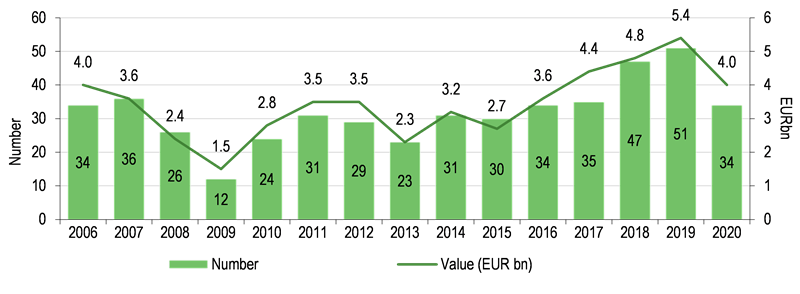
The German mid-market segment (an equity value per deal of €50–250m, which DBAG focuses on) continues to attract foreign PE capital, with 56% of transactions closed in 2020 involving pan-European PE funds (60% in 2019). As a result, the DACH region was one of the most active European PE markets accounting for c 20% of all deals in 2020 according to PitchBook Data’s 2020 Annual European PE Breakdown report. The region’s attractiveness was underpinned, among others, by 1) effective government responses to the pandemic translating into a death rate below neighbouring countries; 2) fiscal-monetary stimulus which limited corporate bankruptcies and a spike in unemployment; and 3) Brexit providing tailwinds for selected DACH-based businesses.
|
Exhibit 5: Transactions in German PE mid-market segment (€50-250m) |
|
|
Source: DBAG |
Moreover, Germany’s high reliance on export-oriented manufacturing is considered one of the factors limiting the COVID-19 impact on the economy vs more service-based economies. Nevertheless, its industrial sector (which had already experienced headwinds from trade tensions before COVID-19) has seen significant impact from the first lockdown phase with German manufacturing PMI down to 34.5 in April 2020 (close to the great financial crisis trough levels). Subsequently however, sector performance rebounded visibly, with industrial production almost back at December 2019 levels and the latest January PMI reading of 57.1 suggesting improved trading conditions, assisted by robust factory activity and new order intake. The sector may be further supported by the recent change in US administration (potentially assisting further recovery in international trade). On the other hand, supply chain bottlenecks (including shipping container shortage) represent limiting factors. DBAG’s end-December 2020 industrial exposure is 43% of the portfolio.
|
Exhibit 6: German industrial development |
|
German manufacturing PMI |
German industrial production |
|
|
|
Source: Refinitiv |
|
Continued high level of investment opportunities
In Q121, DBAG completed the acquisition of congatec (investing €23.8m) which was agreed in August 2020 and it did not announce any new MBOs in the period. At the same time, six add-on acquisitions were announced by DBAG’s portfolio companies (of which three closed in Q121), including DING Gruppe (two acquisitions), vitronet, Gienanth, Multimon, and netzkontor. After the reporting date, the radiology group blikk (held through DBAG Fund VII) performed a spin-off of its nephrology division (operasan) which will be developed as a standalone healthcare platform investment using a ‘buy and build’ approach. DBAG invested €3.2m alongside the DBAG Fund VII which now holds a 71% stake in the business (of which c 13% is attributable to DBAG). Blikk will receive the consideration allowing it to improve its balance sheet structure. Additionally, one undisclosed company in DBAG’s ECF portfolio closed two acquisitions post the reporting date with DBAG providing the company with €3.8m to help fund the deals.
DBAG’s deal origination expertise a mitigating factor to the highly competitive environment
DBAG intends to invest c €120m pa until FY22/23 (vs the historical five-year average of €72m pa) with the start of the investment phase of the €1.1bn DBAG Fund VIII in August 2020 and DBAG’s decision to conduct long-term capital financings exclusively from its own balance sheet. We estimate that a mid-teen percentage amount of DBAG Fund’s VIII main fund has been deployed so far. While competition for quality private assets is currently high, we believe that DBAG’s strong deal origination network with a high proportion of deals sourced from business founders and families, ahead of the broader German PE market (56% vs 26% in 2010–2019 according to DBAG data), represents an important competitive advantage in terms of deal sourcing. The company continues to see a high level of deal opportunities, with 74 reviewed in Q121 (of which 19 related to long-term financing) compared to 54 in Q120 (see chart on front page).
In discussions to exit two to three holdings, including potential realisation(s) in broadband/telecom
At the same time, growing interest from foreign PE investors in the DACH region (and potentially an increase in European SPAC launches similar to the US in 2020) should assist DBAG’s realisation activity. During the Q121 analyst call management highlighted that DBAG is in advanced negotiations related to two exits, with another one at an early stage. We expect that this includes at least one holding from its broadband/telecom portfolio where the average multiple implied by the carrying values at end-December 2020 stands at a healthy 2.5x cost. We note however that DBAG’s ‘growth’ portfolio (41% of the portfolio value at end-December 2020) as a whole (including broadband/telecom) is relatively young with most companies acquired in 2017 or later (except for DNS:Net) and we expect DBAG to spend more time on value creation initiatives for most of them. So far, DBAG has performed one exit from its ‘growth’ portfolio (inexio in Q120) at an attractive money multiple of 7.6x.
DBAG’s industrial portfolio is still on average valued slightly below acquisition cost at end-December 2020 (0.9x at end-September 2020), which suggests it may prefer to extend holding periods to capture the economic recovery phase for most of them. Having said that, it is worth noting that two of DBAG’s funds are currently in their divestment phase: DBAG Fund V (which now holds only one investment in the technical textiles producer Heytex), and DBAG Fund VI with seven holdings, five of which are operating in industrial sectors (Pfaudler, Frimo, Dieter Braun, Gienanth and Silbitz).
|
Exhibit 7: DBAG’s portfolio split at end-December 2020 |
|
By sector |
By age |
|
|
|
Source: Refinitiv |
|
Near-term funding needs secured, but still considering equity/debt raise in the mid-term
DBAG’s financial resources at end-December 2020 stood at €16.3m and it had €53.1m of undrawn credit lines. A further €5.1m of cash is held in investment entities and the company has callable receivables (mostly related to DBAG Fund VII fees) of €19.2m. This brings DBAG’s total available liquidity to c €93.7m which, together with currently negotiated exits, should cover its near-term funding needs. At the same time, fee income from the fund services segment (management guides to €42–44m in FY21) should fully cover its operating costs. Nevertheless, DBAG is considering additional equity and/or debt funding in order to secure its mid-term investment agenda, which includes transactions alongside its managed funds, as well as from its own balance sheet.
Valuation: Premium slightly above long-term average
As highlighted in our earlier notes, DBAG’s reported NAV is almost entirely attributable to the value of its PE investment portfolio and does not account for the fair value of its fund services business, which represented third-party assets under management of c €2.5bn at end-December 2020 and generates considerable recurring fee income (see above). In contrast, DBAG’s market value reflects the value of both its fund services business and its PE investment portfolio. Consequently, there is an inherent premium when comparing DBAG’s share price with its reported NAV, which disguises any underlying premium or discount that the market may be applying to the value of DBAG’s PE investment portfolio.
The current share price implies a 31.8% premium to end-December NAV (vs the five-year average at 26.0%), which equals €143m in absolute terms. Assuming the premium is solely attributable to the fund services segment, this value would imply an 9.2x earnings before tax multiple on the mid-point of management guidance. By applying the average discount of peer companies (7.5%, see Exhibit 10) to the PE investments value, the fund services value is €176m (11.4x earnings multiple).
Exhibit 8: Analysis of DBAG’s market value by segment
Approach |
Private equity investments |
Discount applied to private equity investments value |
0% |
(8%) |
Implied value of private equity investments segment (€m) |
448.7 |
415.0 |
Implied value of fund services segment (€m) |
142.6 |
176.2 |
Implied FY21e earnings multiple of fund services segment* |
9.2x |
11.4x |
Source: DBAG, LPX-Group, Edison Investment Research. Note: *Based on the mid-point of management guidance.
|
Exhibit 9: Share price premium (discount) to NAV over three years (%) |
|
|
Source: Refinitiv, Edison Investment Research |
Peer group comparison
DBAG’s one-year NAV total return in sterling terms of 10.2% is below the peer average, which we believe stems from higher exposure to German industrials which had already experienced macro headwinds prior to the COVID-19 outbreak. The recent performance also affects longer-term returns, which are somewhat below the peer average as well. DBAG is the only fund in the group to trade at a meaningful premium to its NAV, which we explained in the valuation section. While DBAG’s last 12 months dividend yield of 3.8% is above the group average, the prospective yield based on the announced dividend of €0.80 per share (ex-dividend date is 26 February) stands at 2.0%. The manager expects it will be able to increase the payout next year, yet DPS is likely to be lower than pre-COVID-19.
Exhibit 10: Listed private equity investment companies peer group at 15 February 2020*
% unless stated |
Region |
Market cap £m |
NAV TR 1y |
NAV TR 3y |
NAV TR 5y |
NAV TR 10y |
Price TR 1y |
Price TR 3y |
Price TR 5y |
Price TR 10y |
Premium/ |
Dividend yield |
Deutsche Beteiligungs |
Europe |
517 |
10.2 |
19.7 |
91.9 |
174.6 |
(7.9) |
(26.3) |
40.3 |
113.4 |
31.8 |
3.8 |
3i |
Global |
11,532 |
13.5 |
53.1 |
185.2 |
333.7 |
9.4 |
42.0 |
189.5 |
411.2 |
26.6 |
3.0 |
HgCapital Trust Ord |
UK |
1,450 |
22.2 |
76.8 |
162.1 |
300.7 |
21.6 |
85.7 |
217.2 |
301.0 |
16.4 |
1.4 |
ICG Enterprise Trust** |
UK |
698 |
11.1 |
41.2 |
97.0 |
202.5 |
(0.3) |
29.4 |
88.0 |
302.8 |
(18.3) |
2.3 |
Oakley Capital Investments** |
Europe |
534 |
18.2 |
71.6 |
116.2 |
157.4 |
9.3 |
86.7 |
121.6 |
119.3 |
(26.7) |
1.5 |
Princess Private Equity |
Global |
678 |
16.9 |
44.6 |
119.3 |
175.5 |
18.6 |
30.7 |
139.0 |
274.9 |
(26.5) |
4.5 |
Standard Life Private Equity |
Europe |
616 |
8.4 |
34.2 |
93.4 |
181.4 |
19.8 |
30.1 |
125.4 |
274.7 |
(16.5) |
3.3 |
Average |
2,585 |
15.1 |
53.6 |
128.9 |
225.2 |
13.1 |
50.8 |
146.8 |
280.6 |
(7.5) |
2.7 |
|
Rank |
7 |
6 |
7 |
7 |
6 |
7 |
7 |
7 |
7 |
1 |
2 |
Source: Morningstar, Edison Investment Research. Note: *12-month NAV performance based on latest available ex-par NAV (end-December except for ICG Enterprise Trust (end-October) and Hg Capital Trust (end-September).
|
|
Research: Industrials
PIERER Mobility delivered an impressive year in 2020 despite disruptions caused by the pandemic. Market share in its main motorcycle sales regions rose 177bps to 13.1%, the GASGAS acquisition was completed in July, and the newly consolidated e-bikes business exceeded planned sales and profitability. We expect the strong H220 momentum to continue into FY21 with group returns exceeding FY19 levels. The potential change to the ownership structure may also unlock additional value for shareholders.