Last close As at 05/08/2026
—
— 0.00 (0.00%)
Market capitalisation
—
Research: Financials
FCR Immobilien has demonstrated rapid portfolio expansion over the last several years. It has been able to monetise attractive buying opportunities, as illustrated by both the high average rental income yield (11.7% as at end-September 2018) and a solid average return on disposals in 2017 and 2018 ytd at c 28% pa (our estimate excludes rental income). High leverage has been part of this strategy, with net debt to total assets at 72% at end-June 2018 (and likely to increase further) vs the peer average of c 50%. FCR is conducting a technical listing, which should be followed by an IPO.
FCR Immobilien |
High-growth German property investor
Real estate |
Scale research report - Initiation
7 November 2018 |
Share details
Business description
Bull
Bear
Analysts
|
||||||||||||||||||||||||||||
FCR Immobilien has demonstrated rapid portfolio expansion over the last several years. It has been able to monetise attractive buying opportunities, as illustrated by both the high average rental income yield (11.7% as at end-September 2018) and a solid average return on disposals in 2017 and 2018 ytd at c 28% pa (our estimate excludes rental income). High leverage has been part of this strategy, with net debt to total assets at 72% at end-June 2018 (and likely to increase further) vs the peer average of c 50%. FCR is conducting a technical listing, which should be followed by an IPO.
Exposure to Germany’s secondary retail markets
FCR is a real estate investor (with some limited development activities), whose main investment focus is deal sizes between €1m and €50m in tier two locations across Germany. Management believes that this represents an attractive niche, where transactions are beyond the capacities of individual investors, but are too small for institutional players. FCR seeks buying opportunities when properties are offered at attractive prices by distressed sellers, which translates into high rental income yields (company targets at least 12%). These are subsequently enhanced through asset management initiatives aimed at improving the occupancy rate.
Rampant portfolio expansion fuelled by new capital
Although still limited in size, FCR has expanded its portfolio in recent years from just 12 properties at end-2015 (with 51k sqm of lettable area) to 44 (200k sqm) as at October 2018. As a result, annualised net rental income went up from €3.2m to more than €13.0m over this period. This growth is fuelled by a high proportion of debt (80% bank lending at property level plus additional leverage through bond issues at holding level). In order to maintain the growth trajectory without becoming over geared, FCR has also decided to improve its equity position through €8.8m net IPO proceeds it expects to raise. FCR’s earnings and capital are supplemented by selected asset disposals (two to four deals pa in the near term), with proceeds recycled into new underperforming assets with turnaround potential.
Valuation: P/NAV discount, earnings ratios premium
FCR’s last reported NAV per share as at early October stands at €18.50. In this context, it is worth examining the market multiples at which FCR’s peers are currently trading. The average P/NAV ratio for our peer group (based on last reported NAV) stands at 1.08x. For comparison, these listed companies are trading at an LTM P/E and EV/EBITDA of 17.7x and 13.7x, respectively.
|
Historical financials
Source: FCR Immobilien accounts. Note: *Edison estimate based on reported net income. |
Edison Investment Research provides qualitative research coverage on companies in the Deutsche Börse Scale segment in accordance with section 36 subsection 3 of the General Terms and Conditions of Deutsche Börse AG for the Regulated Unofficial Market (Freiverkehr) on Frankfurter Wertpapierbörse (as of 1 March 2017). Two to three research reports will be produced per year. Research reports do not contain Edison analyst financial forecasts.
Company description: Focus on bargain purchases
FCR Immobilien (FCR) is a real estate company headquartered in Munich and focused on retail properties (c 80% of portfolio as at end-October 2018 as per Edison estimates), with a minor presence in office, residential and hotel segments. It targets small and medium-sized properties in tier two locations in Germany. FCR’s preferred investment is between €1m and €50m for individual properties, and between €5m and €50m for portfolios, although the current holding structure is skewed towards the lower end of this spectrum as book value per property at end-September 2018 stood at €1.8m. The company considers this transaction range a niche market, which is beyond the reach of individual investors, but at the same time too small for institutional players. Having said that, there are a number of competitors in this segment, such as Deutsche Konsum REIT and Defama. FCR’s activities cover the entire value creation chain, including bargain property acquisitions, asset management and profitable divestment (but excluding facility management activities).
FCR uses its broad origination network (including banks, real estate companies and intermediaries, as well as asset management companies) to identify distressed entities willing to sell their properties at attractively low prices. As FCR operates primarily in the asset management business rather than real estate development (despite conducting selected projects in this area as well), it is essential to the acquisition process that the detrimental conditions are attributable to the seller and not to the property itself. The company is also looking carefully at the financial situation of the anchor tenant to assess the risk of losing a significant part of rental income from the respective property. Even though the company may become involved in redevelopment works if required, the main efforts within the asset management activities are related to optimisation of tenant structure, as well as lease length and other lease terms.
|
Exhibit 1: FCR Immobilien’s strategy |
|
|
Source: FCR Immobilien |
As bargain purchases represent the key factor in the company’s asset picking process, FCR’s current and prospective portfolio split across real estate market segments is dependent on the availability of attractive opportunities rather than predefined sector exposure ranges/limits. We believe that the company’s skew towards the retail sector may also be a function of the higher availability of lower-volume transactions in this segment in comparison to the office real estate market. However, as FCR’s portfolio grows, its investment volume per transaction increases moderately as well, as average transaction value in H118 was c 15% higher than the historical average. The latest example in this respect represents FCR’s largest acquisition so far, the shopping centre Schlossgalerie in Rastatt with more than 21.6k sqm of leasable space, which significantly exceeds the portfolio average of c 4k sqm.
FCR’s focus on distressed assets allows the company to achieve superior rental yields, with the weighted average at portfolio level at 11.7% as at end-September 2018 (following a slight decline from 14.1% in FY17, discussed in the financials section of this report). The occupancy rate at the end of September-2018 stood at 83%, implying potential to reach a 14.8% yield on a fully let basis.
The company’s business model generally assumes an investment horizon of three to seven years, but FCR conducts asset disposals only when it is able to generate an attractive return. The proceeds are subsequently recycled into new investment opportunities with asset management potential. Basically, as this means exchanging a well-performing property against an asset which is performing below its potential, there is a certain transaction risk embedded in this approach. The above indicative holding period implies an annual portfolio rotation of c 20%. However, given the high number of acquisitions completed in 2017 (with the number of portfolio holdings increasing to 41 from 18 at end-2016), the number of exits in the near term should be around two to four per year (representing a rotation ratio of c 5-10% based on the current portfolio size).
Portfolio overview: 80% exposure to German retail assets
As at end-September 2018, the company’s portfolio consisted of 42 real estates with a 171k sqm total leasable area and c €153.8m gross asset value, according to company estimates. FCR invests mainly in properties available on the secondary market, and the age structure of its portfolio is dominated by assets build in the 1990s or earlier (c 64% of portfolio at end-June 2018). Despite this, FCR prefers to keep capital expenditures low, and concentrate on improving the occupancy rate and tenant structure in the acquired properties. Of the 42 properties held by FCR, 22 were fully let (representing 34% of the total lettable area). At an 83% occupancy rate, the portfolio generated annualised net rent income of €12.5m, with potential to reach €16.5m at full occupancy.
Following the latest acquisitions, which were completed in October, FCR’s investment portfolio reached 44 real estate properties with a total lettable space of c 200k sqm in October. As a result, retail properties currently make up 80% of FCR’s portfolio, with housing and office segments contributing 11.8% and 7.9%, respectively (see Exhibit 2). FCR also owns a single hotel property in Kitzbühel.
FCR’s portfolio includes assets spread across the majority of the German administrative regions (ie 12 out of 16). However, in terms of lettable area, the portfolio is dominated by four regions, including Thüringen, Nordrhein-Westfalen, Niedersachsen and Baden-Württemberg, accounting for c 74% of portfolio (see Exhibit 3). The latter region is represented exclusively by the recently acquired Schlossgalerie in Rastatt.
|
Exhibit 2: FCR’s portfolio structure by segment |
Exhibit 3: FCR’s portfolio structure by region |
|
|
|
Source: FCR Immobilien, Edison Investment Research |
|
Exhibit 2: FCR’s portfolio structure by segment |
|
|
Source: FCR Immobilien, Edison Investment Research |
|
Exhibit 3: FCR’s portfolio structure by region |
|
|
Source: FCR Immobilien, Edison Investment Research |
A closer examination of FCR’s rental income structure confirms the high exposure to the retail business, which accounts for more than 80% of the company’s total rental income (in line with the share in total lettable area). In the retail segment, nearly 40% represents rental revenue from food retailers (such as EDEKA, Lidl or HIT). However, a certain proportion of the multi-retailer sale (categorised as ‘other’ in Exhibit 4) is also attributable to food products. The second largest tenant group is the textile retail business (c 22%), with around half of the rental income coming from discount retailers (eg KiKa, Takko). We estimate that at least c 65% of FCR’s rental income is attributable to non-cyclical tenants which, at the same time, are not being meaningfully affected by the ongoing shift to online shopping. Moreover, most properties in FCR’s portfolio are positioned as neighbourhood stores, which should experience limited impact from online shopping.
On the other hand, FCR has a relatively concentrated tenant base, as its largest tenant (EDEKA) represents (as the anchor tenant) c 12% of the portfolio and the top 10 tenants make up more than 45%. It is worth highlighting that there is a single lease agreement with EDEKA (related to the shopping centre in Seesen), which accounts for more than 8% of FCR’s rental income (this contract matures at end-July 2020). Overall, around 8% of FCR’s lease agreements mature within the next 12 months, with an incremental 17% and 23% maturing within 24 and 36 months, respectively. The weighted average unexpired lease term as at end-September 2018 stood at 5.3 years.
|
Exhibit 4: Rental structure of FCR’s retail portfolio by subsector |

|
|
Source: FCR Immobilien, Edison Investment Research |
Key events in 2018: Portfolio deals and new funding
This year the company continues its dynamic portfolio development through a number of property acquisitions and disposals. As a result of these, FCR’s investment portfolio reached 44 properties with a NAV of €78.2m (company estimate) as at 8October 2018. For further details, please see the portfolio overview section. Moreover, the company has announced two lease successes this year related to the shopping centres in Seelze and Dessau-Roßlau.
FY18 has been also marked by significant changes in the capital structure, including: 1) placement of a new five-year corporate bond with a total volume of €25m; 2) a private placement completed in July 2018 with c €1.0m in gross proceeds and 71.4k new shares issued; and 3) the planned IPO, details of which are included in the shareholder structure and financials section.
Online shopping reshapes letting structure
Like other real estate segments in Germany, the retail sector is currently supported by low unemployment (at c 3-4%), solid disposable income growth (+3.7% in 2017 according to Destatis), as well as record low interest rates prompting consumer spending. This is illustrated by the 4.2% nominal growth in retail sales in 2017. Overall letting activity this year was strongest in Q318, with take-up volume reaching 121,700 sqm. As a result, 9M18 take-up was up 5% y-o-y to 360,600 sqm, with the possibility of the full year number reaching 480,000 sqm (around the 2016 level), according to Jones Lang LaSalle (JLL).
However, the retail business is also shaped by the ongoing trend towards online shopping (representing c 10% of total retail sales in Germany in 2017), which is affecting both letting volumes and its structure. According to a recent JLL study conducted in selected prime locations in Germany, demand for retail space is no longer visibly ahead of available supply. A significant part of the currently vacant space was previously occupied by clothing retailers, which have been particularly affected by online shopping. Although this segment remains the key contributor to overall letting volume in the retail sector (with current share at c 26%), the gap to other sectors is gradually narrowing. At present, the average quarterly take-up from the textile business stands at c 30,000 sqm compared to around 45,000 sqm five years ago, according to JLL. Some of the vacant space was filled by the restaurant/food and health/beauty (in particular fitness) sectors, which currently represent around 20% and 15% of letting volume, respectively. Interestingly, shopping centres without a food anchor (along with secondary shopping centres) are experiencing less investor demand, as they believe that these asset classes should be more affected by the ongoing e-commerce boom as opposed to properties with higher food retail exposure. Only c 1% of consumer spending on food in Germany is attributable to online shopping, compared with 20% for non-food sectors (including 28% in fashion and spell out? sectors).
Prime retail rents remained broadly stable ytd in Germany’s big 10 cities (which include Berlin, Cologne, Düsseldorf, Frankfurt, Hamburg, Munich, Stuttgart, Nuremberg, Hanover and Leipzig), with only Hanover posting a c 3% decline in early 2018. JLL believes that rents may be particularly under pressure outside the big 10 locations, as chain store operators are becoming less aggressive in their pursuit for new locations, while some are actually reviewing their store network. New locations are selected more carefully and rent negotiations have become more intensive. This is also illustrated by the increased number of relocations, shorter contractual terms for rental agreements (and a lower number of long-term lease agreements without flexible adjustment clauses), as well as increased adoption of turnover-linked rentals and pop-up stores for test purposes. However, FCR’s management said that the company does not experience any considerable pressure on rental rates and is able to rotate the tenant structure rather than offer lower rents to existing tenants.
The potential for retail yield compression seems largely exhausted, as prime yields in the largest German cities remain unchanged at low levels somewhere between 2.80% (Frankfurt, Munich) and 3.30% (Düsseldorf and Cologne, according to Colliers) as a consequence of limited supply. This could potentially encourage investors to look beyond the standard prime cities and into B and C cities, on which FCR Immobilien focuses. These markets are often characterised by lower rents and yield volatility, but at the same time lower market liquidity and less transparency. Recent JLL data suggest that the contribution of the largest German cities (big seven, ie the big 10 excluding Nuremberg, Hanover and Leipzig) in total investment volume in commercial real estate was particularly high (60% in 9M18) and represented a 27% y-o-y increase, while other cities witnessed a 13% y-o-y decline in transaction volume. This suggests that investors tend to search for rental growth prospects in prime cities to drive their investment returns rather than exploring higher yields in B and C cities. However, this seems particularly true for office properties, while investment in retail projects is more diversified geographically and also tends to be smaller in volume (mostly in the range of €20–60m, which is at the upper end of FCR Immobilien’s focus range). Still, this suggests that the company may for now continue to operate in its niche market without being disturbed by too many new entrants moving from prime/larger properties.
Management, organisation and corporate governance
Supervisory board and management board
FCR has a two-tier board structure, where the management board sits beneath the (non-executive) supervisory board. The sole member of the management board and FCR’s CEO is the company founder Falk Raudies. He has more than 20 years of professional experience, with an extensive background in real estate valuation and transactions. In the past, he also served as a managing director and board member of Alldis Computer and Rhinos Energy Drink & Food. Since 2009, Falk Raudies has been the owner (95% stake) of RAT Asset & Trading, the majority shareholder of FCR.
The supervisory board is composed of three members:
Professor Dr Franz-Joseph Busse served as portfolio manager and supervisory board member in several German investment funds. He has also been a lecturer at the University of Applied Sciences in Munich since 1982.
Arwed Fischer had been CFO at Patrizia Immobilien between 2008 and 2015. He currently holds a position in five supervisory or advisory boards in the real estate market.
Frank Fleschenberg joined the supervisory board in 2014. His previous experience comes from managing football teams in Germany, as well as his own real estate and financial services company. Since 2006 he has been a management board member of Deutsche Gesellschaft für Grundbesitz in Leipzig.
Organisation
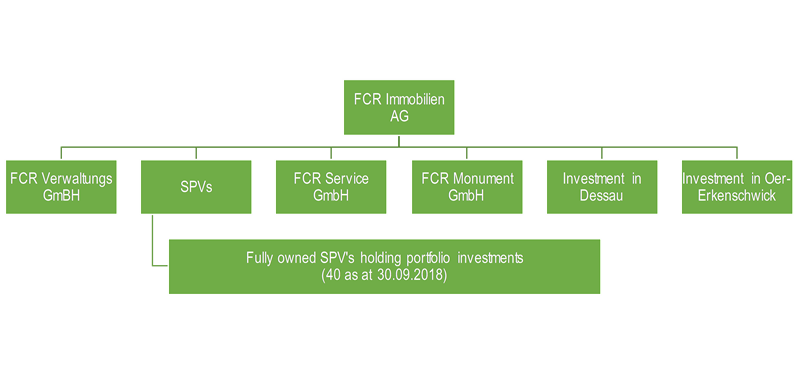
FCR Immobilien AG is a parent company of a group consisting of three fully owned subsidiaries, and SPVs created to hold portfolio investments (see Exhibit 5). Two of FCR’s property investments are held directly by the parent company.
|
Exhibit 5: FCR Immobilien’s organisational structure |
|
|
Source: FCR Immobilien, Edison Investment Research |
Shareholders and free float
FCR Immobilien is majority-owned by Falk Raudies through his investment vehicle RAT Asset & Trading. Following the capital raise in July 2018, when the company issued 71.4k shares at a price of €14.0 per share, as well as subsequent changes in the shareholder structure aimed at increasing FCR’s free float, RAT Asset & Trading now holds a 70.5% stake in FCR. The remaining meaningful shareholders include FAMe Invest & Management (9.2%), MAMBO Vermögensverwaltung GmbH, Pullach (4.6%), RFC GmbH (4.1%) and Claudia Raudies (CEO’s mother, 3.9%). FCR’s free float stands at 20.2%. The company plans to offer 521.2k new shares as part of its IPO. As RAT Asset & Trading neither intends to participate in the IPO as investor, nor plans to sell any of its shares, its stake in the company should drop to c 62.8%, according to our calculations.
Financials
FCR’s key financial metrics are presented in Exhibit 6. The company was transformed from a GmbH & Co KG legal form (which is a combination of a limited liability and a limited partnership) into a joint stock company in 2013. As a result, comparable financials are available from 2014 onwards.
Exhibit 6: Financial summary
€000s |
2014 |
2015 |
2016 |
2017 |
H117 |
H118 |
Income Statement |
|
|
|
|
|
|
Revenue |
3,278 |
12,727 |
12,129 |
16,391 |
7,506 |
14,526 |
growth y-o-y |
N/A |
N/M |
-4.7% |
35.1% |
N/A |
93.5% |
Rental income |
2,394 |
3,089 |
5,729 |
8,490 |
3,526 |
5,976 |
as % of total revenue |
73.0% |
24.3% |
47.2% |
51.8% |
47.0% |
41.1% |
Sale of investment properties and other revenue |
884 |
9,638 |
6,400 |
7,901 |
3,981 |
8,550 |
EBITDA |
1,498 |
3,690 |
3,109 |
4,928 |
2,527 |
3,901 |
EBITDA margin |
58% |
29% |
26% |
30% |
34% |
27% |
EBIT |
1,137 |
3,030 |
2,334 |
3,735 |
2,127 |
3,030 |
EBIT margin |
44% |
24% |
19% |
23% |
28% |
21% |
Profit before tax |
763 |
1,881 |
849 |
1,278 |
926 |
1,459 |
Net income |
492 |
1,358 |
442 |
975 |
781 |
1,063 |
Number of shares (eop*, '000s) |
1,111 |
1,185 |
4,148 |
4,148 |
4,148 |
4,148 |
Balance sheet |
|
|
|
|
|
|
Total non-current assets |
21,855 |
21,829 |
33,552 |
71,838 |
N/A |
76,358 |
of which: investment property |
21,482 |
21,761 |
31,752 |
68,771 |
N/A |
72,220 |
Total current assets |
2,215 |
9,445 |
12,292 |
8,073 |
N/A |
19,308 |
Total assets |
24,498 |
31,347 |
46,069 |
80,147 |
N/A |
95,975 |
Total liabilities |
20,964 |
24,473 |
38,627 |
71,763 |
N/A |
85,659 |
of which: debt |
19,338 |
23,862 |
37,499 |
70,213 |
N/A |
84,739 |
Shareholder equity |
3,427 |
5,785 |
5,931 |
6,906 |
N/A |
7,968 |
Cash flow statement |
|
|
|
|
|
|
CF from operating activities |
N/A |
4,033 |
-2,603 |
2,690 |
N/A |
N/A |
CF from investing activities |
N/A |
(6,731) |
-9,336 |
-34,148 |
N/A |
N/A |
CF from financing activities |
N/A |
8,494 |
11,293 |
30,092 |
N/A |
N/A |
Cash and equivalents (eop*) |
1,163 |
6,959 |
6,312 |
4,946 |
N/A |
15,178 |
Source: FCR Immobilien accounts, Edison Investment Research. Note: *End of period.
Income statement
FCR derives its revenues from two main sources: rental income, which is recurring in nature and income from the disposal of properties, which varies depending on the number of transactions executed during the period. In 2016 and 2017, as well as in H118, rental income made up around 40–50% of group revenue and has grown considerably from €3.1m in 2015 to €8.5m in 2017 and €6.0m in H118 alone. This is a function of the rapid portfolio growth, as discussed earlier in the report (lettable area growing to 158k sqm in H118 from 51k sqm at end-2015, see Exhibit 7).
Exhibit 7: FCR Immobilien KPI summary
|
2015 |
2016 |
2017 |
H118 |
9M18* |
Number of properties |
12 |
18 |
41 |
42 |
44 |
Lettable space ('000 sqm) |
51 |
83 |
140 |
158 |
200 |
Net rental income pa (€m) |
3.2 |
4.5 |
9.5 |
9.3 |
12.5 |
Occupancy rate |
82% |
88% |
88% |
83% |
83% |
Potential net rental income pa (€m) |
3.9 |
5.5 |
10.9 |
11.5 |
16.5 |
Net rental yield pa** |
14.2% |
14.2% |
14.1% |
12.9% |
11.7% |
Potential net rental yield pa*** |
17.3% |
17.3% |
16.1% |
16.0% |
14.8% |
WAULT (in years)**** |
N/A |
4.5 |
3.9 |
4.5 |
5.3 |
Book value of properties (€m) |
21.8 |
31.8 |
68.8 |
72.2 |
N/A |
Source: FCR Immobilien, Edison Investment Research. Note: *Pro forma data including subsequent acquisitions completed in October. **Based on current book value. ***Assuming a 100% occupancy rate. ****Weighted Average Unexpired Lease Term.
Net rental yield at portfolio level remained broadly stable between 2015 and 2017 (14.2% and 14.1%, respectively), while declining somewhat to 11.7% at end-September2018. We believe that the main reason behind this is the lower occupancy rate (83% vs 88% at end-2017) as a result of meaningful portfolio turnover in 9M18. This is because properties sold are usually characterised by a higher occupancy rate (post FCR’s asset management efforts) in comparison to purchased properties. The higher vacancy rate of the newly acquired properties allows FCR to purchase them at a more attractive price point (ie higher initial net rental yields) compared to fully occupied properties. If all properties were fully let, the company estimates that the annualised net rental yield would go up to 14.8% pa, with net rental income at €16.5m (based on pro forma portfolio data as at end-September 2018). However, following the recent acquisitions (in particular, the purchase of the modern Schlossgalerie in Rastatt), the actual annualised rental income had already increased to more than €13.0m (according to FCR).
Prospective growth in rental income from further acquisitions and asset management measures may also allow FCR to reduce its earnings dependency on gains from property disposals and improve its EBITDA interest coverage ratio, which (after excluding the €2.2m disposal gains) stood at quite a low level of 1.03x in H118. This is to some extent related to the fact that FCR’s proceeds from this year’s bond issue were not fully deployed (cash and equivalents as at end-June 2018 at €15.2m) and due to the considerable number of properties acquired in 2017 and H118 where FCR’s asset management initiatives have not fully materialised yet. Going forward, the ratio might also be assisted by a potential refinancing of FCR’s bonds issued back in 2014 at a relatively high coupon rate (see our comment below).
Balance sheet and cash flow
FCR’s financing strategy assumes a 70–80% leverage level (with a preference to the upper end of this range) at individual property level. The debt component normally represents bank loans secured by first ranking fixed charges against the investment property (predominantly floating rate – average interest rate of 2.2% as at end-2017), while the equity component is provided by the parent company, which is either sourced from FCR’s equity or bond issuance. FCR’s first issued bonds were senior secured, while all the bonds issued subsequently constitute second lien mortgage debt. These bonds provide the company with additional flexibility during deal execution and effectively gear up FCR’s investments further. They currently represent a total face value of €45.7m and have a weighted average coupon rate at 7.0% (including the annual bonus paid at maturity for some of the bonds). A detailed summary of FCR’s outstanding bonds is presented in Exhibit 8).
Exhibit 8: FCR outstanding bonds summary
Face value (€000s) |
Coupon rate* |
Coupon payments |
Maturity |
Comments |
|
Bonds 2014-2019 (I) |
1,676 |
8.0% |
Annual |
Apr-2019 |
Senior secured; 3% annual bonus paid at maturity |
Bonds 2014-2019 (II) |
4,000 |
8.0% |
Quarterly |
Jun-2019 |
Second-lien debt; 3% annual bonus paid each year |
Bonds 2016-2021 |
15,000 |
7.1% |
Annual |
Oct-2021 |
Second lien debt |
Bonds 2018-2023 |
25,000 |
6.0% |
Semi-annual |
Feb-2023 |
Second lien debt |
Total |
45,676 |
6.6% |
- |
- |
- |
Source: FCR Immobilien, Edison Investment Research. Note: *Does not include bonus coupons.
As a result, the company’s net debt to equity ratio as at end-June 2018 stood at a relatively high72% (see Exhibit 9) vs the peer average of c 50%, despite the temporarily elevated cash position following the recent bond issue. The net IPO proceeds should constitute (according to FCR’s expectations) a €8.8m cash inflow, while completion of the bond subscription (confirmed last September) translates into an additional €9.0m (according to our estimates). However, this should be offset by the recent investments, in particular the acquisition of the Schlossgalerie in Rastatt announced in early October, FCR’s largest acquisition so far. Consequently, FCR’s net debt to equity ratio is likely to rise further (potentially even above 80%). It must be noted though that these leverage calculations are based on book value of FCR’s investment property (as included on the balance sheet) rather than market values estimated for the purpose of NAV calculation. Based on these fair value estimates, the net debt to equity ratio stood at c 40% at end-June 2018.
|
Exhibit 9: FCR Immobilien’s net debt to book value of total assets ratio |
|
|
Source: FCR accounts, Edison Investment Research |

FCR’s dividend distribution is generally dependent on the extent of the company’s capital needs and consequently payments may be irregular. FCR paid out 21% of net income in 2015, while it refrained from paying a dividend in 2016 and then distributed 19% of 2017 earnings. The company’s covenants embedded in the recently placed bond include a payout cap at 50%, but FCR intends to limit the payout ratio to 25% of net income in any case.
Valuation: Reflects the company’s high growth profile
The company indicated that its NAV as at end-June 2018 reached €72.1m (or €17.40 per share), which represents an increase of 16% vs end-2017 (€62.2m or €15.0 per share based on our calculations). Following the acquisitions completed after the reporting date (Schlossgalerie in Rastatt, as well as two properties in Zerbst and Würselen), FCR estimates that its NAV has risen further to €18.50 per share.
It is important to note that these NAV estimates are not based on regular valuations performed by external real estate experts (which is often the case with real estate investment companies). Instead, FCR relies predominantly on received purchase offers, as well as bank valuations on debt refinancing and internal fair market value assessments. However, the NAV estimate as at end-June 2018 has been validated for the purposes of the share listing by means of financial due diligence conducted by an external advisor.
These valuations are not reflected in FCR’s balance sheet, which translates into a meaningful difference between the book value of assets and the fair value reflected in the NAV estimate. For instance, based on data provided by the company, we estimate that the fair value of FCR’s properties as at end-September 2018 stood at c €150.5m, which compares with a book value of €74.5m. Of this difference, around €14.4m is attributable to the dormitory project in Bamberg, which is currently under development (with scheduled completion planned for early 2020). In this context, it is worth highlighting that the transaction prices in FCR’s eleven executed deals in 2017 and 2018 (ytd), as well as three potential deals where FCR has received a purchase offer, represent on average a 35% premium to the book value of these properties.
It is instructive to review the market multiples at which comparable companies are currently trading. On average, FCR’s peers trade at a P/NAV multiple of 1.08 (see Exhibit 10), ie an 8% premium to their last reported NAV (although some trade at a 10–20% discount). Our selected peers trade on average at an LTM P/E and EV/EBITDA of 17.7x and 13.7x, respectively.
Exhibit 10: Peer group comparison
|
Market cap (€m) |
P/NAV |
LTM* P/E |
LTM* EV/EBITDA |
DEMIRE Deutsche Mittelstand Real Estate |
303 |
0.83 |
5.2 |
6.1 |
Deutsche Konsum REIT |
285 |
1.54 |
7.5 |
9.5 |
Defama |
43 |
1.48 |
26.7 |
15.4 |
Hamborner REIT |
711 |
0.89 |
43.6 |
21.0 |
VIB Vermögen |
593 |
1.11 |
10.8 |
14.5 |
Deutsche EuroShop |
1,694 |
0.63 |
12.7 |
15.5 |
Peer average |
- |
1.08 |
17.7 |
13.7 |
Source: Company accounts, Edison Investment Research. Note: *Last 12 months.
Sensitivities
Based on our examination of FCR’s business profile, as well as the current real estate market environment, we have identified a number of sensitivities listed below:
■
High leverage level: as already discussed in the financials section, FCR targets an LTV ratio at 70–80% at individual property level, which is further leveraged through bond issuances at group level. Consequently, FCR’s net debt to equity level (81% at end-2017 and 72% at end-June 2018) may be considered relatively high in comparison to the market average (which we believe is around 50% for major listed peers). This leaves a relatively small safety margin in the event of adverse changes in property values (driven by yield expansion, decline in occupancy rates or lower rental levels), potentially leading to a breach of debt covenants. However, it must be noted that FCR’s portfolio does not undergo regular revaluations performed by external valuation experts, which could reflect the positive impact of its asset management initiatives (in particular, the increased occupancy rate) on the valuation of individual properties. As a result, book value of FCR’s investment properties after successful implementation of improvement measures would be understated (which would imply elevated LTV levels for successful properties). If the current fair values of FCR’s properties (based on company estimates) would be taken, the ratio would stand at 40% at end-June 2018. This is particularly important given that FCR aims to acquire properties at attractive price levels, implying rental income yields of at least 12% (current average at portfolio level at 11.7% at end-September 2018). This translates into a solid interest coverage ratio even at quite high LTV levels, as the interest rate on bank loans amounts to c 2–3% pa (2.2% pa as at end-2017), while the coupon rate on FCR’s bonds stands at 6.0–8.0% (excluding the 3% coupon bonus in the case of the 2019 bonds). However, this does not take into account loan amortisation (7.8% pa as at end-2017).
■
Narrow sector focus: although the company’s investment strategy entails potential exposure to four different segments of the real estate market, the retail sector represents c 80% of the lettable area within FCR’s portfolio. Moreover, the company invests almost exclusively in Germany. This makes it particularly susceptible to any major negative developments in the German retail real estate sector. This includes the potential adverse impact of the ongoing trend towards online shopping, in particular for non-food sectors.
■
High tenant concentration: the top 10 tenants represent more than 45% of FCR’s portfolio, while the top three (EDEKA, Netto and OBI) make up c 25% of rental income (with EDEKA alone contributing 12%). This may potentially translate into stronger bargaining power on the part of these tenants, although it may also turn out to be a solid foundation for building stronger relationships with these clients. It definitely makes FCR more sensitive to any major change in these clients’ strategies with respect to their store network.
■
Key personnel risk: FCR’s operations are largely dependent on the expertise and investment decisions of Falk Raudies, the sole member of the management board and FCR’s majority shareholder (62.8% after the IPO) through his investment vehicle RAT Asset & Trading (in which he holds a 95% stake). Moreover, Mr Raudies also provided guarantees for the company’s debt obligations amounting to €6.0m.
■
Exposure to less liquid markets: FCR focuses on smaller properties in secondary markets characterised by lower liquidity, which might translate into depressed prices in the event FCR is forced to sell selected projects quickly (eg due to financial liquidity issues or a breach of covenant). On the other hand, this may generate opportunities to buy properties at attractive price levels when the seller is under pressure (which is in fact part of the company’s investment approach).
■
Rapidly increasing scope of operations: the strong growth which the company is currently experiencing may pose challenges from an organisational perspective, and may require team expansion and the introduction of new management measures. On the other hand, a successful expansion would improve economies of scale and potentially also improve FCR’s EBITDA margins.
Written form requirement: FCR normally enters into long-term, but not indefinite rental contracts. The fixed-term contracts are regulated by Article 550 of the German Civil Code, according to which a contract is considered indefinite if it was not prepared in a written form for more than a year. There is a risk that the requirements will not be met for some or all contracts between FCR and its tenants, which would make them indefinite and thus terminable at any time.
|
||||||||
This paragraph mark is needed to maintain formatting, please leave this text for the editors.
Research: Healthcare
MagForce continues to implement its two-pillar strategy. A gross $9.0m capital raise secured by subsidiary MagForce USA in August will enable financing of the pivotal US prostate cancer trial to completion. In Europe, expansion outside Germany has started and a NanoActivator will be installed in Poland by the end of the year. Of the €9.2m reported revenue and other operating income in H118, €24k relates to EU glioblastoma multiforme (GBM) treatments, while the remainder (€8.9m) was one-off, non-cash income relating to hidden reserves as a result of the MagForce USA shares transfer. Revenues are likely to pick up in 2019, following the roll-out of devices across Europe and a launch in the US (in late 2019).