Games is ‘big and growing’
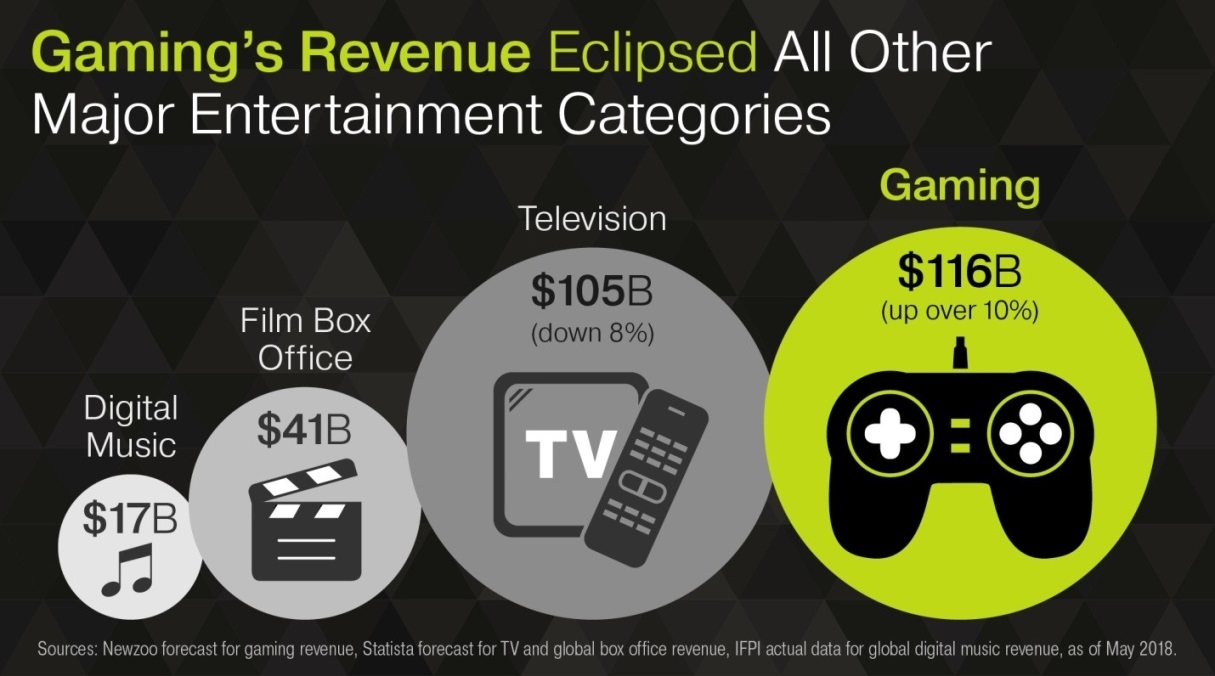
The video games sector first emerged in the 1970s, with games such as Pong, Space Invaders and Pacman. The first games console was the Magnavox Odyssey – released in 1972 – though many still remember the Atari 2600 as their first console. These arcade games evolved into games such as Super Mario Bros on home consoles such as the NES and Elite on the BBC Micro. What started out as a niche pastime for technology-obsessed nerds in the west in the 1970s was adopted by bedroom coders in the 1980s and subsequently developed into an identifiable industry in the 1990s. The games sector has now evolved into a global business that is larger than film, TV or music.
Exhibit 1: Games – a global business larger than film, TV or music
|
|
|
|
Underlining games’ supremacy, the most valuable media IP is also a video game: GTA V is recognised as the ‘most financially successful media title of all time’ with 90 million sales worldwide, and $6bn in revenue.
From the initial inception on PCs, games have proliferated and have now been developed for all platforms and devices, offering compelling content wherever you are and whatever you are doing. Games have also evolved from a physical boxed product (cartridge, floppy, minidisk, CD or DVD) to a digital download; essentially all games content is now downloaded for smartphones and digital download is rapidly increasing for the larger file sizes on PC and console.
With the prospect of eSports, VR and AR, there are still plenty of technological hurdles to be surmounted towards ever more compelling and immersive gaming. And with the prospect of streaming content, games-as-a-service and increasing digitalisation, business models will continue to need to adapt to this rapidly evolving space.
It is useful to look at the global market as a whole, though recognising that there are significant differences between regions and countries, particularly in terms of platform (mobile vs console/PC), the balance between male and female gamers as well as cultural preferences that have an impact on content and playing style.
Looking forward, the largest single market will continue to be China, forecast by Newzoo to reach $50.7bn in 2021, with a CAGR of around 10% from $37.9bn in 2018. Asia-Pacific will remain the highest growth region (extending its lead), with the fastest-growing markets in the coming three years, India and other countries in South-East Asia, as well as China.
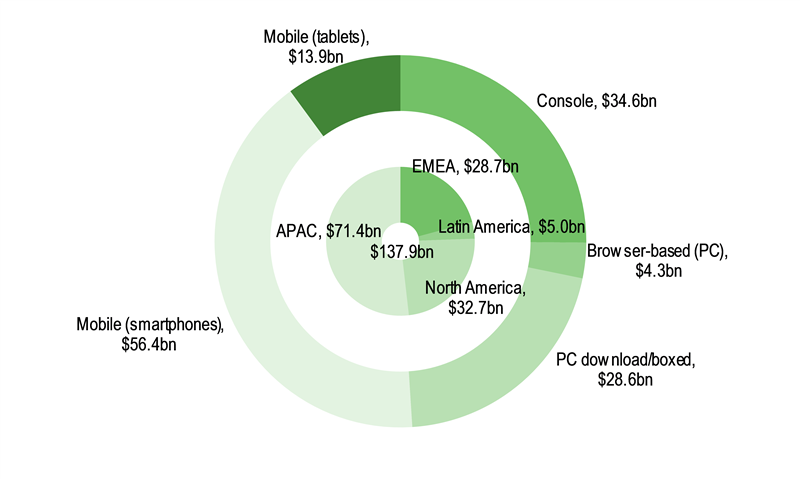
Exhibit 2: The global games market, by region – 2018
|

|
|
|
In terms of 2018 games revenues, the Asia-Pacific region is clearly the largest global gaming market, having generated $71.4bn in 2018 (16.8% y-o-y growth), 52% of the global total. This growth has been largely driven by the growth and increasing penetration of the smartphone, for which the region has, by far, the largest user base.
North America remains the second-largest region, with revenues of $32.7bn (a 10% y-o-y increase), representing 23% of the global total. EMEA is half a step behind, with revenues of $28.7bn (+8.8% y-o-y), representing 21% of the global market, while Latin America, with $5.0bn of revenues, represents the remaining 4%.
The mass-market is mobile
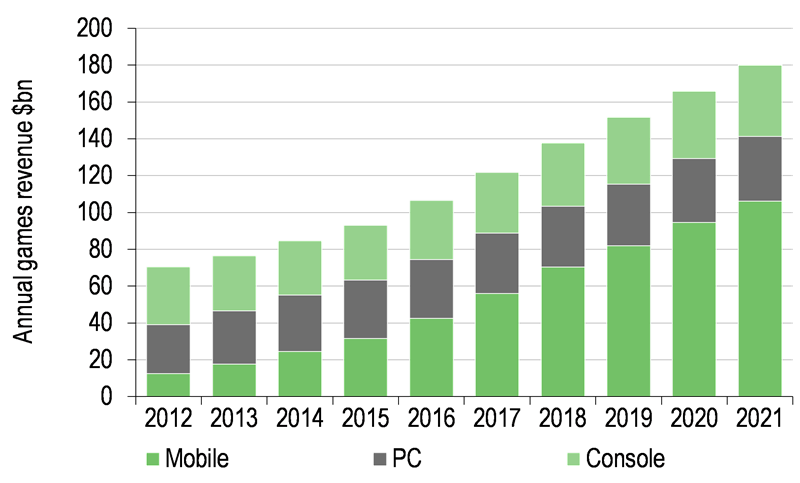
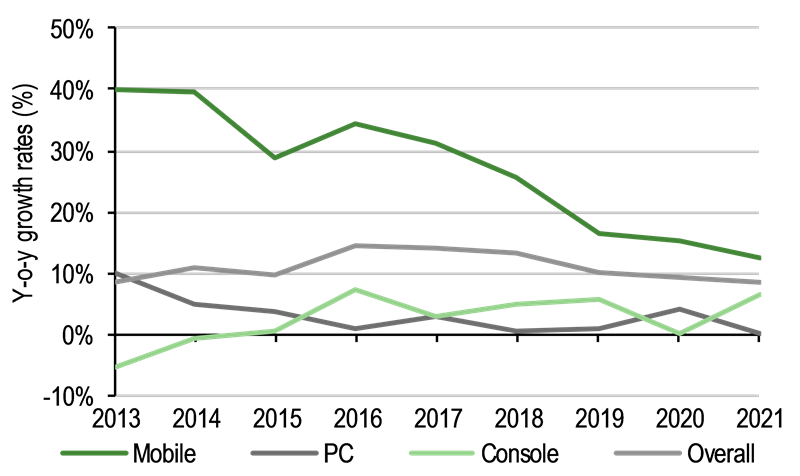
The gaming industry remains in a healthy state overall with growth continuing in all major segments of the games industry: mobile, console and PC.
Exhibit 3: The global games market, by segment – 2018
|
|
Source: Newzoo, Edison Investment Research
|
Mobile gaming (smartphone and tablet gaming) was the largest single segment of the games industry in 2018, expected to have generated $70.3bn, accounting for 51% of the total global market. The segment also accounts for the largest player-base with 2.2 billion games players, the majority of whom use smartphones (as opposed to tablets or traditional handsets).
It is worth highlighting that, for the UK-quoted games companies at least, mobile exposure remains extremely limited (despite Codemasters’ recent announcement of a valuable F1 licensing deal with NetEase to target Chinese mobile users) as the more casual player base, the dominant freemium model and intense competition all contribute to an unattractive mix. Stripping out mobile growth, global PC/console growth is significantly slower, below 5% to 2021.
Console is the second-largest segment with revenues of $34.6bn in 2018. This will grow to $39.0bn in 2021, a CAGR (2017–21) of 4.1%.
The third-largest segment, PC, is expected to have generated $32.9bn of revenues in 2018. Continuing growth in downloaded/boxed PC games has been moderated by declining browser PC revenues, as browser gamers have largely transitioned to mobile.
Combining these two cuts into the data, when we look for the intersection between segment and region, the dominant class are mobile phone users in the Far East, with China far and away the most important single territory.
Trends, drivers and themes
We will build on this very brief introduction to the games sector in future notes, but as an industry primer, it is worthwhile to note and comment on some of the themes driving growth in the games sector today and in the near future.
Fortnite: Growing the audience, but with cannibalisation
What makes the games sector so exciting is that occasionally titles break out and ‘go big’ (eg Clash of Clans, Candy Crush, Grand Theft Auto IV, World of Warcraft). Fortnite is the latest of these titles. Developed by Epic Games (US, private), after the title’s Battle Royale format captured the gaming public’s imagination, Fortnite has now attracted over 200 million registered users with 8.3 million concurrent players. The title is free to play (zero upfront cost), but monetised by the sale of in-game downloadable content, primarily cosmetic enhancements to a player’s characters (Epic is rumoured to have made profits in 2018 of US$2–3bn).
As well as cannibalising existing gamers, Fortnite has reached new audiences, so although a drag on competitor revenues in the short term, the title has likely expanded the overall games audience in the long term. How long will this phenomenon last and what title will be the next ‘big thing’?
The scale of Fortnite’s success has also allowed its developer, Epic Games, a platform to challenge the incumbent digital distribution platform, Steam, owned by Valve (see below for more detail).
Digital distribution: Transformational to all business models
Digital distribution has been to the benefit of all IP owners – developers can now afford to self-publish – but has marginalised retailers, forcing them to evolve their business models.
As with other industries, one of the big revolutions in gaming over the past 10 years has come from the transition from physical distribution of content (ie DVDs) to digital downloads.
Exhibit 6: Numbers of games released on Steam (PC-only games distribution platform)
|

|
Source: Edison Investment Research, SteamSpy data
|
This has allowed publishers to significantly reduce game launch costs (development and marketing costs remain) and avoid the sharp price falls that followed if initial sales were slower than forecast. Digital distribution offers a more flexible model, whereby games can be launched in limited Beta (ie playable but not fully debugged and polished) within a gaming community (for final testing and community engagement) and only formally launched when the game is ready, benefiting from feedback from the test community.
Importantly, this model also allows publishers to launch to a global audience without stock risk or the need to discount prices heavily post-launch.
Platform pricing competition: Epic rocking the boat
Cheaper distribution is an unexpected bonus to both consumer and IP owner, particularly the most digitally advanced. Steam is well established and continues to provide a great service at a now reduced cost to larger publishers, but, needless to say, any reduction in overall distribution costs flows straight to the bottom line of IP owners.
Using the success of Fortnite as a Trojan horse, in Q418, Epic Games announced a challenge to the incumbent PC digital distribution platform, Steam (90% market share). Epic Games proposes to take just 12% of revenue from titles hosted on its platform, leaving 88% for the publisher, down from the established norm of a 30/70 split (Apple, Google and the console platform holders remain at 30%). In response, Steam reduced its revenue share to 25% (from 30%) for revenues in excess of $10m, and 20% for revenues above $50m – annoying small, independent developers but appealing to big publishers. Discord, a US-based messaging app developer for gamers, is looking to go further, offering developers a 90/10 revenue split. Other notable digital game stores include GOG (owned by CD Projekt), Humble, Itch and Kartridge.
Games-as-a-Service (GaaS): Significant risk reduction
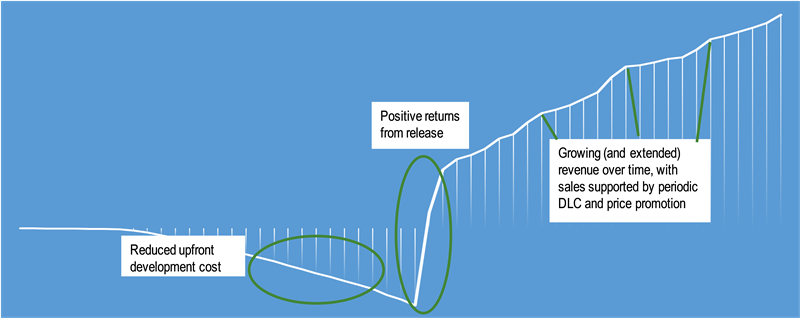
GaaS describes the ongoing relationship with a game’s community post-launch, where the game developer manages the community and provides additional content or events (whether for free or at a charge) to extend the life of the game and increase its lifetime value (LTV).
Digital distribution has allowed a secondary revolution, whereby shorter, more limited core games can be launched, reducing upfront (ie risky) development costs, and then added to by way of downloadable content (DLC) over time, based on user feedback and demand (ie far less risky) to sustain the game’s community. Free or premium content can be used to improve the game and offer an opportunity for incremental future revenue from the title, drawing out the revenue profile, extending its life and strengthening the ongoing direct relationship between the publisher and the game’s community.
Exhibit 7:GaaS cash flow profile
|
|
Source: Frontier Developments, Mello London, November 2018
|
The GaaS business model underpinned by DLC is now established throughout the industry and is an important revenue stream for, eg Sumo Group, as well as a core part of Frontier Developments’ business model.
Console cycle: Not such a concern, but coming
We expect a 2020/21 launch, but will Sony break first (the PS4 is leading this generation, but is showing its age) or Microsoft (losing this generation and trying to get a head start for the next)?
In the early 2000s, the console cycle was an ever-present factor overhanging the sector. Typically, every seven years or so, as the previous generation of hardware started to show its age, a new generation of hardware consoles was launched, building up a user base and seeking to monetise its audience to recoup the huge costs of developing and establishing the console.
Although the games sector is not dominated by the economic cycle, it is subject to the console cycle. With console sales, a smaller part of an expanding pie (vs online, PC, mobile, casual), together with the ability to remotely update platform software periodically with the increasing virtualisation of the console, the games sector as a whole is far more insulated from the cycle today than historically. Nevertheless, although timing is not certain, transition work has started, with 2020/21 being the expected window. We should hear more later this year.
Transition has a huge cost to the hardware manufacturers, Sony, Microsoft and Nintendo, but also delivers a ‘walled garden’ (where the user has restricted access to approved content and services) to their future benefit once the platform base is established.
Google has also thrown its hat into the ring with a streaming console codenamed Project Yeti. Amazon, too, is shortly expected to announce a streaming console.
Streaming/subscriptions: A transformative model?
Streaming (subscription-based models) is just around the corner for the back catalogue, but it may still be some time before front-line games are available to stream.
The ‘next big thing’ (although it is still a number of years away from significant user penetration) is streaming, whereby the game resides and is rendered in the cloud, and streamed live to a ‘dumb’ (or depowered) console. This approach requires robust global communications infrastructure, reduced latency and high-bandwidth, low-cost distribution.
Whether a publisher model or a channel model (think Netflix or Spotify), significant investment is going into developing effective video game streaming models and the associated hardware. There are rumours that Microsoft’s next console will feature both a cloud-based box that streams content and a home console as a hub. A number of the major publishers are also investing in this technology. The end game is that the publisher/console owner has a direct relationship with the consumer and the ability to offer content direct, by way of a subscription.
However, internet infrastructure in many core jurisdictions will need to improve markedly for streaming to become mass-market; latency and lag are currently prohibitive and are likely to remain so for years to come. However, ultimately, the lure of a subscription-based model will be compelling to both publishers and console manufacturers, even if only to monetise their archive of older titles.
This trend can be played through major publishers (eg Electronic Arts), the console manufacturers (Microsoft, Nintendo, Sony and Google) and cloud service providers (Google, Amazon, Microsoft).
eSports: A driver of future growth
From an investor’s perspective, although eSports is a technology with an evolving impact on the industry, the main beneficiaries are Google and Amazon. Pure-play exposure is hard to identify beyond a few specialist eSports companies.
eSports is another revolution in the games industry that will have a significant impact on its future development, but which today has relatively low visibility beyond its select audience. eSports are organised, multiplayer video game competitions, with sponsored professional players and teams.
Once upon a time, gaming was for the solitary player holed up in their bedroom, but that view is now outdated, with online collaborative games growing into eSports (eg League of Legends, Counter-Strike, Overwatch etc). Bizarrely (at least to an outsider), even titles such as Farming Simulator are now forming an eSports league. The necessary ingredients to success appear to be multiplayer titles with a strong community of sufficient size and players with a competitive edge. The audience will choose itself.
Today, eSports provides a further way to build a community around successful titles, extending the life of the game, growing its audience and providing ancillary revenue streams from advertising, sponsorship and merchandising.
These events can draw huge live-streaming audiences on Twitch/YouTube (as well as highlights for download) wanting to watch leading players show their mastery of the game.
Producers of games that may offer attractive future exposure to eSports include Activision Blizzard (for first-person shooters), and potentially Electronic Arts (FIFA, NBA) and Codemasters, who announced a global eSports partnership with Motorsport Network in February 2019, starting with its latest title Dirt Rally 2.0. Otherwise, pure-play exposure is hard to identify beyond a few specialist eSports companies, eg Gfinity in the UK and MTG in Sweden. eSports is also a core part of Game Digital’s strategy.
Virtual reality/augmented reality
One of the major drivers behind the evolution of gaming hardware is the development of virtual reality (VR) and augmented reality (AR). Could a compelling consumer proposition appear in 2019, or 2020 or 2021? It is hard to say, but for the moment, while waiting for the consumer proposition to develop, the best commercial propositions can be found in out-of-home and enterprise VR solutions.
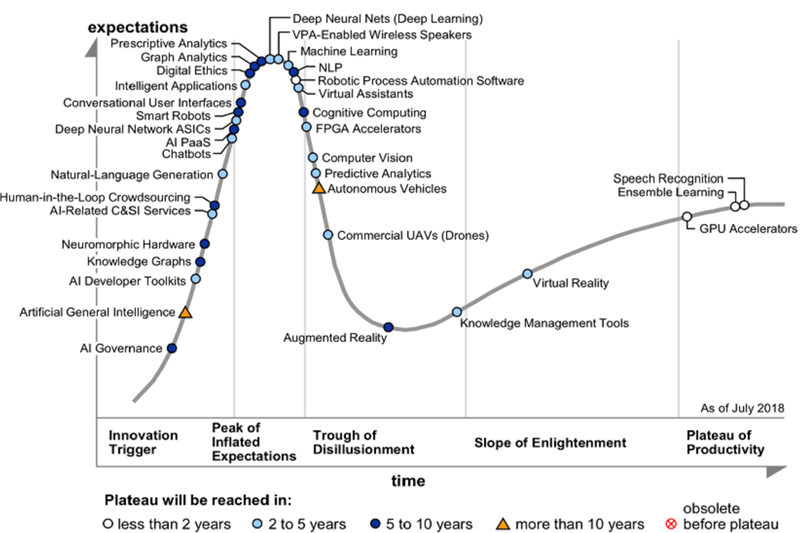
Gartner’s Hype Cycle analysis suggests that Enterprise VR has already arrived as a commercial proposition, but AR and consumer VR are still travelling the curve.
Exhibit 8: Hype cycle for emerging technologies – 2018
|
|
Source: Polar Capital Technology Trust (December 2018)
|
VR is where the user is offered total immersion in a virtual world via goggles or a headset, whereas AR is where a digital user interface is laid across the real world through a pair of glasses or other eyewear (think of a fighter-pilot’s heads-up display), allowing a mix of real and virtual objects.
These technologies have been held up as the future of gaming, offering a more compelling and immersive experience than current screen-based technology. However, the sector is still waiting for mass-market consumer adoption when hardware and content come together to offer a compelling consumer experience at an attractive price point.
Mass-market consumer adoption requires convergence of three principal factors:
1.
Hardware – wireless, lightweight, six degrees of freedom (6DOF), ready-to-wear glasses
2.
Content – variety of compelling, immersive titles
The Oculus Quest headset (Oculus is owned by Facebook) is due to launch in Q119, and could be a big step forward, but a choice of compelling content is still needed for success. Industry insiders suggest mass-market consumer take-up could be seen as early as 2020/21.
However, today, an attractive commercial proposition can be found in ‘out-of-home’ and enterprise VR solutions, where exposure to high-end experiences can be offered commercially, or where the cost savings or other strategic benefits to the enterprise outweigh today’s limited experience.
There are a small number of UK-quoted companies offering exposure to VR: EVR Holdings (live concerts); VR Education (education); and Immotion Group (out-of-home VR). Additionally, one of Mercia Technologies’ largest holdings (‘Emerging Stars’), nDreams, is a leading VR video game developer (Mercia Technologies is an Edison client and a detailed review of nDreams can be found in our initiation note from October 2018: Mercia initiation).
Mobile content: Slowing, but still driving global growth
The UK-quoted games companies offer minimal mobile exposure, as the more casual player base, the dominant freemium model and intense competition all contribute to an unattractive risk profile.
The fastest-growing segment of the games sector remains on the smartphone, where Newzoo forecasts global growth continuing at an IRR of c 19% from 2017–21.
Mobile offers the potential for huge scale and penetration, but monetisation is only becoming harder as premium titles struggle with the swathe of free content available, meaning that the most relevant business model is free-to-play (no up-front cost, discretionary micro-transactions and premium content).
From a games perspective, mobile remains a casual medium where tastes, fads and fashions move quickly, but meaningful revenues are hard to achieve. As a result, mobile gaming is not a core focus for a number of major games companies, eg Ubisoft, Frontier Developments. Activision Blizzard retains significant exposure to mobile through its acquisition of King (maker of Candy Crush), while Glu, Zynga, MAG interactive, Stillfront and Rovio (Angry Birds) offer pure-play quoted company exposure. In the UK, Codemasters has recently signed a significant deal for a mobile racing title with NetEase targeting a Chinese audience and Team17 offers a range of mobile and casual titles.
On mobile, consumer recognition is incredibly powerful, with the consumer drawn to names/IPs that they know and recognise, particularly those titles being played by their peers. This tends to reward successful titles (success begets success) and make the slope even more slippery for new IP. This phenomenon is highlighted by AppAnnie’s The State of Mobile 2019; incumbency matters:
Exhibit 9: Top smartphone games by monthly average user (MAU), 2018
|
Brazil |
Canada |
China |
France |
Germany |
India |
Japan |
South Korea |
US |
UK |
1 |
Free Fire |
Candy Crush Saga |
Anipop |
Candy Crush Saga |
QuizClash |
Ludo King |
Disney Tsum Tsum |
PUBG Mobile |
Pokemon GO |
Candy Crush Saga |
2 |
Candy Crush Saga |
Pokemon GO |
Honour of Kings |
Clash Royale |
Candy Crush Saga |
Candy Crush Saga |
Monster Strike |
Clash Royale |
Candy Crush Saga |
Helix Jump |
3 |
Helix Jump |
HQ - Live Trivia Game Show |
PUBG: Exciting Battlefield |
Pokemon GO |
Pokemon GO |
PUBG Mobile |
Pokemon GO |
Rider |
New World With Friends |
Pokemon GO |
4 |
Cartola FC Oficial |
Helix Jump |
Landlord Poker |
FDJ |
Helix Jump |
Clash of Clans |
Puzzle & Dragons |
Pmang New Mango |
HQ - Live Trivia Game Show |
8 Ball Pool |
5 |
Clash Royale |
Wordscapes |
Mini World Block Art |
Clash of Clans |
Clash Royale |
Doodle Army 2: Mini Militia |
Knives Out |
Everybody's Marble |
Helix Jump |
MobilityWare Solitaire |
|
|
|
|
|
|
|
|
|
|
|
|
|
|
|
Incumbents: published prior to 2018 |
|
|
|
|
|
|
New titles: published during 2018 |
|
|
|
|
Gaming in China: The thaw has arrived
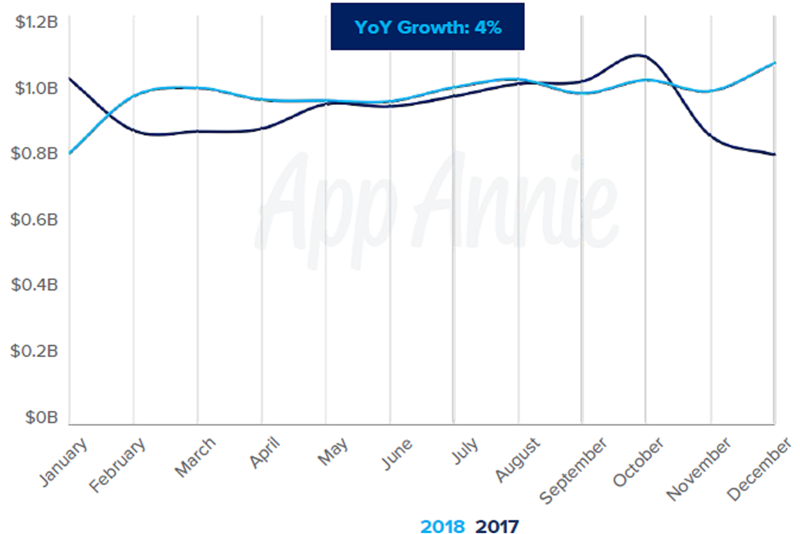
The size of the Chinese market is hard to ignore, but cultural differences mean that many western IPs are not relevant. Western companies usually choose local partners to tackle the key Eastern territories individually. The recent hiatus in Chinese regulatory approvals has affected the pace of growth for mobile games in China as well as encouraging the local incumbents to look for growth (and diversification) overseas (see Exhibit 10 below).
The Asian markets have evolved independently to western markets, with cultural differences helping to shape different styles of game, gameplay and business models.
Japan, with two of the global console manufacturers (Sony and Nintendo), has greater crossover to western markets than China or Korea, the two other largest games markets. In 2018, a change to censorship and regulatory responsibilities brought the new games pipeline in China to a grinding halt, significantly affecting the major games companies, Tencent and NetEase. Games approvals restarted in December 2018, but only a few titles in a huge backlog have been released (to date).
Western studios are now more focused than ever on the opportunity offered by the Chinese audience, but games that are suited to such different markets are rare.
Most developers will partner with one of the strong local players, one of the BATs (Baidu, Alibaba, Tencent) or NetEase, to optimise games for the Chinese market and manage distribution of a game that complies with local requirements for censorship and regulation.
With a huge choice of local hardware manufacturers, the VR market in Asia has also followed a different development path than in the west with VR content largely free-to-play. As a consequence of this ecosystem, hardware sales are significantly ahead of the west, but the quality of game content is generally poor.
Exhibit 10: Chinese consumer spend on games (US$bn)
|
|
|
|
Video Games Tax Relief: Benefit to the bottom line
The benefits of the Video Games Tax Relief (VGTR) are considerable to many of the major UK developers.
The video games tax credit regime was introduced on 1 April 2014 as part of the British government’s broader efforts to support the creative industries in the UK. It provides a tax credit of up to 20% of production costs for developers of commercial video games (on all platforms – PC, console, mobile etc) that are certified as culturally British.
To be eligible the video game development company (VGDC) must be responsible for the majority of the planning, designing, developing, testing and producing of a game, with a minimum of 25% of eligible costs incurred in the EEA.
The VGTR regime has been well received and will continue until 2023 at the earliest (and may well be extended further), helping to support games development in the UK for the foreseeable future. The relief can be claimed for eligible games, though in practice not all developers claim the relief.
We see VGTR as a significant boost to the UK industry to maintain its global competitiveness. Although a future government could amend (or even curtail) the relief, this would seem to us to run counter to two government initiatives: 1) the broader initiative to support UK SMEs to generate employment; and 2) to support UK-based creative industries.
VGTR is a significant benefit for a co-developer such as Sumo Digital and games-engine owning developers such as Codemasters, whilst Frontier Developments prefers the alternative path of applying for R&D tax relief.
We hesitate before mentioning Brexit given the political and economic uncertainties it raises, not to mention the passions. However, looking at the UK sector in 2019, it at least deserves a mention.
In our assessment, the impact of Brexit on the UK video games industry will be negative, although as an international, largely digital service industry, the games sector is well placed by comparison with many other industry sectors.
A report by Games4EU (an anti-Brexit body) states: ‘We need to move our games (both digital and physical), our consoles and our people around the UK and EU – fast and frictionlessly (often referred to as 'just in time' mechanisms). We depend on the regulatory system to enable digital access to our products across the EU.’
We would highlight the key, identifiable issues as:
1.
increased business uncertainty, leading to additional costs, management distraction and contingency planning;
2.
staff attraction and retention – games companies employ skilled (but not necessarily highly paid) staff from around the world. At the margin, EU citizens may be less likely to come to the UK, but for those who do, larger companies are already geared up to obtain visas for staff, a necessity that will presumably extend to include EU staff;
3.
sharing IP and data across borders – as well as concerns over data protection, thought may need to be given about where work is done, what value has been added and how value-add is accounted for and taxed, with the potential for increased costs for products and services; and
4.
as a way to circumvent some of these issues, larger UK companies may choose to open EU studios, eroding potential future employment growth in the UK.
In summary, from an industry perspective, we expect a series of marginal losses, increasing friction and eroding the UK’s competitiveness, with little identifiable benefit in return.
General disclaimer and copyright This report has been prepared and issued by Edison. Edison Investment Research standard fees are £49,500 pa for the production and broad dissemination of a detailed note (Outlook) following by regular (typically quarterly) update notes. Fees are paid upfront in cash without recourse. Edison may seek additional fees for the provision of roadshows and related IR services for the client but does not get remunerated for any investment banking services. We never take payment in stock, options or warrants for any of our services. Accuracy of content: All information used in the publication of this report has been compiled from publicly available sources that are believed to be reliable, however we do not guarantee the accuracy or completeness of this report and have not sought for this information to be independently verified. Opinions contained in this report represent those of the Edison analyst at the time of publication. Forward-looking information or statements in this report contain information that is based on assumptions, forecasts of future results, estimates of amounts not yet determinable, and therefore involve known and unknown risks, uncertainties and other factors which may cause the actual results, performance or achievements of their subject matter to be materially different from current expectations. Exclusion of Liability: To the fullest extent allowed by law, Edison shall not be liable for any direct, indirect or consequential losses, loss of profits, damages, costs or expenses incurred or suffered by you arising out or in connection with the access to, use of or reliance on any information contained on this note. No personalised advice: The information that we provide should not be construed in any manner whatsoever as, personalised advice. Also, the information provided by us should not be construed by any subscriber or prospective subscriber as Edison’s solicitation to effect, or attempt to effect, any transaction in a security. The securities described in the report may not be eligible for sale in all jurisdictions or to certain categories of investors. Investment in securities mentioned: Edison has a restrictive policy relating to personal dealing and conflicts of interest. Edison Group does not conduct any investment business and, accordingly, does not itself hold any positions in the securities mentioned in this report. However, the respective directors, officers, employees and contractors of Edison may have a position in any or related securities mentioned in this report, subject to Edison's policies on personal dealing and conflicts of interest. Copyright: Copyright 2019 Edison Investment Research Limited (Edison). All rights reserved FTSE International Limited (“FTSE”) © FTSE 2019. “FTSE®” is a trade mark of the London Stock Exchange Group companies and is used by FTSE International Limited under license. All rights in the FTSE indices and/or FTSE ratings vest in FTSE and/or its licensors. Neither FTSE nor its licensors accept any liability for any errors or omissions in the FTSE indices and/or FTSE ratings or underlying data. No further distribution of FTSE Data is permitted without FTSE’s express written consent.
Australia Edison Investment Research Pty Ltd (Edison AU) is the Australian subsidiary of Edison. Edison AU is a Corporate Authorised Representative (1252501) of Myonlineadvisers Pty Ltd who holds an Australian Financial Services Licence (Number: 427484). This research is issued in Australia by Edison AU and any access to it, is intended only for "wholesale clients" within the meaning of the Corporations Act 2001 of Australia. Any advice given by Edison AU is general advice only and does not take into account your personal circumstances, needs or objectives. You should, before acting on this advice, consider the appropriateness of the advice, having regard to your objectives, financial situation and needs. If our advice relates to the acquisition, or possible acquisition, of a particular financial product you should read any relevant Product Disclosure Statement or like instrument.
New Zealand The research in this document is intended for New Zealand resident professional financial advisers or brokers (for use in their roles as financial advisers or brokers) and habitual investors who are “wholesale clients” for the purpose of the Financial Advisers Act 2008 (FAA) (as described in sections 5(c) (1)(a), (b) and (c) of the FAA). This is not a solicitation or inducement to buy, sell, subscribe, or underwrite any securities mentioned or in the topic of this document. For the purpose of the FAA, the content of this report is of a general nature, is intended as a source of general information only and is not intended to constitute a recommendation or opinion in relation to acquiring or disposing (including refraining from acquiring or disposing) of securities. The distribution of this document is not a “personalised service” and, to the extent that it contains any financial advice, is intended only as a “class service” provided by Edison within the meaning of the FAA (i.e. without taking into account the particular financial situation or goals of any person). As such, it should not be relied upon in making an investment decision.
United Kingdom Neither this document and associated email (together, the "Communication") constitutes or form part of any offer for sale or subscription of, or solicitation of any offer to buy or subscribe for, any securities, nor shall it or any part of it form the basis of, or be relied on in connection with, any contract or commitment whatsoever. Any decision to purchase shares in the Company in the proposed placing should be made solely on the basis of the information to be contained in the admission document to be published in connection therewith. This Communication is being distributed in the United Kingdom and is directed only at (i) persons having professional experience in matters relating to investments, i.e. investment professionals within the meaning of Article 19(5) of the Financial Services and Markets Act 2000 (Financial Promotion) Order 2005, as amended (the "FPO") (ii) high net-worth companies, unincorporated associations or other bodies within the meaning of Article 49 of the FPO and (iii) persons to whom it is otherwise lawful to distribute it. The investment or investment activity to which this document relates is available only to such persons. It is not intended that this document be distributed or passed on, directly or indirectly, to any other class of persons and in any event and under no circumstances should persons of any other description rely on or act upon the contents of this document (nor will such persons be able to purchase shares in the placing). This Communication is being supplied to you solely for your information and may not be reproduced by, further distributed to or published in whole or in part by, any other person.
United States The Investment Research is a publication distributed in the United States by Edison Investment Research, Inc. Edison Investment Research, Inc. is registered as an investment adviser with the Securities and Exchange Commission. Edison relies upon the "publishers' exclusion" from the definition of investment adviser under Section 202(a) (11) of the Investment Advisers Act of 1940 and corresponding state securities laws. This report is a bona fide publication of general and regular circulation offering impersonal investment-related advice, not tailored to a specific investment portfolio or the needs of current and/or prospective subscribers. As such, Edison does not offer or provide personal advice and the research provided is for informational purposes only. No mention of a particular security in this report constitutes a recommendation to buy, sell or hold that or any security, or that any particular security, portfolio of securities, transaction or investment strategy is suitable for any specific person. |
|
Frankfurt +49 (0)69 78 8076 960 Schumannstrasse 34b 60325 Frankfurt Germany |
London +44 (0)20 3077 5700 280 High Holborn London, WC1V 7EE United Kingdom |
New York +1 646 653 7026 1,185 Avenue of the Americas 3rd Floor, New York, NY 10036 United States of America |
Sydney +61 (0)2 8249 8342 Level 4, Office 1205 95 Pitt Street, Sydney NSW 2000, Australia |
Frankfurt +49 (0)69 78 8076 960 Schumannstrasse 34b 60325 Frankfurt Germany |
London +44 (0)20 3077 5700 280 High Holborn London, WC1V 7EE United Kingdom |
New York +1 646 653 7026 1,185 Avenue of the Americas 3rd Floor, New York, NY 10036 United States of America |
Sydney +61 (0)2 8249 8342 Level 4, Office 1205 95 Pitt Street, Sydney NSW 2000, Australia |
|
General disclaimer and copyright This report has been prepared and issued by Edison. Edison Investment Research standard fees are £49,500 pa for the production and broad dissemination of a detailed note (Outlook) following by regular (typically quarterly) update notes. Fees are paid upfront in cash without recourse. Edison may seek additional fees for the provision of roadshows and related IR services for the client but does not get remunerated for any investment banking services. We never take payment in stock, options or warrants for any of our services. Accuracy of content: All information used in the publication of this report has been compiled from publicly available sources that are believed to be reliable, however we do not guarantee the accuracy or completeness of this report and have not sought for this information to be independently verified. Opinions contained in this report represent those of the Edison analyst at the time of publication. Forward-looking information or statements in this report contain information that is based on assumptions, forecasts of future results, estimates of amounts not yet determinable, and therefore involve known and unknown risks, uncertainties and other factors which may cause the actual results, performance or achievements of their subject matter to be materially different from current expectations. Exclusion of Liability: To the fullest extent allowed by law, Edison shall not be liable for any direct, indirect or consequential losses, loss of profits, damages, costs or expenses incurred or suffered by you arising out or in connection with the access to, use of or reliance on any information contained on this note. No personalised advice: The information that we provide should not be construed in any manner whatsoever as, personalised advice. Also, the information provided by us should not be construed by any subscriber or prospective subscriber as Edison’s solicitation to effect, or attempt to effect, any transaction in a security. The securities described in the report may not be eligible for sale in all jurisdictions or to certain categories of investors. Investment in securities mentioned: Edison has a restrictive policy relating to personal dealing and conflicts of interest. Edison Group does not conduct any investment business and, accordingly, does not itself hold any positions in the securities mentioned in this report. However, the respective directors, officers, employees and contractors of Edison may have a position in any or related securities mentioned in this report, subject to Edison's policies on personal dealing and conflicts of interest. Copyright: Copyright 2019 Edison Investment Research Limited (Edison). All rights reserved FTSE International Limited (“FTSE”) © FTSE 2019. “FTSE®” is a trade mark of the London Stock Exchange Group companies and is used by FTSE International Limited under license. All rights in the FTSE indices and/or FTSE ratings vest in FTSE and/or its licensors. Neither FTSE nor its licensors accept any liability for any errors or omissions in the FTSE indices and/or FTSE ratings or underlying data. No further distribution of FTSE Data is permitted without FTSE’s express written consent.
Australia Edison Investment Research Pty Ltd (Edison AU) is the Australian subsidiary of Edison. Edison AU is a Corporate Authorised Representative (1252501) of Myonlineadvisers Pty Ltd who holds an Australian Financial Services Licence (Number: 427484). This research is issued in Australia by Edison AU and any access to it, is intended only for "wholesale clients" within the meaning of the Corporations Act 2001 of Australia. Any advice given by Edison AU is general advice only and does not take into account your personal circumstances, needs or objectives. You should, before acting on this advice, consider the appropriateness of the advice, having regard to your objectives, financial situation and needs. If our advice relates to the acquisition, or possible acquisition, of a particular financial product you should read any relevant Product Disclosure Statement or like instrument.
New Zealand The research in this document is intended for New Zealand resident professional financial advisers or brokers (for use in their roles as financial advisers or brokers) and habitual investors who are “wholesale clients” for the purpose of the Financial Advisers Act 2008 (FAA) (as described in sections 5(c) (1)(a), (b) and (c) of the FAA). This is not a solicitation or inducement to buy, sell, subscribe, or underwrite any securities mentioned or in the topic of this document. For the purpose of the FAA, the content of this report is of a general nature, is intended as a source of general information only and is not intended to constitute a recommendation or opinion in relation to acquiring or disposing (including refraining from acquiring or disposing) of securities. The distribution of this document is not a “personalised service” and, to the extent that it contains any financial advice, is intended only as a “class service” provided by Edison within the meaning of the FAA (i.e. without taking into account the particular financial situation or goals of any person). As such, it should not be relied upon in making an investment decision.
United Kingdom Neither this document and associated email (together, the "Communication") constitutes or form part of any offer for sale or subscription of, or solicitation of any offer to buy or subscribe for, any securities, nor shall it or any part of it form the basis of, or be relied on in connection with, any contract or commitment whatsoever. Any decision to purchase shares in the Company in the proposed placing should be made solely on the basis of the information to be contained in the admission document to be published in connection therewith. This Communication is being distributed in the United Kingdom and is directed only at (i) persons having professional experience in matters relating to investments, i.e. investment professionals within the meaning of Article 19(5) of the Financial Services and Markets Act 2000 (Financial Promotion) Order 2005, as amended (the "FPO") (ii) high net-worth companies, unincorporated associations or other bodies within the meaning of Article 49 of the FPO and (iii) persons to whom it is otherwise lawful to distribute it. The investment or investment activity to which this document relates is available only to such persons. It is not intended that this document be distributed or passed on, directly or indirectly, to any other class of persons and in any event and under no circumstances should persons of any other description rely on or act upon the contents of this document (nor will such persons be able to purchase shares in the placing). This Communication is being supplied to you solely for your information and may not be reproduced by, further distributed to or published in whole or in part by, any other person.
United States The Investment Research is a publication distributed in the United States by Edison Investment Research, Inc. Edison Investment Research, Inc. is registered as an investment adviser with the Securities and Exchange Commission. Edison relies upon the "publishers' exclusion" from the definition of investment adviser under Section 202(a) (11) of the Investment Advisers Act of 1940 and corresponding state securities laws. This report is a bona fide publication of general and regular circulation offering impersonal investment-related advice, not tailored to a specific investment portfolio or the needs of current and/or prospective subscribers. As such, Edison does not offer or provide personal advice and the research provided is for informational purposes only. No mention of a particular security in this report constitutes a recommendation to buy, sell or hold that or any security, or that any particular security, portfolio of securities, transaction or investment strategy is suitable for any specific person. |
|
Frankfurt +49 (0)69 78 8076 960 Schumannstrasse 34b 60325 Frankfurt Germany |
London +44 (0)20 3077 5700 280 High Holborn London, WC1V 7EE United Kingdom |
New York +1 646 653 7026 1,185 Avenue of the Americas 3rd Floor, New York, NY 10036 United States of America |
Sydney +61 (0)2 8249 8342 Level 4, Office 1205 95 Pitt Street, Sydney NSW 2000, Australia |
Frankfurt +49 (0)69 78 8076 960 Schumannstrasse 34b 60325 Frankfurt Germany |
London +44 (0)20 3077 5700 280 High Holborn London, WC1V 7EE United Kingdom |
New York +1 646 653 7026 1,185 Avenue of the Americas 3rd Floor, New York, NY 10036 United States of America |
Sydney +61 (0)2 8249 8342 Level 4, Office 1205 95 Pitt Street, Sydney NSW 2000, Australia |
|