Last close As at 05/08/2026
GBP1.33
▲ 3.00 (2.31%)
Market capitalisation
GBP137m
Research: Investment Companies
Baker Steel Resources Trust (BSRT) has been affected by the challenging funding environment for mining development projects, especially for single-project junior mining companies. The funding environment led Tungsten West to carry out an interim fund-raising at a depressed valuation. BSRT’s key potential NAV trigger for this year remains a possible successful funding by Futura Resources to launch production at its two coking coal mines in Australia. While the fund-raising has again been delayed and the demand for coking coal may be affected by a global economic slowdown, the project’s economics remain favourable at current coking coal prices.
Baker Steel Resources Trust |
Facing a challenging funding environment |
Investment trusts |
21 June 2023 |
Analyst
|
||||||||||||||||||||||||||||||||||||||||||||||||||||||||||||||||||||
Baker Steel Resources Trust (BSRT) has been affected by the challenging funding environment for mining development projects, especially for single-project junior mining companies. The funding environment led Tungsten West to carry out an interim fund-raising at a depressed valuation. BSRT’s key potential NAV trigger for this year remains a possible successful funding by Futura Resources to launch production at its two coking coal mines in Australia. While the fund-raising has again been delayed and the demand for coking coal may be affected by a global economic slowdown, the project’s economics remain favourable at current coking coal prices.
|
BSRT’s portfolio by investment type as at end-March 2023 |
|
|
Source: Baker Steel Resources Trust data |
Potential from structural demand for commodities
BSRT’s investment manager highlights several factors that may support the company’s portfolio, including: (1) structural growth in demand for commodities (eg from the electric vehicle and renewable energy industries); (2) demand from China following the reopening of its economy; (3) low inventory levels of base metals (eg copper, nickel, zinc) versus historical averages; (4) a potential pickup in M&A activity from miners, manufacturers and energy firms; (5) persistent high inflation; and (6) the West seeking to secure supplies of critical commodities in ‘friendly’ jurisdictions.
The analyst’s view
BSRT is more than a simple beta play on commodity prices, given its focus on realising the valuation upside from project development and its investment in projects that offer a solid safety margin in terms of an internal rate of return (IRR) based on consensus price forecasts. The majority of BSRT’s current portfolio is held either in producing assets – Cemos, Caledonia Mining Corporation (CMCL), Silver X – where further production ramp-up/expansion offers re-rating potential, or in projects approaching mine construction (eg Tungsten West) and production (Futura Resources) whose valuations may benefit from project de-risking in the case of successful progress. We believe that, once the fund-raising/M&A environment improves, this portfolio may experience several positive NAV catalysts from project progress, leading to a potential asset sale/IPO and/or recurring royalty/dividend streams. Following the expiry of the lock-up on CMCL shares, BSRT is again looking for potential new investment opportunities.
Tungsten West’s developments illustrate persistently tough funding environment
Monetary tightening and macroeconomic uncertainty (further exacerbated by the issues of US regional banks) continue to weigh on corporate funding, making the financing of mining development projects more challenging. This is reflected in the recent developments at Tungsten West (TUN, LSE), one of BSRT’s portfolio holdings developing the tungsten Hemerdon mine in the UK.
|
Exhibit 1: Contributions of key holdings to BSRT’s NAV total return in 2023 to date (pp) |
|
|
Source: Baker Steel Resources Trust data, Edison Investment Research. Note: *Contribution of Polar Acquisition to end-March 2023 (last available data). |
Forced to conduct an interim fund-raising at a steep discount to end-March share price
In January 2023, Tungsten West released the results of its revised feasibility study (FS) that indicated a base-case post-tax net present value of £297m and an IRR of 25%. The FS included an estimate for pre-production capital expenditure, corporate commitments and working capital requirements of £54.9m in total.
Last year, Tungsten West agreed to a non-binding term sheet for a US$30m royalty sale with a global mine royalty investment fund, which was expected to close in Q123 following the completion of the revised FS. It also planned to secure an additional £10.0m of funding, which would allow it to commission the Hemerdon project (which was originally planned in H123). However, the company struggled to secure the funding and decided in early April 2023 to conduct an interim fund-raise through: (1) the placement of convertible loan notes (CLN) bearing a payment-in-kind coupon of 20% pa; and (2) an open offer for newly issued shares. As a result, Tungsten West raised around £7.1m in gross proceeds (out of the maximum planned £8.95m), which will provide capital to meet its near-term contractual liabilities and annual expenditure, as well as finance its planning and permitting activities. Tungsten West is now focused on securing the mineral processing facility permit, which will include imminent low-frequency noise trials, as the management drives progress of Hemerdon towards production. The interim fund-raising was carried out at a 77.5% discount to the closing price on 31 March 2023, resulting in a significant decline in Tungsten West’s share price.
Board changes and review of funding and strategic options
The funding measures were coupled with changes to the company’s management and non-executive board. Neil Gawthorpe was appointed as the new CEO in March 2023; Francis Johnstone (BSRT’s representative) and Grace Stevens stepped down as non-executive directors in March 2023; James McFarlane (managing director) stepped down in April 2023; and Mark Thompson (one of the founding directors of Tungsten West) stepped down as executive vice chairman in May 2023.
The new CEO led a review of the funding and strategic options. On 2 June, the company announced that the cost reduction programme was nearing completion, with a forecast 42% headcount and monthly payroll cost reduction (resulting in minimal one-off costs). Meanwhile, project capex for the front-end rebuild has been scaled back to existing capital commitments for equipment purchase, as well as low-frequency noise trial work. This was coupled with the halt of refurbishment work, pending the completion of permitting and funding processes. Tungsten West also carried out small-scale production of tungsten and tin concentrate at the Hemerdon mine (shipped to an offtaker in May 2023). Finally, we note that the company recently announced a strategic partnership with fusion energy company Oxford Sigma to explore and establish critical supply pathway options for the use of tungsten for radiation shielding and plasma-facing components within fusion energy devices.
Futura Resources and Cemos remain key drivers
We note that the impact on BSRT’s NAV from Tungsten West’s issues has been moderate in 2023 to date, as the investment represented just 5.4% of BSRT’s NAV at end-2022. BSRT’s key portfolio drivers remain Futura Resources and Cemos Group, which have a combined share of BSRT’s portfolio value of around 54% at end-May 2023.
Futura Resources’ fund-raising still pending
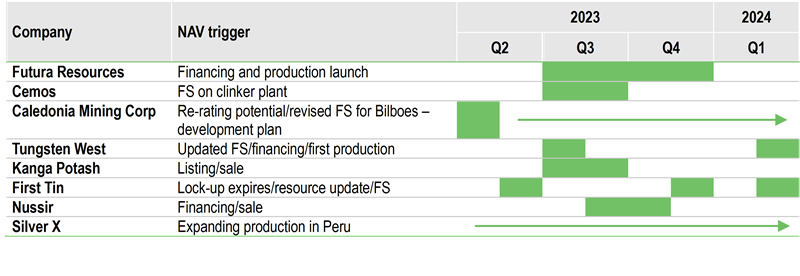
As discussed in our previous update note, a potential successful fund-raising of Futura Resources (28.9% of end-May 2023 NAV), followed by production launch (with Wilton likely to come first given limited start-up capex of c A$25.0m), represents the key potential catalyst for BSRT this year. Here, we note that funding has been pending since 2021, initially postponed by the COVID-19 pandemic and subsequently by an unofficial Chinese ban on Australian coal. BSRT expected the funding to close in Q123 (following the award of mining licences in November 2022), but the process is taking longer than expected. Management indicated that one of the reasons for this was the introduction of a higher royalty by the government of Queensland (where Futura Resources’ projects are located) in 2022 (which we discussed in our August 2022 note), which led some investors to remain on hold with financing the project.
NAV upside on successful production launch still sizeable
According to BSRT’s management, Futura Resources can start mining at the sites around three months after a potential closing of funding. Management expects that, at full capacity, Futura Resources’ two mines should produce two million tonnes of saleable product after washing and processing. Management highlighted that, based on coking coal prices when the 2022 annual report was published in late April 2023, the project’s profits would allow it to repay the start-up capex of around US$35.0m in under a year. This compares with Futura Resources’ total equity valuation (implied by the current fair value of BSRT’s stake) of A$63.0m at end-March 2023. Therefore, we continue to see potential for a significant NAV uplift if BSRT can secure funding for the project and start production at current coking coal prices (although we note that it may potentially have to sell its output at a discount if the financing involves an offtake agreement or for other reasons, such as impurities). Current Australian coking coal prices are around US$220–230 per tonne compared to Futura Resources’ all-in sustainable cost of US$80 per tonne.
BSRT’s investment in Futura Resources is a combination of equity (26.9% stake), a 1.5% gross revenue royalty and a A$600k bridge loan. The fair value of BSRT’s holding has remained broadly stable in 2023 to date in local currency terms, although the sterling value has declined slightly due to weakness of the Australian dollar against sterling.
Nussir looking for strategic investor; Kanga Potash seeking funding or trade sale/IPO
Nussir (4.0% of BSRT’s end-May 2023 NAV) has also faced challenges in raising funding for its project copper mining project in Norway and is now seeking a deal (sale or merger) with a strategic investor. BSRT will seek to retain exposure to the project, for example through royalties (similar to Bilboes Gold). BSRT also continues to explore the possibility to finance or sell the Kanga Potash project in the Democratic Republic of the Congo (6.1% of end-May 2023 NAV). The definitive FS completed in 2020 indicated an IRR of 22% based on a muriate of potash price of US$282 per tonne, compared to the current price of around US$350–400 per tonne.
Other portfolio developments
|
Exhibit 2: Potential portfolio NAV triggers with indicative timelines |
|
|
Source: Baker Steel Resources Trust |
Cemos still aiming to double capacity by 2025
Cemos (25.0% of end-May 2023 NAV) is in its third year of production, with BSRT’s management expecting production volumes and EBITDA to be broadly stable versus 2022 at 202k tonnes of cement and €8.5m, respectively. The company continues to target a doubling of production capacity to 570k tonnes pa by 2025 based on the second production line acquired in mid-2022, with required expenditure at around €7.0m (which should be financed internally). Moreover, Cemos is still exploring the possibility of building a low-cost clinker plant. BSRT assumes that Cemos will complete the FS on the clinker plant soon and commence installation of the second line around Q124. The valuation of BSRT’s stake in Cemos has remained broadly stable in euro terms so far this year.
Caledonia Mining Corporation (CMCL, NYSE) facing technical challenges in Q123
CMCL (10.4% of end-May 2023 NAV) reported its Q123 results in May 2023, with some technical challenges (equipment failures and logistical issues) affecting production and resulting in gross revenues of US$29.4m (vs US$35.1m in Q122). As a result, gross profit stood at US$5.9m (down 65.4% y-o-y), translating into a Q123 net loss of US$5.0m (vs a US$5.9m net profit in Q122). The company’s management believes these challenges have already been resolved and it is encouraged by production and cost data in April and between start of May and the date of releasing the Q123 results. CMCL restarted production from oxide mining at end-March 2023 and (despite some technical challenges) expects that gold mining from near surface oxide deposits will be cash neutral. This should allow the project to maintain operational integrity ahead of the revised FS related to the larger underlying sulphide project.
CMCL’s shares are up by 9% from January 2023 to 20 June (2% down to end-May 2023). We note that BSRT’s six-month lock-up (from the moment of the Bilboes deal completion on 6 January 2023) will soon expire. BSRT is likely to sell down its CMCL holdings over the medium term so it can deploy the proceeds in unlisted junior mining projects, in line with its core strategy. Meanwhile, its stake in CMCL offers regular dividend income; CMCL has declared two interim dividends of US$0.14 each so far this year, translating into an annualised yield of around 4.1% and a gross dividend for BSRT of US$0.45m. Moreover, we note that BSRT retained exposure to the Bilboes gold project it sold to Caledonia through a 1% net smelter royalty. BSRT expects it to generate an income of around US$2.6m per year (assuming withholding tax of 15% and a gold price of US$1,800 per ounce).
First Tin (1SN, LSE): Steady progress on both of its projects
On 5 May 2023, First Tin (3.6% of end-May 2023 NAV) announced that it had submitted the complete documentation for its mine permit application to the Saxonian Mining Authority for its Tellerhäuser underground tin project in Germany, with the authority’s decision expected before the end of Q324. It expects to complete the definitive FS in H124. Moreover, the definitive study for the Taronga open-pit tin project in Australia is scheduled for completion in Q423. First Tin announced on 12 June that it had completed all drilling at the Taronga project, with its results confirming an extension of around 400 metres to the south-west.
Polar Acquisition written further down due to geopolitical risks
In its March NAV update, BSRT highlighted that the Prognoz mine is on schedule for mining to start in late-2023 and first revenue to be generated in Q224. This should allow for BSRT to collect first royalties in H224. That said, BSRT acknowledges various Russia-related risks that may result in its inability to collect the royalty. Accordingly, BSRT marked down the value of its Polar Acquisition holdings by 75%. As at end-March 2023, the holding was valued at around twice the potential annual royalty cash flow, according to BSRT.
|
|
Research: Industrials
Thrace Group’s Q123 results highlight continued growth in underlying adjusted EBITDA (excluding personal protective equipment (PPE) related products), as it increased by 4% and 22% compared to Q122 and Q120 (pre-PPE boost) respectively. Despite a modest drop in Q123 volumes of 4%, management anticipates sustained continuing profitability in Q223. Management expects H123 EBITDA from the traditional portfolio to be in line with previous years’ levels at around €25m, which is consistent with our forecasts, which remain unchanged. As mentioned in our recent note, we value the company at €8.23 per share, implying plenty of upside potential.