Xbrane now focuses on developing high-margin biosimilar products. In July, Xbrane did a deal with STADA on Xlucane, its Lucentis biosimilar and gained an upfront fee of €7.5m; management estimates that Xbrane’s 50:50 profit share could be worth up to €100m per year. STADA will market Xlucane. Xbrane aims to start clinical development in Q119. In drug delivery, Spherotide bulk sales to Iran were SEK14m to June 2018. In Europe, the key market, Spherotide development requires a partner to fund trials. The Chinese deal with CR Pharma completed in February, bringing a SEK13m fee. Our valuation has been revised to SEK581m.
Written by
Xbrane Biopharma |
Biosimilar focus after successful partnering |
Update and Q318 results |
Pharma & biotech |
23 November 2018 |
Share price performance
Business description
Next events
Analyst
Xbrane Biopharma is a research client of Edison Investment Research Limited |
|||||||||||||||||||||||||||||||||||||||||||||||
Xbrane now focuses on developing high-margin biosimilar products. In July, Xbrane did a deal with STADA on Xlucane, its Lucentis biosimilar and gained an upfront fee of €7.5m; management estimates that Xbrane’s 50:50 profit share could be worth up to €100m per year. STADA will market Xlucane. Xbrane aims to start clinical development in Q119. In drug delivery, Spherotide bulk sales to Iran were SEK14m to June 2018. In Europe, the key market, Spherotide development requires a partner to fund trials. The Chinese deal with CR Pharma completed in February, bringing a SEK13m fee. Our valuation has been revised to SEK581m.
Year |
Revenue* (SEKm) |
PBT** |
EPS** |
DPS |
P/E |
Yield |
12/16 |
0.0 |
(25.11) |
(5.52) |
0.0 |
N/A |
N/A |
12/17 |
20.77 |
(44.16) |
(8.14) |
0.0 |
N/A |
N/A |
12/18e |
22.16 |
(3.40) |
(0.58) |
0.0 |
N/A |
N/A |
12/19e |
25.00 |
(182.15) |
(28.81) |
0.0 |
N/A |
N/A |
Note: *Revenue includes other income. **PBT and EPS are normalised, excluding amortisation of acquired intangibles, exceptional items and share-based payments.
Xlucane the core focus with STADA partnering
Xlucane is developing a biosimilar of Lucentis (ranibizumab, Roche/Novartis; 2017 sales: $3.3bn) to treat wet age-related macular degeneration (wAMD). In July 2018, it was globally partnered with STADA, a German company with €2.3bn 2017 sales, a large generic portfolio and strong European sales capability. Development costs and post-marketing net profits are split 50:50. Competitors include bioeq (partnered with Formycon) with Phase III data and Samsung Bioepis with a Phase III trial underway. Xbrane and STADA plan to be ready for a European launch in 2022 on patent expiry with the planned Phase III clinical trial being initiated in Q119.
Spherotide requires a partner to enter European trials
Triptorelin is a generic product to treat prostate cancer, endometriosis and uterine fibroids usually given every one or three months as a depot formulation. Ipsen, the market leader, sold €348.7m of branded Triptorelin in 2017. Xbrane is developing Spherotide as a generic triptorelin depot. Iranian bulk sales of one-month product from 2017 appear level at about SEK25m a year. The Chinese deal with CR Pharma brought in SEK14.6m (US$1.6m) in H118. Development depends on signing a partner to fund trials. Substantial European sales will require a three-month depot form; this is about one year behind the current one-month product.
Valuation: Excellent Xlucane deal boosts value
We have revised the indicative valuation based on cash flows between 2019 and 2030, adjusted for updated financials, clinical timelines, probabilities and the better than expected STADA deal on Xlucane. With company expectations of up to a €100m yearly profit share from Xlucane, the value is revised to SEK581m. This equates to SEK92/share before any further dilution. We estimate that Xbrane will require possibly SEK100m of cash in 2019 to fund its 50% share of the company-estimated €30–40m Xlucane Phase III costs. The valuation assumes the Phase III is run efficiently to enable a mid-2022 European launch.
Company background
Xbrane Biopharma, a Swedish company, has recently changed its strategic focus to the production of biosimilars: generic biopharmaceutical products. Biopharmaceuticals are high-value therapeutics and hard to replicate, so the generic biosimilar market is much higher priced and less competitive than for typical generics. Equally, there are barriers to entry such as the need for sophisticated production systems and the requirement for significant clinical trials.
Xbrane has partnered its lead biosimilar Xlucane with STADA, a largely European company, in a 50:50 net profit share deal, which adds significant value. Xbrane has an efficient bacterial manufacturing technology, scaled up by a contract manufacturer, which offers a cost advantage due to an up to eightfold higher yield.
Xbrane now gives a lower priority to its slow release, small molecule generic, Spherotide. It has a Chinese deal but needs a European partner to run clinical studies. There are some bulk sales to Iran.
Xbrane listed on the Nasdaq Stockholm stock exchange on 3 February 2016 at SEK42.50 per share. If is based in Stockholm with an Italian drug formulation and manufacturing subsidiary, Primm Pharma, acquired in 2015. There were 25 employees in September 2018.
Biosimilars: A lucrative niche with a 50:50 partner
Many biological drugs are either complex proteins such as antibodies that must be manufactured in expensive mammalian cell culture systems, or smaller simpler proteins (peptides) that can be made in bacterial fermentation systems, Xbrane’s niche.
Exhibit 1: Xbrane biosimilar portfolio
Products (generic name sold by) |
Activity and indications |
2017 sales |
Patent expiry |
Launch from |
Lucentis (ranibizumab, Novartis Europe, Roche US) |
A small antibody fragment that binds the signalling molecule VEGF. By blocking VEGF, the blood vessel growth into the retina that causes wAMD is halted. This leads to a recovery in visual acuity. Lucentis is an antibody fragment of 48.4kDa with a binding region similar to Avastin (bevacizumab, Roche, Avastin, is much larger as a whole antibody). Lucentis is injected into the eye once per month. It was first approved in the US in 2006 for wAMD and has since been approved for macular oedema following retinal vein occlusion, diabetic macular oedema, non-proliferative diabetic retinopathy and proliferative diabetic retinopathy. |
US (Roche): $1.9bn Europe (Novartis): CHF1.4bn |
US 2020 Europe 2022 |
2021/ 22 |
Cimzia (certolizumab, UCB) |
Certolizumab is an antibody fragment conjugated to an approximately 40kDa polyethylene glycol. The PEG improves the half-life enabling a dose of 200mg every two weeks. It binds tumour necrosis factor alpha (TNFα, PEG2MAL40K) and is used to treat inflammatory diseases like Crohn’s disease and moderate rheumatoid arthritis. |
US: €918m Europe: €370m RoW: €136m Total €1429m Growth 9% |
US 2021 Europe 2024 |
2024+ |
Oncaspar (pegaspargase, Servier from Q218) |
Used to treat acute lymphoblastic leukaemia alongside chemotherapy. It is a bacterial enzyme: L-asparagine amidohydrolase. This is covalently conjugated to monomethoxy-polyethylene glycol (mPEG) to improve its half-life when injected. The treatment of ALL is potentially being changed by the development of CAR T-cell therapies. In December 2017, the EMA approved a lyophilized (freeze-dried) ONCASPAR version with a 24-month shelf life. This could defend the branded market against generics. |
About US$174m |
Launched 1994 so no patent but possible biological exclusivity to 2026 in Europe, no protection in US. |
2024+ |
Asparginase (Jazz Pharmaceuticals) |
Bacterial enzyme preparations variously available in US and Europe. Erwinaze (asparaginase Erwinia chrysanthemi) US + EU Kidrolase (L-asparaginase E. coli) EU + RoW |
Erwinaze $197.3m |
Source: Edison Investment Research based on product websites and company annual reports
Xbrane’s specific advantage is that its bacterial fermentation system is highly efficient, (up to eightfold higher yields claimed), at producing smaller, biological drugs such as antibody fragments like Xlucane (the lead product) or certolizumab (a pipeline project), or simple enzymes such as pegaspargase (a pipeline project). Exhibit 1 shows the current Xbrane biosimilar pipeline. Xbrane’s management has stated that it may move into a mammalian cell culture system to enable a broader future pipeline i.
Economically, a substantial market is needed to give a return on biosimilar development. This is first because costs are relatively high since clinical trials are required and regulatory timelines are longer than for simpler chemical generics. Second, the eventual price is often about 50% of the original, on-patent branded product, which gives many biosimilars lower margins in a more competitive market. Hence, smaller product markets are not favoured as returns on the required investments are more uncertain. Xbrane, however, has the competitive advantage of an efficient bacterial product system, which is expected by management to increase margins. When this system can be used, it means that smaller markets and more competitive larger markets can be accessed economically. Xbrane also reduces risk by partnering projects before costly trials are run.
High-efficiency manufacturing of small proteins
Xbrane owns IP pertaining to a protein expression system in E. coli, named Lemo21. This has been published (Wagner et al., 2008), Exhibit 2. Xbrane has used this system to achieve up to 85% lower production costs compared to standard bacterial systems.
The core patent is titled ‘Expression system for proteins’ (WO2009106635). The patent has been granted in the US (US8138324B2) and Europe (EP2268818B1); protection runs to February 2029.
Xbrane runs a pilot-scale facility and does not have its own GMP production facility for Xlucane. Commercial manufacturing is outsourced to a CMO with capacity to produce at a larger scale. The plan is to scale up production for the clinical trials required for registration in the US and EU. Note that two other preclinical projects require a further step of PEGylation. This is a well understood but specialist process that needs to be correct to obtain the right dosing profile. Xbrane will have to subcontract this as it has no obvious experience in manufacturing products using this technique.
Exhibit 2: Lemo21 background
Aspect |
Comment |
Technology |
Lemo21 consists of an E. coli bacterial strain tunable for membrane protein overexpression. This works by adding in calibrated amounts of a sugar, rhamnose or arabinose, to alter the expression level of the T7 RNA polymerase. This gives an overall yield. |
Advantage |
Xbrane states that this results in an eightfold higher yield compared with the conventional, non-tunable T7 system for E. coli. Xbrane has used this system to undertake contract development so has experience from 10 client projects. |
Research use sales |
Lemo21 is sold as a research product through New England Bio Labs. It has been licensed to Oxford Nanopore (a DNA sequencing company) for commercial use. This produces a small annual revenue stream. |
Other cost factors |
Bulk production costs are only one element of the overall cost; purification, packaging and quality control are also factors and in effect largely fixed costs. Lower raw material production costs are more likely to be important once the product gains significant market share. |
Aspect |
Technology |
Advantage |
Research use sales |
Other cost factors |
Comment |
Lemo21 consists of an E. coli bacterial strain tunable for membrane protein overexpression. This works by adding in calibrated amounts of a sugar, rhamnose or arabinose, to alter the expression level of the T7 RNA polymerase. This gives an overall yield. |
Xbrane states that this results in an eightfold higher yield compared with the conventional, non-tunable T7 system for E. coli. Xbrane has used this system to undertake contract development so has experience from 10 client projects. |
Lemo21 is sold as a research product through New England Bio Labs. It has been licensed to Oxford Nanopore (a DNA sequencing company) for commercial use. This produces a small annual revenue stream. |
Bulk production costs are only one element of the overall cost; purification, packaging and quality control are also factors and in effect largely fixed costs. Lower raw material production costs are more likely to be important once the product gains significant market share. |
Source: Edison Investment Research, Xbrane presentations and patents
Xlucane: Gazing at the $3.3bn Lucentis market
Xlucane is Xbrane’s proposed biosimilar of Lucentis. Lucentis competes with Eylea (aflibercept Regeneron) and off-label Avastin (bevacizumab, Roche). When it launched, Eylea initially took market share from Lucentis but the Lucentis market now appears to have stabilised. Lucentis growth in 2017 was 1% in the US and 5% in Europe. Eylea continues to grow strongly: 11% in the US and 14% in Europe.
The cost of Lucentis was originally thought to be much higher than Eylea as Lucnetis has a more frequent (monthly) dosing interval after the three month lead in period whereas Eylea is very two months after the initial lead in. In reality, the two appear to be very similar. Ferreira et al (2015) found that the “Mean dosing interval was 51.0 days (± 41.8 days) in patients receiving ranibizumab and 54.1 days (± 36.0 days) in those receiving aflibercept”.
There are two significant potential biosimilar competitors to Xlucane, Exhibit 3. The more advanced threat is from bioeq, which plans to sell a biosimilar, FYB201, developed by Formycon. FYB201 has successfully completed its primary Phase III endpoint so could be filed with the FDA during 2019, enabling it to be launched into the US on patent expiry in June 2020. It will therefore gain an initial advantage, although we are uncertain what US marketing and sales arrangements bioeq has in place. Samsung Bioepis is potentially a more dangerous competitor, with multiple biosimilar products already approved by the EMA and FDA. It has SB11 in Phase III with the trial completion in mid-2020. It is likely to be the second biosimilar in the US market, perhaps by late 2021/ early 2022. Samsung Bioepis products are marketed by Biogen and Merck. The Pfenex (US) product has been on hold after Phase II since 2017. It might restart development but this seems unlikely.
In Europe, bioeq and Samsung Bioepis will probably have gained EMA approvals by the mid-2022 patent expiry date. The need for country-by-country price negotiations means that European roll outs are prolonged, with gradual sales development.
A long-term complication could be from biosimilars to Eylea. Eylea patent expiries are in 2023 (US) and 2025 (EU). The whole wAMD market could then become highly competitive and price sensitive.
Exhibit 3: Competition
Company |
Product |
Status |
Comments |
Intas |
Razumab |
Market (India) |
Launched in India in June 2015 at 25% discount vs Lucentis. Was withdrawn due to safety issues and then re-launched to specialist centres. Razumab has not passed the FDA and EMA biosimilarity standards. |
Bioeq / Formycon |
FYB201 |
Phase III |
The 500-patient Phase III against Lucentis (two-arm study) ran from February 2016 to June 2018 and on 2 May 2018 reported a successful primary endpoint after eight weeks. The endpoint was the change in the best corrected visual acuity after eight weeks of dosing. Patients were treated in all for 48 weeks and secondary endpoints required six- and 12-month assessments. The development is in partnership with bioeq, which funded the study and holds global rights. An FDA submission is expected; US marketing needs to be defined. |
Samsung Bioepis |
SB11 |
Phase III |
SB11 is in a randomised, double-masked 704-patient comparative Phase III study due to complete in December 2019 with full safety data in June 2020. This indicates a possible US launch in H122 if the FDA filing occurs by late 2019. |
Pfenex |
PF582 |
Phase I/II study. Development on hold. |
In August 2016 Pfenex regained rights from Pfizer to PF582. Pfenex stopped investing in development in 2017. The project remains on hold according to the 2017 annual report. |
Source: Edison Investment Research
STADA deal
Xbrane and STADA announced an agreement in July 2018. STADA paid €7.5m (SEK77m) as an upfront fee to cover its share of Xbrane’s costs to date. The partners are sharing the costs of development 50:50. STADA will market in European and North America and profits will be equally split after costs.
STADA is a German company with two divisions: generic prescription and branded products (over-the-counter (OTC) remedies). STADA already sells filgrastim and EPO biosimilars, and has two other biosimilar products in development: Forteo for osteoporosis in 2019 and biosimilar pegfilgrastim (Neulasta). STADA continues to invest in the biosimilar market.
It was acquired in late 2017 by Nidda, owned jointly by Bain Capital and Cinven. In 2017, sales were over €2bn. The sales split is about 60% generic to 40% branded. STADA sales costs are about 22% with about 9% administration costs. CoG in 2017 was over 50%, showing why STADA is seeking more profitable biosimilar products with higher margins. STADA’s biggest markets were Germany, France, Italy, Spain and Russia. There are no US sales.
Development of Xlucane
The proposed 600-patient Phase III trial primary endpoint will be either the change of retinal thickness after one month, visual acuity (ETDRS letters) after two months or both. In the bioeq Phase III trial, the primary endpoint was visual acuity after eight weeks with secondary endpoints at up to 12 months. Samsung Bioepis uses both endpoints. Xbrane’s management has estimated the clinical costs at between €30m and €40m, with Xbrane paying half. To be competitive in the market, the clinical data package will need to be comparable with those from bioeq and Samsun Bioepis.
EMA review times for biosimilars appear variable, depending on the data available. A standard centralised review of a new product takes 210 days plus two clock stops of at least one month each. After a recommendation, formal commission approval takes several months.
Xbrane plans to initiate the study in Q119. Assuming a six-moth follow-up, an EMA filing could be made by Q320 on management plans. This could enable an approval by Q321. This would give time for final launch preparations and national pricing negotiations. In the US, FDA review under the 351(k) biosimilar process now appears to take 12 months. FDA review would use the same data as submitted to the EMA.
For forecasting, we have assumed that Xlucane is ready for European launch in mid-2022 on Lucentis expiry, in line with management statements, and is therefore on an equal market basis to the two competitors. In the US, it seems likely that Xlucane will be the third biosimilar into the market, and so the fourth approved product.
Xlucane market forecast
The Lucentis (ranibizumab) market is split between the US, with about 930,000 doses used in 2015 at $2,000 per dose (monthly), and other territories, largely Europe, selling 2,441,000 doses in 2015 at $1,000 per dose. Accordingly, the US offers much better margins on under half the volume. The total Lucentis market in 2017 was valued at US$3.3bn. After an earlier fierce battle with Eylea, which gained a majority share, the market has stabilised with 1% US and 5% European growth in 2017.
Accordingly, we have revised our initial market forecast of decline to a low growth scenario of 1% in the US and 5% in Europe until patent expiries, then there is an assumption of volume stability. In reality, biosimilar launches will cause fluctuations in volumes (up) and prices (down) but predicting these is not feasible. We assume, as before, a gradual decrease in price to 55% of current levels with biosimilars taking up to 75% in Europe and 60% in the US. Note that this might be as high as 90% over time based on the filgrastim (Neupogen) biosimilar market. The strategy that Roche and Novartis adopt is an additional factor that may hamper market penetration of biosimilars if they lower the price towards that of the biosimilars. This will help to retain market share and defend its price.
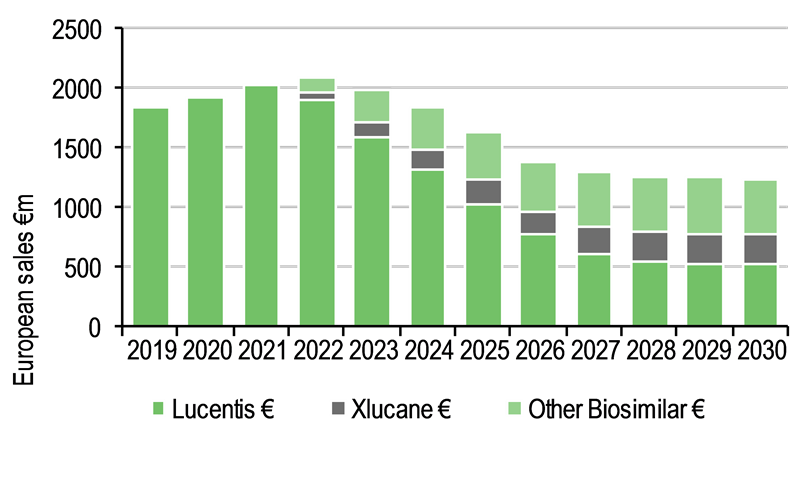
Our forecast estimates that, by 2030, the US market for ranibizumab might be valued at US$1.1bn (Exhibit 4) and the European market at €1.2bn (Exhibit 5), globally US$2.7bn at current exchange rates. Of this, Lucentis might retain 45% with other ranibizumab biosimilars gain about 45%. This leaves Xlucane with just over 10% of global sales implying STADA revenues of over US$ 250–300m.
|
Exhibit 4: US market estimates |
Exhibit 5: European market estimate |
|
|
|
Source: Edison Investment Research |
|
Exhibit 4: US market estimates |
|
|
Source: Edison Investment Research |
|
Exhibit 5: European market estimate |
|
|
Source: Edison Investment Research |
The reason for the lower overall Xlucane share is our assumption of a lower US share, maximum 15% (as against 20% previously) due to later market entry and a high probability of two biosimilar competitors already established in the market. STADA sold its US company in 2006 and focuses on Europe and some Asian countries. STADA might re-enter the US market, but this is not specifically stated and the timeframe is unknown.
In Europe, the biosimilar market is assumed to be split equally between two competitors and Xlucane, each with 33% biosimilar share. This assumption relies on Xbrane and STADA completing the Phase III trial and approval process plus national pricing discussions before mid-2022. STADA has an existing European generic sales capability especially in Germany, France and Italy, although its effectiveness at selling biosimilars is not disclosed in STADA accounts
The profit share from Xlucane sales will depend on STADA’s marketing costs. STADA currently has a 20% operating margin on generics but this is mostly very competitive, small molecule products and some biosimilars. We have followed Xbrane’s expectations and assume a 10% cost of goods (due to Xbrane’s efficient manufacturing system) and European marketing and sales costs at 20%; this is in line with STADA’s disclosed 2017 cost breakdown. There may be some specific administration and other distribution costs, estimated at around 5%. This would give a European operating margin of 65–70%, which in a 50:50 split is about a 33% share of sales to Xbrane. The need for additional marketing arrangements in the US could limit the US profit share, but this is very unclear.
We have increased the European probability of success from 55% to 60%. This is a marginal increase given partnering has been achieved; however, the previous value already assumed partnering. We aim to increase this probability once biosimilarity on technical grounds is accepted by regulators and the Phase III is underway. Xbrane has already reported that Xlucane has passed internal tests of equivalence; an animal study reported in October 2018 showed pharmacokinetic equivalence in rabbits. The US probability of success has been reduced from 45% to 30% due to an uncertain marketing position. Note comments on the STADA deal in the later section on finance.
Xlucane revised indicative value
The DCF value before company overheads and tax is SEK1.2bn (Exhibit 6). The new indicative value is based on management expectations of up to a €100m profit share at peak. In our previous forecast in January 2017, we used similar market penetration and price rates in Europe but only assumed a 15% royalty; the 50:50 STADA deal is much more lucrative. We have also increased the probability of successfully reaching the market from 55% to 60%. However, we have become more sceptical about the US market opportunity and have reduced the US biosimilar market share to 15% from 20% and the probability of successfully reaching the market from 45% to 30%.
Exhibit 6: Xlucane value estimate before corporate costs and tax
Item |
Probability |
NPV @12.5% |
European (SEKm) |
60% |
SEK1,281.80 |
US (SEKm) |
30% |
SEK68.20 |
Total NPV profit share to 2030 |
SEK1,350.00 |
|
Trial cost share |
-SEK139.33 |
|
Net cash flow risk adjusted |
SEK1,210.67 |
Source: Edison Investment Research
Slow-release delivery systems: Spherotid
Xbrane’s generic small molecules delivery systems are developed and produced though an Italian subsidiary, Primm Pharma, acquired in 2015. Primm Pharma creates microspheres. These are made from biocompatible polymers with small molecule therapeutics embedded. The microspheres are implanted under the skin (a depot formulation) and slowly degrade to release the therapeutic at a steady, calibrated rate. Rate of release is crucial, the small molecule therapeutic is easy to source.
The lead Primm project is Spherotide, a generic combination of triptorelin, a gonadotropin releasing hormone (GnRH) agonist with poly(lactic-co-glycolic acid) (PLGA) as the polymer carrier. Other projects are on hold until they are partnered, so they may not progress. The Spherotide project could enter clinical development in 2019 to show equivalence to the current branded product but this trial depends on gaining adequate funding from a partner.
Triptorelin background
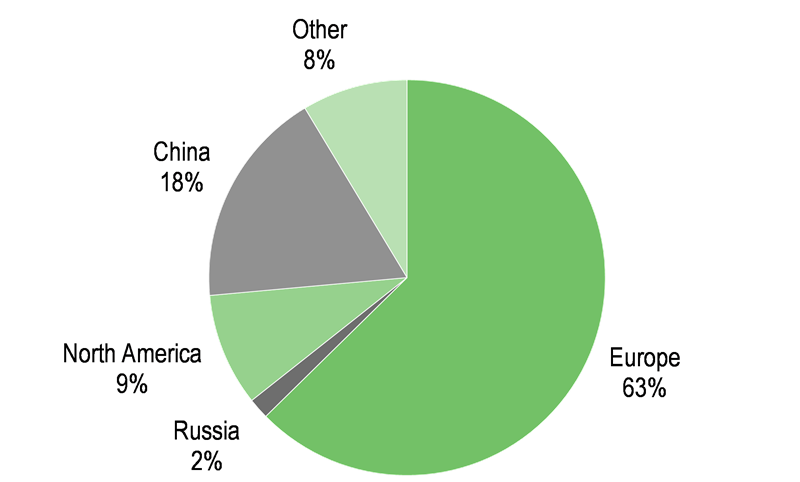
The medical background is shown in Exhibit 7. Triptorelin is sold in one, three- and six-month implantable depot formulations plus short-acting injectable versions (used only in fertility treatments). The 2015 world market for triptorelin (Exhibit 8) was worth $446m (€390m) (IMS data). Ipsen sells triptorelin under the Decapeptyl brand and controls the market for three- and six-month formulations; Decapeptyl sales in 2017 were €348.7m with 3.6% growth. Ipsen’s sales are protected by the difficulty of formulating three- and six-month generic formulations. For Xbrane, the European market (Exhibit 9) is crucial. However, to access most of this market, and the biggest segment by value, a three-month depot formulation is required.
Exhibit 7: GnRH background information
Aspect |
Commentary |
Indications |
GnRH agonists are mainly (at least 75% of sales) used to treat advanced, hormone responsive prostate cancer in men (with localised or distant spread). In women, GnRH agonists treat endometriosis and uterine fibroids. They can also be used to manage precocious puberty. There are other molecules in this class: Zoladex (goserelin, AstraZeneca) and Lupron (leuprolide, AbbVie). |
Pharmacology and flare |
The pharmacology of these products is well known. GnRH (also called LNRH) agonists initially stimulate the overproduction of sex hormones (a flare) but then cause sex hormone production to decrease. GnRH agonists are also injected to trigger ovulation in women undergoing fertility treatments. |
Long-term therapy |
After the initial flare, the gonads cease to produce sex hormones. As a steady dose of drug is needed to keep hormone levels supressed, GnRH agonists are given by depot delivery to ensure constant delivery over a period of months. Any generic also has to show this constant delivery profile and avoid repeated flares. Hence, clinical trials are needed to demonstrate equal performance of the formulation. |
Formulations |
Depot formulations (86% by value) alleviate endometriosis and help control the growth of prostate cancer (the main use). The one-month formulation is available from several suppliers and is the main product in markets such as China and Iran. In Europe, the three-month formulation dominates. The US market is limited as other GnRH agonists are preferred. |
Dose versions |
The standard delivery (dose) periods are one-month (3.75mg) and three months (about 11.25mg) but a six-month (22mg) depot of triptorelin is available, largely from Ipsen and Allergan. Pricing varies but a one-month depot cost $90–190 in 2015. Three-month doses are three times the one-month price. Fertility versions are one-day doses sold in high volumes, priced at about $10 per dose. |
Aspect |
Indications |
Pharmacology and flare |
Long-term therapy |
Formulations |
Dose versions |
Commentary |
GnRH agonists are mainly (at least 75% of sales) used to treat advanced, hormone responsive prostate cancer in men (with localised or distant spread). In women, GnRH agonists treat endometriosis and uterine fibroids. They can also be used to manage precocious puberty. There are other molecules in this class: Zoladex (goserelin, AstraZeneca) and Lupron (leuprolide, AbbVie). |
The pharmacology of these products is well known. GnRH (also called LNRH) agonists initially stimulate the overproduction of sex hormones (a flare) but then cause sex hormone production to decrease. GnRH agonists are also injected to trigger ovulation in women undergoing fertility treatments. |
After the initial flare, the gonads cease to produce sex hormones. As a steady dose of drug is needed to keep hormone levels supressed, GnRH agonists are given by depot delivery to ensure constant delivery over a period of months. Any generic also has to show this constant delivery profile and avoid repeated flares. Hence, clinical trials are needed to demonstrate equal performance of the formulation. |
Depot formulations (86% by value) alleviate endometriosis and help control the growth of prostate cancer (the main use). The one-month formulation is available from several suppliers and is the main product in markets such as China and Iran. In Europe, the three-month formulation dominates. The US market is limited as other GnRH agonists are preferred. |
The standard delivery (dose) periods are one-month (3.75mg) and three months (about 11.25mg) but a six-month (22mg) depot of triptorelin is available, largely from Ipsen and Allergan. Pricing varies but a one-month depot cost $90–190 in 2015. Three-month doses are three times the one-month price. Fertility versions are one-day doses sold in high volumes, priced at about $10 per dose. |
Source: Edison Investment Research based on literature sources
|
Exhibit 8: Depot sales of triptorelin by world region |
Exhibit 9: Triptorelin depot sales by European region |
|
|
|
Source: Edison Investment Research based on 2015 IMS data |
|
Exhibit 8: Depot sales of triptorelin by world region |
|
|
Source: Edison Investment Research based on 2015 IMS data |
|
Exhibit 9: Triptorelin depot sales by European region |
|
|
Source: Edison Investment Research based on 2015 IMS data |
Commercial outlook, Iran, Europe and US
Xbrane gained GMP validation of its Italian production facility in 2017. This enabled sales of bulk one-month Spherotide to its Iranian partner, Pooyesh Darou. By selling in bulk, Iranian taxes and restrictions are avoided. Geopolitical pressure on Iran is considerable but pharmaceuticals are excluded from import sanctions as they are classes as humanitarian supplies. However, payment for pharmaceutical imports has become more complex as many banks will not handle Iranian transfers. Up to June 2018, Xbrane has seen steady sales at SEK20–25m per year; ytd 2018 SEK15.6m. We have kept this sales level roughly constant in our forecasts as the Iranian situation is uncertain; our original forecast assumed increasing sales to about SEK50m. The reported gross margin in H118 was 21% rather than the 50% formerly expected; this is probably a function of low volumes.
The European market (excluding single-use injections) was worth about $244m in 2015 (IMS). The top five European countries account for about 86% of sales, see Exhibit 9 above. To gain regulatory approval in Europe, Xbrane needs to run comparative studies between Decapeptyl and Spherotide one- and three-month formulations. One-month depot trials in prostate cancer in 200 patients and in endometriosis in 150 patients are being planned. Xbrane will follow the decentralised procedure, that is, country-by-country approvals. Xbrane has no European partner so has not initiated any clinical studies. Xbrane has indicated that preparatory work for a trial will be completed by Q219. Assuming a partner is signed in 2019 and the trial and regulatory process takes two years, a one-month formulation could be marketed possibly starting, we assume, in 2022. We have seen no data on a three-month formulation but understand from Xbrane that this formulation is about 12 months behind the one-month, so might launch from 2023. A three-month trial in prostate cancer is planned.
The one-month formulation is about a quarter by value of the European market and this segment is more competitive. However, countries differ so Italy, $54m of sales in 2015 and 21% of the market, prefers one-month formulations and offers a good initial sales base; Germany prefers the three month. Significant European sales are unlikely until a three-month formulation is approved.
Xbrane has no plans to run US trials. It is possible that a US partner can be signed after obtaining FDA approval based on the European clinical dossier. In 2015, the US market was worth $36m, largely the three-month formulation sold by Allergan under the Trelstar brand; Canada adds $7m. We doubt that a one-month formulation would be economic as US entry requires the three-month product not making any launch before 2023 and possibly later. We do not forecast any US sales.
A deal with BioAvenir for sales in Israel was signed in December 2016. Xbrane estimates a sales potential of SEK5m per year based on EMA approval. Xbrane and BioAvenir will share the profits. Xbrane received a licence fee of SEK1m divided into an upfront in 2016 and milestone payments prior to launch in 2020. There is also a deal with a South Korean partner running local clinical studies.
China: The CR Pharma deal
In February 2018, CR Pharma gained Chinese government approval and foreign currency to complete the deal, first noted in 2016, with Xbrane. The upfront was SEK14.4m, about US$1.6m. The overall deal value is ‘high single-digit millions’ so we assume possibly a further US$6m in milestones might be received; such deals are usually weighted towards regulatory approval. Xbrane will supply the product and CR Pharma will run and fund the required Chinese clinical trials.
China mostly uses one-month formulations of triptorelin. The 2015 Chinese market was valued at US$69m, about 18% of world sales, and was dominated by Ipsen. Current regulations for generics in China mean that prior external approval of a generic is required before a local Chinese study can be initiated. Hence, Chinese launch dates lag European dates, implying a 2024 timeframe. The regulations may change because novel therapeutics can enter clinical trials in China before external approvals; we have not assumed any rule changes, however.
Projecting the Spherotide market and value
Competitively, Decapeptyl remains a significant revenue and profit stream for Ipsen, so it is likely it will defend its sales in core territories. Ferring sells injectable and one-month formulations. The commercial concept is that the price of Spherotide will be half that of the branded product. Xbrane has indicated that it intends to its marketing partners, as yet unsigned, at 50% of this price. Cost of goods will be about half of Xbrane’s revenues but will fall with volume efficiencies; we assume a 5% experience curve. The three-month depot formulation is much more profitable than the one month.
The model used for sales estimates remains unchanged except that the expected European launch date has been pushed back from 2020 to 2022. The three-month formulation is at least 12 months behind these dates: 2023 Europe (formerly 2020), 2024 China and possibly US, (formerly 2022).
We have reduced the one-month probability of success from 60% to 45% and the three-month probability from 45% to 25% because of the uncertainty over time to market. To value deal fees and milestones, we assume a 50% European deal probability of SEK80m total with SEK20m upfront, similar to the Chinese deal. As China requires an approved product the probability is equal to the one-month probability of 45%.
Iranian bulk sales are now expected to be steady at SEK25m per year at 20% gross margin. We have increased the probability from 50% to 85%; the small remaining probability adjustment is due to geopolitical factors.
Overall, the indicative, probability-adjusted Spherotide value has reduced from SEK300m to SEK131m (Exhibit 10). However, if a partner is signed in 2019 or 2020, or Xbrane decides to invest directly, the project should rise significantly in value.
Exhibit 10: Spherotide valuation before corporate costs and tax
Territory |
Peak |
Probability |
NPV adjusted |
NPV 1 mth |
64 |
45% |
15 |
NPV 3 mth |
82 |
25% |
39 |
Iran |
25 |
85% |
26 |
China |
118 |
% |
56 |
Total NPV |
289 |
136 |
|
Milestones |
44 |
50% |
21 |
Clinical |
-44 |
-33 |
|
Total NPV |
0 |
132 |
Source: Edison Investment Research
Sensitivities
Xbrane’s lead product Xlucane, its Lucentis biosimilar, should be straightforward to develop as two other biosimilar products have already tested the route and trial designs. Xbrane is attempting to complete a large clinical trial in a short timeframe and’ although this is feasible, timelines could easily slip. That could impact on European market share estimates. STADA seems to be investing in biosimilars but the initiative appears early and STADA has no track record in the biosimilar market. The trial will cost Xbrane €15–20m. We have been cautious in our estimate of US sales because STADA has no US operations. Once the US strategy is disclosed, this estimate can be revised as there is significant revenue potential in the lucrative US market given Xbrane’s potentially more competitive production system.
In Europe, Spherotide is targeting a stable market so there is little impact on potential market share in delaying market entry. Xbrane does not intend to start Spherotide clinical development until a partner is found to provide funding and a marketing channel. The large Chinese market, where Xbrane has a deal, seems to depend on a European approval creating a leveraged risk. However, this will be value enhancing once a deal is agreed. More concerning is the lack of any data on the critical three-month formulation required for the main European markets. The US market is very small.
Financially, Xbrane will need more cash for ongoing operations and clinical development. The scope for large deals in generic markets is limited, so further equity or loans will be needed. If Xbrane intends to develop other biosimilars requiring more complex mammalian cell culture production systems, this will require significant additional capital. It would allow the company to access the largest biosimilar markets but competition in these is already well advanced.
Financials: Complex cash flows
Ytd to 30 September, Xbrane reported SEK13.0m in other income from the Q1 CR Pharma deal and SEK77.3m in Q3 from the STADA deal. There was about SEK8.0m of other income. Iranian sales of bulk Spherotide were SEK15.6m (of which SEK13.15m were in H1) with a cost of goods of SEK12.2m, probably mostly fixed overheads. We expect overall revenues for the year to be about SEK120m assuming a further bulk sale is made to Iran in Q4.
STADA paid SEK77m in an upfront fee in Q3. Xbrane then invoiced STADA for 50% of the development costs in H2; this is not taken through the P&L. This leads to an accounts receivable value on 30 September of SEK68.6m vs SEK8.0m on 30 June. The movement in accounts receivable in Q3 was -SEK106.6m, greater than implied from a simple balance sheet comparison. We assume that most of the balance was settled by STADA in Q4.
In preparation for the Xlucane clinical trial, Xbrane recorded prepayments of SEK53m and creditors of SEK47m on 30 September. These gave a positive cash flow of SEK81.4m, again, more than a simple balance sheet comparison indicates. Operating cash flow in Q3 was SEK35.1m.
In H1, Xbrane drew a SEK35m bridging finance loan from Serendipity Group, a 10% shareholder. A further SEK10m was drawn in Q3, giving a short-term debt of SEK45.6m on 30 September. The overall cash flow for Q3 was SEK44.2m. Cash on 30 September was SEK64.3m. We expect year-end cash to be in the range of SEK70–80m assuming a high level of prepayments and accruals with some reduction in liabilities. In 2019, we assume the cost of the Xlucane trial to be €12–15m, which will require possibly SEK100m of additional funding excluding any Serendipity loan repayment.
No clinical development of Spherotide is envisaged until a partner is signed and we have not assumed any Spherotide deal in 2019 in our financial forecasts (Exhibit 12).
Exhibit 12: Financial summary
SEK000s |
2016 |
2017 |
2018e |
2019e |
||
Year end 31 December |
GAAP |
GAAP |
GAAP |
GAAP |
||
PROFIT & LOSS |
|
|
|
|
||
Revenue |
|
|
0 |
20,771 |
22,163 |
25,000 |
Cost of Sales |
0 |
(15,829) |
(17,417) |
(19,750) |
||
Gross Profit |
0 |
4,942 |
4,746 |
5,250 |
||
Other income (grants and deal fees) |
4,824 |
2,515 |
98,437 |
0 |
||
EBITDA |
|
|
0 |
(40,871) |
901 |
(176,616) |
Operating Profit (before GW and except.) |
|
(24,907) |
(43,939) |
(1,637) |
(179,154) |
|
Intangible Amortisation |
(557) |
(779) |
(2,054) |
(2,054) |
||
Other |
0 |
0 |
0 |
0 |
||
Operating Profit |
(25,464) |
(44,718) |
(3,691) |
(181,208) |
||
Net Interest |
(202) |
(217) |
(1,767) |
(3,000) |
||
Exceptionals |
0 |
0 |
0 |
0 |
||
Profit Before Tax (norm) |
|
|
(25,109) |
(44,156) |
(3,404) |
(182,154) |
Profit Before Tax (FRS 3) |
|
|
(27,769) |
(44,935) |
(5,458) |
(184,208) |
Tax |
0 |
0 |
(229) |
0 |
||
Profit After Tax (norm) |
(24,882) |
(44,156) |
(3,633) |
(182,154) |
||
Profit After Tax (FRS 3) |
(27,769) |
(44,935) |
(5,687) |
(184,208) |
||
Average Number of Shares Outstanding (m) |
4.5 |
5.4 |
6.2 |
6.3 |
||
EPS - normalised (öre) |
|
|
(552) |
(814) |
(58) |
(2,881) |
EPS - normalised fully diluted (öre) |
|
|
(552) |
(814) |
(58) |
(2,881) |
EPS - FRS 3 (öre) |
|
|
(616) |
(828) |
(91) |
(2,914) |
Dividend per share (öre) |
0 |
0 |
0 |
0 |
||
Operating Margin (before GW and except.) (%) |
N/A |
N/A |
N/A |
N/A |
||
BALANCE SHEET |
||||||
Fixed Assets |
|
|
81,168 |
82,861 |
102,130 |
92,989 |
Intangible Assets |
62,658 |
63,657 |
65,711 |
57,608 |
||
Tangible Assets |
17,875 |
18,569 |
17,531 |
16,493 |
||
Investments |
635 |
635 |
18,888 |
18,888 |
||
Current Assets |
|
|
43,526 |
28,101 |
121,374 |
37,422 |
Stocks |
2,497 |
3,065 |
2,651 |
2,651 |
||
Debtors |
1,499 |
8,072 |
10,000 |
10,000 |
||
Cash |
31,338 |
7,903 |
71,523 |
-12,429 |
||
Other current assets |
8,192 |
9,061 |
37,200 |
37,200 |
||
Current Liabilities |
|
|
(5,523) |
(17,029) |
(118,795) |
(118,795) |
Creditors |
(5,523) |
(17,029) |
(73,202) |
(73,202) |
||
Short term borrowings |
0 |
0 |
(45,593) |
(45,593) |
||
Long Term Liabilities |
|
|
(4,908) |
(4,664) |
(12,827) |
(105,888) |
Long term borrowings |
(1,726) |
(1,119) |
(9,282) |
(109,282) |
||
Other long term liabilities |
(3,182) |
(3,545) |
(3,545) |
(3,545) |
||
Net Assets |
|
|
114,263 |
89,269 |
91,882 |
(94,272) |
CASH FLOW |
||||||
Operating Cash Flow |
|
|
(39,143) |
(36,848) |
16,305 |
(181,952) |
Net Interest |
0 |
0 |
0 |
0 |
||
Tax |
0 |
0 |
0 |
0 |
||
Capex |
(12,766) |
(3,347) |
(1,500) |
(1,500) |
||
Acquisitions/disposals |
0 |
0 |
0 |
0 |
||
Financing |
101,770 |
20,004 |
48,250 |
100,000 |
||
Dividends |
0 |
0 |
0 |
0 |
||
Other |
(21,241) |
(2,637) |
565 |
(500) |
||
Net Cash Flow |
28,620 |
(22,828) |
63,620 |
(83,952) |
||
Opening net debt/(cash) |
|
|
(992) |
(29,612) |
(6,784) |
(16,648) |
HP finance leases initiated |
0 |
0 |
0 |
0 |
||
Other |
0 |
0 |
(53,756) |
(100,000) |
||
Closing net debt/(cash) |
|
|
(29,612) |
(6,784) |
(16,648) |
167,304 |
Source: Edison Investment Research, Xbrane Biopharma accounts
|
|||||||||||||||||||||||||||||||||||||||||||||
|
|
Research: TMT
IQE is benefiting from multiple megatrends as it supplies epitaxy for the photonics chips that transmit data in the volumes required for full adoption of the Internet of Things and provide the accurate visual information required for autonomous vehicles, Industry 4.0, augmented reality and virtual reality. This is driving a second wave of growth, with an estimated 66% increase in PBT forecast between FY16 and FY19. Our DCF analysis indicates that the share price is undervalued if photonics growth resumes in Q219 and is sustained over a five-year period, in line with management guidance.